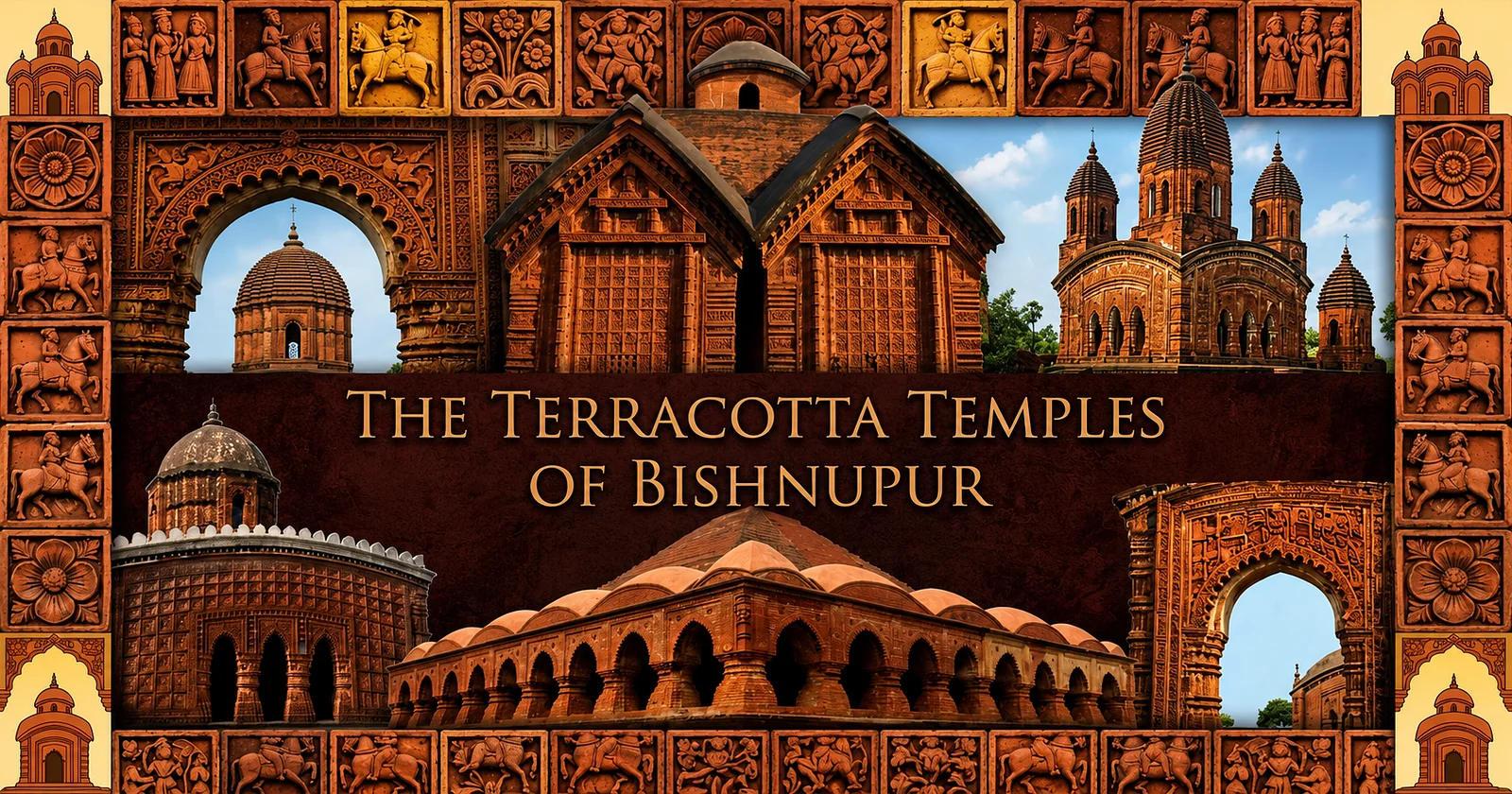
Have you been to Bishnupur in West Bengal? If you have not been there yet, then you are likely missing out on a wonderful, spiritual, calming experience. Far away from the hustle and bustle of cities in Bishnupur, Bankura district, this city is a home to the rich culture of temples, art and architecture. The beauty of simple yet elegant terracotta temples is what makes them stand apart. In 1997, the temples of Bishnupur were placed in the UNESCO World Heritage Tentative List.
There was a time when Bishnupur was known as Mallabhum, ruled by the Malla Kings. They transformed Bishnupur into a rich centre of art, culture and Vaiṣṇava devotion. Among them, Bir Hambir was the first to move into Gaudiya Vaishnavism. He was later followed by other kings such as Raghunatha Singha and Durjab Singha, who poured their love and devotion for Kṛṣṇa and Rādhā. They crafted the beautiful temples using laterite clay and bricks with intricate terracotta panels. There are a few standout temples that will mesmerize you the most.
Let us start with the oldest brick temple here, the Rasamancha Temple, which was built by Bir Hambir around 1600 century. It is a huge temple measuring 30m square and 12.5m high. The pyramidical superstructure is what attracts the most. Here, you can enjoy walking among the circumbulatory galleries. Well, don’t get lost among the mysterious pillars though! The lush green surrounding environment adds more serenity to it. During the festivities, this is where they would bring out the deities in the older times.

Now, let's move to another beautiful masterpiece, the Shyama Rai Temple. According to the foundational plaque found in the temple, this was founded by Raghunath Singha in 1643. This beautiful architecture is an example of a Pancha Ratha Temple architecture. Every wall in this temple depicts various tales. You can see here a wide range of scenarios from common life, like hunters chasing deer, soldiers swaying over elephants, traders rocking those pointy hats, villagers sowing fields, to the divine scenarios like Samudra Manthan and Mahābhārata warriors clashing. Don’t miss the look above! The top frieze depicts Kṛṣṇa in Rāsa līlā with the Gopis. You can’t help but smile at the storytelling. This is what is so unique about the temple that you can find such variations all in one place.


Terracotta work on Shyamrai Temple.
Next is the Jor Bangla Temple, which is also known as the Keshto Ray Temple. It is the most impressive terracotta temple of all. This temple was also constructed in 1655 by King Raghunatha Singha. It is a great example of a combination of Chala Style and Ratna Style architecture. When you wander around here, you will find terracotta walls lit up like a festival! You can have a glance at musicians playing flutes and drums, graceful dancers and the Daśāvatāras of Viṣṇu. If you peek closer, you will find Rāmāyaṇa plates showing various scenes, Kṛṣṇa uplifting Govardhana mountain, along with folk scenes of farmers ploughing with oxen, women grinding spices. Enjoy standing in front of it at a quiet hour, and you will find yourself in the duality of an ordinary rural house with rich illustrative walls where everyday Bengal merges into a continuous narration of sacred Vaishnavism.

If the Jor Bangla temple leaves you with a feeling of a village house that turned divine, then the Madan Mohan Temple will come across as a concentrated shrine where Kṛṣṇa’s stories wrap you around from all sides. Standing in the northern part of Bishnupur, this temple was built in 1694 by Durjan Singha as a temple for his family deities, Kṛṣṇa (Madan Mohan) and Rādhā. It is a beautiful example of the Ratna Style temple of Bengal. Once you begin looking at the surface, the temple comes alive. The outer walls, plinths and even the interior details are rich in terracotta reliefs that dwell on Kṛṣṇa līlā episodes, Kaliya Daman, gopies in conversation, Śrī Kṛṣṇa playing flute, along with the scenes of Rāmāyaṇa. It is almost as if the artisan is walking you through the theology and mythology visually!


Apart from the gems, there are many other amazing temples like Kalachand, Radha Shyam, Nandalal, Lalji, and Radha Madhav. Each and every temple will depict a story of its own.
One thought might have arisen in your mind by now: why terracotta? Well, it was not a random choice. It was more of a logical outcome of geography, material and existing craft tradition. Bishnupur simply did not have abundant, good-quality building stones like sandstone or granite. What they do have is rich laterite clay ideal for making bricks and baked clay (terracotta). Furthermore, terracotta tiles could be moulded, fired and then composed like a vast visual text. This modularity made it easier to cover walls with continuous bands of narrative.
So now, by the time you step out of the temple complex and wander into the lanes of Bishnupur, you will realise something quietly striking. The stories you just saw on terracotta walls do not end at the temple boundary; they spill into silk, metal and clay in people’s homes! It is as if the epics you walked past simply change medium and start travelling with people on their bodies, in their jewellery, in the things they worship with every day. This is where you will find other beauties like the Baluchari sarees and Bishnupur crafts, which are softer, portable extensions of the same devotional imagination.
If you listen to local lore, Bishnupur’s connection with silk is not new at all. Some sources claim that a form of silk weaving was present in Mallabhum from at least the time of Jagat Malla, who was one of the early Malla rulers. The successive kings encouraged different crafts to flourish under their protection. Historically, the saree we now call Baluchari first became recognisable in the 18th century in a small village called Baluchar in Murshidabad under the Nawab Murshid Quli Khan. He brought weavers with him and settled some of them in Baluchar when he shifted his capital from Dhaka to Murshidabad. For a certain period of time, that village was the main centre of looms where stories from the Rāmāyaṇa, Mahābhārata and courtly life unfolded on the anchal (pallu) of the saree. However, floods of the Ganga later submerged much of Baluchar and many weavers and their descendants moved inland towards Bankura. It is at this point that Bishnupur quietly became a second home for the craft.

Baluchari sari
Here, the connection with the terracotta temples becomes much more than a poetic metaphor. The Baluchari sarees have designs taken directly from the temple walls surrounding the town. These beautiful Bishnupur’s Baluchari designs were influenced by the terracotta temples. The mythological stories became a common feature. So the same Kṛṣṇa Rāsa līlā on Shyāma Rai’s frieze reappears on silk. The chariots and warriors that you will see on Jor Bangla’s can be found across the pallu in tiny repeated frames. Isn’t it amazing that the saree acts more like a mobile version of the temple narrative? It is something that even if you leave Bishnupur, you can still carry its visual theology elsewhere.
We all know that History isn’t always kind. Just like many luxury crafts, Baluchari weaving also declined sharply under colonial rule. It happened due to various factors like political instability, shifting trade routes and when the industrial textiles undercut the older patronage networks. Sadly, by the late 19th and early 20th century, the tradition had almost vanished, and many families abandoned weaving altogether. The story might have ended there if not for a deliberate act of revival. In the first half of the 20th century, the artist Subho Tagore (Subho Thakur) became interested in the old Baluchari examples he had seen and decided that this narrative silk deserved a second life. He invited Akshay Kumar Das, who was a master weaver from Bishnupur, into his centre to learn new weaving techniques. He then sent him back with both technical and moral support so that the Bishnupur looms could adapt the Baluchari style for local production. So with the financial backing from silk philanthropists such as Hanuman Das Sarda and later with help from cooperative and khadi institutions, the Baluchari weaving slowly took root in Bishnupur as a revived tradition.
If you talk to weavers, many will first point out how much labour is hidden inside the amazing storytelling saree. The authentic Balucharis are still woven from fine mulberry silk on handlooms. Some are made in tussar as well. The weaver works with an extra weft technique where additional coloured threads are inserted to build up small figurative scenes. The show features attractive scenes like Kṛṣṇa playing the flute, Sīta’s abduction, and a royal durbar. Before the jacquard mechanism came in, the complex designs were created with older jala systems, which required enormous skill to handle. When the jacquard cards were introduced in the 20th century, it was slightly easier to reproduce detailed motifs. This, however, did not reduce the time it takes a human to sit at the loom every day. A single richly patterned piece can easily take 10–15 days of steady work and sometimes even more.
With the passage of time, the mythological angle also deepened. Many Baluchari sarees from Bishnupur now specialise in vivid Rāmāyaṇa or Mahābhārata themes. They are filled with episodes like Sīta’s svayamvara, the game of dice, the battlefield dialogue of Kṛṣṇa and Arjuna or Hanumān leaping across the ocean, which have all been turned into repeatable borders and pallus. They perfectly show the same narrative frame as those of epics, which makes the saree a moving archive of Indian culture. The medium simply changes from clay to silk, but the underlying impulse is the same. In this sense, Baluchari sarees are not just separate add‑ons to the beauty of Bishnupur, they are the soft continuation of the terracotta temples' visual language, carrying Mallabhum’s imagination quietly into the present day.

Once you start noticing this movement of stories from walls to fabric, your eyes will automatically begin to pick them up in other materials too. Bishnupur’s lanes are full of small clues! They will have a beautiful brass Śrī Kṛṣṇa on a shop shelf that looks like he has just stepped down from a temple frieze, a pair of conch bangles etched with tiny lotus motifs, and a clay plaque of a musician that feels like a cousin of the figures on Jor Bangla. This is where Bishnupur’s handicrafts come in and accompany you in the same journey from the temple courtyard to home.
And then of course, there is the horse which you can't help but ignore!
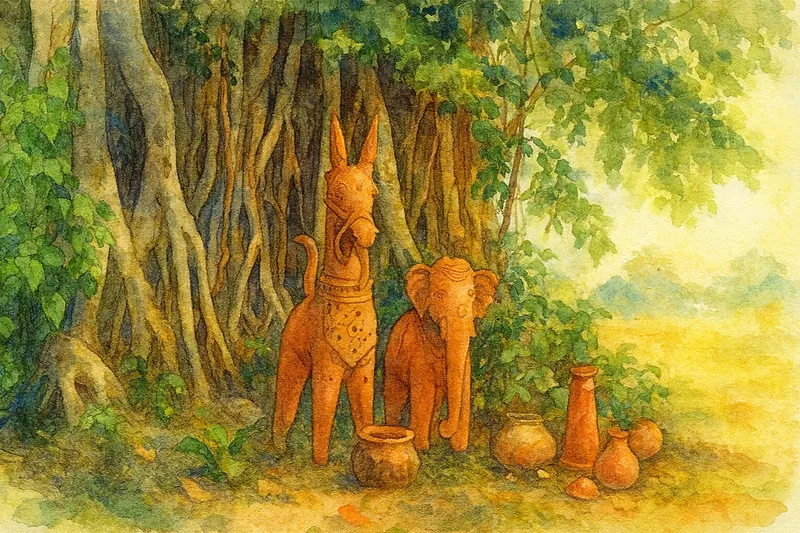
The famous Bankura terracotta horse has almost become a mascot for the region. It is even used in government logos and posters. These horses are built from local clay in separate parts, then joined, sun-dried and carefully fired so that their bodies stay hollow yet strong. Their tall, upright necks, alert ears and stylized faces are not realistic like a naturalistic sculpture. They are more symbolic, almost like a living pillar. You will see them in all sizes, from tiny palm-sized pieces to almost life-sized ones that guard doorways like quiet terracotta sentinels.

If you look closely, then the detailing on these horses repeats the same vocabulary you have already seen on the temples. The rows of dots and lines, floral bands, tiny bells, harness patterns and decorative saddles. It is as if the artisans have taken the border motifs of a temple panel and wrapped them around an animal form. That is why the horse fits so well into the Bishnupur story.
Out of all the various rich handicrafts, the Dokra (lost‑wax) metal casting is perhaps the most striking example. The making process will surely amaze you! Here, artisans build up a figure in beeswax over a clay core, wrap it in more clay, and then let the wax melt away in the fire as molten metal takes its place. When the outer clay is broken, a hollow brass or bronze form emerges. The most common figures are a flute‑playing Kṛṣṇa, a village drummer, or a group of dancers who look uncannily like the processions you saw carved in terracotta temples. The technique is surely different from brick and tile work, but the idea of using clay as the base for a narrative image remains the same. The clay becomes mould, and the metal becomes memory.

The smaller everyday crafts are simply beautiful too. The conch‑shell bangles (śaṅkha) worn by married women are shaped, polished and sometimes engraved with delicate Vaiṣṇava symbols such as flutes, peacocks and pairs of Rādhā and Kṛṣṇa. There are many miniature temples, horses, plaques and toys sold around the heritage zone. So if you see with an overall point of view, then the Baluchari sarees, the terracotta horse and Bishnupur’s wider handicrafts feel less like souvenirs and more like smaller satellites orbiting the great terracotta temples. The Malla kings may have built the big brick statements, but the generations of weavers, potters, metalworkers and carvers have kept that statement alive by translating it into forms that can travel, be used and loved in everyday life.

In the end, Bishnupur will always lead you back to its temples. The sarees, the terracotta horses, the Dokra idols and conch bangles are all beautiful in their own right, but they decorate around the main attraction of Malla kings’ terracotta shrines. The Rasamancha, Shyama Rai, Jor Bangla and Madan Mohan still stand as the town’s first great act of storytelling, where clay devotion and everyday life were fused into a continuous narrative carved on walls and pillars. What makes Bishnupur special is that this narrative never froze into a museum piece. When you walk through Bishnupur, you are not just visiting some temple town with a few nice crafts attached, but you are also moving through a living ecosystem where architecture, textiles and handicrafts all spring from the same devotional root.
That is why, even after you leave, what will linger in your mind is the feeling of those temples. The quiet corridors of Rasamancha, the crowded panels of Shyama Rai, the village house intimacy of Jor Bangla and the intense bhakti wrapped around Madan Mohan become the reference points against which everything else in Bishnupur makes sense. Bishnupur reminds us that when faith, art and earth come together with patience, they can outlast dynasties and empires. The buzzing markets keep telling their stories in clay, cloth and metal ages after their original patrons have faded from memory. Bishnupur isn't just ruins; it is Bengal's vibrant heritage, proving art and faith can outlast empires.