Though the horse is not endemic to the subcontinent, the animal holds a special position within Hindu society and religious thought, emerging first in the Vedic corpus as a potent symbol of sovereignty, cosmic vitality, and generative force. The earliest sacred articulation of this significance appears in the Ṛg Veda, in the elaborately described aśvamedha yāga, the horse sacrifice. Through this rite, which can only be performed by kings, the horse serves as a divine mediator between the earthly king’s dominion and celestial order, its freedom to roam marking the extent and legitimacy of royal sovereignty, while its ritual death enacted a transfer of vitality to the realm. The intimate association of the horse with fertility—dramatized in the ritual union between the queen and the sacrificed horse—framed equine potency as central to political strength, dynastic continuity, and cosmic wellbeing. These early religious roles underscore that, from its earliest appearance in South Asia, the horse was not merely a utilitarian animal but a manifestation of auspicious, life-giving power.

Illustration from the Mahābhārata: Yudhiṣṭhira wanted to perform the Aśvamedha (horse-sacrifice), in which a special horse would be allowed to wander freely for a year. Anyone who challenged the horse's freedom would face the accompanying Pāṇḍava army, led by the youngest Pāṇḍava brother, Prince Arjuna. These paintings show preparations for the sacrifice. On the front, three heroes present an elaborately ornamented horse to the Pāṇḍavas' court, where they seek advice from the four-armed deity Kṛṣṇa. 19th century Paithan, Maharashtra. Philadelphia Museum of Art
As Vedic mythology evolved, the horse became integrated into a wider cosmological framework linking divine motion, light, and protection. Solar deities across the Indo-European world were associated with equine imagery, and in Hindu tradition, this finds its clearest expression in the iconography of Sūrya. His chariot—drawn by four or seven horses or, in some visual schemes, a single seven-headed steed—traverses the heavens daily, establishing the horse as a vehicle of cosmic rhythm and illumination. Similarly, the Aśvins, divine horse-faced twins described as healers and harbingers of dawn, ride a golden chariot that precedes the rising sun. These associations root the horse in the structure of time itself: it becomes an emblem of transition, the arrival of light, and the restoration of life.

Bodh Gaya quadriga1 relief of Sūrya and Classical example of Phoebus Apollo on quadriga; Drawing from Alexander Cunningham, Report For The Year 1871-72 Volume III, Plate XXVII, and description p.97. Source: Wikimedia Commons
In later Hindu religious imagination, the horse also emerges as a theological instrument of eschatological renewal: Śrī Mahāviṣṇu’s future avatāra Kalki is envisioned as a steed-mounted warrior who shall manifest at the end of the kaliyuga, the current era, to destroy unrighteousness and restore dharma. The larger vernacular tradition also has deities and heroes such as Kṣetrapālas, Aiyaṉār (the Tamil village guardian), and Madurai Vīran, who are mounted on their horses. Across Tamil Nadu, Kerala, Rajasthan, and the tribal regions of Gujarat and Madhya Pradesh, terracotta or wooden horse sculptures proliferate as votive offerings or as representations of the mounts of these guardian deities. In this popular devotional sphere, the horse becomes a signifier of protection, intercession, and the sustenance of everyday life in rural landscapes.
The horse further occupies a transformative role in Hindu mythology through its integration into divine embodiment. Viṣṇu as Hayagrīva (meaning “the horse-faced”), who bears the head of a horse, represents the salvific power of wisdom: he rescues the stolen Vedas, restoring sacred knowledge to the world. Taken together, these traditions reveal that the religious significance of the horse in Hindu art and mythology far surpasses that of its historical military importance. Its sacred presence in rituals, iconography, and folk worship across centuries marks it as a key symbol of sovereignty, protection, and cosmic order within the Hindu imagination.
The Bankura horse is one such enduring symbol, embodying the sacred memory of the Vedic horse, which finds renewed expression through regional craftsmanship, folk worship, and modern cultural consumption. The transformation of the Bankura horse—from a sacred votive figure rooted in esoteric village ritual to a celebrated emblem of modern Indian handicraft—illustrates the dynamic continuity between religious symbolism and consumer culture. As Harsha Dehejia so eloquently puts it in his essay ‘Gods Beyond Temples’,
“Whether it is a tree that is held sacred or a naturally occurring stone that is revered, a river that is the embodiment of divinity itself, an ancestor that is worshipped, a fabric that is simply draped, a road-side shrine on a busy street or a votive terracotta horse that is lovingly made and offered, a narrative scroll that holds its audience spell-bound; here is religion at work that is as spontaneous as it is intense, charged with faith, fervor and commitment, now private and now shared, that forms an integral part of the lived lives of these common people, be they rural or urban, tribal or traditional. The rituals and practices for these deities are neither scripted nor canonized, but what they may lack in grandeur, erudition and ceremony they more than make up for in the faith and feeling that they generate.”
Originating principally from the village of Panchmura in Bankura district in West Bengal, the sculptural tradition of the Bankura terracotta horse rose to national prominence in the late twentieth century, when it not only became the symbol for All India Handicrafts but also a ubiquitous fixture in Indian homes as décor. The phenomenon was propelled by the artistic recognition of potters such as Rashbehari Kumbhakar, whose national acclaim — supported by state-led cultural promotion and scholarly interest — enabled the terracotta horse to travel from rural shrines to urban drawing rooms and global exhibition spaces. Yet beneath this modern status as a design object lies a deep religio-cultural heritage.
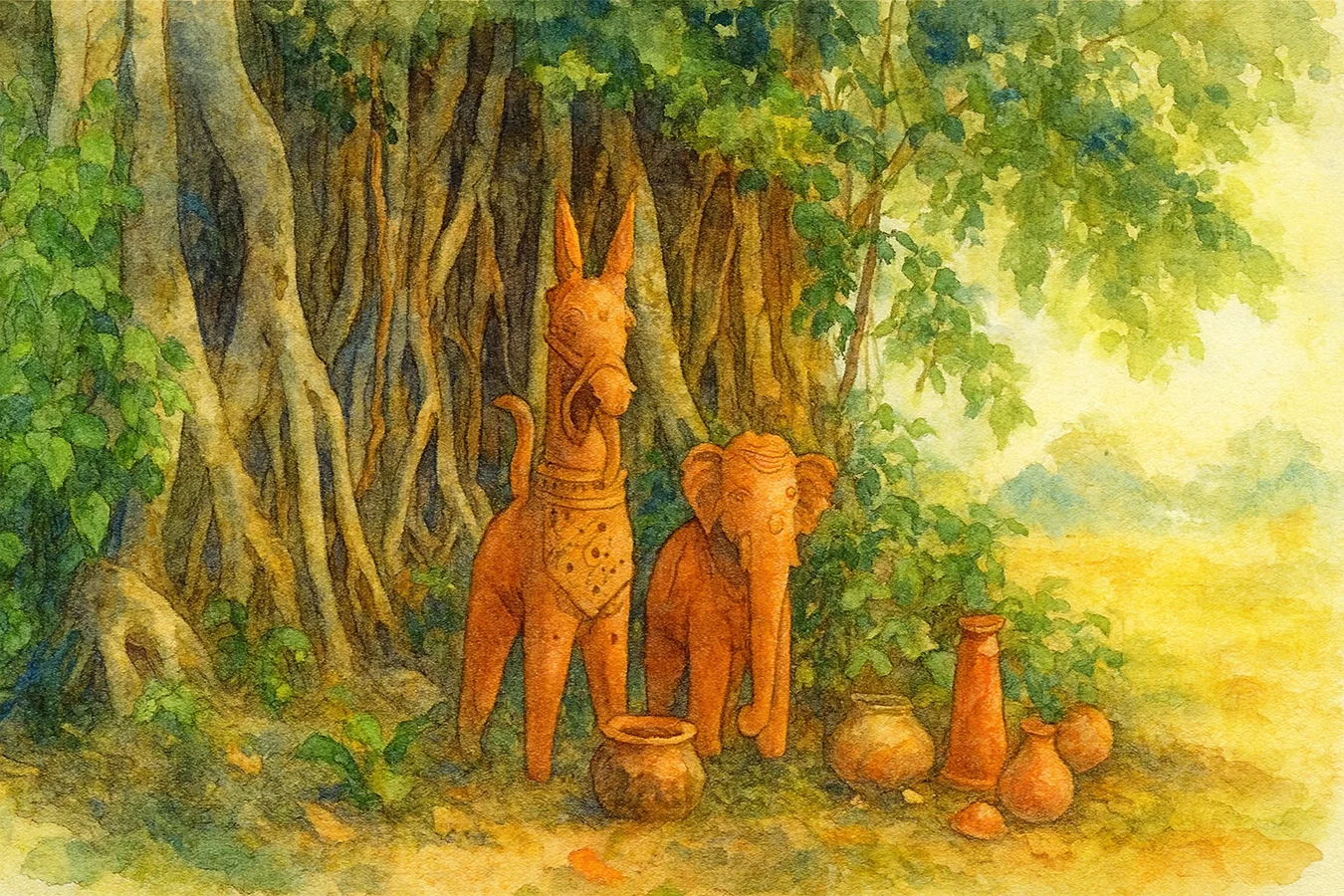
Central to these religious origins is Dharmathakur, the grāma devatā of the Rarh region, and their God of justice and death. His vāhana is the horse, and Dharmarāj, as he is called, continues to attract votive offerings in the form of terracotta or wooden horses deposited in large clusters at village thānas. Many village Gods receive horse figures as a promise or thanks for the fulfillment of wishes, but the large numbers of terracotta horses placed together in Dharmarāj’s shrines are especially noticeable. Historically, the terracotta horses functioned as manat offerings—material pledges made to powerful local deities. In the folk imagination, the horse was regarded as the swiftest messenger to the divine, a vehicle capable of carrying a supplicant’s plea directly to the deity without priestly intercession. These horses, therefore, act as symbolic sacrifices made by villagers when their prayers are granted. Some believe that this tradition may also come from an older link between the horse and the Sun god. These scattered accumulations of horses near village shrines or under sacred banyan trees or in sacred groves are ceremoniously left untouched. They reflect a deep expression of the community’s collective piety and hope for protection, agricultural abundance, rainfall, and immunity from misfortune such as snakebite, thereby attesting to the continuing sacred agency attributed to the Bankura horse in rural life. Even as their forms have evolved, Bankura horses continue to embody this social and spiritual function as tangible intermediaries between the everyday and the sacred.
Terracotta work, using locally available clay, had long been a defining artistic practice in the region, reaching a high degree of refinement during the reign of the Malla kings of Bishnupur. The prominence of terracotta horses in Bankura appears to have reached a zenith during this time, when the introduction of cavalry into the army and the patronage of terracotta temple architecture elevated local clay arts to new heights of sophistication, as evidenced by the celebrated Bishnupur temples. From narrative reliefs of the Rāmāyaṇa, Mahābhārata, and Vaiṣṇava devotional themes to votive figures of horses, elephants, and deities, the art was once embedded in sacred architecture and later gradually dispersed as artisans migrated from temple-centered employment to broader craft production. Today, the continuation of this heritage rests primarily with the Kumbhakar potter community of Panchmura—around sixty families who remain committed to preserving and innovating within the terracotta tradition. Their techniques and aesthetic sensibilities have spread to neighboring villages such as Bibarda, Chhilumpur, Jaykrishnapur, Sandhara, and Ruisar, ensuring that the craft, though fragile, persists as a living cultural practice.


The Bankura horse is a charming figure, with an elongated neck, bulging eyes, pointed ears, and a decorative saddle. Characterized by their distinctive rust-red, burnt-brick hue derived from the iron-rich soil of the Rangamati region, these horses remain deeply embedded in the cultural and environmental landscape of Bankura—an arid, drought-prone terrain where their striking presence beneath banyan trees reflects a longstanding synthesis of tribal beliefs which later became a mainstream Bengali Hindu practice. Located along the ancient trade corridor linking Magadha and Utkala, the region would have long witnessed caravans of majestic, ornamented war-horses and elephants, leaving powerful visual impressions on its inhabitants. This proximity to the elite symbolism of horses in warfare and kingship—ranging from the epics to historical conflicts—reinforced the animal’s aura of strength, prestige, and divine sanction.
The stylistic evolution of the Bankura horse highlights a parallel process of aesthetic diversification shaped by religious adaptation and craft innovation. Distinct regional styles—such as the iconic long-necked, alert-eared, upturned-tailed horses of Panchmura or the pearl-ornamented forms of Sonamukhi—testify to both inherited iconography and shifting cultural influences. The adaptation of production techniques to accommodate modern markets—from modular design for safe transport to mechanized potter’s wheels—demonstrates that traditional craft remains responsive to the demands of commerce, tourism, and global circulation.
The modern cultural ascent of the Bankura horse owes much to the mid-twentieth-century craft revival movement in India, particularly to the advocacy of Kamaladevi Chattopadhyay, freedom fighter, feminist, and one of the most influential champions of Indian handicrafts. In the early 1950s, while documenting regional artisanal traditions, Kamaladevi drew national attention to the terracotta horses of Bankura, presenting them as exemplary embodiments of India’s deep artisanal heritage. Under her leadership, the Indian Cooperative Union (ICU) transformed the government-run handicrafts and textiles emporium in Connaught Place into India’s largest crafts department store and a key platform for Indo-American cultural exchange. It rapidly emerged as a major center for the export of handicrafts, particularly to the United States, and the Bankura horse—now reproduced in formats ranging from traditional terracotta to cast brass—became both a bestseller and the official logo of the emporium. This new institutional visibility positioned the horse as a modern national symbol, circulating among elite urban consumers and international visitors while simultaneously representing the developmental ambitions of early post-Independence India, in which handicrafts were promoted as engines of rural employment, foreign exchange earnings, and cultural diplomacy.
Despite these changes, the Bankura horse maintains its symbolic and traditional continuity, serving as both a sacred offering and an aesthetic artifact. Its presence in modern Indian homes, craft emporia, and export catalogs are, in some ways, a rupture from its religious past, but it is also a nod to the enduring vitality of folk traditions within an evolving, rapidly modernizing socio-cultural landscape. Its journey from rural ritual space to handicrafts markets speaks to the resilience and adaptability of India’s artisanal cultures, where sacred symbolism continues to shape artistic identity while creating new forms of cultural expression and economic value.
Notes:
- A quadriga is a Roman chariot drawn by four horses, often used for chariot racing.
References:
- Gods Beyond Temples, Harsha Dehejia. New Delhi: Motilal Banarsidass, 2006.
- Geer, Alexandra van der. "Equus caballus, the domestic horse". In Animals in Stone (Leiden, The Netherlands: Brill, 2008), doi: https://doi.org/10.1163/9789047443568_020
- https://www.joinpaperplanes.com/the-terracotta-horses-of-bankura-west-bengal/