The cult of the goddess Tripurā, later exalted under the epithet Tripurasundarī (“the Beauty of the Three Worlds”), occupies a central position within the South Indian Śākta Tantric traditions. Its doctrinal foundation is preserved in the Tripurārahasya (TR), a Saṃskṛta text of South Indian provenance, composed most likely between the thirteenth and sixteenth centuries CE, though possibly later. This work, deeply embedded in the Śākta-Tantric milieu, articulates the esoteric teachings of Tripurā and became a cornerstone of what subsequently crystallized into the living tradition of Śrīvidyā—the most widely disseminated of India’s Śākta cults.
According to Alexis Sanderson’s typology of Tantric schools, the Śrīvidyā tradition belongs to the Kulamārga, the Śākta current that developed between the ninth and twelfth centuries CE, inheriting the radical and transgressive ritualism of the Kāpālika ascetics. Within the Kulamārga, four currents are distinguished, and the Tripurā cult is traced to the Dakṣiṇāmnāya (“Southern transmission”), which centered on the veneration of Kāmeśvarī, Kāmadeva, and the Nityā (“eternal”) goddesses. From this milieu emerged the Tripurā-Tripurasundarī cult, whose principal scriptural authorities are the Nityāṣoḍaśikārṇava and the Yoginīhṛdaya (YH), both Kashmirian texts composed in the 11th century CE.Though its textual origins are Kashmirian, the Tripurā tradition took firm root and flourished in South India, where it absorbed the philosophical currents of the non-dualist Śaiva schools of Pratyabhijñā and Spanda. The transmission of these Kashmirian Śaiva metaphysics into the Tripurā cult was mediated by South Indian commentators such as Śivānanda (1225–1275), Vidyānanda, and Amṛtānanda (1325–1375), whose exegetical works shaped the doctrinal and soteriological framework of the tradition.In its later syncretic developments, the Tripurā-Tripurasundarī cult was assimilated into the cult of Lalitā-Kāmākṣī at Kāñcīpuram, a process formalized in the Paraśurāmakalpasūtra (PKS), a ritual manual composed between the fifteenth and sixteenth centuries CE. Through such assimilations, the tradition evolved into the Śrīvidyā system, centered on the mantra of the goddess herself. Crucially, in South India, the Śaṅkarācāryas of Kāñcī and Śṛṅgeri also adopted and propagated Śrīvidyā, reframing its dynamic Kashmirian Śaiva non-dualism through the lens of Advaita Vedānta’s illusionistic metaphysics. This fusion ensured the continuity and expansion of the Tripurā tradition, embedding it both in esoteric ritual culture and in the wider intellectual framework of Vedānta.
The Form of the Goddess Tripurā
The Goddess Tripurā is conceived in multiple, complementary modalities, each expressing a dimension of her presence and accessibility to the devotee. Her mantra constitutes her phonic manifestation, while her yantra, the Śrīcakra, embodies her visual and aniconic form. The Śrīcakra functions as the essential diagrammatic support for meditation and ritual, and proficiency in its use is regarded as indispensable for the initiate of the Śrīvidyā tradition.
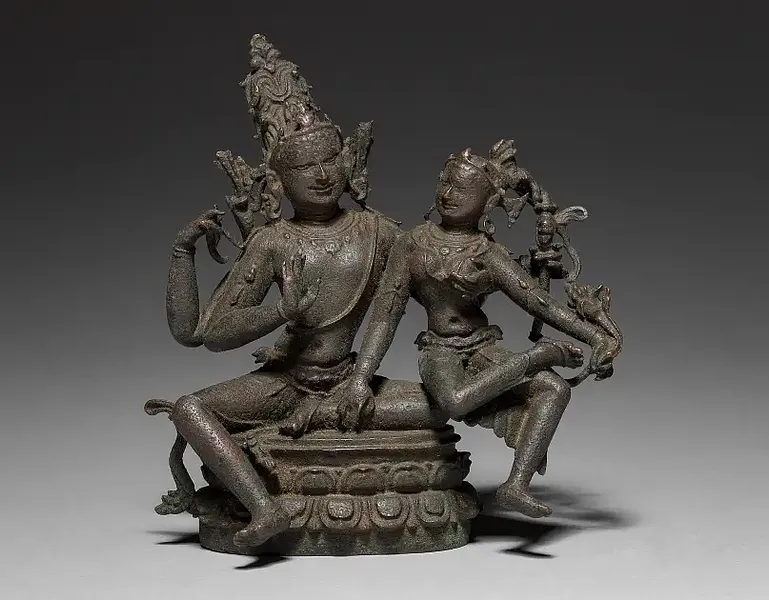
Within this tradition, the Goddess is primarily represented in her aniconic form through the Śrīcakra, a fact that may account for the relative scarcity of her anthropomorphic depictions. The earliest extant images of Tripurā can be identified in South Indian bronze sculptures dating from the tenth to the twelfth centuries CE. From the twelfth century onward, temple cult images of Tripurasundarī begin to appear, often furnished with the attributes of pāśa (noose), aṅkuśa (goad), and the gestures of varada (granting boons) and abhaya (dispelling fear). In certain instances, manuals of iconography, such as Mahīdhara’s Mantramahodadhi (1589), also attest to the substitution of the varada and abhaya mudrās with the bow and arrows, thus fixing her recognizable iconographic repertoire.The correlation between the Goddess and her cakra is articulated with such intensity that the Śrīcakra is described as “the other body of the deity.” In elaborating this identification, Amṛtānanda cites the Nityāṣoḍaśikārṇava, which has a description of Tripurā’s corporeal form, before recalling a striking formulation from the Yoginīhṛdaya (YH): “This is the form in which the supreme splendor abides embodied as the Śrīcakra, surrounded by the sparkling waves of her multitudinous energies.” The employment of the term vapus (“body”) here is significant, suggesting both the goddess’s wondrous beauty and the equivalence of her aniconic and anthropomorphic embodiments. In this way, the YH portrays even the abstract diagram of the Śrīcakra as suffused with her radiant bodily presence.Despite her transcendent and ineffable essence, Tripurā is understood to reveal herself in concrete, corporeal forms out of compassion for her devotees, both human and divine. This theological principle is repeatedly emphasized in the hymnic literature of the tradition. Thus, at the beginning of the Mahākalpa, a hymn to Bālā appears, affirming: “Under the impulse of compassion, you manifest yourself to your devotees in this way, with a body limited by hands, feet, and so on.” The same motif recurs in a hymn to Tripurā herself, where the goddess’s accessibility is celebrated:
“O faultless one, by virtue of your great compassion towards the devotees who bow before you, you accord them the grace of a path easily accessible to mind, word, and eyes. O mother intent upon the salvation of the world, you take the form in which you are meditated upon by each creature devoted to the veneration of your lotus-like feet. … O supreme Śivā, what wonder that you, endowed with the power of the great māyā, assume manifold corporeal forms to bestow the fruits of desire upon those who have sought refuge in you?”
The tradition makes explicit that such forms are assumed for the salvation of beings: “In order to rescue these beings, you take manifold, outward, gross forms (sthūlarūpa), intelligible to their eyes.” Among these multiple manifestations, the most important is identified with the figure bearing a bow, arrows, a noose, and a goad. For those who venerate this form of Tripurā, the texts affirm, this is the supreme and most efficacious embodiment of the goddess.
The Iconographic and Poetic Form of Tripurā
The Nityāṣoḍaśikārṇava offers one of the earliest and most elaborate descriptions of the goddess Tripurā in her corporeal form:
“… the Goddess resembling a lotus, red [as] the beams of the newly risen sun, similar to a blossom of China rose [and] a blossom on a pomegranate tree, red as water [mixed with] saffron, adorned with a hair net of small bells and a glittering diadem of rubies; the flower bud of her curved forehead [is] like a dark swarm of bees, her round lotus-like face [is] of a fresh red color, she has a soft band on her curved, half-moon-like forehead, her lovely brow is shaped as the bow of Śiva, [she is the] supreme Goddess; her eyes [are] glancing from side to side playfully, rejoicing in happiness; her golden earrings [are] far spreading with the intensity of their sparkling luster; the fullness of her round beautiful cheeks surpasses the circle of the immortal moon, her straight nose [is like] a line measuring every action; [she is] equal to ambrosia, with her lips crimson like a bimba fruit [or] a red flower bud, the loveliness of her smile overpowers the sweetness of an ocean of nectar; beautified by a chin endowed with unparalleled qualities, she has folds in her neck like a spiral shell, [she is] large-eyed, with voluptuous arms as soft as lotus fibres; her lotus-like hands [are] tender and shaped like petals of red lotuses, the firmament is pervaded by the moonlight of the fingernails of her lotus-like hands; her high breasts [are adorned] with a string of pearls, [she is] beautified by her belly [endowed] with three undulating folds; adorned with her navel looking like a whirl of currents of beauty, her large and handsome hips [are] fastened by a girdle made of invaluable gems; the line of hair [over her] bimba-like round buttocks is like a precious elephant goad; [she is] the lady whose delicate thighs [are like] quivering stems of plantain trees, adorned with shanks comparable to the beauty of plantain trees; … with a garment of red cloth, holding up in her hands the noose and the goad, sitting upon a red flower and adorned with red ornaments, [she is] four-armed, three-eyed, bearing the bow with five arrows, with her mouth full of betel mixed with camphor and cinnamon, radiant with her tall body, from her moon-like toenails to her sun-like fingers; her ruddy figure [shows] the unrestrained lust of an elephant [in rut], [she is] richly and suitably dressed for all amorous enterprises, adorned with every ornament; causing joy in living beings, giving pleasure to living beings, attracting living beings; appearing as the origin of the world, made of all mantras, beautiful Goddess [granting] all happiness, made of all good fortune, eternal, rejoicing in supreme felicity.” [abridged and edited]
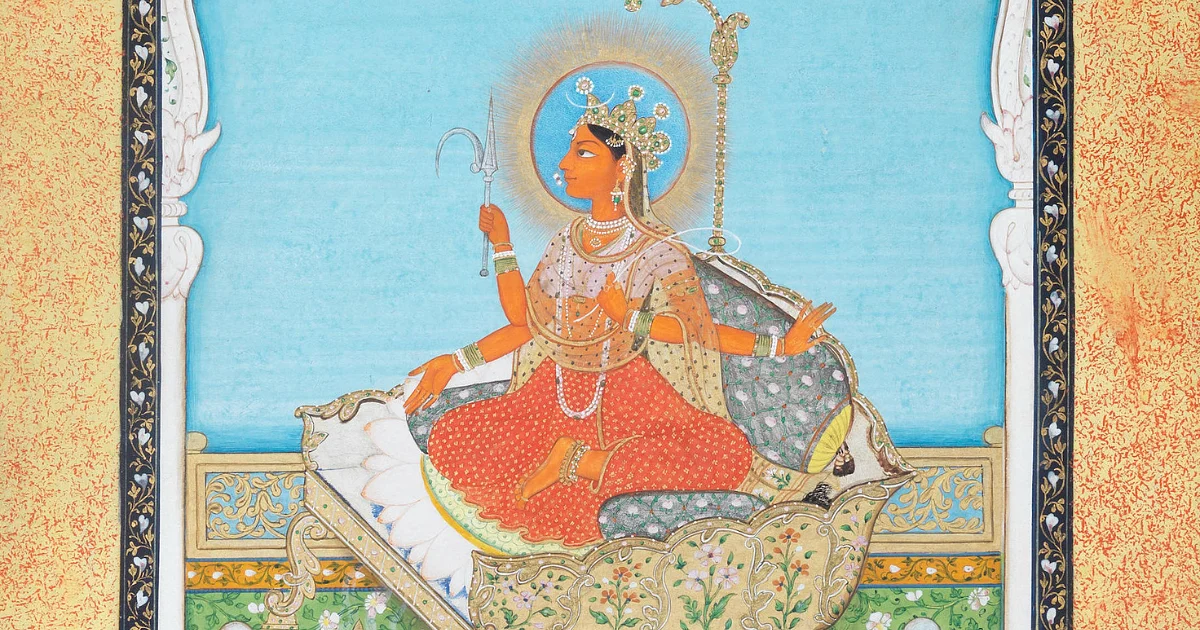
This portrait establishes her principal iconographic traits: she is radiant, red-hued, adorned with jewels, three-eyed and four-armed, holding the noose (pāśa), goad (aṅkuśa), bow, and five arrows. The Yoginīhṛdaya reiterates these same attributes: “Shining, she holds the noose made of the energy of will, the hook which is [energy of] knowledge, the bow and the arrows made of energy of action.” Amṛtānanda, in his commentary, provides symbolic exegesis: the noose embodies icchāśakti (the power of will), as the goddess binds beings; the goad signifies jñānaśakti (the power of knowledge), controlling the elephant of thought; while the bow and arrows represent kriyāśakti (the power of action), aligning thought (the bow) with the senses (the arrows).
The poetic imagery of the Nityāṣoḍaśikārṇava underscores Tripurā’s seductive beauty, aligning her with the aesthetic ideals of classical kāvya literature. Her allure is not merely ornamental but ontological: she is revealed as the very source of śṛṅgāra—erotic love, amorous play, and aesthetic experience. The bow and five arrows, which she shares with Kāma, reinforce this association. Her role as bestower of saubhāgya (happiness, prosperity, good fortune) leads her tradition to be designated the saubhāgyasaṃpradāya.
The Tripurārahasya (TR) parallels these depictions with its own hymnic and narrative descriptions. Three passages in the Mahākhaṇḍa recount her manifestations: first, before Kāma, in the form in which he meditates upon her (dhyātarūpa); second, before the gods, in response to their invocation against the asuras; and third, as she rises from the sacrificial fire of Consciousness. In these episodes, she retains the iconographic traits of the Nityāṣoḍaśikārṇava—red hue, jewels, noose, goad, bow, and arrows—with additional features: the crescent moon upon her head, and, in the manifestation before Kāma, a sugarcane bow (puṇḍracāpa) with flower-arrows (puṣpabāṇa), echoing Kāmadeva’s own weapons.
Such attributes bind Tripurā iconographically with Lalitā, who appears in the Lalitopākhyāna (LU) radiant in red, adorned with jewels, and bearing the same weapons. The texts emphasize that she is also the abode of śṛṅgārarasa. Likewise, these traits are shared by Kāmākṣī of Kāñcī, further consolidating the convergence of these local and pan-Śākta goddesses. Indeed, in the TR, when Kāma beholds Tripurā, he composes hymns in her praise, extolling her as Kāmeśvarī, Tripurā, Lalitā, and Kāmākṣī, a testament to their fluid identities.
Her theological significance, however, transcends iconography. A hymn from Chapter 1 of the Māhātmyakhaṇḍa extols her cosmic role:
“You alone, one, you in person, filled with a great and infinite power, were present in the form of Consciousness at the beginning of all the worlds. You whose body, alone, is the good seed of all the buds [forming together] the net of the worlds’ garlands, [you are she who], in the form of supreme bliss, by supreme benevolence, carries out the preservation of the individual souls… As waves [are] to the ocean, as jars, jugs and vases [are] in relation to clay, as light [is] to the sun, as ornaments [are] in relation to gold, in the same way this whole [world] is shone forth out of you [who are] in the form of Consciousness: immediately appeared [it is] in the form of Being, and yet in its wonderful appearance it is different from that [Being].”
The Tripurārahasya also envisions her in a more martial and majestic form: golden-hued, red-clothed, crowned by the crescent moon, and endowed with eighteen hands bearing an array of attributes—the bow, noose, bell, drum, bowl of gems, shield, japamālā, lotus, book, cinmudrā, conch, disc, sword, trident, axe, mace, goad, and arrows. This imagery evokes the eighteen-armed Durgā of the Devīmāhātmya, who likewise arises from the effulgence of the gods and is armed with their collective weapons. The parallel reinforces Tripurā’s identification with the supreme goddess of pan-Indian Śākta traditions.Goddess Tripurā’s mythological roles extend beyond abstract theology. She is reborn on earth as the daughter of Nanda to empower Kṛṣṇa against Kaṃsa; as Kātyāyanī to slay Śumbha and Niśumbha, as Caṇḍikā in their demon-slaying exploits; as Kālī to destroy the asuras known as Kālakañjas; and even Durgā — mahiṣāsuramardinī — is said to be a partial emanation of Tripurā. Ultimately, with the form of Lalitā—her fullest and most resplendent manifestation—Tripurā wages war against the demon Bhaṇḍa, a conflict that occupies the central narrative of the Lalitopākhyāna.
Tripurā must be visualized as simultaneously iconic and aniconic, both metaphysical and accessible. Whether manifest through the Śrīcakra as her subtle “other body” or through the compassionate assumption of anthropomorphic forms endowed with a bow, arrows, noose, and goad, the Goddess bridges the gap between transcendence and immanence. Theological reflection within the Yoginīhṛdaya and the Nityāṣoḍaśīkārṇava underscores her role as both the ineffable ground of consciousness and the salvific deity who accommodates herself to the limited faculties of her devotees. This multivalence illustrates the Śākta strategy of integrating non-dualist metaphysics with ritual and devotional practice, so that the inaccessible supreme reality becomes available to embodied beings through contemplation, worship, and visualization. Through her multiple names—Tripurā, Lalitā, Kāmeśvarī, Kāmākṣī—she gathers and reconciles strands of theology, poetry, and ritual practice, becoming both the intimate goddess of śṛṅgāra and the transcendent force that sustains and subdues the universe. At the present juncture of Navarātra—a festival ritually dedicated to the manifold forms of the Goddess—it is especially apposite to meditate upon the Goddess Tripurāsundarī, who is not only beautiful and compassionate, but also soteriologically efficacious.
Source: Linder, Silvia Schwarz. Goddess Traditions in India: Theological Poems and Philosophical Tales in the Tripurārahasya. Leiden: Brill, 2015.Image: Goddess Tripurasundarī enthroned, with vessels and offerings before her; Pahari, Mandi, circa 1820-30