“If Ananda Coomaraswamy had not arisen amidst us as if from a sacrificial fire and tried to awaken our minds to the glories of a rare art, we should have been now practically dead to the wonder-world that is Indian Art. If today more and more of our educated persons begin to appreciate some of the art relics of our land, it is in no small measure to his unabting exhortation to recognise our ancient culture which formed the basis for an eternal philosophy inspiring every field of activity, and particularly the art of sculpture and painting.
He declared: “In any case whether we demand of art merely the reflection of ourselves, or the vision of something beyond us, it is certain that we must understand and recognise, if not accept the Indian ideal of character, and we must know something of the extent to which this character has been actually realised in life’’. Art and life are so organically merged with each other that to think of the one apart from the other will be suicidal to our culture.”
K. Chandrasekharan, Ananda Coomaraswamy’s Approach to Indian Art
Modern art criticism is often understood as an interpretive and evaluative discourse surrounding works of art. The critic is expected to situate a work within aesthetic traditions, social contexts and political frameworks, examining questions of meaning, originality, representation and ideology. In the contemporary world, art criticism is largely external to artistic production itself: the critic occupies a distinct position from the artist and the audience, producing commentary that may praise, contextualize or interrogate a work. In some cases, it creates a crisis of pseudo-profundity (first described in the Pennycook Study in 2015) that can be extended into the world of art. Moreover, it is more often than not dependent on the personal and subjective tastes of the critic.
In contrast, the pre-modern conception of art criticism in India was founded on very different assumptions. Hindu art was never regarded primarily as a medium for self-expression, political commentary or mimetic representation. Instead, it was understood as a disciplined means of communicating an idealized reality, giving a glimpse into a higher philosophical plane and intended to evoke aesthetic experience in a prepared spectator. Criticism, therefore, was not merely the expression of personal tastes. It was a science of evaluating whether an artwork successfully embodied the principles of śāstra, manifested rasa and bhāva, and revealed the artist's extraordinary skill. The artist, like the poet and the musician, had elaborate canons for criticism that aided the appraisal of the merits and defects in pictorial works of art.
For instance, in the Upamitibhāvaprapañcakathā, there is a passage that carries an elaborate description of the qualities that constitute a great painting: delicately outlined in unobtrusive yet precise lines; bright and harmonious colours; suggestive of depth through modelling and shading; ornamentation introduced appropriately; bodily proportions are symmetrical; emotions are convincingly expressed; and the composition as a whole is graceful and compelling. Yet these technical excellences alone do not make a composition worthy of praise. Beyond line, colour and composition lies what Saṃskṛta aestheticians called the artist's unique kauśala—a subtle creative brilliance that captivates the viewer and gives the work its distinctive life. As later theorists expressed it, "citreṣv eva manohāri kartuḥ kim api kauśalam"—in paintings there exists an indescribable charm arising from the artist's special skill.
The artist must internalize his subject through contemplation and identify himself with it before attempting representation. Artistic creation is thus a form of disciplined vision. The Śukra Nītisāra insists on dhyāna or meditation in order for the artist to achieve this transcendence of their art: “The image-maker should be expert in this visual contemplation, since thus, and in no other way, and verily not by direct observation can the end be achieved. The necessity for the artist to identify himself absolutely with his subject or merge his own consciousness in that aspect of nature which he wishes to interpret is emphasized. Direct observation is considered to be of little efficacy to the image maker. Concentration during meditation is ordained for him to be pursued. It is yoga in other words. This meditation is common to all artists whether of poetry, dance, music, painting or sculpture when they start their endeavours. We have instances of Vālmiki and Vyāsa having entered upon Dhyāna before undertaking (to begin) their epics.” The artist does not copy the world; he realizes and manifests an ideal form already apprehended inwardly.
In addition to disparate passages in various texts, the most systematic treatment of painting and art criticism appears in the Citrasūtra section of the Viṣṇudharmottara Purāṇa. This text outlines technical principles governing drawing, colour, proportion, composition, foreshortening, shading and iconography. It was not merely a manual for painters but a treatise on aesthetic judgement, prescribing the standards by which artworks were to be evaluated. The Citrasūtra goes into excruciatingly minute detail — such as even the shape of hair, like kuntala, daksiṇāvarta, etc., long and fine, curling to the right; the measurement of limbs in general according to tāla proportions (facial proportions); different shapes of the eyes (like cāpakāra, matsyodāra, etc.); poses or sthānas; different methods of foreshortening or kṣayavṛddhi; the methods of shading; the modes of representing different subjects chosen for delineation, such as kings, courtiers, courtesans, warriors, animals, rivers, etc. The existence of such detailed prescriptions demonstrates that art criticism in India had developed into a sophisticated discipline. Far from being unsystematic or purely mystical, it possessed a rigorous technical vocabulary.
Recent scholarship has challenged the common assumption that India lacked a tradition of art criticism. Rather than a separate profession of critics writing reviews, criticism was embedded within Saṃskṛta treatises on painting, sculpture, drama and poetics. As mentioned earlier, texts such as the Viṣṇudharmottara Purāṇa, the Nāṭyaśāstra, and later works on poetics and aesthetics developed sophisticated vocabularies for discussing artistic merit and defect. Art criticism in India thus existed not as a secondary discourse, but as an integral part of artistic theory and practice.
The philosophical basis of Indian art criticism differed fundamentally from modern Western notions of realism and imitation. Indian art theorists were less concerned with reproducing external appearances than with conveying inner meaning and emotional truth. As later scholars of Indian art such as Ananda Coomaraswamy have argued, Indian art privileged the subjective and contemplative over the mere objective. The artist and the sahṛdaya—the sensitive, cultivated spectator—were both indispensable to the aesthetic experience. Art could not be fully appreciated without cultural and emotional preparation, for its purpose was not to imitate reality but to reveal a deeper truth beneath surficial appearances.
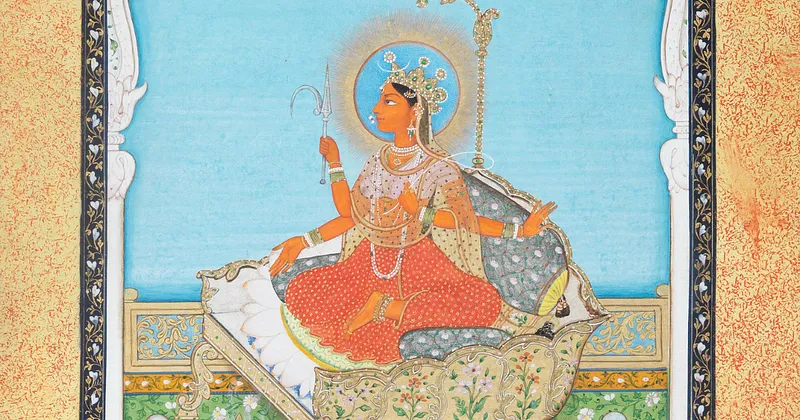
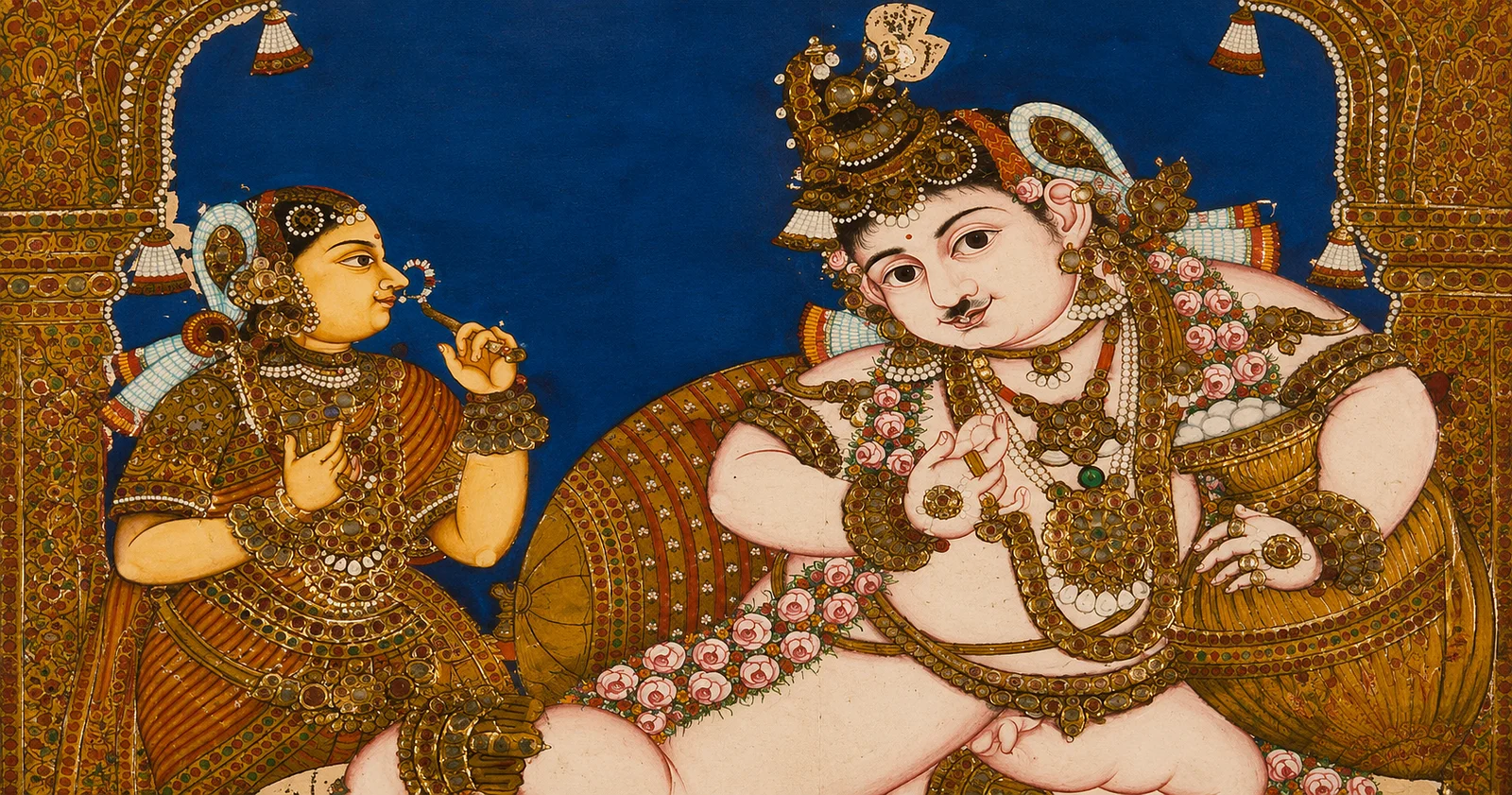
This orientation explains why Indian art often departed from strict naturalism. Long arms, stylized eyes, exaggerated proportions and unconventional perspectives were not errors but deliberate artistic choices. The goal was to communicate bhāva—emotion, mood or spiritual significance—even if realism had to be sacrificed. An example is the manner in which, in Tanjavur paintings, Śri Kṛṣṇa, though a baby, is often depicted as larger than the adults around him — not because the artist lacks perspective, but because Indian art prioritizes spiritual truth over visual realism. Kṛṣṇa, though depicted as a child, is the supreme reality (Parabrahman), and his enlarged figure visually communicates his cosmic importance. The diminutive size of the surrounding cowherds and cattle emphasizes their dependence on the divine and their absorption in his līlā. This departure from naturalistic proportion exemplifies a central principle of Indian aesthetics—that art should convey bhāva and inner meaning rather than merely imitate external appearances. As Ananda Coomaraswamy observed, such seeming "distortions" are intentional symbolic devices, enabling the artist to express metaphysical truths that realistic representation can never adequately capture.
One passage praises the artist capable of depicting natural forces in convincing ways. The painter who can render wavy lines, flames, smoke and fluttering flags so as to indicate the direction of the wind is commended as possessing exceptional skill. Even greater, however, is the artist who can distinguish in painting the subtle difference between figures asleep and dead. Artistic excellence did not lie in photographic accuracy but in the ability to convey states of being that are emotionally and psychologically distinct.
Indian art criticism was therefore both technical and experiential in a way that is distinct from the Western tradition. The Viṣṇudharmottara enumerates defects as carefully as it describes virtues: coarse or weak drawing, lack of symmetry, muddy colours, awkward poses, absence of emotion, careless execution and lifeless representation are all faults that diminish artistic value. Such criteria reveal that criticism was systematic and normative. An artwork could be judged according to recognized standards rather than subjective preference alone.
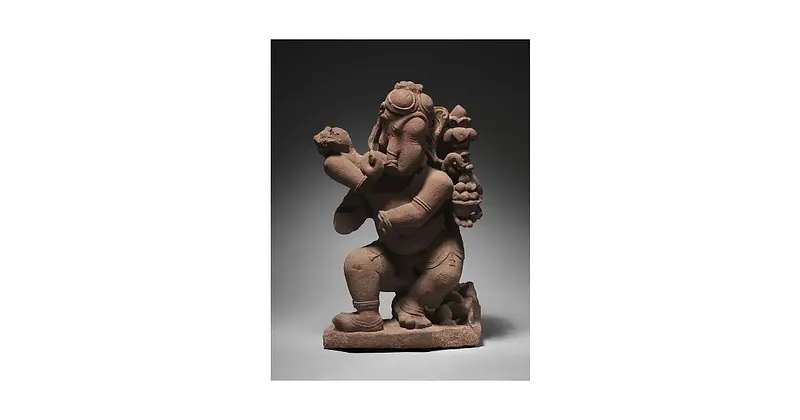
A picture should suggest more than it explicitly shows. The clothing of a princess might indicate her unmarried status. The famous relief at Mahabalipuram depicting a sage performing sūryopāsanā evokes midday through posture and action rather than through direct representation of the sun's position. The artwork thus communicates through suggestion and resonance, a principle that parallels the theory of dhvani in Saṃskṛta poetics. Yet Indian aesthetic thought never reduced art to technique alone. Theories of rasa and aesthetic experience remained central. An artwork succeeded not merely when it obeyed formal rules but when it produced a distinctive emotional and contemplative state in the viewer. The spectator, or sahṛdaya, was expected to participate actively in this experience. Saṃskṛta aesthetic theory repeatedly emphasizes that aesthetic relish is possible only for one whose sensibility has been cultivated. The work of art is completed in the encounter between artist and spectator.
In the Sāhitya Darpana, a work attributed to Viśvanātha, the author tries to make an attempt to describe the nature of rasa. It says: “The function of flavour (rasa) is theirs whose knowledge of absolute values is innate; it is self-revealed as an intellectual ecstacy (ananda cinmaya) devoid of conceptual contacts, at the summit of being; born of one mother with the fruition of God, life is as it were a flash of blinding lightening of trans- mundane origin, impossible to analyse and yet in the likeness of our being”. (Mirror of Gesture, A. Coomaraswamy).
Ananda Coomaraswamy argued that art and the appreciation of art emerge from a shared cultural world. This understanding was inseparable from the broader philosophical foundations of Indian civilization. Religion, science and art were not viewed as autonomous domains but as interconnected ways of apprehending reality. Artistic production was governed by śāstra, nourished by spiritual practice and directed toward the communication of truth. Beauty was not an arbitrary or subjective category. It emerged when artistic form conformed to deeper principles of order and meaning. Coomaraswamy famously interpreted the image of Śiva as Naṭarāja as embodying this synthesis of art, cosmology and metaphysics: the dance of the deity simultaneously represents cosmic rhythm, philosophical truth and aesthetic beauty.
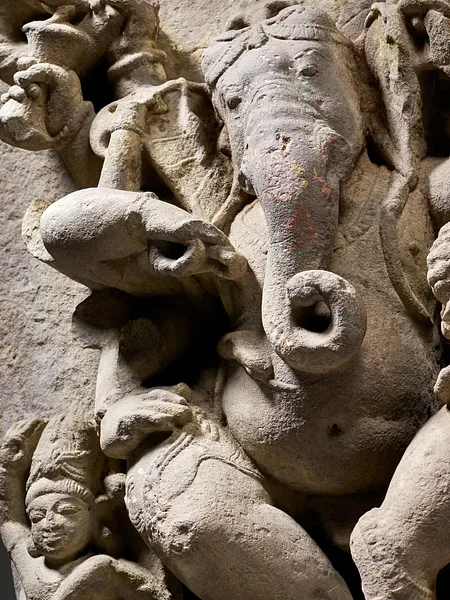
This conception explains why Indian art criticism privileged idealization over imitation. A gigantic Kṛṣṇa surrounded by diminutive cowherds, or colossal temple guardians effortlessly holding massive maces, are not failures of realism. Their truth is symbolic and experiential rather than optical. The critic's task is therefore to understand whether the work successfully conveys these higher meanings.
Pre-modern Indian art criticism was thus not only present, contrary to the claims of Western scholarship, but a richly developed discourse that united technical analysis, philosophical reflection and aesthetic experience. Saṃskṛta treatises codified artistic standards with remarkable precision, yet always recognized that true artistic greatness transcends rule-bound execution. Modern art criticism often celebrates originality, disruption and subjective interpretation. The Hindu tradition valued discipline, rasa and the communication of higher truths and beauty.
See also: Advaita in Art - The Transcendent Nature of Hindu Art https://www.brhat.in/dhiti/advaita-in-art-the-transcendent-nature-of-hindu-art
References:
South Indian Paintings by C. Sivaramamurti
Ananda Coomaraswamy’s Approach to Indian Art, an essay by K. Chandrasekharan