The cotton handloom tradition of India stands among the great manufacturing institutions of the world, remarkable not only for its scale but also for its continuity. For nearly five millennia, Indian looms have remained constantly in motion. Archaeological remnants of cotton thread recovered from the ruins of the Harappan civilization (c. 5000–3500 BCE) testify to an early mastery of spinning and weaving, situating cotton at the very foundations of South Asian material culture. From these beginnings emerged a textile tradition that would, for centuries, clothe vast portions of the world for most of history.
By at least the first century CE, Indian weavers were supplying international markets with cotton fabrics of exceptional quality. What followed was a prolonged golden age—stretching from the early Roman period until the dawn of the nineteenth century—during which Indian cotton textiles became the single largest manufactured trade commodity of the pre-industrial world. Written records across geographies repeatedly attest to their quantity, variety, and technical sophistication. During the height of the Roman Empire, Indian textiles were exchanged for gold on a massive scale. Pliny the Elder, writing in the first century CE, calculated that imports of Indian goods—chief among them cotton fabrics—cost Rome nearly one hundred million sesterces annually. He lamented that India was draining the empire of its wealth, a complaint that inadvertently underscores the desirability and value of Indian cloth in the ancient Mediterranean world.
Centuries later, in 851 CE, Suleiman, an Arab merchant who visited Calicut, recorded his astonishment at the fineness of Indian textiles, noting that garments were woven with such delicacy that they could be drawn through a ring of middling size. By the early sixteenth century, the maritime trade networks of the Indian Ocean had expanded further, and Indian cottons circulated in ever-greater diversity. In the early seventeenth century, Pyrard de Laval asserted that Indian fabrics clothed “everyone from the Cape of Good Hope to China, man and woman…from head to foot.” Paid for in gold and silver, textile trade was a cornerstone of India’s legendary wealth. More importantly, it established cloth as one of India’s most enduring medium of artistic expression and technological prowess. The story of Indian textiles, therefore, is not simply one of commerce or craft, but of a living tradition whose methods, aesthetics, and systems of production proved resilient enough to endure centuries of political change and global circulation.

From antiquity, Indian cottons acquired a reputation for qualities that other regions struggled to replicate: exceptionally fine spinning and weaving, and lightweight and breathable cloth. However, beyond mastery in spinning and weaving, India’s crowning textile achievement lay in the patterned application of brilliant, fast dyes. This was not a single technique but a coordinated system of processes: bleaching and preparation of cloth; pattern design; resist methods; the application of metallic mordants; the precise alignment of multiple carved blocks; the preparation of dyes for predictable effects; hand-painting of fine details; and, finally, controlled dyeing, washing, and finishing—occasionally enhanced with tinsel. These skills were grounded in empirical, hereditary knowledge whose roots extend back to the dyeing practices of Mohenjo-daro. Central to this system was the use of mordants to bind dyes permanently to cotton fibers, a domain in which Indian dyers developed particular expertise with red and black and their many tonal variations. Combined with indigo and a small range of other dyes, these techniques enabled a rich chromatic vocabulary, often further articulated through resist patterning akin to batik. Patterning was executed freehand, by block, or through a combination of both methods.

Technical mastery granted Indian dyers exceptional creative flexibility. They could reliably respond to commissions demanding specific patterns, colors, and finishes for diverse markets. Distinct palettes and motifs were calibrated to destination: deep maroons, blacks, and reds articulated with fine white resist lines travelled to Thailand; hip wrappers with saw-toothed borders and geometric or floral fields circulated across Southeast Asia; Christian altar frontals reached Armenia; and Europe imported bed hangings with monumental flowering trees, as well as dress fabrics designed to be cut and tailored into gowns, robes, and vests. European trade correspondence reveals a growing dependence on this capacity for variation. As the “Indian craze” swept European fashion in the late seventeenth century, merchants demanded ever greater novelty—requesting, in 1697, “good brisk colors” and “rambling fancyes of the country,” pointedly specifying that they should contain “no English patterns.”
Within this vast and voluminous textile trade, Gujarat’s early attainment of special prominence has mainly been attributed to perfecting the use of organic dyes and block-printing techniques. These advances positioned the region as a major producer of cotton textiles for Indian Ocean markets, particularly those linked through the Red Sea, including Egypt. Contemporary accounts underscore both the scale and specialization of this industry. Writing from Malacca in 1515, Tome Pires described ships arriving from Gujarat and the Coromandel Coast laden with cloth of “thirty different sorts,” their cargoes valued at eighty to ninety thousand cruzados per voyage. Such testimony reveals an industry capable of producing a wide spectrum of textiles, calibrated to distinct markets, uses, and aesthetic preferences rather than a single, undifferentiated export good.

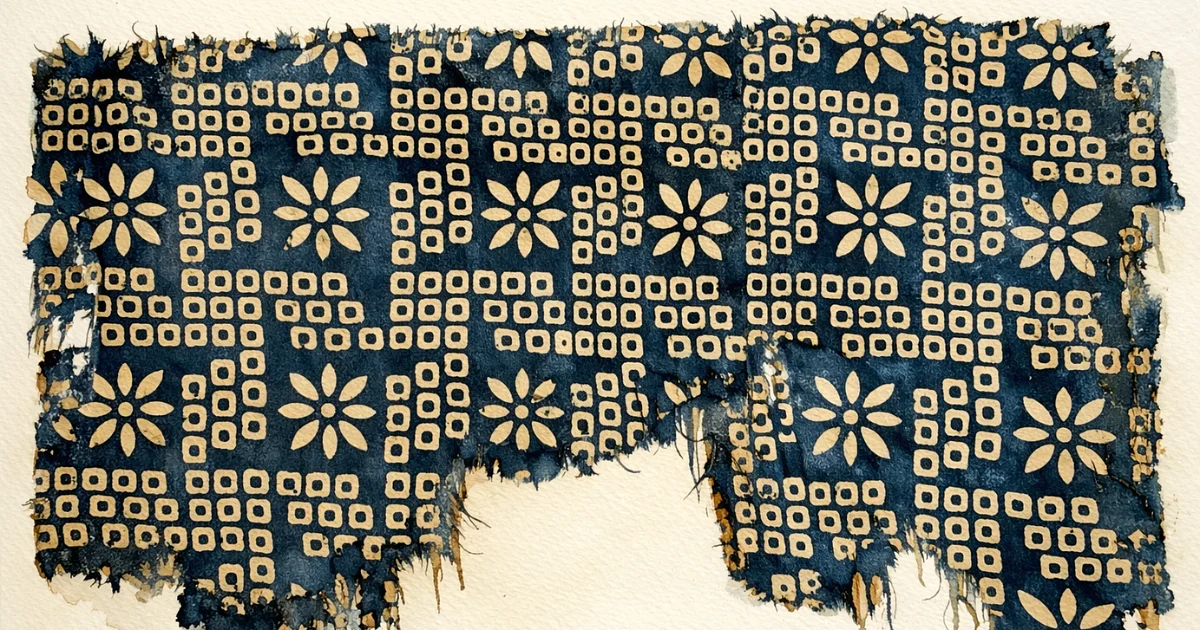
For a long time, however, the full extent of the Gujarat–Egypt textile connection remained underexplored. This changed in the early twentieth century, when large numbers of Indian cotton fragments were excavated in Egypt, particularly in and around Fustat, near Cairo. Often referred to as “Indo-Egyptian” or “Fustat fragments,” these textiles prompted sustained scholarly attention and offered rare material evidence of medieval textile circulation across the Red Sea littoral. These textile fragments survived there in quantities that are almost impossible to find in India, since the arid climate of the Egyptian Red Sea region managed to preserve fabric that would have long deteriorated in the humid, monsoon-heavy environments of South and Southeast Asia. In the 1930s, the textile historian Rudolf Pfister attributed many of these fragments to western India, specifically Gujarat, based on stylistic parallels with Indian art and architecture. This attribution was later strengthened through motif analysis, most notably the identification of a distinctive duck pattern that appears identically on Fustat fragments and on Gujarat-made textiles produced for Southeast Asian (such as Indonesia) markets in the late fifteenth and early sixteenth centuries. The precise replication of this motif across regions provided a decisive visual marker for Gujarat as the center of manufacture.


Crucially, the Fustat evidence also complicates assumptions about export textiles as courtly luxuries. Studies by the Science Museum Group emphasize that much of this cloth was of low to middling quality—block-printed rather than hand-painted, and limited to two or three colors—indicating cost-efficient production for everyday use. This reframes India’s textile power not as the creation of luxury masterpieces alone, but as the ability to supply dependable, affordable cloth at scale: an ‘industry’ long before the advent of modern industrialization. Read in this light, the Fustat fragments are visual documents of a connected medieval maritime world, though they represent but a small portion of a far more extensive global corpus of trade and history. Indian textiles being described as “craft” is too infinitesimal a word for what cloth has always meant on the subcontinent: a wearable art form, a crucial socio-cultural element, and an economic engine that carried Indian aesthetics across oceans.
References
- Parthasarathi, Prasannan. “The Indian Challenge and the Rise of Manchester.” Journal of the Science Museum, 2025, Article no. 231907, doi:10.15180/231907.
- Shaikh, Ayesha U. “Made in India, Found in Egypt: Red Sea Textile Trade in the Thirteenth and Fourteenth Centuries.” Heilbrunn Timeline of Art History, The Metropolitan Museum of Art, March 1, 2023, https://www.metmuseum.org/essays/red-sea-textile-trade
- Uzramma, "Cotton to Cloth: An Indian Epic" (2006). Textile Society of America Symposium Proceedings. 330.
- https://digitalcommons.unl.edu/tsaconf/330