Let him who wishes to enter the worlds that are reached by sacrificial offerings and the performance of religious obligations (iṣṭapūrta) build a temple to the gods, by doing which he attains both the results of sacrifice and the performance of religious obligations. Bṛhat Saṁhitā LV. 2
The Hindu temple is not merely a physical edifice constructed from stone or brick, but constitutes a sophisticated manifestation of metaphysical and aesthetic consciousness deeply rooted in the civilizational ethos of India. It functions as a material articulation of a timeless spiritual cosmology that mediates between the earthly and the transcendent, encapsulating the vision of reality posited by Hindu metaphysical systems. The temple does not simply serve as a site of devotional practice; it is, more profoundly, an epistemological and ontological statement, a concretized form of sacred knowledge designed to enable the devotee’s journey towards realization through darśana. In the Hindu aesthetic consciousness, all art is a means of experiencing a state of bliss akin to the absolute state of ānanda or jīvanmukti.
Stella Kramrisch in her magnum opus The Hindu Temple: The Evolution of its Form and Meaning writes that to the pilgrim and devotee who visit a temple, it is a “tīrtha made by art, as others are by nature, and often it is both in one. A Hindu temple unlike the Vedic altar does not fulfil its purpose by being built; it has of necessity to be seen. Darśana, the looking at the temple, the seat, abode and body of divinity and its worship (pūjā), are the purpose of visiting the temple. To fulfil this purpose in addition to being an offering and work of pious liberality the temple has not only its proportionate measurement but also the carvings on its walls, and the total fact of its form.”
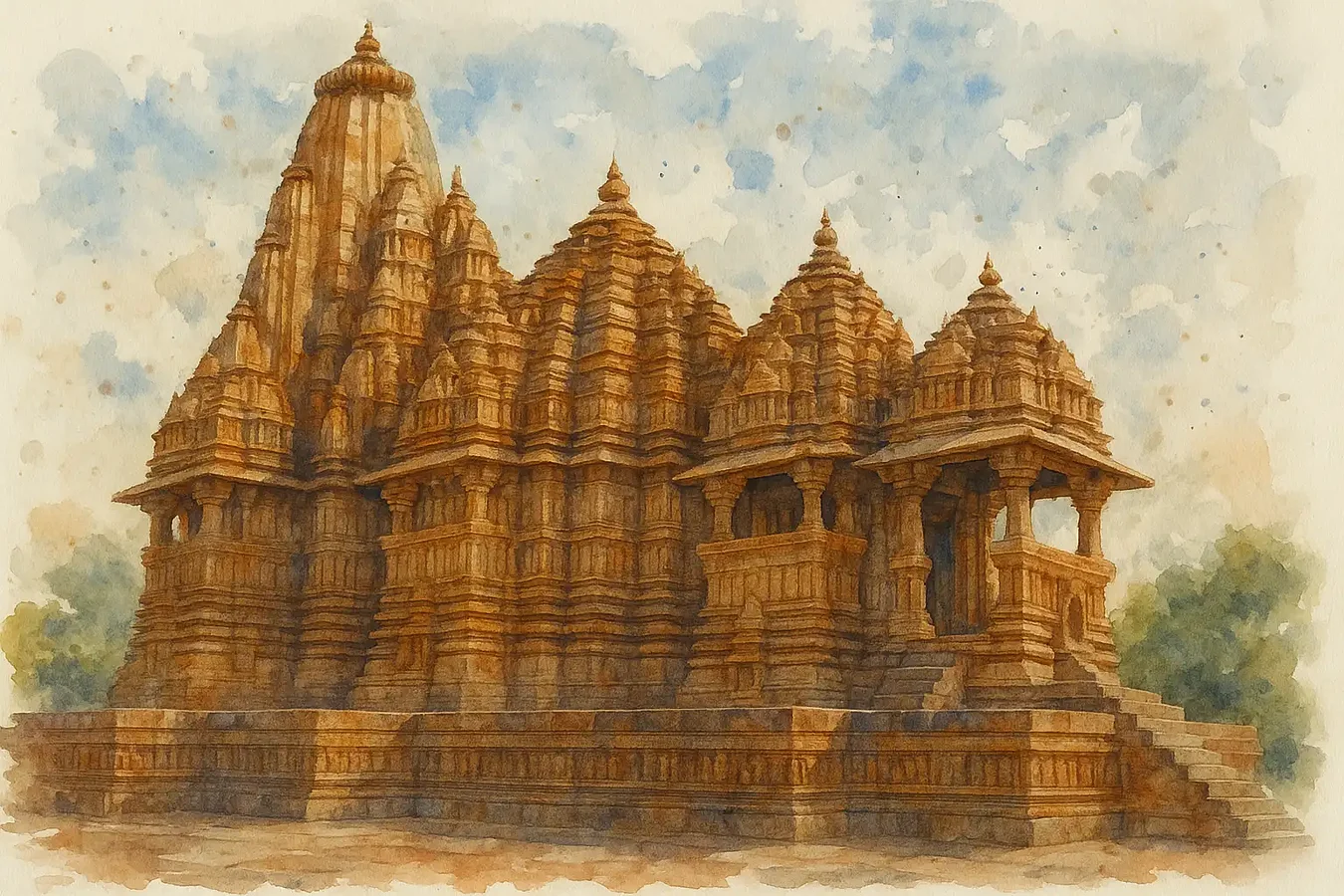
The structural composition of the temple is meticulously ordered according to sacred geometries and cosmological principles. From the garbhagṛha (the sanctum sanctorum, housing the principal deity) to the vimāna (the towering superstructure), and from the maṇḍapa (pillared hall) to the prakāra (enclosure walls), each architectural element is a crucial part in the construction of its cosmic symbolism. The temple is conceived as a microcosm, an analog of the universe, and its vertical axis is intended to represent the axis mundi — the spiritual conduit linking the earthly plane with the celestial and infernal realms. In Sacred and the Profane, Eliade writes that in the great Oriental civilizations, including India, “the temple received a new and important valorization. It is not only an imago mundi; it is also interpreted as the earthly reproduction of a transcendent model”. This aligns the Hindu temple with a universal religious impulse—to recreate cosmic order on earth. Eliade treats the Hindu temple as an earthly reflection of ṛta, cosmic order— both a cosmogram and a theophanic space, where the architecture enacts and embodies the universe’s sacred structure.

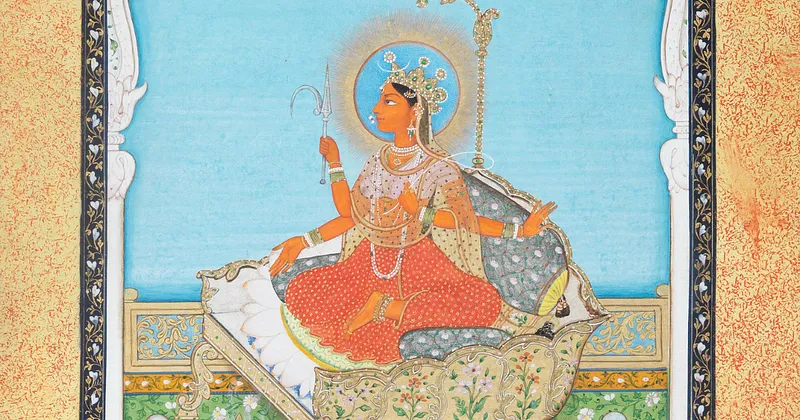
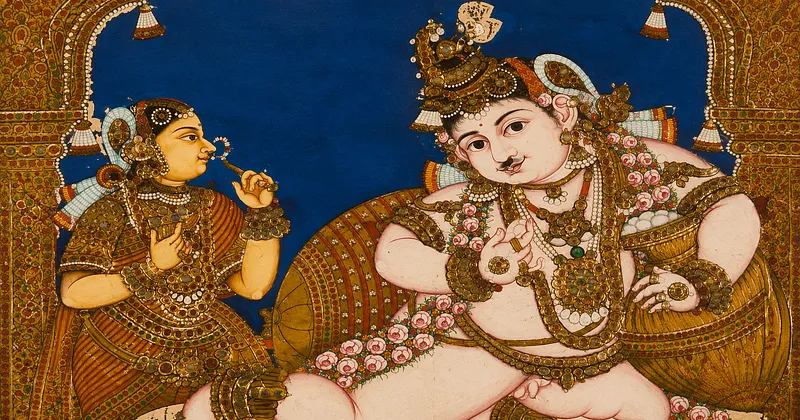
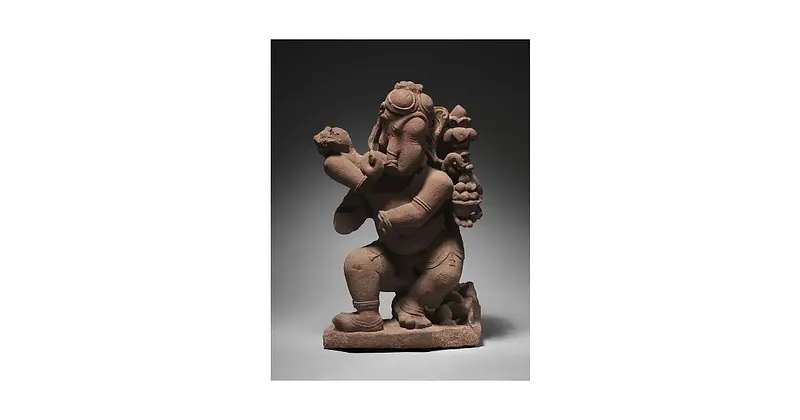
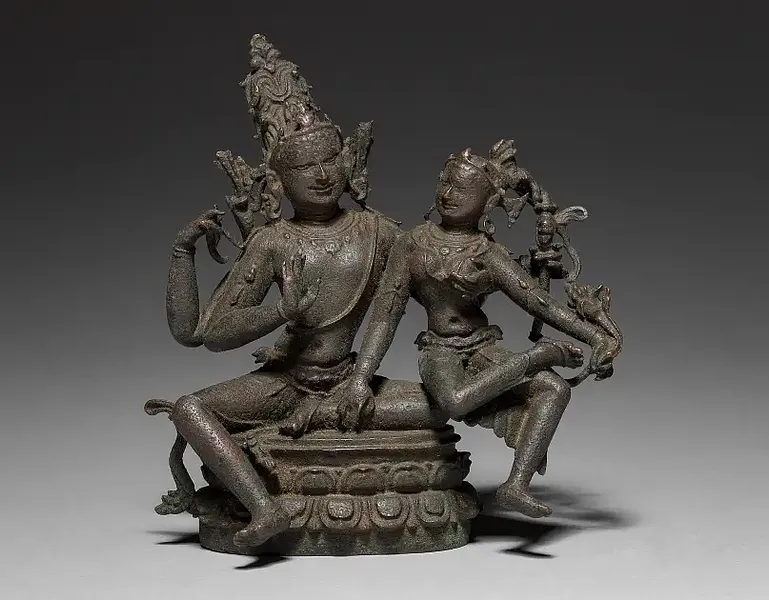
The sculptural program of the temple complements and enhances this architectural symbolism. Indian sculpture is not mimetic as in the Western sense; it does not seek to replicate the phenomenal world but rather to render visible the invisible, to embody metaphysical archetypes in forms that suggest their true essence. As Śrī Aurobindo writes, “The divine self in us is its theme, the body made a form of the soul is its idea and its secret.” The myriad images that populate the temple space— deities, mythological episodes, cosmological diagrams, and esoteric symbols—are to be understood not as idols but as hypostases of the divine.
Every aspect of the sculptural form is meticulously codified to convey specific psychological and spiritual significance. The postures (āsana), gestures (mudrā), and bodily attitudes (bhaṅga) of the figures are not merely aesthetic embellishments but are integral to the work’s symbolic language. Kapila Vatsyayan insists that when it comes to sculpture, “everything in the figure—face, hands, limbs, postures… has been analyzed with the object of correlating each physical gesture with an inner meaning.” Sculpture, in this context, becomes a semiotic system wherein each morphological detail functions as a signifier of transcendental states. This semiotic logic parallels the structures of classical Indian music and dance, wherein formal elements are orchestrated to evoke rasa and induce a corresponding state of consciousness in the audience.
Underlying this symbolic system is a complex and rigorous framework of proportion and measurement. The systems of tāla (modular proportion), aṅgula (unit length), and sūtra (central axis), as well as the classifications of sculptural types into sātvika, rajasika, and tamasika, reflect a highly evolved theory of form. These proportions are not merely mathematical but are symbolically charged, embodying emotional and spiritual resonances. Vatsyayan further writes that “When the Śilpasūtra discusses the exact points from which the brahmasūtra has to be drawn in any particular pose and the exact distance of each limb or part of the human figure from this line, it is fully conscious of the corresponding emotion which these deflections and poss will arouse: thus the samabhaṅga is the pose of perfect poise and balance, the weight and mass of the body being equally divided and the right and left halves of the figure being placed in symmetrical positions.” Just as the rāga in Indian music organizes tonal relationships to elicit specific moods, so too does the sculptor combine formal elements to generate visual configurations of rasa.
Crucially, the image in Hindu religious practice is not an endpoint but a medium. The act of gazing upon a mūrti is not mere observation but a contemplative discipline akin to meditative visualization. The process of temple construction itself is imbued with ritual and symbolic significance. The selection of the site, the orientation of the structure, and the ceremonial act of laying the foundation stone are all acts that replicate and reaffirm cosmic order — the mythological narrative of creation being ritually re-enacted in the ritual acts.
The sculptor follows a precise system of proportions to depict different types of figures, whether gods, humans, or mythic beings. The relationships of measurements to axes (sutra) determine the symbolic and emotional expressiveness of each image. The smallest anatomical detail—the shape of the nostrils, the breadth of the navel, the position of the feet—is significant and deliberately worked out to support the total pose or attitude.
The Hindu temple represents the apogee of Indian aesthetic, spiritual, and philosophical expression. It is a holistic artifact that integrates form and meaning, symbol and structure, experience and transcendence. Through its architecture, iconography, and ritual function, it serves as both a mirror and a map—reflecting the structure of the cosmos and guiding the seeker toward the realization of the Absolute. It embodies the profound Indian conviction that beauty is not merely ornamental but ontological; that form, when rightly apprehended, can reveal the formless; and that through disciplined engagement with sacred art, the human soul may glimpse, however briefly, the eternal. In this way, the Hindu temple fulfills its highest function—not merely to house the divine, but to disclose it.
If the measurement of the Temple is in every way perfect, there will be perfection in the universe as well. Mayamata, XXII. 93
Indian architecture, and the Hindu temple in particular, articulates the philosophical axiom of unity within multiplicity. The profusion of sculptural detail, the labyrinthine complexity of form, and the multiplicity of shrines and images are not ornamental excess but are, in fact, deliberate articulations of a metaphysical unity that underlies and transcends all differentiation. Indian architecture, through its crowded mass of sculpture and ornament, its abundance of design, and its immensity, represents the unity underlying multiplicity. Every detail must return to that unity and further its significance. Otherwise, it has not fulfilled its purpose.
Hindu architecture proves most powerfully that all art reposes on some unity and all its details… must go back to that unity and further its significance; otherwise it is not art and has not fulfilled its function.
Architecture, more specifically the temple, represents heaven on earth and arouses the rasa of adbhuta, or wonder. It is a visual and spatial experience that leads to aesthetic realization. Indian architecture, especially temple architecture, is not a matter of utility or form alone. It springs from a deep spiritual realization of the infinite divine. Śrī Aurobindo aptly states, *The divine self in us is its theme, the body made a form of the soul is its idea and its secret.*
The artist, according to this tradition, is not concerned with subjective self-expression but rather, his task is to intuit the Divine Self and recreate it through symbols of line, form, and rhythm. In this process, the artist is likened to a worshipper who has seen the Godhead and seeks to convey his realization through the technique of his craft. He must first conquer all personal suffering and attain a state of calm, hṛdayaviśrānti, before he can express anything through art.
Artistic creation begins only when this state is achieved, and it is aimed not at representing ideas or conflict, but at evoking pure joy, ananda. The aesthetic experience is thus second only to the supreme experience and is called its twin brother—brahmānandasahodara.
References
- Eliade, M. (1961). The sacred and the profane: the nature of religion. Harper & Row.
- Kramrisch, Stella. The Hindu Temple, Volume 1. Delhi: Motilal Banarsidass, 1946.
- Vatsyayan, Kapila. Classical Indian Dance in Literature and the Arts. New Delhi: Sangeet Natak Akademi, 1968.