When Part 1 of this series, ‘Was Karṇa rejected by Drona?’ was published, I had people in my groups and on social media asking about a particular statement in the post:
“But Karṇa had an unfair advantage. He was the son of the Aṅga royal, Adhiratha…”
One of the foundational beliefs of the Karṇa -as-tragic-hero notion is that he was discriminated against because of his ‘caste’. The term ‘Sūta’ itself is much misunderstood and much maligned, as is the concept of varṇa. This article is about this much-discussed but oft-misunderstood varṇa.
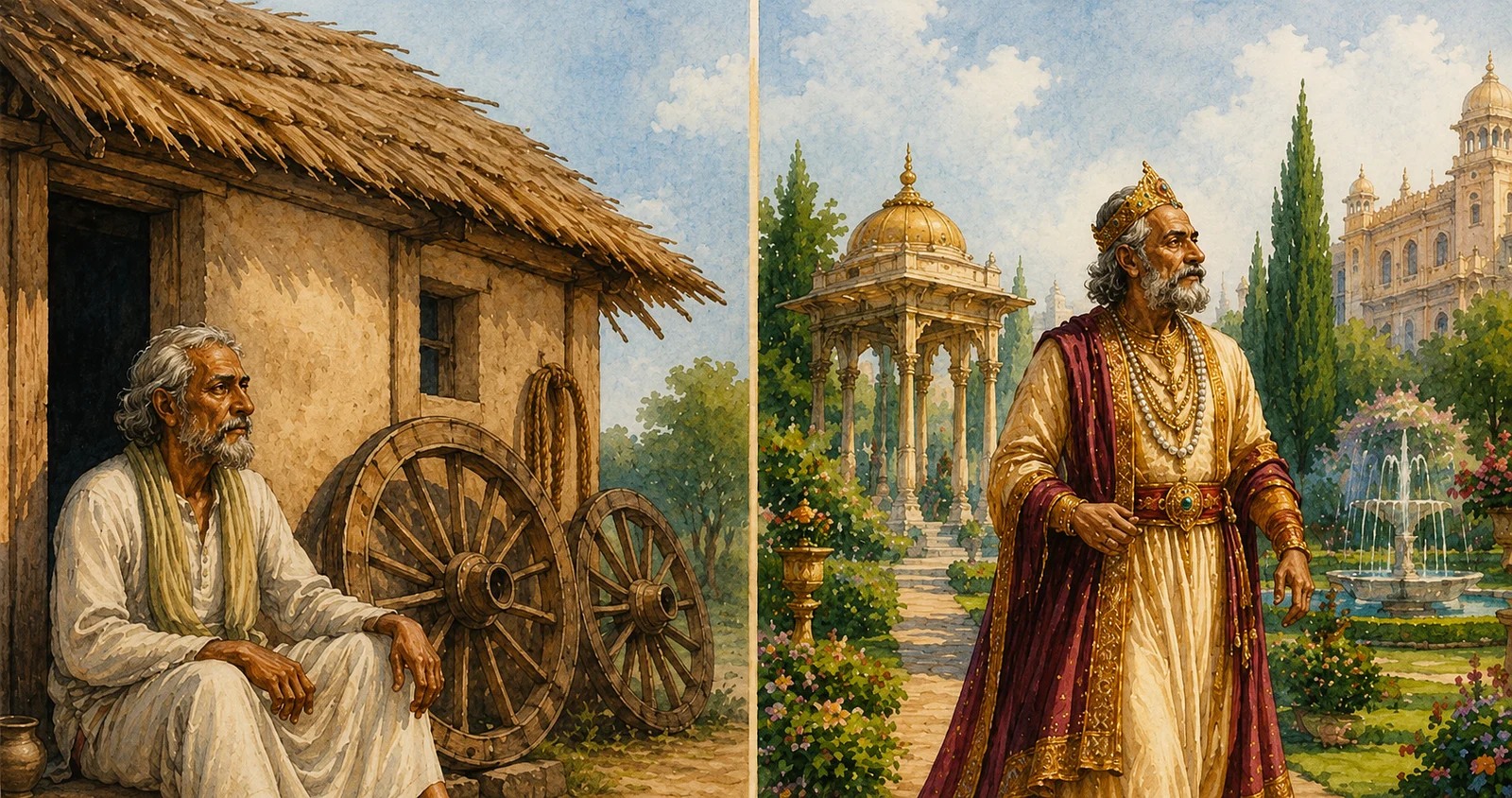
But first, let’s talk about the statement that Karṇa was an Aṅga ROYAL. Or rather, his foster father, Adhiratha, came from the kingly lineage of Aṅga.
Let’s rewind the clock a little and go back several generations in the lineage of Adhiratha. Trace his ancestry, and a very interesting fact comes up. The Pāṇḍava/ Kauravas, the Yādavas, and Adhiratha all share a forefather, Yayāti.
Yayāti is the famous Candravaṃśī king who was cursed with a sudden onset of old age by his father-in-law, Śukrācārya. He exchanged his old age with his youngest son, Pūru, become young once more, lived many years in happiness before realizing that it was an exercise in futility to chase after physical joys.
King Yayāti was the origin point of many of the prominent clans that make an appearance in the Mahābhārata. Here’s a pictorial representation that should make it easy to trace these clans:

There’s more to this than just the fact that the Pāṇḍavas and Adhiratha came from the same kingly line. We have Adhiratha’s entire lineage clearly laid out in many texts, showing that he was a royal, which made his adopted eldest child, Karṇa, an Aṅga royal as well.
For example, the Bhāgavata Purāṇa gives us this description of the lineage from Yayāti to Adhiratha:
 Take a look at line 3, name 2. Aṅga. The kingdom was named after this particular member of the royal family.
In the Viṣṇu Purāṇa, after the recounting of Karṇa ’s lineage, the descendants are described as the ‘Aṅga kings’. In the Vāyu Purāṇa too, Karṇa is described as a ‘member of the family of kings of Aṅga’ and also the son of a charioteer.
Remember that warrior princes were trained to be charioteers as well. That’s precisely why:
-
Arjuna did not bat an eyelid before volunteering for the role when Uttarkumāra needed a charioteer at Matsya
-
Uttarkumāra himself easily switched places with “Bṛhannalā” when Arjuna decided to do the fighting instead of the prince
-
Kṛṣṇa so easily and seamlessly slipped into the role of Pārtha-Sārathi
-
Even the prideful Śalya took the reins of Karṇa’s chariot and excelled at that role
Abhimanyu is admired as the ‘charioteer son of Subhadrā’ in the Harivaṃśa. In the Mārkaṇḍeya Samasyā Parva of the Mahābhārata, Kṛṣṇa describes to Draupadī how her boys are being trained at Dvārakā. He specifically says that Abhimanyu trains them in chariot driving and in handling the horses, along with the use of astra-śastra.
Let me put this simply: Being a charioteer did NOT preclude being a royal at all.
Adhiratha was a charioteer as well as an Aṅga royal.
Let’s clarify yet another oft-misunderstood fact.
Who is a Sūta?
When a Kṣatriya man married a Brāhmaṇa woman, their progeny was Sūta. We do have a mention in one of the purāṇas of a mixed varṇa marriage, a few generations before Adhiratha. Perhaps that is how a Kṣatriya family line had Sūta descendants.
Do take a close look at the Yayāti–Devayānī (kṣatriya man- brāhmaṇa woman) lineage, though—you will find some interesting clans listed there!
Coming back to the Sūta question, here are the other famous Sūtas who feature in the Mahābhārata:
The itihāsa opens with a Sūta paurāṇika who is, in fact, called Sauti. His name is Ugraśrava, and he is the person who narrates the entire tale to the sages at Naimiṣāraṇya. He is addressed as Sauti with great respect by revered sages like Śaunaka, and given an exalted seat as their paurāṇika.
In the Bhāgavata Purāṇa, we see that his father Sūta Romaharṣaṇa was seated at a higher level than the sages, as he was their paurāṇika and thus deserving of that position.
Sūtas were famed storytellers who held the sacred responsibility of carrying legends with their inner dhārmika teachings across the land. Sūtas were also, as we know, very skilled charioteers.
BUT, Sūtas also held positions of power, and we see examples in the Mahābhārata even apart from Adhiratha and his clan.
-
Kīcaka, commander of the forces of Matsya—the most powerful man in Matsya. So powerful that King Virāṭa did not dare question him
-
His sister Sudeṣṇā, the queen of Matsya, whose daughter was married to Abhimanyu
-
Sañjaya, Dhṛtarāṣṭra’s closest confidante and the man who nonchalantly and with impunity took the king to task for all his adhārmika decisions
So we see Sūta bards, Sūta charioteers, Sūta commanders, Sūta kings and queens too—all in one single itihāsa.
Let me anticipate the next question.
Was the address ‘Sūta/Sūtaputra’ derogatory?
Let’s start with a few verses from the Mahābhārata where Karṇa is addressed as Sūta/Son of Sūta (all excerpts from Gita Press Mahabharata):
1)

‘Sūta-nandan (son of Sūta)! Having seen Yudishtira’s Rajasuya, I too wish…’
Can you guess who the speaker is here who addresses Karṇa as ‘Son of Sūta’ so casually? Who is this person who uses this ‘derogatory’ term?
It is no Pāṇḍava, not Kuntī, no ally of Pāṇḍavas either.
It is Duryodhana, the best friend of Karṇa. The prince who believed Karṇa to be his closest confidante and trusted him with his life, literally.
Duryodhana was certainly not the only one to address Karṇa as Sūta or Sūta putra.
Here are a few other verses from the text where Karṇa’s Sūta background is highlighted or he is addressed as Sūta or son of Sūta:
2)
‘… Radhanandan Sutaputra Karna, Maharathi Kripacharya, myself with my brothers, and Raja Bhurisrava…’ – Speaker: Śakuni about Karṇa
3) 
’Karṇa, you are most intelligent, knower of astra -sastra and the one who brings joy to Suta-kula…’- Speaker: Dhṛtarāṣṭra addressing Karṇa
4) 
‘… Sutaputra Karna and Arjuna both delightedly, in that battle, wounded each other with arrows decorated with colourful feathers…’- Speaker: Sañjaya, Sūta himself, about Karṇa
5)
‘…The famed Sutaputra Karna saw the Agneyastra and to appease it, use the Varunaastra…’- Speaker: Sañjaya, a Sūta himself, praising Karṇa ’s prowess.
6)
‘Wounded by the Sutaputra, Mahabahu Bheemasena stood unmoved like a mountain…’- Speaker: Sañjaya, a Sūta himself, addressing Karṇa as Sūta-putra .
7) In fact, the Sūta Sañjaya refers to Karṇa as Sūta-putra over and over again, and you can see how the terms Adhiratha-putra and Sūta-putra are used by him almost interchangeably.


This begs the question: Would a Sūta describe another with a term that was used to insult, humiliate, or demean them? Obviously not, which leads to the conclusion that the terms Sūta or Sūtaputra were simply used as epithets, in a way.
Other Sūtas were also addressed in this way. Here is Dhṛtarāṣṭra talking to the Sūta Sañjaya:

Here is Vaiśampāyana Mahārṣi addressing Sañjaya as Sūtaputra:

The terms Sūta or Sūtaputra were NOT used as taunts or to humiliate a person.
BUT did the Pāṇḍavas use it with that connotation?
Did the Pāṇḍavas believe that Sūtas were ‘inferior’ in some way?
That’s not true either. Uttarā was the daughter of a Sūta queen Sudeṣṇā. The Pāṇḍavas gladly had her married to their beloved Abhimanyu. Parīkṣit, the chosen heir of the Pāṇḍavas, was the grandson of Sūta queen Sudeṣṇā. Don’t forget that Yuyutsu, son of a Vaiśya maid, became a mentor-figure to Parīkṣit or that Vidura, son of a Śūdra woman, was highly respected and loved by the Pāṇḍavas.
Given all these facts, is there enough foundation to believe that Sūtas were oppressed in general, and also specifically by the Pāṇḍavas? Or that the terms ‘Sūta’ or ‘Sūtaputra’ were used as taunts?
I leave it to you to decide.
Jai Śrī Kṛṣṇa.
Note: The excerpts are taken from the Geeta Press version to show the exact shlokas.

.png)
.png)
.png)