Any discussion about the Mahābhārata inevitably veers around to the debate about how some key characters were unfairly treated. Karṇa is the subject of a startlingly large number of such debates. Arguments about oppression or unfair treatment meted out to him or plain discrimination against him are plenty, and this is problematic. That’s because they form a foundation for many conclusions being drawn about how ancient Indian society treated people from different walks of life; conclusions that are based on MYTHS.
Karṇa oppression tales often become ‘proof’ of Varṇa-based ‘caste’ discrimination practiced in those ancient times. This article is not going to dive deep into the Varṇa vs caste difference or talk about the intricacies of Varṇa itself. What this article WILL do is dismantle common fallacies around Karṇa that ground many of these caste- based oppression theories.
However, there are so many myths around Karṇa that one article cannot possibly cover them, which is why this is Part 1 of a series.
So let’s begin with a very popular notion:
Karṇa was Rejected by Droṇa
Well, he was not.
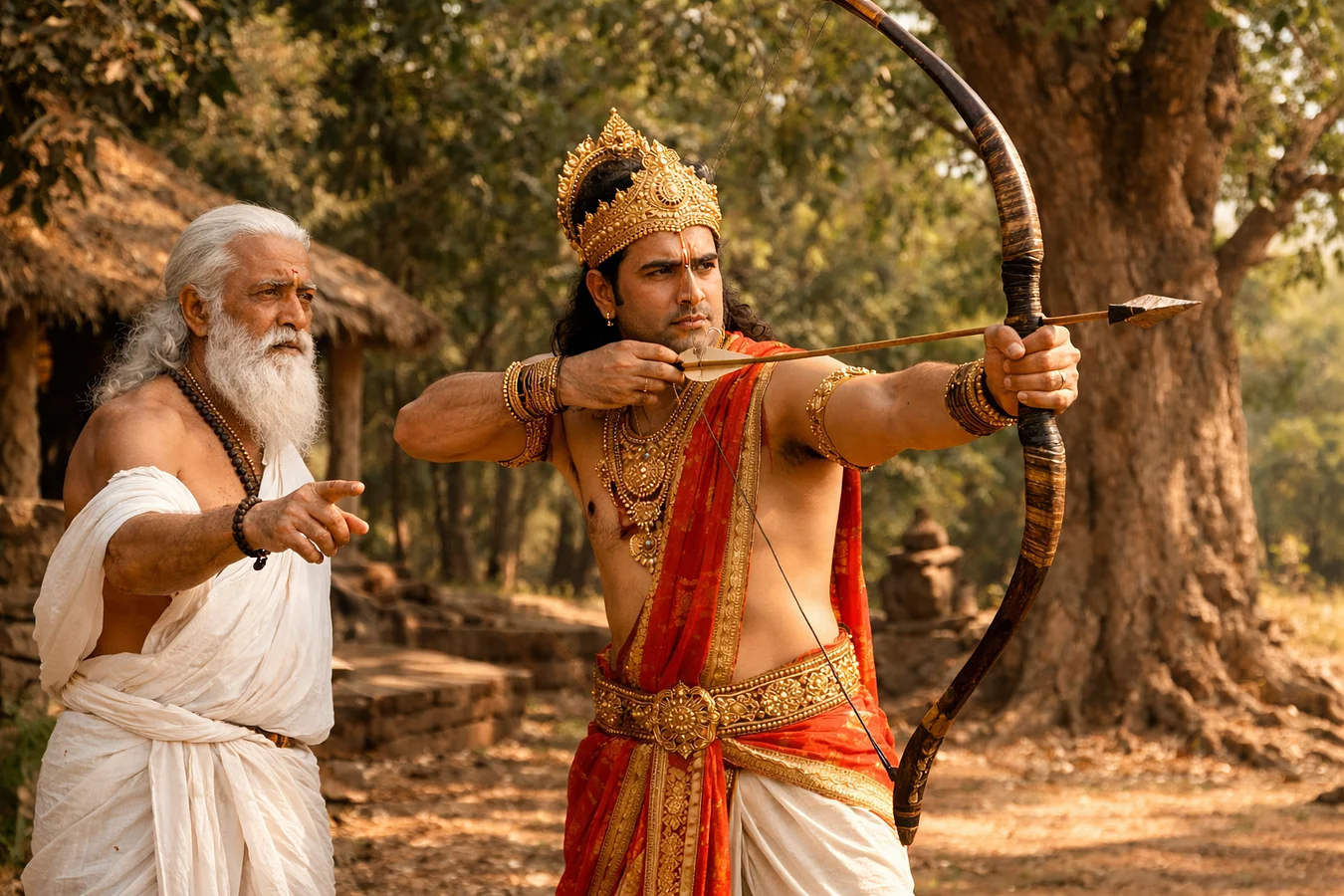
Karṇa WAS Droṇa-śiṣya. He was a student of Droṇa and Kṛpa at the gurukula built by Bhīṣma for training the princes of Hastināpura.
In fact, it was during their stint in Droṇa gurukula that Karṇa and Duryodhana’s friendship grew deep and strong. They bonded over a common feeling- a strong dislike for the Pāṇḍavas. In the Mahābhārata, we find several references to Karṇa being Droṇa-śiṣya.
Mention 1:
As the text goes:
“There, he (Karna) went to Drona to learn about weapons. The brave one became Duryodhana’s friend. Having obtained the four kinds of weapons from Drona, Kripa and (Parasu)Rama, he became famous in the world as a great archer. Having allied himself with Dhritarashtra’s son, he was engaged in enmity towards the Parthas. He always desired to fight with the great-souled Phalguṇa.” (Excerpt from the Kundala Harana Parva- BORI CE English translation[1])
Note the mention that he was friends with Duryodhana at the Droṇa gurukula. In fact, it was here that the friendship grew deep, thanks to a common dislike of the Pāṇḍavas.
Mention 2:
Much earlier, in Sambhava Parva, we get another mention of Karṇa as Droṇa-śiṣya and also a glimpse of WHY Karṇa had such dislike for Arjuna, who was around a couple of decades younger than him.
“The Suta’s son was envious of Partha and always competed with him. With Duryodhana’s support, he showed his contempt for the Pandavas.” (Excerpt from Sambhava Parva- BORI CE English translation)
In fact, Karṇa’s dislike of the Pāṇḍavas was so strong that he participated in assassination attempts on them along with Duryodhana and Śakuni.
“Though the poison was extremely virulent and was meant to kill Bhima, Bhima digested and tolerated it. Then Duryodhana, Karna and Subala’s son Shakuni tried many other means to kill the Pandavas. However, the Pandavas, scorchers of their enemies, got to know about all of these.” (Excerpt from Sambhava Parva- BORI CE English translation)
Mention 3:
This mention of Karṇa being Droṇa-śiṣya comes straight from the horse’s mouth, as it were. Here, Karṇa is reassuring Sūrya deva, who has come to caution him that Indra shall come soon to ask for the Kavaca Kuṇḍala. Karṇa mentions that he is Droṇa’s student as well as Paraśurāma’s.
“Concerning Arjuna and me, I will vanquish Arjuna in battle. O god! You know about the great strength of weapons I have obtained from Jamadagni’s son (Parasurama) and from
the great-souled Drona.” (Excerpt from Kundala-aharana Parva- BORI CE English translation)
But did Droṇa only teach Hastināpura’s princes?!
A common misunderstanding is that Droṇa was ‘hired’ exclusively for the princes of Hastināpura. Bhīṣma did ask Droṇa to train the princes, and it was for this express purpose that a place was built by him to house the acārya and the students. However, the gurukula was not only for the Kuru clan princes.
As we have seen, it was evidently open to Karṇa. But Karṇa had an unfair advantage. He was the son of the Aṅga royal, Adiratha, who was a good friend of Dhṛtarāṣṭra’s. He was sent to Hastināpura by his father to gain higher education, and it is not surprising that, given the connection, he got access to the premium gurukula. But what about others? Did Droṇa teach any others, too?
YES. It was not ONLY Hastināpura’s princes (and Karṇa) who trained at the Droṇa gurukula. Dhṛṣṭadyumna and Sātyaki were notable Droṇa students too. In fact, students from across Bhāratavarṣa came to Droṇa gurukula, thanks to Arjuna being such a prodigy that people wanted to train where he had trained. Much like a modern-day JEE or NEET academy, parents want to enrol their boys in a gurukula that has an ‘AIR 1’ ranker or ‘topper’ among its students!
“Other princes also came to Drona, supreme among Brahmanas, to learn the use of arms the Vrishnis, the Andhakas, kings from many countries and Radheya, the son of the Suta. They made Drona their preceptor. The Suta’s son was envious of Partha and always competed with him.” (Excerpt from Sambhava Parva- BORI CE English translation)
So, why was Ekalavya rejected then?
The next question, logically, would be about Ekalavya. Did Droṇa reject him, or was he too a student of Droṇa’s like Karṇa?
No, Ekalavya WAS rejected by Droṇa, but the reason is not quite what is popularized. In fact, the story of Ekalavya that is popularly known has several crucial missing facts that add significant context to the events that unfolded between Droṇa and Ekalavya. But that is a topic for a different post because there are several myths about Ekalavya, too, that must be dismantled. (Here is a link to my paid podcast on Ekalavya’s story beyond the Mahabharatha.)
For now, I leave you with the fact that Karṇa was NEVER rejected by Droṇa.
With this one simple truth, the whole narrative of how a brāhmaṇa, Droṇa, discriminated against the Sūta Karṇa, falls to pieces instantly. So the next time someone uses this argument to speak of ‘caste discrimination’ in ancient Indian society, do correct them and acquaint them with the TRUE Mahābhārata.
Jaya Śrī Kṛṣṇa
References
1) The BORI CE stands for the Bhandarkar Oriental Research Centre’s Critical Edition of the Mahābhārata. The excerpts are from the English translation of the same by Shri Bibek Debroy.
.png)