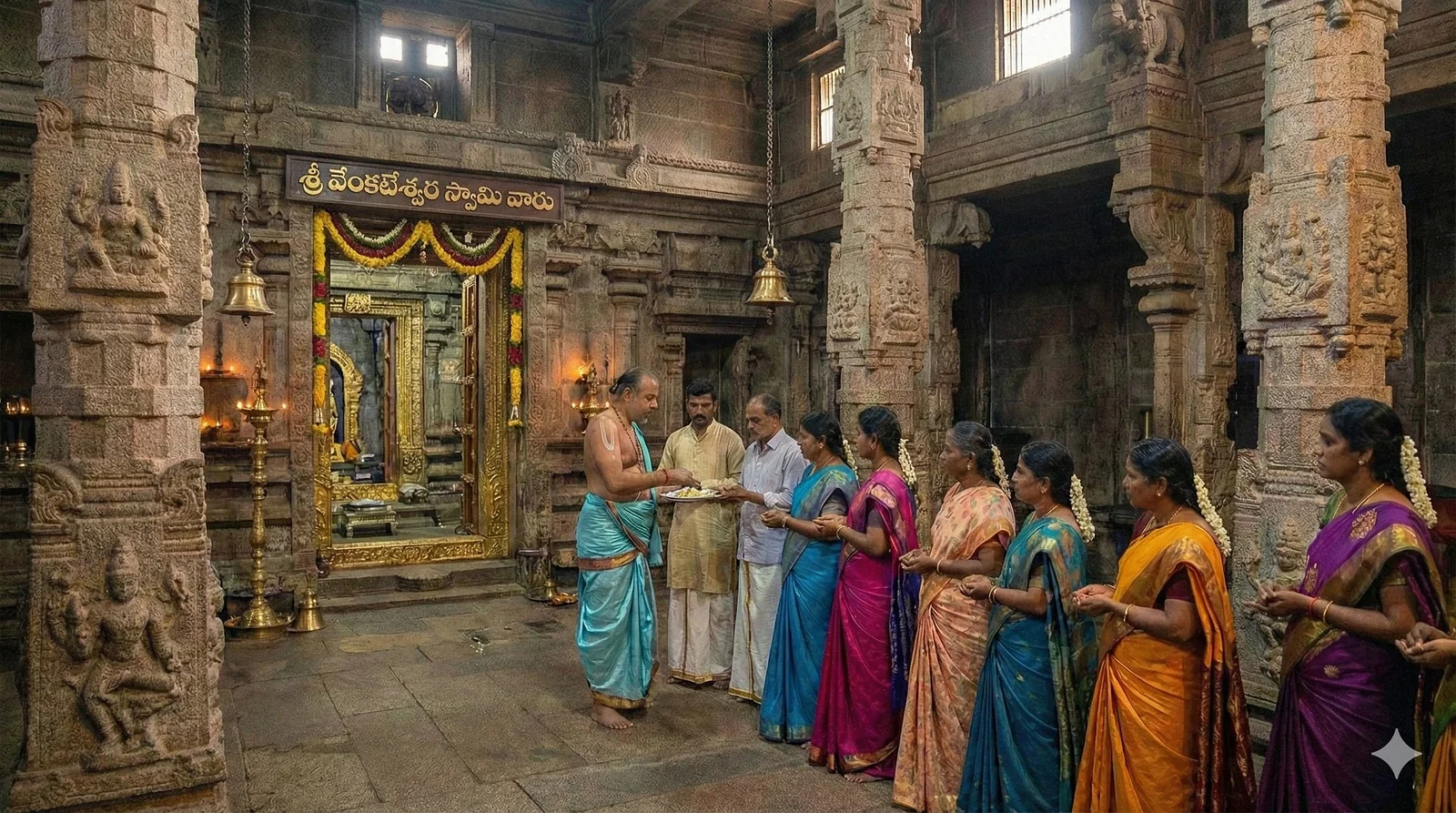
There is a popular adage in Telugu that roughly translates to the lamentation: “Even if Bhagavān granted my wish, the arcaka (priest) did not.” The saying, which is used to bemoan the interference of a middleman in obtaining or achieving something, points to the cultural centrality of the arcaka in the Hindu context. Any visitor to a Hindu temple almost inevitably interacts with the arcaka when they come to have darśanam of the mūrti, even if that interaction is as perfunctory as simply taking the ritually sanctified tīrtha and prasāda from him. The arcaka is a mediator of sorts between Bhagavān and the devotees that come to see Him. In most South Indian temples, in particular, where devotees are not permitted to enter the garbhālaya (sanctum sanctorum) or touch the deity, the arcaka conveys devotees’ offerings to the deity and performs arcana on their behalf and in their name.
Halley Kalyan, an India-based writer and commentator on tradition, Hinduism, and Indian society, recently highlighted one such interaction between arcaka and devotee through an X post. While Kalyan was visiting a temple, he witnessed a devotee being rebuked by the arcaka, who “was visibly upset when a devotee mistakenly touched the vessel and spoon used to serve tīrtham.” The arcaka told the devotee, “You people consume alcohol and meat. You don't follow any śaucam rules. You are not supposed to touch this tīrtham vessel. You need to be careful when you are here. Don't do this next time.’
Reflecting on the episode, Kalyan identified the arcaka’s behavior as discriminatory but identified the discrimination as one predicated upon śauca, or ritual purity. The arcaka, by virtue of the spiritual rules he followed, the attire he was wearing, and the cleanliness that he was practicing during the time he was serving the deity, was imbued with the requisite śauca to enter the inner sanctum, serve the deity, and touch the tīrtha vessel. The devotee, to the contrary, did not possess these attributes. There was no need to change this existing model, which plays out in a spiritual context, Kalyan argued.
Responding to Kalyan’s X post, author and speaker Sahana Singh argued that the arcaka should have refrained from “speak[ing] rudely like this to someone who genuinely made a mistake without knowing.” Such conduct on the arcaka’s part, Singh apprehended, would deter the devotee in question from visiting the temple again. Though she acknowledged the primacy of śauca in a ritual space, Singh underscored the fact that “being kind and compassionate is even more important.” In Singh’s view, “pujaris [need] to be kind and have the ability to respond gently to mistakes” so as to avoid driving away devotees with genuine bhakti from the Hindu fold because they had negative experiences with arcakas at temples.
Commenting on Singh’s critique, X user Pranav Surampudi argued that “[t]he substance of rules is what matters not the tone or attitude of the one [who] point[s] it out.” In other words, adherence to śauca in a ritual environment trumps the assuagement of devotees’ feelings, “niceties” be damned. Surampudi also adds that bhakti that is contingent on a “good experience” is not true bhakti at all.
So what are we to make of all of this? And why does it matter in any case? Perhaps the second question is easier to answer than the first. Visiting temples and worshipping the deity is an integral part of most Hindus’ spiritual practice, and in that course, interactions with arcakas are inevitable. As Singh notes, these interactions can define the devotee’s experience at the temple and whether they want to return. And, certainly, devotees continuing to visit temples large and small is key to keeping them anchored in their dharma, and by extension, sustaining dharma as a whole.
Of course, for Surampudi, the idea of a “good experience” at a temple is itself irrelevant, perhaps even scandalous. You aren’t at an amusement park or a restaurant, he would argue; the point is not for you to be, per se, entertained. By extension, the idea of “customer service” is inapplicable at a temple, in that the arcaka is not there to kowtow to the devotees’ whims and caprices. He is there to serve the deity.
Here, a fundamental point emerges. The arcaka and the devotee are, or at least should be, motivated by the same purpose and objective: to serve and venerate the deity to the best of their ability. The way in which each does this differs. While the arcaka personally renders service to the deity and can enter the inner sanctum, the devotees offer their sincere prayers from outside the garbhālaya. The undercurrent of bhakti that characterizes the actions of both arcaka and devotee should, then, fundamentally be the same. The arcaka and devotee have different but complementary roles in the temple ecosystem, each of which is vitally important. When both arcaka and devotee share this underlying understanding, resolving the impasse detailed above becomes significantly easier.
The devotee is often filled with devotional ardor that motivates their actions. At many major shrines, devotees travel hundreds of kilometers because they feel some strong attachment to the deity and believe that He will alleviate their difficulties or bestow upon them things that they wish for. In the Bhagavad Gītā, Śrī Kṛṣṇa delineates four kinds of devotees; the vast majority of devotees fall into the first two categories, namely ārtas (those afflicted by something) or arthārthīs (those desirous of something). The intensity of their desires from the Divine is reflected in the fact that they want to be as close to Him as possible. Bhagavān is mine, they think: my protector, my mother, my father, my everything. I have come to Him for what I seek. It is in this devotional ardor that devotees may overlook things like maintaining śauca by not touching the tīrtha vessel. Or perhaps the devotee may not even be aware of the fact that they should not touch the tīrtha vessel.
But are they obligated to educate themselves about śauca and to be cognizant of it when visiting a temple? Absolutely. To do so is a true offering to the deity, for by abiding by śauca, the ritual purity of the temple is preserved, and the deity is pleased. As a case in point, the entire controversy surrounding women’s entry into the Sabarimala temple in Kerala turned on the wishes of the deity Himself as a naiṣṭhika brahmacārī, a life-long celibate. The great offering that a devotee can offer the deity is to accede to His wishes. To think about the appropriate ritual framework for worshipping the deity in addition to one’s own desires is, in and of itself, a form of Vedāntic discovery and spiritual advancement, because it represents the transcendence of aham (“me”) and mama (“my”). It requires the devotee to acknowledge that the temple visit is not simply a transaction: I visit the deity, offer something to Him, and get what I want in return, with the arcaka merely being a facilitator of that transaction. There is something deeper and loftier that characterizes the relationship between Bhagavān and the devotee. Such a transformation in thinking could well put devotees on their way to ascend to the two higher tiers of devotees that Śrī Kṛṣṇa mentions in the Gītā, namely jijñāsus (seekers of Truth) and jñānīs (those who have attained realization).
Let us turn briefly, now, to the arcaka. Certainly, his duty is first and foremost to the deity and not to coddling devotees’ sentiments. Devotees must also understand that, in many temples, the arcakas’ situation is less than ideal. Though they are, in many cases, connected to the temple through their family, who have been serving the deity for generations, they receive rather paltry wages. They must often work under the direction of an Executive Officer, a secular government official employed by the state Endowments Department who may know little about the temple and its traditions. Despite all of this, most arcakas stand as vigilant sentinels, protecting and serving the deity against all odds. The devotees must understand that what seems like a chastisement by the arcaka may well only be his impassioned attempt to safeguard the sanctity of his beloved deity.
This is not to say that the conduct of every arcaka at every temple is beyond reproach. It is for the arcaka, too, to remember that they are in a position of great privilege to be able to serve the deity in a manner that few others can, and thus to act in a manner that befits this status. Though the devotees may not scrupulously adhere to śauca, the bhakti that motivates them is the same as that which the arcaka is driven by. And thus, a bit of compassion can go a long way. After all, are devotees, however imperfect they are, not also dear to the very deity that the arcaka so devotedly serves?
It is a relationship characterized by mutual respect and by mutual devotion to the deity, who stands silently, always watching, that must characterize the bond between arcaka and devotee at the many hallowed shrines in Bhārata and beyond.


.png)
.png)