.png)
It has been over two and a half decades since I was in grad school, but I still remember the title of a book we had to read as part of a course. It was called Singing the Land, Signing the Land, and its contents were mind-altering at that point in my life. In it, the author Helen Watson explores the divergence between European and Aboriginal ways of viewing the land and our relationship with it. She describes at length the idea of dream-time and the walkabouts undertaken by Aboriginal people. As they walk, they sing the landscape into life, remembering how it was shaped in a mythic time when the Gods first walked the Earth. On those ancient trails, they encounter the actual places and natural formations (rocks, trees, water bodies) that the songs are referring to, thus real-izing the dream in the present. In such a worldview, the person’s self-perception is moulded fundamentally by the fact that he/she is a participant in a divine opera, and his/her work in this world is the remembrance of the scene in all its existing perfection. This is a radically different view from how the post-Enlightenment European mind sees the human subject in “nature”. In the European view, the human subject is separate from both geography and history. History is to be studied and ‘made’ rather than relived or renewed, and geography is to be controlled rather than revered. Of course, being a westernized Indian, I had unconsciously absorbed a lot of that point of view by the time I was in college (though, as modern Indians, we remain largely schizophrenic in relation to such matters).
Another anecdote comes to mind. A couple of years after I’d returned to India and settled in Auroville, I was driving past a village (I’m not sure which one, though I’m guessing it was Alankuppam), when I saw a large gathering crowded around a bed of burning coals. One by one, men, women, and children ran across the glowing coals on bare feet with cries of Arogara! and Govinda Govinda!. Today, this sort of event is an ordinary part of my life, but I remember my astonishment back then, which was made more apparent later that evening, during a conversation with a resident European woman who, too, had purely by chance witnessed the fire-walking ceremony. She mentioned how bewildered she felt that day when she realized that in the twenty years she had lived in India, she had not once had any inkling that such incredible acts of tribal devotion were happening all around her every day. It felt, she said, like the India she imagined she knew over all those years might not actually exist at all!
These are the kinds of bubbles we tend to inhabit as modern people, but unlike that old lady, many of us are happy to use ready-made social judgements or academic labels to neatly package phenomena or experiences that are alien to us. We do this because it is easier to label than to engage. We get to maintain a comfortable academic distance while retreating into our self-appointed positions of imagined neutrality.
This is a problem because it is we (and others like us) who are writing the books, making the news, filming the movies and occupying teaching positions in schools and universities. In other words, it is we (the utterly ignorant) who end up standing as representatives of our people, thus forever perpetuating our westernized points of view. These get amplified and ultimately become “reality”. This is exactly what has happened in our country over the past seven decades. So much so that our unserious and unrooted worldviews are ultimately fed back to common folk via school textbooks, TV and social media. In the face of this ubiquitous propaganda, the still-rooted Indian, contrary to the grain of every bit of inherited wisdom he has received, begins to unconsciously, but voluntarily, uproot himself. My friend Aurelio, from Verite, put it best when he mentioned in passing during a conversation that – “…there is something going on here that we simply don’t understand, and every time we are arrogant enough to try to make an intervention, we only cause damage.”
Another time, when Bhaskar and I were building in Verite, there was some lafda with regard to building material. It appeared that Karthik had taken some material away from our building site. Bhaskar and I went to speak to him to try to get our material back. I, in keeping with my self-image as a rational, worldly-wise architect, went armed with some volume calculations – “See, we had these many cubic feet of sand, we paid for so many cft, now we only have these many, and you have that many, which means you need to return x amount of sand to us”.
But I never got to utter a word. Bhaskar and Karthik embarked on a meandering conversation about how their relatives knew each other, and for how long they had known each other, and about that time they had had breakfast together in that particular roadside eatery, etc., etc. I stood flabbergasted and watched this absolutely irrational performance from the sidelines. We could have our sand back in two minutes, I thought, if only I could lay out the arithmetic... but no. What it took to get our sand back without insult or anger or resentment was a twenty-minute-long conversation about everything but the sand. That was an early lesson I learnt about the lubrication that keeps the community alive in community-bound rural Tamil Nadu, a lubrication that is no doubt inefficient, but has at its heart a goal higher than mere efficiency. I learned that day that good outcomes were often more valuable than achieving immediate goals.
Anyway, what I’m trying to demonstrate here is that all the time that I thought I could see (maybe even going so far as to assume that I could see better than most), I had, in reality, been utterly blind… with a blindness that had been cultivated in me over decades of “education”. It has taken decades more for me to unlearn all of that certitude and to see again, or at the very least to maintain a patient non-judgementalism.
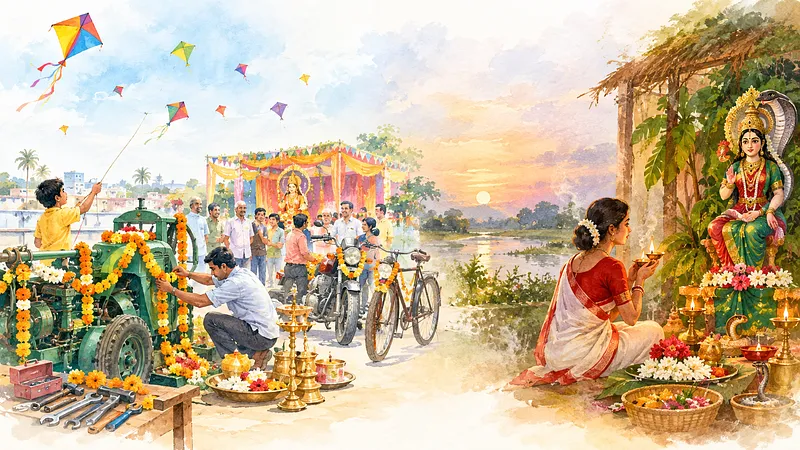
And so it was that after a series of such learnings, I started to look around me with fresh eyes. It was then that I began to see that the brilliance of the Aboriginal worldview that had shaken my then-existing certainties back in 2001 was not some exotic, tribal, Australian thing that I could romanticize because it was distant and ancient, but was in fact in full bloom even here in India, all around me in rural Tamil Nadu, where I lived. That worldview centered around a sacred geography was not an artifact of a distant or dead culture, but was an actual contemporary fact that stared me in the face via the lived everyday reality of the people we now counted as friends and neighbours.
A bit has been written in English about the sacred geography of India, focusing on the well-known tīrtha sthalas – Varanasi, Rameshwaram, Chaar Dhaam, Mathura, Pandharpur, Kamakhya, Ganga, Kaveri, Narmada – or specific to Tamil Nadu, the Aaru Padai Veedu of Murugan, the Paadalpetra Sthalams and Divya Deśas of Shaivism and Vaishnavism, etc. But very little has been written about how this macro sacred geography is built from the bottom up via the micro sacred geographies of every Indian village. The macro is reflected in the micro and vice versa in a remarkable and fecund fractal exchange.
Here, I plot out the geography of the village we live in with the sacred places marked. Many I have discovered only recently, so it may well be that there are more hidden spots that I am yet to discover. The trees, the embankments, the yeri, the kazhani, the settlements… all are sanctified by the presence of a deity specific to them. There may not be specific songs that describe the landscape as in the Aboriginal Dreamtime, but there are songs for the deities that list specific places, and the paths that connect the communities with these spaces are all paths that are traversed by the annual processions and the oorvalams of the deities, thus creating a literal map of sanctified routes and nodes. These routes and nodes merge into those of the next village and the next and then the next… creating a nation-wide tapestry of landscape made divine.
In this country, as long as we are alive to the possibility, we inhabit a mythic reality. We wake every day to walk in the footsteps of the Gods.
Till recently, I hear, people would go barefoot everywhere in Tiruvannamalai. The entire town was considered sacred. If we think about it, it is not as fantastic a phenomenon as it now appears. In every village, people walked (and continue to walk) barefoot. Footwear is a very recent phenomenon in rural India. The materialists among us will lay the blame on a low GDP, but I think there’s more to it than that. Of course, our imaginations of what life should be and how our relationships with the Earth ought to be are rapidly changing with cell phone towers and highways dramatically altering information, and people flows. Land is now a commodity. Water is now a resource. Trees are now ‘in the way’. And this new attitude can now only be managed by a giant centralized entity that zones land, supplies piped water and keeps track of GDP. There are now laws, and the bureaucrats, where once only self-conscious restraint and reverence reigned. A decentralized world, left alone, will, over a long enough period of time, develop a delicate web of inter-dependencies whose continued harmonic balance is contingent upon the willingness of people to uphold certain tacit trust-based agreements. These agreements ultimately carry weight because all parties are aware that they have been made within the boundaries of a sacred geography. The trees and rocks have ears, and even today, in the villages, we take our footwear off when we exchange promises or money. The Earth is our conscience, and our bare feet upon it our acknowledgement of that.
Big-Foot city slickers like me would do well to learn to tread lightly. It is better that we stand back and learn, rather than judge and rush to intervene. A fabric of enchantment has been woven over the land... only those who have been blessed to see it and are willing to learn to embroider are truly useful here.
An Extraordinary Map of an Ordinary Place

1. Gangaiamman - kaavaldeivam of abundance, from whom the garagams come and to whom the garagams return after they have visited (and blessed) every house during the annual thiruvizha.
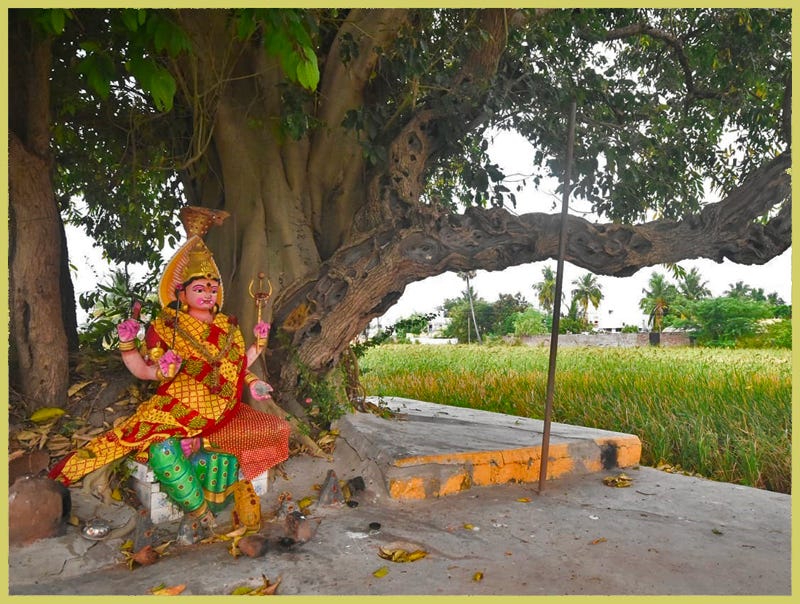
2. Vinayagar - our everyday deity of auspicious beginnings, seen in the hearts of settlements rather than the fringes. To borrow Tamil Sangam categorization, he sits firmly in a community’s Agam, rather than its Puram. His arrival within a community denotes a self-image of settlement rather than movement.
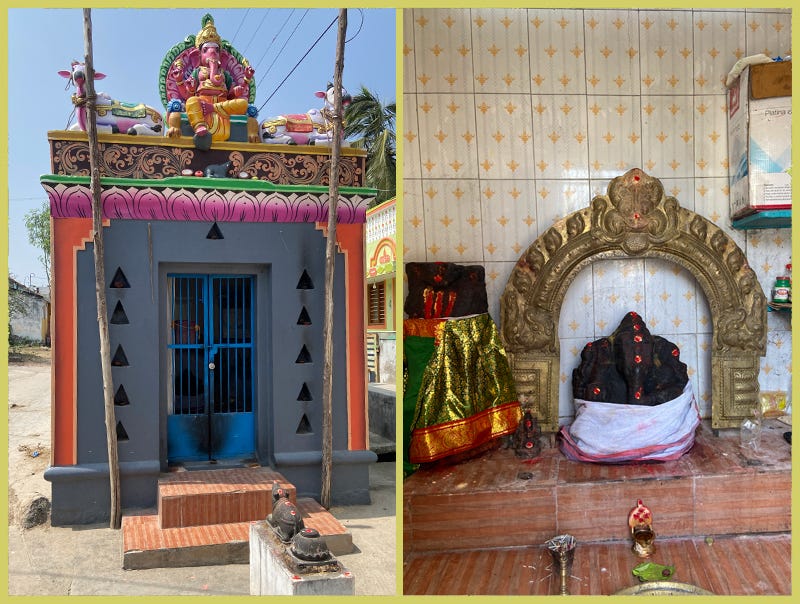
3. Mariamman - rain bringing grāma devatā to whom the consolidated koozhu of the community is brought for sanctification before redistribution.
Navagrahangal - the nine celestial houses in earthly form.
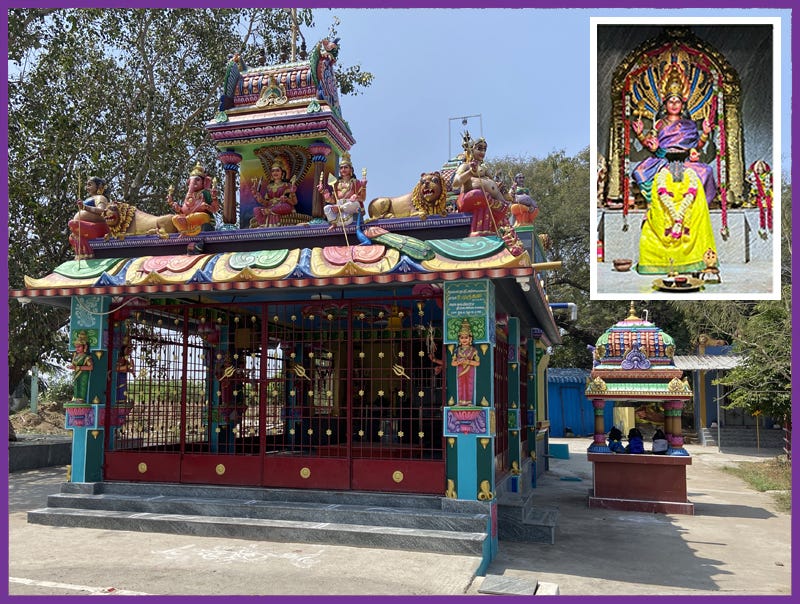
4. Parashaktiamman - the primordial cosmic feminine force that is the source of all creation, and to whom the women make their annual vows before the pilgrimage to Melmaruvathur.
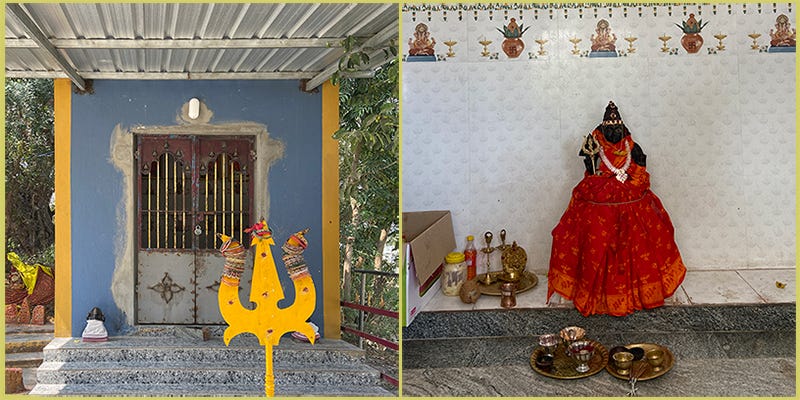
5. Naagamma - deity of fertility and protection, seen here as an aspect of Pārvatī Devi with her two sons flanking her - Gaṇeśa and Muruga.
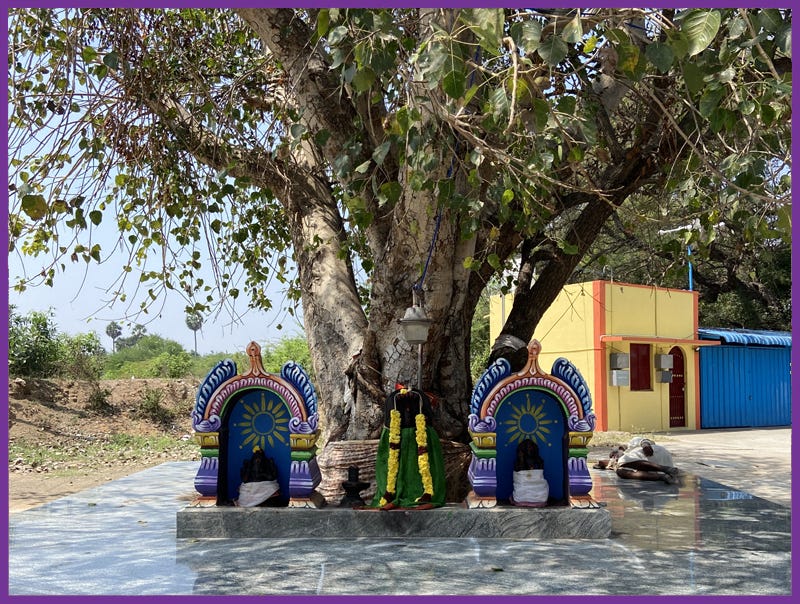
6. Pon Raayar - kaavaldeivam of the wild spaces, seen here in the thorny scrub north of the yeri.
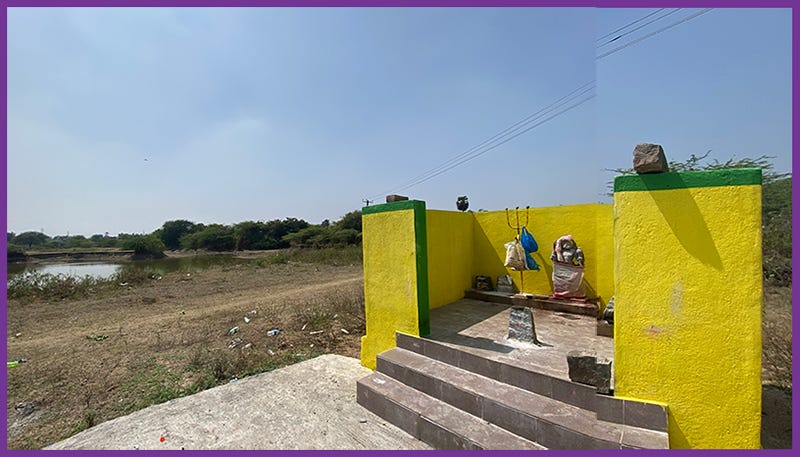
7. Munishwaran - kaavaldeivam of the boundaries who safeguards from evil spirits, black magic, enemies, accidents, diseases, and negative energies, seen here at the edge of the kazhani, where he is offered his sacrifices and favourite vices (sarakku and suruttus).
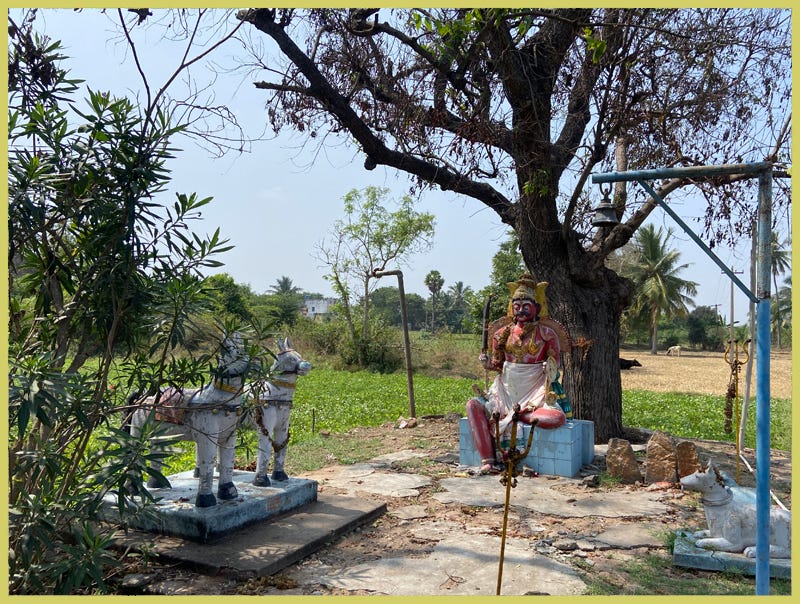
8. Gangaiamman - again, in a more rudimentary form.
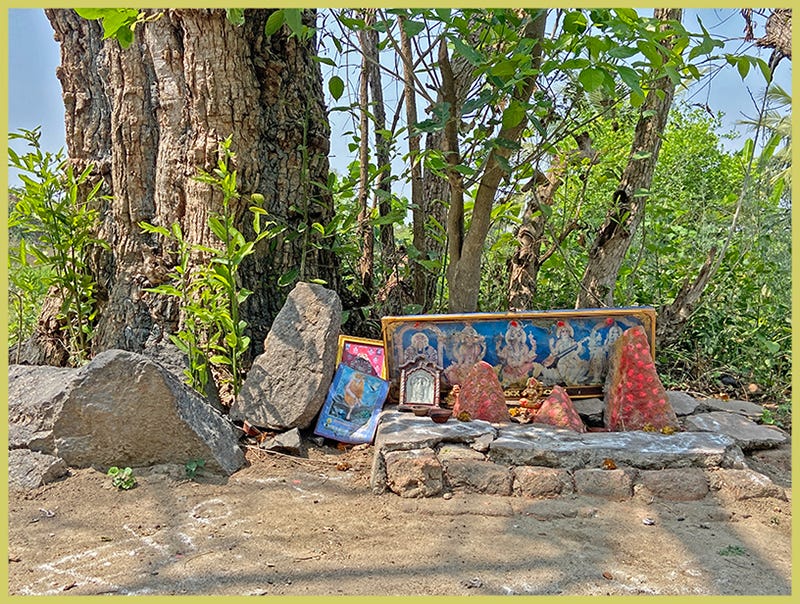
9. Kaliamman - fierce kaavaldeivam, who in her Tantric and esoteric aspects is associated with the gaining of siddhis & divination abilities. Here she is seen in the brush behind the settlement on poromboke land in keeping with her wild and extra-ordinary nature.
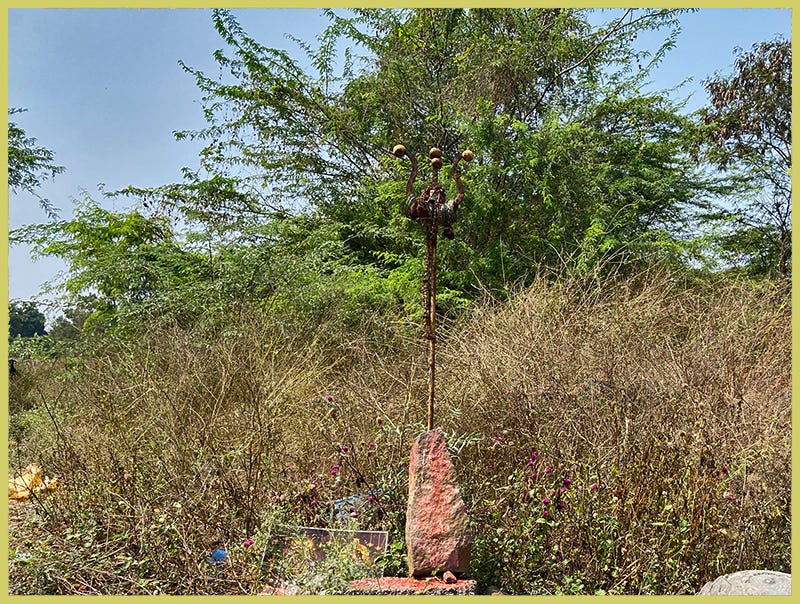
10. Mariamman and Navagrahangal - again, with the original deity seen in the foreground.
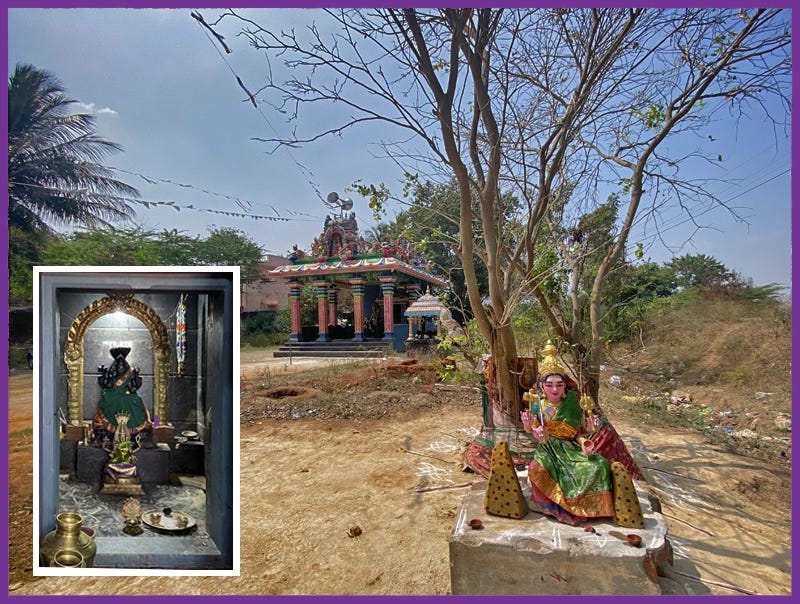
11. Muniappan - another form of Munishwaran, seen here at the edge of the fields west of the yeri.
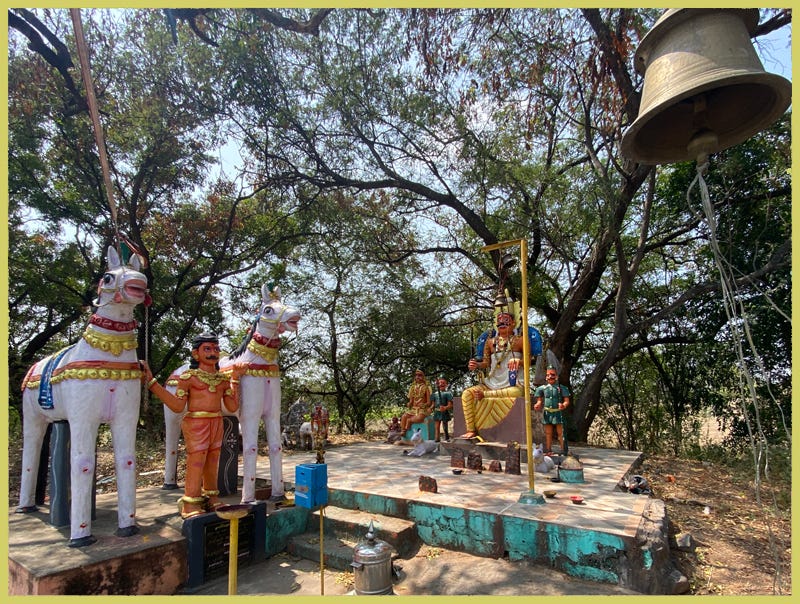
12. Ellaiappan - a specific boundary deity present at the edges (ellai) where one village ends and another village begins, seen here with an etched spear-tip. To the south lies Chettipattu and to the north, Kananthampoondi.
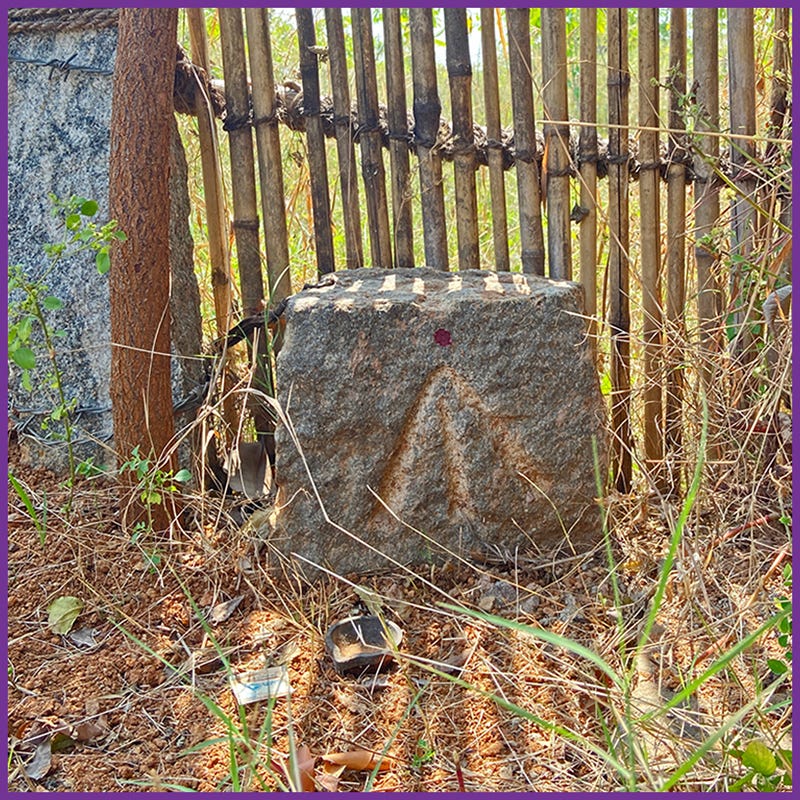
13. Vediappan - the hunter deity, seen here as protector in his sacred grove. Often seen with bow and arrow, here he is represented simply by stones.
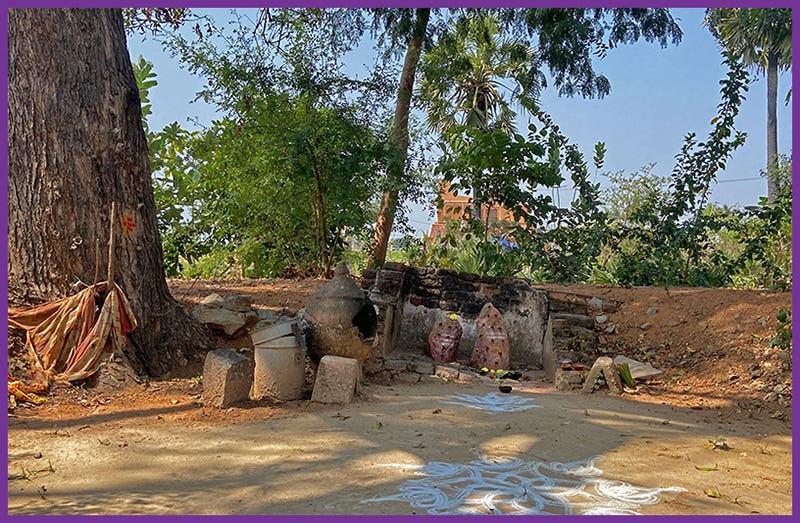
14. Munishwaran - again, with his horses, old and new.
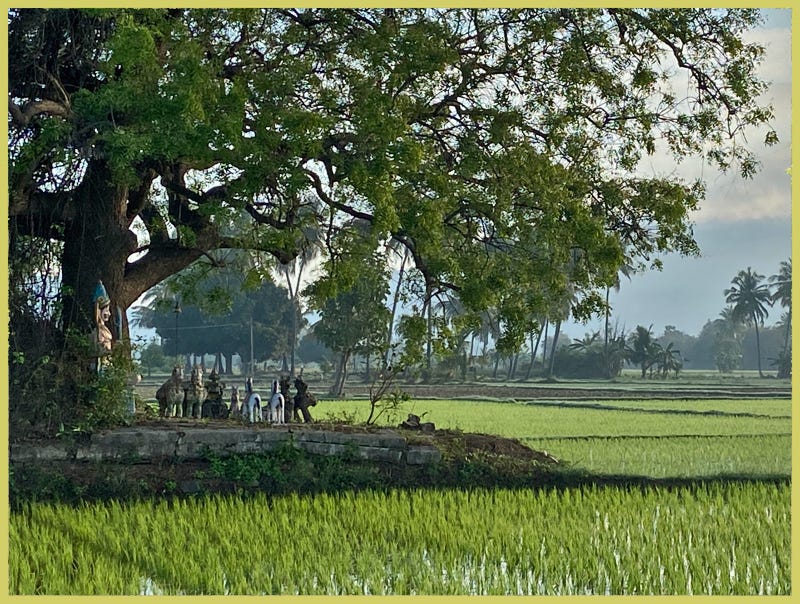
15. Mariamman - again. Here, we see the splinter community building its own sacred infrastructure afresh.
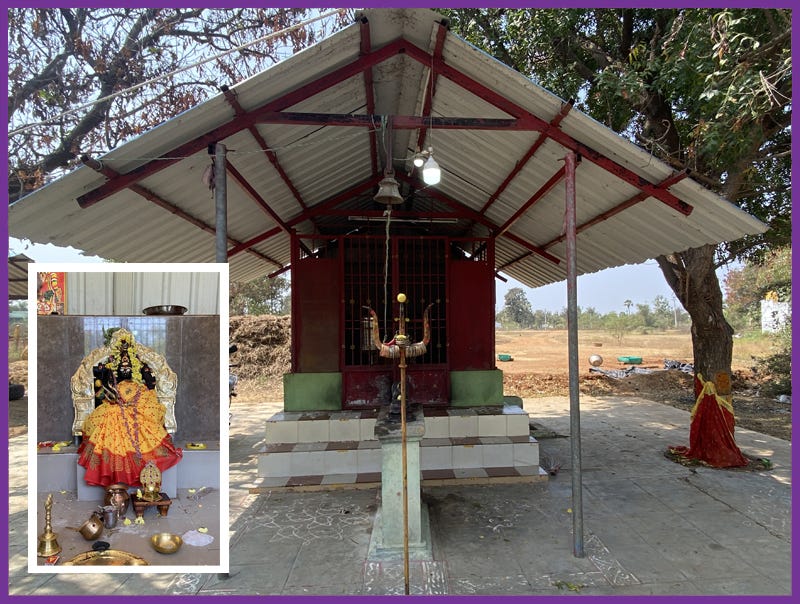
16. Vinayagar - again. Here too, we see the splinter community building its own sacred infrastructure afresh.
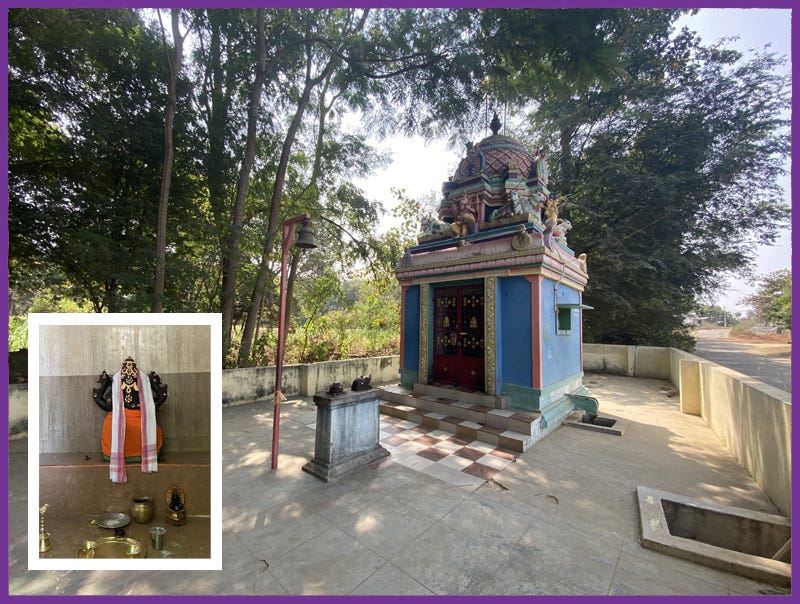
17. Munishwaran - the original deity from before the other, more anthropomorphic deities, were built closer to the settlement. From occupying pride of place in the fields bordering Samudram yeri, it is now overshadowed by the highway. Still presides over annual sacrifices.
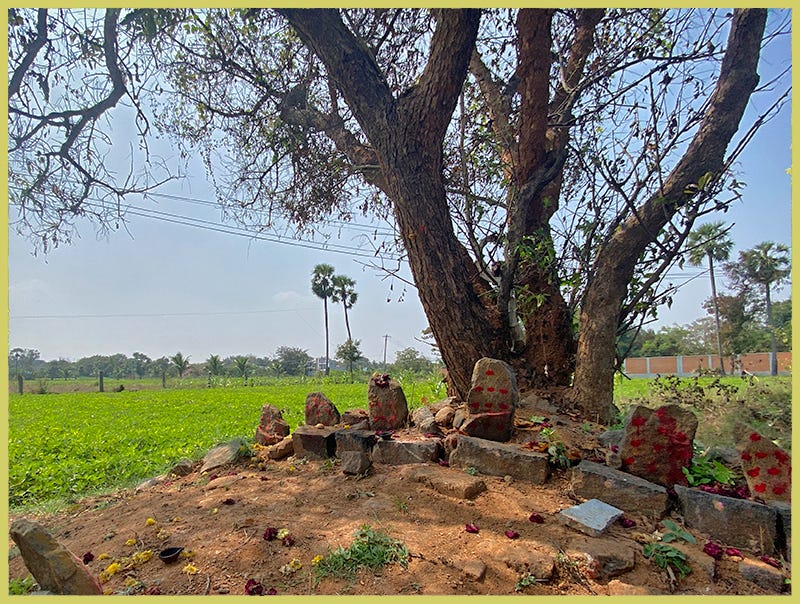
18. Putramman - powerful svayaṃbhū abode of the nalla paambu (cobra), seen as a living deity of feminine energy to whom offerings include milk and eggs.
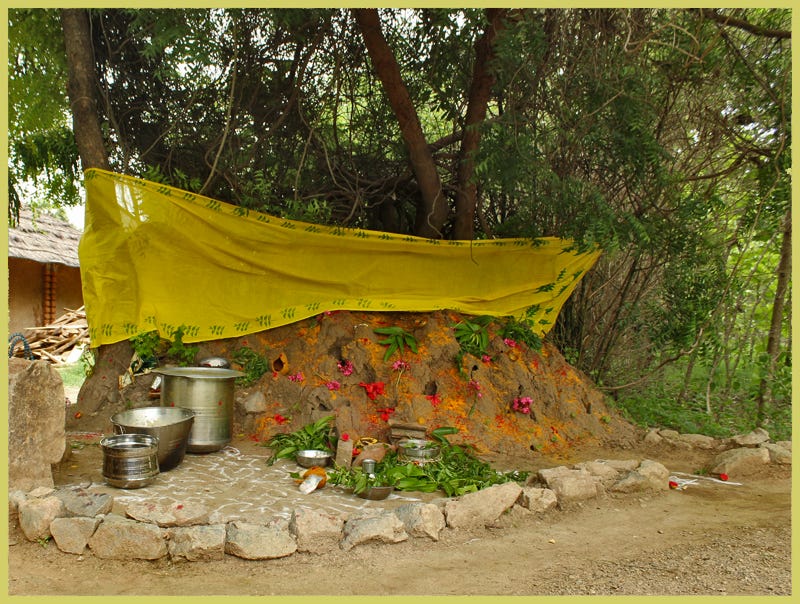
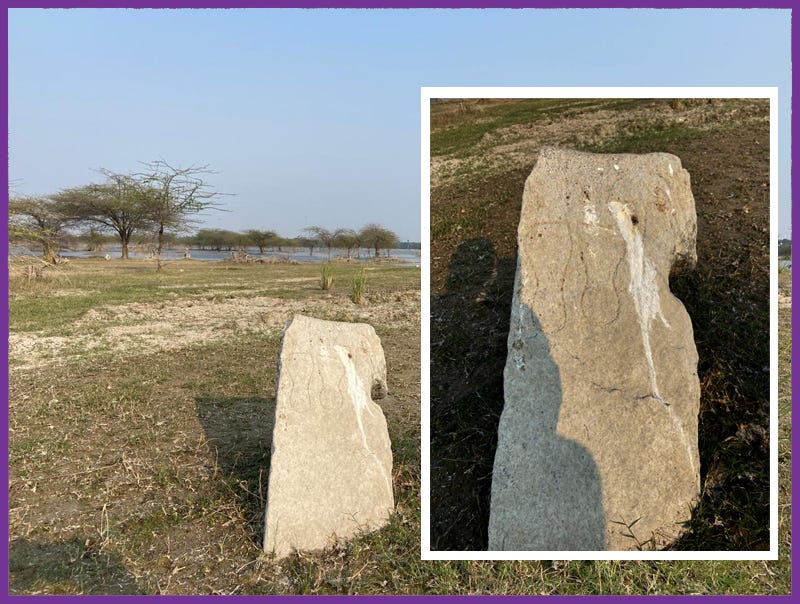
19. Ellaiappan - in the Samudram yeri flood plain, to the south lies Kananthampoondi and to the north, Samudram. Notice the pāda imprints engraved onto the stone.
Note: The Article Originally Appeared Here
Glossary
-
Tīrtha Sthala - place of crossing (spiritually speaking)
-
Aaru Padai Veedu - the six houses of war (literally barracks), of Muruga
-
Paadalpetra Sthalams - the 276 Shiva temples of Tamilagam that have been honoured in songs sung by the Nayanmaars & compiled in the Thevaram
-
Divya Deśams - the 108 Vishnu temples, not limited to Tamil Nadu, that were glorified by the Alwars in song
-
Ooruvalam - the movement of the deity around the ooru (town) on special occasions
-
Kaavaldeivam - protector deity
-
Thiruvizha - sacred festival
-
Garagam - decorated earthen pots containing sanctified water that are carried around the ooru, representing the deity herself
-
Agam - Puram - two categories of poems in Sangam poetry, one talking about matters of the interior and the other talking about matters of the exterior
-
Grāma Devatā - village deity
-
Yeri - ancient irrigation tank
-
Kazhani - irrigated lands downstream of the yeri
-
Sarakku & Suruttu - alcohol and cigars
-
Ellai - boundary
-
Koozhu - fermented millet/rice drink offered as naivedhyam to the graama devata during the koozhu festival
-
Svayaṃbhū- self-emerged
-
Pāda - feet

.png)