.png)
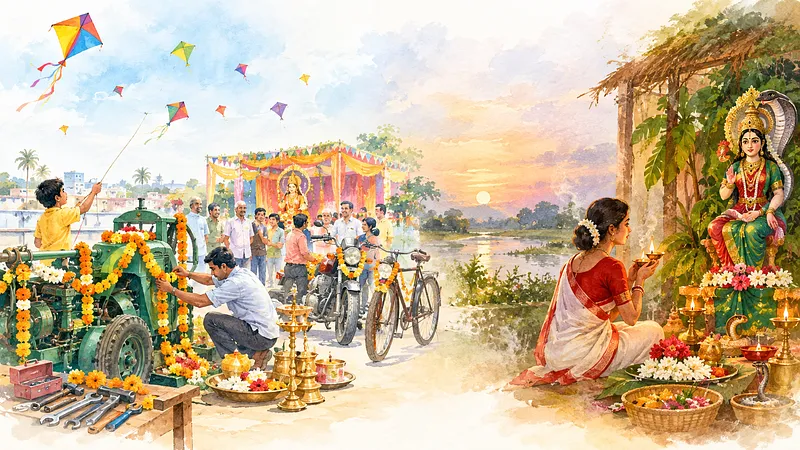
When most of us think of temples, our imagination often leads us to rituals, deities, and offerings. We picture long queues, the scent of flowers and incense, and the solemnity of darśana. Yet this worldview overlooks the depth of thought that went into creating an ecosystem that has endured centuries of political upheaval, social change, and cultural transformation. Temples as abodes of the divine, also functioned as living institutions around which communities organized their internal and external worlds.
Over time, rituals have evolved, and modes of worship have changed, yet temples continue to occupy a sacred place in the collective consciousness of this country. The reason lies in their foundation, intent, and the multifaceted purpose for which they were conceived. The temple was envisioned as a holistic institution, one that offered a sense of belonging and purpose to people across social and economic strata.
In its own unique way, the temple functioned simultaneously as a financial system, a mechanism of wealth redistribution, a marketplace, an art centre, an educational institution, and a community hub. The wealthy donated resources for collective welfare, while the less privileged received support as divine grace. Artists and traders found opportunity, scholars found forums for inquiry, and communities found continuity. This was the genius of the temple ecosystem: a thoughtful, self-sustaining design born of civilizational foresight.
A System for a Complete Life
To understand this ecosystem fully, one must view it through the lens of the four Puruṣārthas, the foundational goals that have guided the Bharatiya way of life: Dharma (order and duty), Artha (material prosperity), Kāma (pleasure and aesthetic fulfilment), and Mokṣa (liberation).
The temple served as a physical manifestation of this value framework. It provided an integrated platform where all four pursuits could coexist, ensuring that a complete life: material, emotional, ethical, and spiritual was not the privilege of a few but an accessible reality for the entire community. The temple deliberately intertwined the spiritual with the material, and the inward with the outward, creating balance by design.
Artha: Temple as a Financial Hub
The Mandira arthavyavasthā, or temple economy, emerged from a civilizational understanding that material wealth, when offered with intention, acquires moral meaning. In the early vaidika worldview, this relationship was articulated in the Rigveda through yajña: the act of offering, and dakṣiṇā: the gift that completed yajña.
As religious life expanded beyond itinerant sacrifice and fire rituals, this sacred principle found expression in more enduring social and institutional forms through the Āgamic tradition. Working alongside the vaidika corpus and grounded in the same metaphysical vision, the Āgamas systematized temple-based worship by laying down detailed prescriptions for architecture, consecration, daily ritual, festivals, mantra recitation, and institutional conduct. In doing so, they transformed episodic ritual into continuous practice and devotion into organization.
Ritual demanded resources, resources demanded organization, and organization demanded stewardship. What began as a ritualized offering gradually assumed institutional form. Temples came to receive land grants (agrahāra), donations (dāna), and royal endowments, cultivated by local communities and managed through temple treasuries.
By the early classical period, with texts such as Kauṭilya’s Arthaśāstra reflecting the growing importance of religious endowments, temples had begun to function as key centers of economic management. Epigraphic records from the Gupta, Chola, and Vijayanagara periods clearly show temples acting as de facto banks, issuing regulated loans to traders and artisans at controlled interest rates, thereby ensuring the circulation of wealth and economic stability.
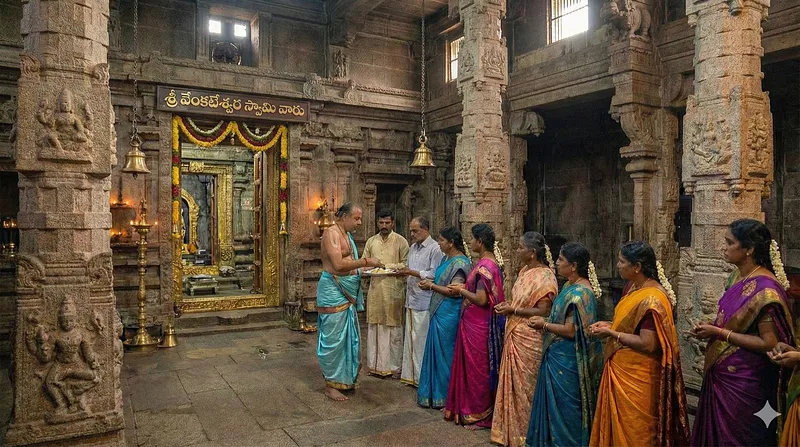
Inscriptions from the Brihadeeswara Temple of the Chola dynasty record control over several hundred villages, with revenues directed toward maintenance, ritual activity, and community welfare. During the Vijayanagara Empire (1336–1646 CE), temples emerged as major employers, sustaining priests, artisans, dancers, musicians, and merchants, and in the process driving regional prosperity.
Geographically positioned at the heart of towns, temples naturally evolved into centers of trade and exchange. Crucially, transactions conducted within temple precincts were not merely social contracts but spiritual ones. Accountability extended beyond legal enforcement to a shared moral order, fostering trust and credibility in economic life.
Ultimately, the temple’s genius lay in elevating artha beyond mere accumulation. By embedding economic activity within a sacred framework, wealth was not only generated but ethically regulated and consciously redistributed, offering a model of economic life that no purely secular marketplace could replicate.
Dharma: Temple as the Preserver of Order, Knowledge, and Practice
At the core of the temple ecosystem lay its custodianship of Dharma, not simply as moral instruction, but as a living order that upholds and sustains life itself. Rooted in the understanding of dhārayate iti dharmaḥ (“that which upholds”), dharma refers to the sustaining moral order that maintains harmony between the individual, society, and the cosmos, through normative conduct. The temple functioned as the space where this order was encountered, rehearsed, and preserved through institutional continuity.
Temples safeguarded vaidika chants, ritual manuals, philosophical texts, and oral traditions that demanded fidelity across generations. The recitation of mantras, performance of daily rites, and observance of seasonal and life-cycle ceremonies were sacred practices that cultivated attentiveness, restraint, responsibility, and ethical awareness. Over time, ritual trained individuals to act in harmony with a larger cosmic and social rhythm, embedding Dharma through practice rather than preaching.
Along with rituals, temples functioned as centres of learning and intellectual engagement. Libraries and attached gurukulas trained scholars in scripture, grammar, logic, astronomy, medicine, and philosophy. Forums for śāstrārtha, or structured debate, allowed diverse schools of thought to engage within a shared ethical framework, ensuring the continued adaptability of dharma remained dynamic without losing its coherence.
Dharma also found expression through service. Temples housed vaidyaśālās that offered free āyurvaidika medical care and supported education, water management, and social welfare as duties rather than acts of charity. Artha, the wealth generated through these, was reintegrated into society through dharma-bound action.
In this way, the temple functioned as the living ground of Dharma itself, where knowledge, ritual, and responsibility were continuously sustained, allowing tradition to endure not as memory alone, but as lived continuity across generations.
Kāma: Temple as a Cultural and Aesthetic Ecosystem
The temple ecosystem did not address material sustenance alone; it consciously made space for desire, joy, beauty, and emotional fulfillment. This is where kāma finds institutional expression. In the bhāratīya worldview, pleasure and aesthetic enjoyment were not distractions from a meaningful life, but essential components when experienced with awareness and balance.
Temples embodied this philosophy through deliberate sensory engagement. Intricate sculptures, vibrant murals, classical music, storytelling traditions, painted walls, and graceful dance forms were not ornamental excesses. They were expressions of the divine made accessible to human senses. Architecture, sound, movement, colour, and rhythm converged to create spaces where emotion and devotion coexisted.
This aesthetic dimension was deeply integrated into social life. Festivals and mahotsava transformed temples into centers of collective celebration, attracting artisans, performers, and craftsmen from across regions. Temples thus became patrons and preservers of local art forms, ensuring their continuity across generations.
Importantly, this cultural vibrancy was inseparable from economic life. Festivals brought together trade, performance, and craftsmanship, creating marketplaces where commerce and culture reinforced each other. Desire: for beauty, expression, and experience was neither suppressed nor left unregulated, but channelled through shared rituals and communal participation.
Kāma, therefore, was not indulgence but refinement. By embedding pleasure within a sacred and collective framework, temples ensured that joy strengthened social bonds and spiritual sensitivity rather than fragmenting them.
Mokṣa: Temple as an Architecture of Inner Freedom
Beyond material prosperity, aesthetic fulfillment, and social order, the temple ultimately oriented individuals toward Mokṣa, not as a distant promise of heaven, but as an experiential reminder of inner freedom. Mokṣa, in the bhāratīya understanding, was not an escape from life, but liberation from compulsive attachment to it.
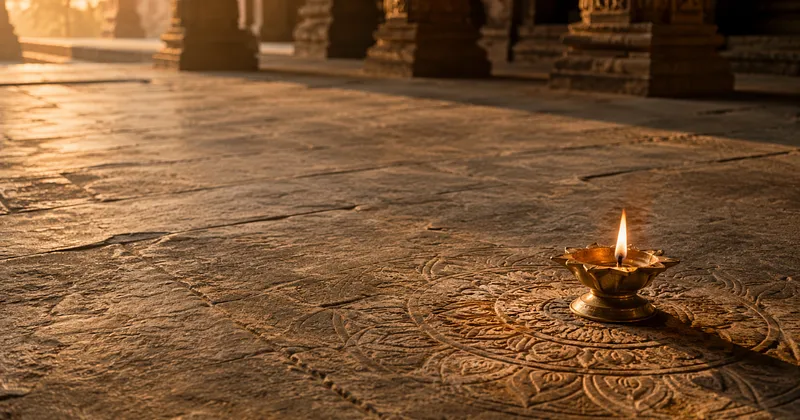
This orientation was cultivated through design and practice rather than instruction alone. Temple architecture guided individuals inward: from dhvajasthambhas and open courtyards to narrowing pathways, from light to shadow, from sound to silence. Within this space, every visitor followed the same movements, bowed in the same posture, and stood equally before something larger than the self.
Such experiences temporarily dissolved distinctions of wealth, power, and status. Temples did not erase social differences outside their walls, but created moments where those differences became inconsequential. Shared gestures of humility, silence, and awe fostered a collective awareness that no individual exists in isolation or supremacy.
Mokṣa was thus woven into everyday life rather than positioned against it. After engaging in artha, participating in kāma, and upholding dharma, the temple offered space for reflection and detachment without renunciation. Liberation was not postponed to the end of life; it was practiced within it.
Decline, Disruption, and the Enduring Blueprint
Despite their resilience, temple ecosystems were not immune to disruption. Their decline did not result from a loss of faith, but from the systematic dismantling of their institutional design and autonomy. Over centuries, the balanced integration of artha, kāma, dharma, and mokṣa was gradually fragmented.
Islamic invasions damaged temple infrastructure and plundered them, but a decisive rupture occurred under colonial administration. Regulatory interventions stripped temples of land, revenue, and governance, severing the link between spiritual authority and community-driven administration. Post-Independence, continued state control further constrained their ability to function as self-sustaining ecosystems.
What survived was devotion but not design.
Modern temple towns revived through pilgrimage and tourism reflect fragments of the old system, yet often remain disconnected from the principles that once made temples engines of regional development and social cohesion. The ancient model was decentralized, locally rooted, and sustainable, irrespective of scale.
The relevance of the temple ecosystem today lies not in reinstating religious institutions as governing authorities, but in understanding the principles they embodied: moral accountability, collective participation, and decentralized organization. Temples worked because they were trusted spaces where wealth circulated responsibly, pleasure was refined through culture, duty was institutionalized through practice, and inner freedom remained a living ideal.
In contemporary times, glimpses of this older logic can still be observed in selective contexts. Organizations such as the International Society for Krishna Consciousness (ISKCON), while operating within a modern and global environment, have consciously rebuilt temple-centred communities that integrate ritual life, food distribution, learning, artistic training, everyday courses for children, economic self-sufficiency, and inward discipline. Their success lies not in invention, but in retrieval, in revisiting an inherited design where the temple functions as a nucleus of everyday life rather than a site of isolated worship.
Seen this way, the temple ecosystem offers a civilizational framework that acknowledges the full spectrum of the Bhāratīya way of life.
A society that absolutizes artha becomes extractive.
One that absolutizes kāma becomes decadent.
One that absolutizes dharma becomes rigid.
One that absolutizes mokṣa becomes escapist.
The temple endured because it harmonized all four: offering not perfection, but balance. And it is this balance, more than any single institution, that remains the most enduring lesson of the temple ecosystem and of Sanātana Dharma itself.

.png)