Read Part One: Āryāvarta.
At the base of Āryan culture, like many cultures, is a tension about the nature of relationships. What is the basis of a relationship? Is it reciprocity? Or is it unconditional giving? Such questions are timeless, being as relevant today as they were thousands of years ago. Ancient Āryans saw their relationships with the various gods as experimental conditions to understand the true nature of relationships. Typically, gods give without asking and also take without asking. However, what would it be like to build a reciprocal relationship with them where humans and gods can make demands on each other and expect each other to fulfill those demands?

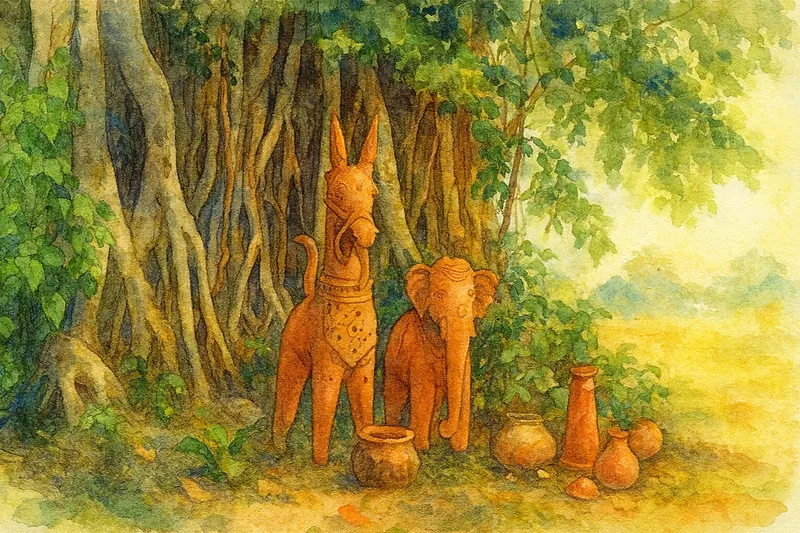
The Upaniṣads internalize these sentiments and speak of building a relationship with our inner self, as it is the unmanifested reality that truly reflects the manifested external reality. But in the Ṛgveda, the focus is more on externalization than on internalization. So in order to build a relationship with, say, Araṇyānī, the goddess of Forest Pools, a ṛṣi would typically recede into the forests and materially build that relationship. Such a relationship would be embodied by a mantra, or a special call, to remind the goddess of said relationship. In a world where there is no concept of ownership or private wealth, the only thing that a human could be said to truly own is the relationships that they build. And by extension, the only attainable private wealth that can be passed down within the family as inheritance is a hymn.

This forms the internal structure of the Ṛgveda. The hymns from the first, eighth, ninth, and tenth maṇḍalas are the hymns owned by the Kanva family of priests who aided the Bhārata kings, after which India, that is Bhārata, is named. Books 2 to 7 are the hymns of various other families of ṛṣis, such as Vasiṣṭha and Viśvāmitra, who had served as the priests of the Bhārata Kings at various pivotal moments in the Bhārata history. Vasiṣṭha is one of the most celebrated priests of the Ṛgveda because he not only builds a relationship between the Bhārata kings and Indra, the hero of the Ṛgveda, but also between Indra and Varuṇa, the two major gods of the Vedas. Vasiṣṭha’s Indra-Vāruṇau hymns are known, not just for their poetic mastery, but also for their kenotheistic spirit that is found across the Ṛgveda: that humans can not only build a relationship with gods but also between gods, by recognizing the cosmic spirit that is common to all humans and gods.
In the Taittirīya Āraṇyaka of the Kṛṣṇa Yajurveda, this cosmic spirit is given a name, Īśāna, and is equated with Śiva.
Īśānassarvavidyānām īśvaras sarvabhūtānām brahmādhipatir brahmaṇo’dhipatir brahmā; śivo me astu sadāśivom
Meaning: From Īśāna comes all knowledge and all disciplines. Īśāna is the expansive spirit responsible for the expansion of human and cosmic consciousness. Īśāna brings auspiciousness. Īśāna is auspicious.
In the third maṇḍala of the Ṛgveda, Viśvāmitra, the family priest of Tṛtsu-Bhāratas, reveals a mantra, famously known as the Gāyatrī mantra, which is a prayer to the gods Sāvitra and Uṣas, where Sāvitra-Uṣas, the gods of the sky between sunset and sunrise, are called Devas. It is called the Gāyatrī Mantra because the hymn is set to the Gāyatrī meter.
Tat Savitur Vareṇyaṃ Bhargo Devasya DhīmahiDhiyo Yonaḥ Pracodayat
Meaning: Sāvitra, the regent of dusk, is, verily, the god of the heavens. May he light up our inner being.
Metrics: Three lines of hymn. The first line has seven syllables while the next two lines have eight syllables. This meter is called Nicṛt-Gāyatrī, meaning a syllable short of complete Gāyatrī, which would have eight syllables in every line.

What is it that invokes human relationships with gods? Is it the meaning of the words? Or is it the intonation and sounds? This is another tension that exists across Indic thought, which also roughly corresponds to the tension between reciprocal relationships and one-sided favors. If we are to say that it is the words of the Vedas that have meanings, then we think of the gods as conscious and sentient beings who will negotiate the value of actions and counteractions much like humans do. Commentators like Pāṇini (and perhaps Yāska, whom Pāṇini quotes) set store by words and their meanings favor this version.
On the other hand, the popular 13th-century empire builder Sāyaṇācārya, whose commentary is considered the most authoritative in present times, takes the view that words and meanings of hymns are not important. It is only the meter and intonation that matter. This view seems to consider gods as unselfconscious beings whose favors become triggered by producing the right kinds of sounds. These two views also seem to set up the dialectic of Indic thought: the Dvaitic impulse, which sees God as a self-conscious almighty, and the Advaitic impulse, which views God as an unselfconscious consciousness, an abstract substance that permeates the cosmos.
In Indic thought, these opposing impulses are synthesized by positing the supreme almighty God as an unmanifested non-unselfconscious entity which comprises both self-conscious and unconscious aspects of the various manifest gods.
Trivia
- Gāyatrī Mantra continues to be an important part of initiation rituals that signify a person’s readiness to take on vaidika studies. Gāyatrī meter accounts for a quarter of the hymns of the Ṛgveda.
- Vidyāraṇya and his brother Sāyaṇācārya were the priests of the Virupaksha temple near Hampi. They worked with the kings Harihara Raya and Bukka Raya to establish the Vijayanagara Empire.
- Advaita, Dvaita, and Viśiṣṭādvaita are the three most important interpretations of vaidika thought, which aim to explain how the Vedas envision the Supreme causal entity for our cosmos.