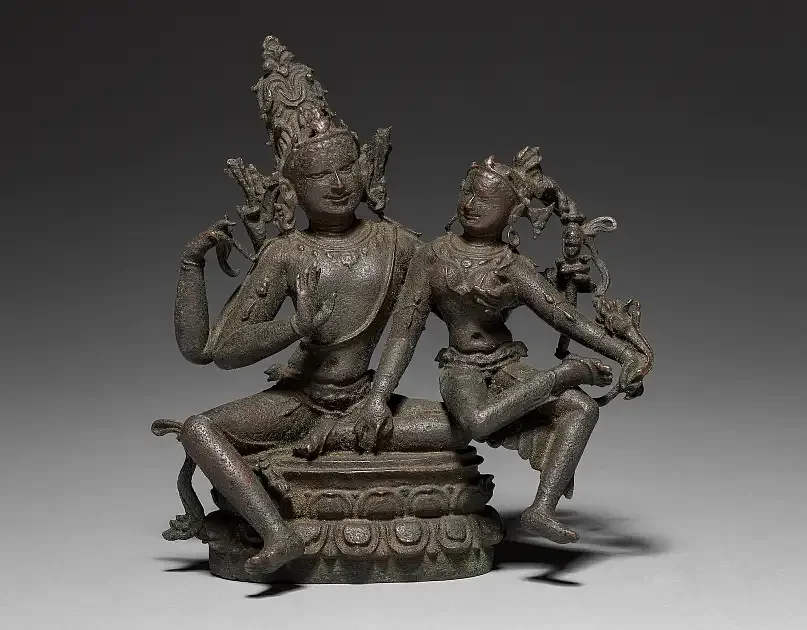
Header image: Umāmaheśvara, Pala era (9th century), East India
namaḥ śivābhyāṃ navayauvanābhyāṃ parasparāśliṣṭavapurdharābhyām । nagēndrakanyāvṛṣakētanābhyāṃ namō namaḥ śaṅkarapārvatībhyām ॥ 1 ॥ śrī umāmaheśvara stotramMy namaskāra to Śiva and Pārvatī (referred to by the epithet Śivā) who are eternally youthful, who embrace each other affectionately; of whom one is the daughter of the mountain and the other bears the symbol of a bull; I offer my namaskāra again and again to that Śaṅkara and Pārvatī.
Images of Śiva and Pārvatī embracing (āliṅgana) are numerous from the beginning of the present era, found in every school and era of art across the country. Umāmaheśvaramūrti brings the God and Goddess of the universe together in the most tender of love. Śiva's body is curved towards Pārvatī, whose shape aligns with his. Śiva's hand cups Pārvatī’s breast in an endearing gesture of love.

Umā-Maheśvaramūrti, Nepal. 900s. Stone. Previously held by The Denver Art Museum, the sculpture has been returned to the people of Nepal in 2021
In this stunning mūrti from the tenth century Thakuri Dynasty of Nepal, Śiva and Pārvatī, are seen sumptuously adorned and enthroned amid mountains and retinue. Śiva embraces Umā with His lower left arm, which rests on her shoulder, and the Goddess lovingly nestles against his powerful body. In a gesture of trusting intimacy, Pārvatī rests one of Her arms on Śiva's thigh and one on her own. Śiva’s mild, passive mien is made known by His raised upper right hand holding a rosary and his pose of royal ease (lalitāsana). A flaming nimbus (śirascakra) encompasses his head. Next to Śiva is a seated Nandi; below, a diminutive Kārtikeya who extends his hand to his peacock vāhana. Next to Pārvatī are her companions and ladies-in-waiting carrying a fly whisk and a long-handled umbrella. A leopard skin with its somnolent face grinning, is spread out over the rock beneath the ornate cushion where the two Gods are seated. Below the throne are Kārttikeya, Gaṇeśa and an emaciated Bhṛṅgi looking up at Śiva in passionate devotion.

Umā-Maheśvaramūrti, Nepal. 900s. Stone. Previously held by The Denver Art Museum, the sculpture has been returned to the people of Nepal in 2021
The Viṣṇudharmottara Purāṇa and the Rūpamaṇḍana describe the iconography of Umāmaheśvaramūrti. The Viṣṇudharmottara states that in this aspect, the images of Śiva and Umā must be seated on an āsana (seat), embracing each other. Śiva is ordinarily depicted with the jatāmukuṭa (twists of matted hair worn in the form of a crown) accentuated by a crescent moon; one of His hands bearing a nīlotpala (blue lotus) and the other arm embracing his wife Pārvatī. Umādevī must have a generous bust and hip; with Her right hand embracing the right shoulder of Śiva and in Her left hand She must hold a mirror, as Pārvatī ordinarily does. Both the figures of Śiva and Umā, should be sculpted and adorned beautifully.
The Rūpamaṇḍana states that Śiva should have four arms, one holding a triśūla, one holding a mātuluṅga (a kind of citron), one holding a snake, and one thrown over the shoulder of Umā. Śiva must be red like the coral. The group must be accompanied by the Vṛṣabha or the bull of Śiva, Gaṇeśa, Kumāra and a lean emaciated figure of the ṛṣi Bhṛṅgi.
वागर्थाविव सम्पृक्तौ वागर्थ प्रतिपत्तये । जगत: पितरौ वन्दे पार्वतीपरमेश्वरौ ।। Kāḷidāsa, RaghuvaṁsamI offer my salutations to the parents of the universe, Pārvatī and Parameśvara, who are inseparably united like speech and its meaning, for bestowing upon me the knowledge of words and their meaning.
The divine marriage of Śiva and Pārvatī is a symbol not only of their union but of their unity. As the father and the mother of the universe, one cannot exist without the other. This togetherness of God and Goddess is pregnant with meaning on more levels than one: Umāmaheśvara are divinely wedded lovers, exalted in their embrace; they can also be realized as representing puruṣa and prakṛti. In each age and school of art, every sculptor realized Umāmaheśvara in a unique way, guided by the iconographic texts. The image of Umāmaheśvara is an ontological symbol, yet simultaneously depicts domestic harmony and bliss.
References
- Gopinatha Rao, T. A.. Elements of Hindu iconography. Vol. 2 : Pt. 1
- Kramrisch, Stella. Manifestations of Shiva. Philadelphia: Philadelphia Museum of Art, 1981