Hari-Hara, the composite form Hari (Viṣṇu) and Hara (Śiva), represents one of the most enduring visual expressions of theological synthesis in Indian art, with each half of the body distinctly embodying the preserver and the destroyer. It is known by a wide range of names across textual traditions— as Hari-Rudra, Saṅkara-Nãrayaṇa, Haryārdha (Untarakamikāgama), Hari-Śaṅkara (Agnipurāṇa), Hara-Hari (Tantrasāra), Śiva-Narāyaṇa (Matsyapurāṇa), Kṛṣṇa-Śaṅkara and Rudra-Narāyaṇa (Vayupurāṇa). Its origins can be traced back to the Kuṣāṇa period, with early examples from Mathura already establishing the defining bifurcated iconography. Over time, particularly during the early medieval period, Hari-Hara images proliferated across the subcontinent—from North India (Mathura, Osian, Khajuraho) to Gujarat and Assam, and extensively in the Deccan and South India (Badami, Mamallapuram, Aihole, Pattadakkal). While regional variations appear in attributes and stylistic treatment, the essential schema—distinct yet unified halves marked by their respective emblems—remains consistent. This wide geographic spread and iconographic continuity underscore Hari-Hara’s significance as an exalted deity.

This composite form is grounded in a rich textual tradition. Various śilpa treatises and Purāṇas prescribe differing attributes for Hari-Hara. The Viṣṇudharmottara Purāṇa, for instance, assigns varada, triśūla, cakra, and lotus to his hands, along with Nandi and Garuḍa as their respective vāhanas. Other texts, such as the Īśānaśiva-gurudevapaddhati and the Rūpamaṇḍana, offer alternative combinations of attributes, where the lotus is replaced by a śaṅkha. The Aparājitapṛcchā, a twelfth-century text from Gujarat specifies the attributes of varada, triśūla, chakra, and śaṅkha, and refers to the form as “Kṛṣṇa-Śaṅkara.” The worship of this composite deity was widespread, with parallels found in Nepal—such as the Hari-Śaṅkara temple at Patan—and in Southeast Asia, where inscriptions from Cambodia attest to multiple appellations, including Śambhu-Viṣṇu and Hari-Śaṅkara. Despite these variations, the designation “Hari-Hara” remains the most appropriate, also supported by texts like the Matsya Purāṇa and the Mānasollāsa, which similarly describe the deity with the attributes of varada, triśūla, cakra, and śaṅkha.
The 1223 CE Davangere inscription declares that “Some say there is no god on earth [but] Hari, and some saying there is no god on earth but Hara, to remove their doubts Hari-Hara murti-idol was revealed in a single form; which form of glory may it protect us.” The inscription states that the Hari-Hara Kṣetra was greater on earth than Rameshwaram, Varanasi or Kurukshetra. In the Uttarakānda of Rāmacaritamānasa, there is a story of a devout Śaivite who hated the very sight of Viṣṇu and therefore could not understand the love of his Śaivite guru for Hari. His guru finally explained to the distraught disciple that only by worshipping Hari could one attain Hara. Hari is the beloved of Hara; just as Hara of Hari.
The sole reward, my son, of worshipping Lord Śiva is
uninterrupted devotion to Śri Rāma’s feet. Śiva
himself, as well as Brahma, adores Śri Rāma.
Hari-Hara acquired notable prominence in Southeast Asia, especially within the pre-Angkorian Khmer world and among the Devarāja cult, and to a lesser extent in South India, where it is associated with Ayyappa—the offspring of Śiva and Mohinī (Viṣṇu). Interestingly, much of the exegetical literature on Hari-Hara emerges relatively late and is predominantly in Telugu. While sculptural representations of the deity are attested from the early medieval period onward, later painted traditions—particularly from the seventeenth century—appear in regions such as Travancore, Kalighat, and notably the western Himalayas. In Southeast Asia, the significance of Hari-Hara was closely tied to political ideology. Śiva and Viṣṇu represented distinct models of kingship, and their fusion in a single anthropomorphic form provided a powerful symbolic tool. In pre-Angkorian Cambodia, especially during the seventh century, rulers in the Śaiva-oriented north sought to consolidate authority over southern regions where Vaiṣṇava traditions prevailed. The image of Hari-Hara thus functioned as a visual and theological synthesis, embodying the convergence of these two modes of sovereignty and legitimizing the unification of territorial and political power.
.jpg)
Harihara, Phnom Da style, 7th century Khmer
Musée Guimet-Iéna
The Chandella Hari-Hara in the British Museum distinguishes itself as an extraordinarily refined and conceptually complete articulation of Śaiva–Vaiṣṇava synthesis, where theological abstraction is rendered with striking visual precision. Its expanded parikara, enabled by its monumental scale, transforms the image into a cosmological tableau: Śiva’s familial retinue is counterbalanced by a rich sequence of Viṣṇu’s avatāras, embedding temporal myth within a unified divine body. Stylistically, the work is firmly rooted in early Khajuraho iconography—distinguished by refined detailing such as the treatment of the cakra, whose tassel curves inward toward the fingers (in contrast to the outward sweep of Pratihāra/Kanauj examples), and the presence of a subtle dhotī fold line across the thigh. The figure’s balanced proportions, calm expression, and the use of flat pilasters with ardharatna motifs further align it with 10th-century temple sculpture. The flanking stylized banana plants and the compositional parallels with contemporaneous Khajuraho images, such as the Śatdhārā sculptures and the Pārvatī figure, reinforce its placement within an early, cohesive Chandella visual language marked by clarity, symmetry, and controlled ornamentation. Dated to around the mid-10th century, it occupies a formative position within Chandella art, and, being large, likely resided in the garbhagṛha.

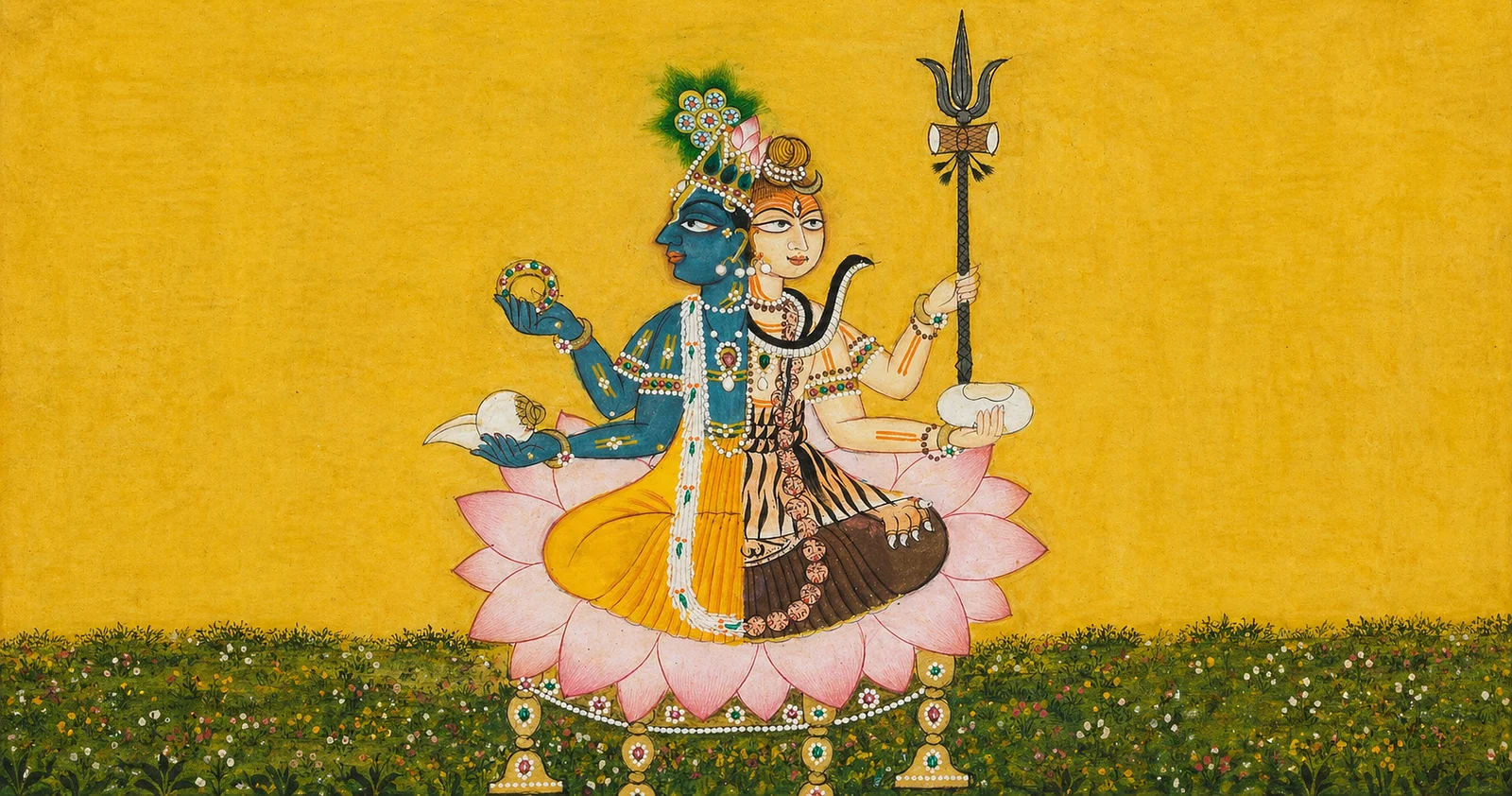
The c. 1720–40 Mankot painting of Hari-Hara closely adheres to the iconographic prescriptions of the Viṣṇudharmottara Purāṇa, the deity vertically divided equally, standing rigidly over the cosmic ocean. The two halves are meticulously differentiated: Hari, rendered in dark blue, wears regal ornaments and holds the mace and lotus, while Hara, in white, is clad in tiger skin and bears the trident and drum. This duality extends to every detail—crown and matted hair, pearl and rudrākṣa, kaustubha and a serpent, and even the tilaka marks—creating a refined visual symmetry. Central to the image is its symbolic colour logic: the dark blue of Hari signifies creative, all-encompassing energy (prakṛti), while the white of Hara represents dissolution and reflective truth (vikṛti). Together, they articulate a philosophical cycle of creation and destruction, presenting Hari-Hara as a complete expression of cosmic unity.

Harihara, the composite form of Śiva and Viṣṇu
Mankot, Jammu and Kashmir, circa 1720-40
Pahari representations of Hari-Hara introduce a remarkable degree of stylistic and conceptual nuance, moving beyond rigid iconographic bifurcation found in śilpa toward a more fluid and interpretive visual language. While the foundational vertical division between Hari and Hara is retained, Pahari artists—especially in painted traditions from Mankot, Chamba, and Mandi—treat this division with subtle variations, sometimes even reversing the conventional left–right schema to reflect shifting sectarian or political emphases. A defining stylistic feature is the meticulous mirroring and transformation of details across the two halves: ornaments morph (kaustubha into a serpent), necklaces transition (pearls into rudrākṣa), and garments shift (yellow dhoti into tiger-skin), producing a continuous yet differentiated surface rather than a stark split.

Harihara Seated, c. 1700
Blue-skinned Vishnu wears a fine red garment, while the ash-covered ascetic Shiva sits on a tiger skin. Vishnu’s garland of flowers transforms into Shiva’s garland of skulls as it passes through the center of the figure. Their crossed legs bridge the space, as does a gilt crown from which Shiva’s matted hair protrudes on one side.
Equally striking is the sophisticated use of colour—deep blue for Hari and white or ash-grey for Hara—not merely as identifiers but as metaphysical signifiers of prakṛti (creative potential) and vikṛti (transformative or destructive force), creating a chromatic dialectic across the figure. Facial treatment too becomes expressive: profiles, three-quarter views, and the strategic placement of tilaka marks (ūrdhva-puṇḍra vs. tripuṇḍra) emphasize dual identity while maintaining compositional harmony. In more complex Mandi examples, the syncretism becomes even more layered, with multi-headed, multi-armed Sadāśiva-Nārāyaṇa forms where Śaiva and Vaiṣṇava attributes are deliberately redistributed across sides, sometimes even “swapped,” suggesting not just unity but interchangeability.

Harihara, the composite form of Śiva and Viṣṇu
Basohli, Pahari school, 18th century
Overall, the Pahari Hari-Hara is less a static composite and more a dynamic —stylistically characterized by fluid transitions, symbolic colour play, and intentional iconographic ambiguity, reflecting the region’s subtle engagement with sectarian balance and theological synthesis.
There is a saying that at the time of death, Viṣṇu whispers the name of Śiva in the ear of the dying so that he may attain the domains of Śiva in perpetuity. Also, the dying utters the name of Viṣṇu to curry favour with Śiva. The variations seen in painted Hari-Hara images over sculpture likely stem from the shifting religious alignments of the hill states that produced them. As Lavy has argued for pre-Angkorian Cambodia, the appeal of Hari-Hara lay in its capacity to embody multiple forms of authority within a single image, making it a potent instrument for both political and religious consolidation. A similar logic can be applied to the western Himalayas, where the composite imagery perhaps helped reconcile divergent ideological tendencies, particularly in the wake of Mughal expansion into the region and the concurrent rise of Vaiṣṇava influence—though regions like Mandi retained strong Śaiva affiliations. In this context, the form of Hari-Hara becomes intelligible as a deliberate synthesis of competing sectarian positions.
In the Harihara stōtra, a śloka spoken by Yama to his foot soldiers is as follows:
gaṅgādhara ‘andhakaripo hara nīlakaṇṭha
vaikuṇṭha kaitabharipō kamaṭhābja-pāṇe
bhūteśa khanḍaparaśo mṛḍa canḍikēśa
tyājyā bhaṭā ya iti santhathamāmananti (2)
गङ्गाधरान्धकरिपो हर नीलकण्ठ वैकुण्ठ कैटभरिपो कमठाब्जपाणे॥
भुतेश खण्डपरशो मृड चण्डिकेश त्याज्या भटा य इति सन्ततमामनन्ति ॥२ ॥
Translation: “Spare those who chant continuously the names of the one who bears Gaṅgā, one who is an enemy of Andhaka — Hara, whose throat is blue in color; one who is the vanquisher of Kaitabha in Vaikuṇṭha, one who holds a kamanḍalu in His hand and wields the battle-axe; the Lord of the Bhūtas, Mṛḍa (an epithet of Śiva, meaning, one who is easily pleased), who is the consort of Canḍika.”
Hari-Hara is not merely an iconographic fusion, but a profound aesthetic and philosophical resolution of duality. Śiva and Viṣṇu are seen as distinct yet inseparable expressions of a single underlying reality. As with many strands of Hindu thought, the image ultimately gestures toward a deeper metaphysical unity: that multiplicity itself is only a surface manifestation of oneness, where apparent oppositions dissolve into a shared cosmic principle.