Introduction
This is the fourth essay in this series of deliberations on a systemic analysis of all things Indian and how we can start looking at our past, present and future through a more systemic lens than being beholden to the contemporary political landscape. Here is Part One, Part Two and Part Three.
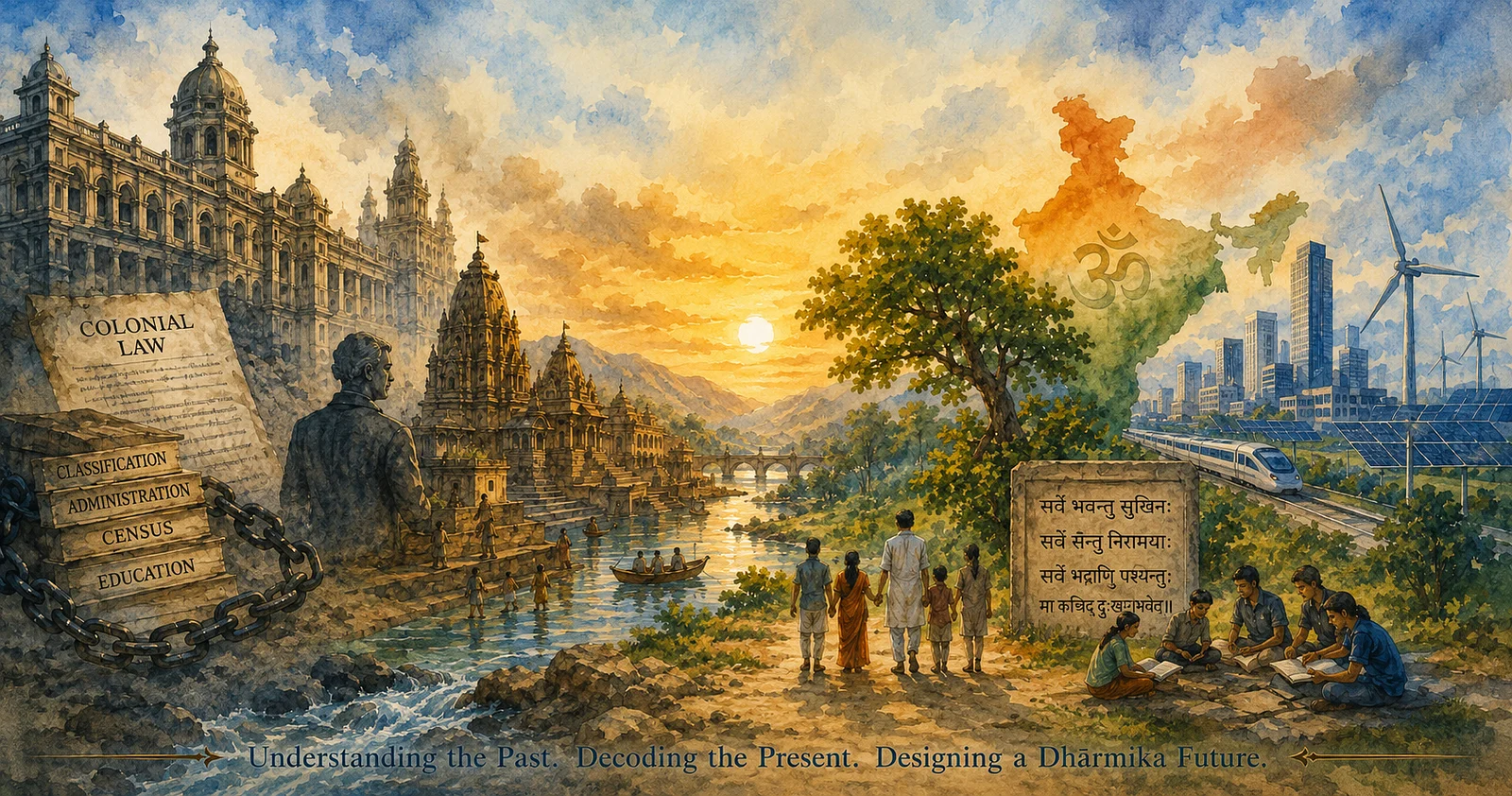
Any serious attempt to understand the contemporary condition of Indian society must move beyond surface-level political analysis and engage the deeper systems that have shaped its institutional, social, and intellectual life. Present-day conflicts over caste, welfare, state policy, social identity, and national vision cannot be adequately interpreted as isolated developments of the current moment. Rather, they are outcomes of long historical processes involving colonial lawmaking, the restructuring of public administration, the transformation of knowledge systems, and the incomplete reconfiguration of inherited institutions after independence.
A systemic approach reveals that social realities are not self-generating; they are produced, reinforced, and transmitted through systems of governance, classification, pedagogy, and cultural memory. From this perspective, the Indian present must be read as the cumulative effect of both colonial disruption and postcolonial continuity. At the same time, reflection on the past is meaningful only insofar as it contributes to a vision for the future. The question, therefore, is not merely how India arrived at its present condition, but what kind of knowledge architecture can guide its renewal.
Let’s examine that question by analyzing the relationship between system, society, and state in the Indian context. It argues that genuine civilizational renewal requires a rethinking of political institutions, social incentives, cultural identity, and public consciousness through frameworks internal to the Indian tradition. Such a rethinking involves the recovery of a dhārmika understanding of public order, the restoration of civilizational continuity through sacred geography and paurāṇika pedagogy, and the reorganization of statecraft in accordance with a more integrated conception of human and collective flourishing.
Colonial Systems and the Production of the Present
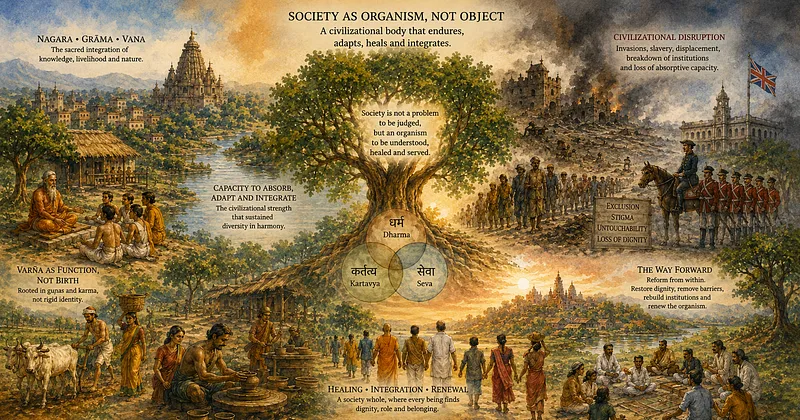
Modern Indian society cannot be understood without acknowledging the profound consequences of colonial intervention. Colonial rule altered not only legal and administrative structures but also the underlying worldview through which governance and society were conceptualized. Law-making lost its earlier diversity and became aligned with a different doctrine of public administration. This transformation affected social relations in lasting ways because administration is never ideologically neutral. The paradigm through which a state sees its population also shapes how that population comes to understand itself.
The downstream effect of colonial governance was therefore not limited to institutional centralization or bureaucratic reorganization. It extended to the very categories through which society was interpreted and governed. Equally significant was the transformation of knowledge production. Indigenous forms of understanding, transmission, and social interpretation were displaced, marginalized, or rendered inferior. As a result, contemporary social tensions cannot be separated from the systems that generated them. The conflicts visible today are not simply social accidents; they are products of inherited administrative and epistemic arrangements.
The Unfinished Promise of 1947
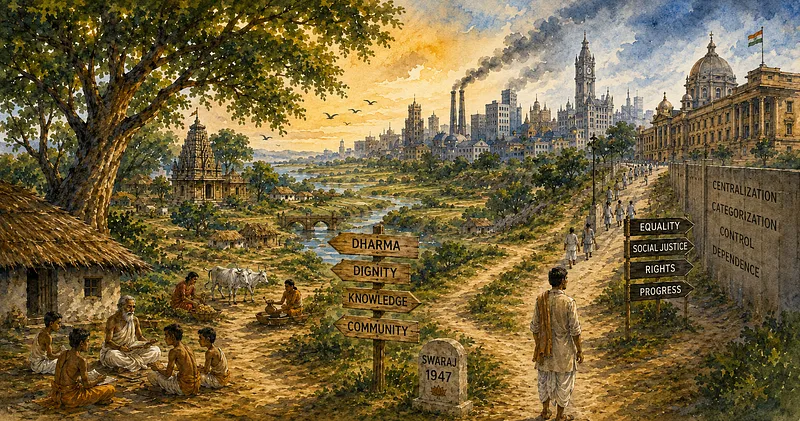
The moment of independence in 1947 carried both possibilities and limitations. It opened the door to the restructuring of inherited systems, yet much of the colonial framework remained intact. The postcolonial state inherited not merely institutions but also many of the assumptions embedded in them. Thus, while political sovereignty changed hands, the deeper grammar of governance, social classification, and public policy often remained continuous with colonial logic.
This continuity explains why many central debates in modern India, particularly those concerning affirmative action, welfare, inter-group relations, and the role of the state have become increasingly entangled and cacophonous. These debates are frequently conducted within inherited colonial conceptual frames rather than through a serious reconsideration of the systems that produced them. A systemic analysis, therefore, seeks to decouple contemporary issues from their immediate political noise and place them in relation to the worldview and doctrine that organize the modern state.
Social Incentives, State Doctrine, and the Problem of Backwardness
The modern state does not merely administer society; it actively shapes social aspiration through the categories it institutionalizes. When the state classifies communities through durable labels such as “forward” and “backward,” it creates a social ladder governed by policy incentives. Such categories become more than descriptive devices; they generate political competition, social psychology, and public expectations.
A central concern in this framework is that state doctrine organizes aspiration around backwardness. Before independence, when the British were categorizing social groups, most groups demanded to be classified as forward. As opposed to that, today most groups compete to be categorized as backward or scheduled, to avail incentives. Thus, a country that had a majority of forward groups as a poor, newly independent country, now has a majority of backward/scheduled groups in spite of developing into one of the world's strongest economies. If public competition increasingly rewards claims to disadvantage, society risks internalizing a downward spiral in which the removal of backwardness is no longer the explicit goal. In that case, even a national developmental vision such as “Viksit Bharat 2047” remains incomplete if it speaks only in economic terms. Economic transformation, while important, is ultimately an outcome of collective social effort. A meaningful national goal must also include the explicit removal of backwardness in intellectual, moral, institutional, and social terms.
Such a reorientation would require identifying and incentivizing the forces that propel society toward advancement rather than only managing the structures that preserve stagnation. The knowledge function becomes central in this respect.
The Primacy of Knowledge and the Need for a Whole-System Approach
One of the clearest indicators of systemic weakness lies in the deficiencies visible in knowledge generation. Whether in research, technology, manufacturing, or institutional innovation, contemporary shortcomings often trace back to a deeper erosion of the knowledge function. Although modern policy discourse increasingly acknowledges the importance of research and development, such recognition often remains fragmented and instrumental.
A systemic perspective requires treating knowledge not as a specialized sector but as one of the foundational functions of civilization. The generation, refinement, and transmission of knowledge shape every other domain, including governance, economy, and public ethics. For this reason, a civilizational future cannot be built on economic ambition alone. It requires a deliberate effort to place the knowledge function at the center of national aspiration.
Electoral Democracy and the Limits of Political Instrumentation
Another major issue concerns the way electoral democracy has come to dominate modern political imagination. In public discourse, criticism of electoral democracy is often treated as a rejection of democracy itself. Yet electoral democracy is only one instrument through which the democratic ideal may be realized. The broader principle at stake is the meaningful representation of public will and the accountability of institutions to that will.
The question, therefore, is not whether democratic ideals are valid, but whether current institutions adequately reflect public will, translate it into policy, and allow citizens to evaluate results. Universal adult franchise and periodic elections are important mechanisms, but they need not be treated as the final or only instruments available to human political evolution. The transparency, efficacy, and moral orientation of institutions matter just as much as their electoral legitimacy.
A more rigorous framework would therefore ask how institutions can better reflect public will without reducing political life to majoritarian arithmetic or rhetorical manipulation.
Public Will, Divine Order, and the Dhārmika State
In the dhārmika political imagination, public will is not necessarily opposed to a higher moral or cosmic order. Rather, it is complemented by what may be called divine will. Traditional Indian conceptions of rulership often treated the head of state as a representative of both. Legitimacy depended not only on sacred symbolism but also on public esteem. Without popular respect and acceptance, authority could not be sustained.
This differs from certain Western historical experiences in which the abuse of divine kingship produced a sharp opposition between divine authority and public sovereignty. Secular modernity, in those contexts, often displaced the divine with the public. A dhārmika framework does not require such displacement because it does not begin with the same antagonism. Instead, it seeks a harmonization between a higher ethical order and public legitimacy.
This harmonization has institutional consequences. It implies that the purpose of the state is not simply to manage competing interests but to cultivate conditions under which the highest forms of conduct become socially and politically meaningful. A national vision worthy of civilizational renewal must therefore seek not only efficiency or stability but also the moral elevation of public life.
Triguṇa and the Reimagining of State Architecture
A more radical critique of the modern state emerges through the framework of the three guṇas: sattva, rajas, and tamas. This framework is presented as a theory of reality with direct relevance to political design. Modern systems of governance, particularly those shaped by Western historical experience, are often built around the fear of tyranny. Their institutions therefore fracture power across the legislature, executive, judiciary, military, and security agencies in order to prevent domination.
While this arrangement may serve as a practical response to historical conditions, it reflects an incomplete understanding of human and social energies. Rājasika power is both feared and revered, and institutions are designed largely to restrain its excesses. Sattva, as a harmonizing and elevating principle, is only partially and inadequately represented. Tamas is often treated merely as inertia or stagnation rather than as a necessary principle of stability, continuity, and dissolution.
A dhārmika state architecture would not merely balance competing powers; it would seek a more holistic harmonization of functions. Rājasika force would be organized through executive and security institutions, sātavik force through the knowledge function, and tāmasika force through appropriate oblivion and awakening of awareness, and importantly the force of action. Without such a balance, political systems overemphasize conflict, mobility, and competition while neglecting integration and repose. The result is institutional fragmentation rather than civilizational harmony.
Sacred Geography and the Spatial Basis of Civilization
Civilizational renewal also requires recovering a meaningful understanding of geography. In this perspective, geography is not a neutral container of political administration but a differentiated field of sacred and functional significance. Categories such as puṇya bhūmi, karma bhūmi, tapo bhūmi, and jnāna bhūmi suggest that different landscapes are suited to different civilizational purposes. Likewise, the locations of jyotirliṇgas, shakti pīthas, tīrthas, and other sacred centers form a civilizational map through which social, spiritual, and political life were historically organized.
This understanding also shaped the identification of centers of governance, trade, and knowledge. Places such as Indraprastha, Pataliputra, and Ujjain were not random capitals but civilizational nerve centers from which multiple functions could be harmonized. A renewed statecraft rooted in Indian categories would therefore take geography seriously, not merely as territory, but as a source of civilizational intelligence.
Knowledge Sheaths, Social Landscapes, and Civilizational Continuity
The continuity of Indian civilization historically depended on the continuity between knowledge and lived space. Formal and rigorous knowledge traditions such as śāstra existed in organic relation to more practice-centered and narrative forms, including āgama, purāṇa, sthala-purāṇa, and local tradition. These constituted a layered system in which the highest theoretical abstractions remained connected to lived practice, regional memory, and social life.
This continuity also appeared spatially. Highly formalized centers of knowledge and governance coexisted with less formalized landscapes such as villages, pilgrimage routes, and forests. Each had a place in the civilizational whole. Modern policy, by contrast, often operates with a contempt for what is not organized according to bureaucratic rationality. The result is excessive formalization and over-urbanization without an integrating principle linking formal and informal life.
Understanding this earlier continuity is essential because it offers an alternative to both centralized abstraction and fragmented localism. It reveals a civilization capable of maintaining coherence across multiple levels of formality, practice, and knowledge.
Paurāṇika Pedagogy and the Recovery of Civilizational Consciousness
One of the most significant elements in this framework is the recovery of the paurāṇika mode as a vehicle of civilizational consciousness. Paurāṇika knowledge is not merely a repository of stories; it is a pedagogic and encyclopedic system that integrates metaphysics, ethics, geography, ritual, memory, and social life. It connects communities to sacred sites, to regional and civilizational history, and to the moral imagination necessary for collective continuity.
The erosion of this paurāṇika cognitive structure is identified as one of the most serious consequences of colonization. Modern historical method, while useful in certain respects, often remains detached from lived continuity. It presents the past as an object of post-mortem analysis rather than as a living presence. Paurāṇika narration, by contrast, sustains a form of collective consciousness in which knowledge, place, identity, and aspiration remain integrated.
The recovery of this mode is therefore not antiquarian. It is central to any future-oriented civilizational project because societies require not only information but also formative narratives that elevate character and harmonize collective life.
Identity, Jāti, Deśa, and Organic Social Cohesion
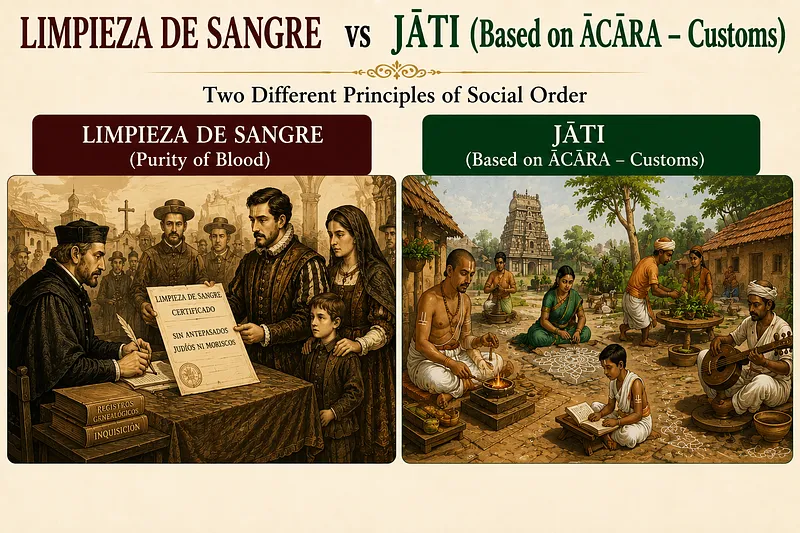
The social question in India is often reduced to jāti, yet this framework argues that such a reduction is itself a distortion. Jātis exist, but their current overemphasis obscures other historical motifs of cohesion, particularly sampradāya, deśa, and kula. Deśa, understood as a geocultural unit, is especially significant because it embodies regional continuity across time without negating civilizational unity.
The larger Hindu identity, in this view, need not conflict with these more specific forms of belonging. The problem arises when a supra-identity is left theoretically vague and becomes a vehicle for negating the very diversities it ought to include. A healthy civilizational identity must be capacious enough to contain deśas, sampradāyas, jātis, sacred geographies, and regional narratives within a broader dhārmika order.
Equally important is the recognition that Indian society has historically possessed forms of organic harmony. Large sampradāyas and long-enduring traditions demonstrate that unity did not need to be artificially manufactured. What existed was a form of natural cohesion grounded in functioning institutions and shared civilizational motifs. The task today is therefore not to engineer synthetic unity, but to understand and strengthen the institutions and motifs that already generate social harmony.
Narrative, Regional Vaibhava, and a New Cultural Program
A renewed civilizational program would involve narrating the greatness, history, and sacred geography of each deśa within the larger framework of Bhārata. Such a project would not be limited to conventional disciplines such as anthropology or history. It would constitute a distinct mode of civilizational narration grounded in pedagogy, memory, and cultural self-understanding.
Each region could recover and formally articulate its own vaibhava, its lineages, sacred centers, political achievements, and intellectual contributions without severing these from the larger dhārmika framework. This would generate a deeper and more stable form of pride than reactionary or fear-based identity politics. Pride would arise from recognition of inherited excellence and from the continuity of place, memory, and meaning.
Such narration would not fragment the whole. On the contrary, it would strengthen collective consciousness by allowing regional identities to flourish within a shared civilizational structure.
The deśa vaibhava brings to the fore the cultural geography and its continuity, while seeing the political as part of it. A grand narrative of itihāsika nature complemented with several "caritraka" narratives that are not all consistent across but only internally consistent, bring completeness to what can be called our own narrative through our own prism.
Nation, State, and the Reorientation of Public Institutions
A crucial distinction in this framework is that between nation and state. The nation is not an artifact created by the state; it possesses a prior and deeper civilizational reality. The state must therefore derive its institutions from that reality rather than attempt to impose an abstract order upon it.
This entails a fundamental reorientation of public institutions. Administrative policy, urban planning, educational design, and legal systems would need to recognize deśa, sampradāya, sacred geography, and differentiated human aims. Public life would no longer be designed solely around resource distribution or uniform management. Instead, it would seek to create conditions in which communities could pursue excellence according to their own functions and traditions, provided they did not violate the legitimate space of others.
Such an arrangement would likely foster greater ownership of public space, more beauty and diversity in civic life, and a stronger sense of belonging - as we see it has done in the past under Rāma, Yudhiṣṭhira, Vikramārka, Guptas, etc. Social harmony would emerge not from coercive uniformity but from appropriately structured freedom within a civilizational order.
Conclusion
A systemic analysis of India’s past and present reveals that contemporary conflicts cannot be resolved through policy adjustments alone. They are rooted in deeper questions of worldview, doctrine, knowledge, and institutional design. Colonial systems reconfigured the categories through which Indian society was governed and understood, while postcolonial continuity preserved many of these structures. As a result, debates over social justice, identity, democracy, and development are often conducted within conceptual limits inherited from a disrupted past.
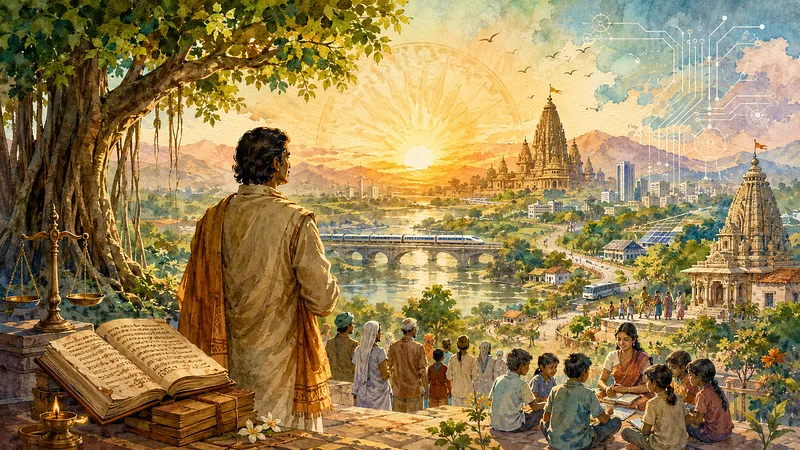
A meaningful future for Bhārata requires more than economic growth or administrative efficiency. It requires civilizational renewal grounded in indigenous categories of thought and organization. Such renewal must include the restoration of the knowledge function, the rethinking of political legitimacy beyond electoral reductionism, the recovery of sacred and civilizational geography, the recognition of organic institutions of social cohesion, and the reactivation of paurāṇika and dhārmika modes of pedagogy and public consciousness.
The future cannot be imagined merely as an escape from historical damage. It must be envisioned as the rearticulation of a civilizational order capable of an integral view across the diversity, enabling excellence and fulfillment, and harmonizing society through principles internal to its own traditions. Only then can the aspiration for national rejuvenation become something more than a developmental slogan. It can become a coherent and living vision of collective flourishing.
References:
Orient and Occident – III Structure - Knowledge - https://swarajyamag.com/analysis/orient-and-occident-iii-structure-knowledge
Corollaries of Cliché-s: Tolerance and Diversity - https://skandaveera.wordpress.com/2015/02/23/corollaries-of-cliche-s-tolerance-and-diversity/
Dharma Rajya Explained: Ancient India's Constitutional Framework for Modern Governance - https://youtu.be/TX8JKpU4SJU?si=ZNmSt2LoSFLnRTnN
Cultural Economy - https://www.youtube.com/watch?v=JpHe0NBmAjs
Idea of India, Unity and National Integration - https://arisebharat.com/2013/11/20/idea-of-india-unity-and-national-integration/
Shanti parva and Anushasana parva of the Mahabharata
Henry VIII and the Protestant Triumph - https://www.jstor.org/stable/1848586

.png)