.png)
“The realm of fairy-story is wide and deep and high and filled with many things: all manner of beasts and birds are found there; shoreless seas and stars uncounted; beauty that is an enchantment, and an ever-present peril; both joy and sorrow as sharp as swords. In that realm a man may, perhaps, count himself fortunate to have wandered, but its very richness and strangeness tie the tongue of a traveller who would report them. And while he is there it is dangerous for him to ask too many questions, lest the gates should be shut and the keys be lost.”
J. R. R. Tolkien, Tree and Leaf
Fairy tales seemingly occupy a paradoxical space in a child’s mind: they are fantastical and wondrous, yet at the same time deeply instructive, by being intimately concerned with teaching how to inhabit reality. To tell a child a fairy tale is to initiate them into a symbolic, culturally rich language through which the world becomes intelligible. Fairy tales contribute to the development of moral and cultural intelligence of a child, and also provide a crucial emotional grammar. A child, encountering fear, jealousy, loss, or hope within the secure confines of a story, is able to process these otherwise overwhelming emotions by identifying with the protagonist. The dark forest, the wicked stepmother, the long journey—these are not merely plot devices, but symbolic structures through which children rehearse their own emotional lives. Far from encouraging escapism, such narratives offer a controlled imaginative space in which emotions can be confronted, ordered, and ultimately resolved. This early engagement with symbolic struggle often equips individuals, later in life, with a greater capacity for emotional articulation and resilience, producing adults who are not less grounded, but more deeply adjusted to the complexities of human experience.
Yet postmodern criticism of fairy tales and myths attempts to render them obsolete in our dystopian, sanitized, tech-driven world, approaching them as narratives shaped by—and often reinforcing—older structures of power. Feminist critics, in particular, argue that many traditional tales reproduce rigid gender hierarchies: passive heroines, dominant male rescuers, and vilified older women, thereby limiting the imaginative and social possibilities available to children. From this perspective, the simplicity of these stories masks ideological work, encoding assumptions about beauty, authority, and virtue that reflect the societies in which they emerged. This has led to a proliferation of revisionist retellings that seek to subvert these patterns by granting agency to marginalized characters and complicating moral binaries. A contemporary example is Stepsisters, an upcoming Disney project that reimagines the Cinderella narrative from the perspective of the so-called “misunderstood” stepsisters. Criticism also draws attention to the violence and morbidity embedded in many tales—scenes of abandonment, cruelty, and punishment—questioning their psychological and ethical suitability for children. Yet even within this critique lies a tension, for others contend that it is precisely this darkness, when understood symbolically, that gives fairy tales their enduring depth and resonance.
Importantly, fairy tales sustain something that modernity actively erodes: our sense of wonder. They preserve an enchanted vision of the world in which meaning is layered, where the ordinary is suffused with possibility, and existence itself invites curiosity. “The child intuitively comprehends that although these stories are unreal, they are not untrue,” Bettelheim writes — they take place in faraway lands or in the distant past when things were different. The cultivation of this sort of enchantment with the world around us is not a retreat from reality, but an enrichment of it—cultivating imagination, deepening perception, and anchoring the child (and adult) within a cultural continuum of stories that have long shaped human consciousness. In this sense, fairy tales do not merely belong to childhood; they refine it, leaving behind a residue of wonder, moral clarity, and emotional depth that continues to inform one’s engagement with the world long after the stories themselves have been “outgrown”.
In most ancient societies, there is no clear separation between myth, folk, or fairy tale; together, they form the corpus of literature in these cultures. The Nordic languages have only one word for both: saga. In the Hindu universe, Purāṇa is “that which lives from ancient times”, and includes mythological and legendary lore. Bettelheim, in his writes that these tales are “the purveyors of deep insights that have sustained mankind through the long vicissitudes of its existence, a heritage that is not revealed in any other form as simply and directly, or as accessibly, to children.”
A myth, fable, and fairy tale might seem interchangeable, but they are narratives with fundamentally different intentions and modes of meaning. A fable is overtly didactic: a constructed narrative in which animals or even inanimate objects are made to speak and act like humans for the explicit purpose of delivering a moral lesson. Its structure is closed and unambiguous. The meaning is stated outright, often with a tone that can feel moralizing or cautionary. Nothing is left to interpretation; rather, the listener is told what to think and how to behave. A myth, on the other hand, is not such a straightforward moral sermon designed to regulate behavior through fear or instruction. Rather, it operates at a civilizational level. Myths address all the foundational questions in one way or another— on the origin of the world, the nature of existence, and the ideals that govern human life—in an authoritative manner. The myth becomes something to be lived and reenacted, shaping social practice and personal aspirations. The fairy tale, in contrast to both, moves away from prescription and toward suggestion. Like myths, fairy tales engage with enduring human questions: What is the world like? How should one live? How does one grow into oneself? Yet, unlike myths, they do not offer answers, but present symbolic narratives which are open to interpretation: the child is free to draw—or not draw—connections between the story and their own life. This openness is precisely what gives fairy tales their psychological power.
Fairy stories unfold in a manner that mirrors the structure of a child’s own thinking, where inner conflicts and emotions are experienced in vivid, often externalized forms. Characters and events stand in for internal struggles, making them graspable without the need for abstract reasoning. In fact, as Bettelheim observes, “The unrealistic nature of these tales (which narrow-minded rationalists object to) is an important device, because it makes obvious that the fairy tales’ concern is not useful information about the external world, but the inner processes taking place in an individual.” As a result, children often find deeper comfort and conviction in fairy tales than in direct or rational explanations offered by adults. The story “feels true” because it aligns with their inner experience of the world.
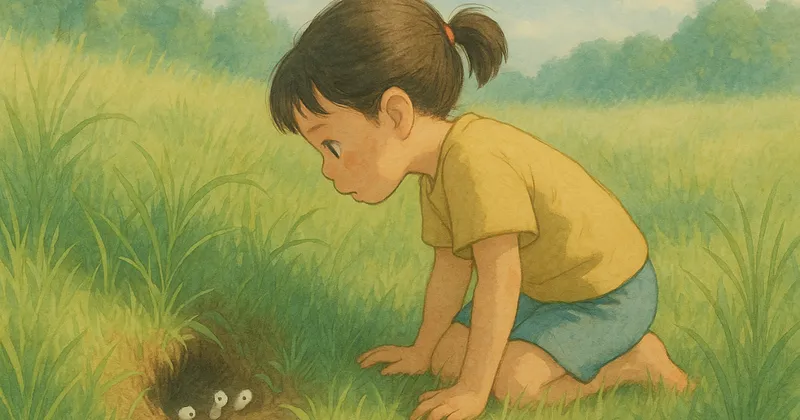
In addition, to the child, the boundary between the animate and the inanimate is not sharply drawn; what exists is alive, and alive in the same way that we are. If stones, trees, or animals seem silent, it is only because one has not yet learned how to listen and understand. In attempting to make sense of the world around them, the child quite naturally turns to these inanimate presences for answers, expecting them to respond. Being deeply self-centered, he imagines that animals speak his language of concern and feeling—as they do in fairy tales, and as he himself does when he speaks to real or imagined companions. The child is certain they understand him, even if they do not openly reply. It is therefore no accident that animals play such a central role in stories for children: they serve as familiar and sympathetic intermediaries, giving voice to the child’s inner life while guiding the narrative forward. Because animals move freely through the world, it feels natural that they accompany or direct the hero on distant journeys. And since all motion implies life to the child, even the wind may speak or carry the hero onward, as though the entire world were quietly alive and responsive to his quest.
Plato arguably had a better understanding of what shapes the human mind than many modern advocates of a strictly “realistic” or “rationalistic” upbringing. In his view, the education of future citizens in an ideal state must begin with myths, not factual information. Likewise, even Aristotle, an advocate of pure reason, acknowledged that: “The friend of wisdom is also a friend of myth.” Contemporary scholars approaching myth and fairy tale from philosophical and psychological perspectives have arrived at similar conclusions, despite their personal intellectual persuasions. Mircea Eliade, one of the most influential Western scholars on religious studies, for instance, characterizes folk narratives and mythological stories as paradigmatic structures for human conduct—forms that confer meaning and value upon life itself. Drawing on anthropological insights, he and others argue that the stories that forge a civilization either emerge from, or symbolically encode, either rites of initiation or rites of passage: processes that involve the figurative death of an inadequate former self and a rebirth into a higher plane of existence. He suggests that this explains their enduring psychological force, their embodiment of a strongly felt human need, and their capacity to articulate dimensions of the lived experience that ordinarily remain suppressed or outside conscious awareness.
“To ask what is the origin of stories (however qualified) is to ask what is the origin of language and of the mind.”
J. R. R. Tolkien, On Fairy Stories
Literary giants like J. R. R. Tolkien and Charles Dickens recognized the importance of fairy stories to early childhood development. Tolkien emphasised that all four essential qualities make a true fairy tale: fantasy, recovery, escape, and consolation. Recovery entails a renewal of spirit after experiencing despair; escape from real or perceived dangers; and above all, it necessitates the presence of consolation. The “happy ending” is intrinsic to the form and structure of the story and also its impact on the psyche. No matter how dark or perilous the journey, the ending uplifts and evokes an emotional response in the child. Through fairy tales, the minds of children are introduced to higher forms of thought and feeling, cultivating a sensibility that prepares them to engage more deeply with the greater works of literature and art.
Dickens recognized the profound influence that the magical figures and events of fairy tales had on his own imagination and artistic development. He was sharply critical of those who, guided by a narrow and ill-informed rationalism, sought to sanitize, dilute, or banish these stories altogether—thereby depriving children of their deeper value in life. For Dickens, the symbolic imagery of fairy tales serves a vital psychological function: it enables children to engage with and organize the otherwise unruly forces of their inner world. In doing so, the stories assist in the development of a more mature consciousness—one capable of bringing order and civility to the chaos of the unconscious. Bettelheim observes that “The fairy tale never confronts us so directly, or tells us outright how we must choose. Instead, the fairy tale helps children to develop the desire for a higher consciousness through what is implied in the story. The fairy tale convinces through the appeal it makes to our imagination and the attractive outcome of events, which entices us.” The fairy tale reinforces the conviction that a meaningful and fulfilling life remains attainable despite hardship—but only for those willing to confront the trials that forge a true sense of self. They suggest that courage in the face of uncertainty invites unforeseen assistance, as if unseen forces align with those who dare to start the journey. At the same time, they caution that those who are too fearful or complacent, and too weak-willed to risk transformation, are left to lead a humdrum existence—even if a worse fate may not befall them.
“Child of the pure unclouded brow
And dreaming eyes of wonder!
Though time be fleet, and I and thou
Are half a life asunder,
Thy loving smile will surely hail
The love-gift of a fairy-tale.”
C. L. Dodgson (Lewis Carroll), Through the Looking-Glass
As a cognitive and transformative experience crucial to childhood, stories, moreover, are meant to be heard, not read. Whether a fairy tale delights and creates a lasting impact on a child, or falls completely flat, depends solely on the spirit in which it is told. A loving grandmother who tells it with warmth to a child nestled close, listening in quiet enchantment, conveys something altogether different from a parent who, out of obligation, reads the same story without interest and monotonally. When the adult recounting the tale actively participates, it deepens and enriches the child’s experience. In that shared experience, the child feels seen and understood, their inner world is mirrored in the tale.
“Fairy tales describe inner states of the mind by means of images and actions.” In doing so, they perform a function no abstract discourse can replace: they translate the unseen movements of the psyche into forms that can be felt, remembered, and understood. Across civilizations, stories have carried forward not only cultural memory but also the symbolic structures through which individuals learn to orient themselves—morally, emotionally, and imaginatively—to the world. For the child, they offer a language of meaning; for the adult, they remain a reservoir of insight, allowing them to relive the most cherished moments of childhood and recall familial warmth. Their endurance of fairy tales lies precisely in their ability to shape our inner world while binding us to a larger cultural inheritance, ensuring that the deepest patterns of human experience are neither lost nor left unsaid.
References:
-
Tree and Leaf by J. R. R. Tolkien
-
The Uses of Enchantment: The Meaning and Importance of Fairy Tales by Bettelheim, Bruno

.png)