.png)
Introduction
This essay is the first in a series that argues for a systemic understanding of contemporary Indian social problems rather than a linear historical narrative centered on discrete actors, events, and isolated outcomes. For this, a four-level analytical framework consisting of worldview, doctrine, institutional architecture, and lived reality in order to explain the emergence of enduring social and political conditions needs to be adopted.
Through this framework, it is examined as to whether many present-day social problems should be understood as intrinsic moral failures of Hindu society or as the outcomes of long-term systemic subjugation. In particular, the colonial centralization, legal restructuring, altered forms of sovereignty, and transformations in urban planning and resource management in order to trace both civilizational continuities and the breakdown of those continuities is analyzed. A critique of the modern ideological responses to these developments is also presented, to present the argument that a more accurate understanding of India’s past requires reconstructing causation at the systemic level so that historical interpretation, state knowledge, and future institution-building may be grounded in civilizational reality rather than inherited ideological assumptions.
A Four-Level Framework for Systemic Analysis
By “systemic analysis,” it does not mean tracing every event from the bottom up or cataloguing every individual interaction. In a society as large and complex as India, such an approach risks producing endless chains of causation without analytical clarity. A more useful method is to identify the core principles by which the system functions. The four-level view of worldview, doctrine, institutional architecture, and lived reality helps with such an understanding.
Within this framework, lived reality is the manifest outcome of deeper structural forces. Policy, in the context of the state, is itself a visible product of institutional architecture. That architecture, however, exists to serve a doctrine, and doctrine emerges from a prior worldview. If one seeks to understand why institutions function as they do, or what kinds of systems might generate better outcomes, one must move upstream from policy and outcomes toward architecture, doctrine, and worldview. This contrasts with linear historical methods, which often focus on specific actors and incidents and then construct rival narratives around them. Although such methods may generate useful knowledge, they often obscure multi-causality, interdependence, and the relations among different levels of causation. A systems approach, by contrast, is better suited to understanding how different elements interact across levels and produce long-term outcomes. That is far closer to a dhārmika and dārśanika way of thinking about causation than the usual linear mode of modern historical analysis of the West.
Rethinking Social Injury and Historical Causation
This methodological distinction is especially important in the Indian context. Much modern discourse on colonial India begins with visible social outcomes and then imputes causation retrospectively. Bhārata, once one of the most populous and prosperous geo-cultural entities in the seventeenth and eighteenth centuries, was reduced within a relatively short period to an impoverished society under colonial rule. Yet the interpretation of this transformation has often been framed narrowly in economic terms and attributed to internal moral failures of Hindu society. In this way, systemic subjugation came to be reinterpreted as a society oppressing itself. Once this reframing was accepted, the entire oppressor-victim lens was altered. This interpretive shift continues to influence policymaking by justifying a transformative state that assumes a permanent role in reshaping society according to an inherited narrative.
This raises a foundational question: does the presence of a social injury necessarily prove intrinsic moral failure within society, or might it instead reflect systemic conditions that affected all groups, albeit asymmetrically? Discussions of feudal or social structures in India have often lacked this systemic clarity and have instead fallen back on abstract moral blame assigned to social groups without reconstructing the institutional and historical conditions within which those groups operated.
Broken Continuities: Sovereignty, Rule, and Civilizational Disruption
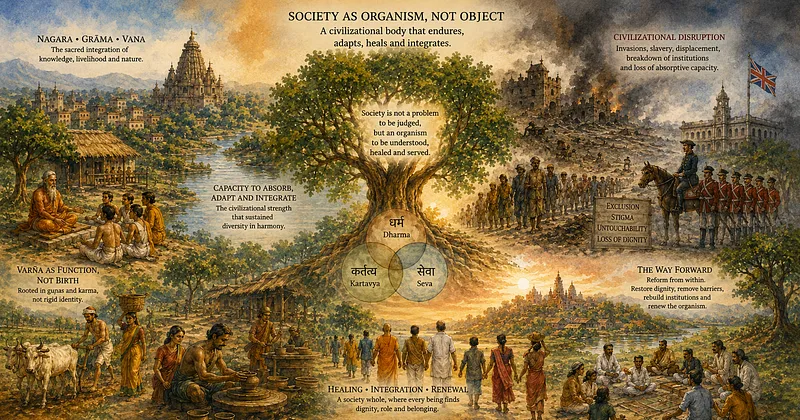
The central issue is not merely who ruled India, but how legitimacy and sovereignty were organized. The continuity of Hindu civilization, extending from the sovereign level down to local institutions such as the grāma, nagara, vana, and pattana (port town), had already been partially disrupted under earlier regimes of Muslim rule. The urban systems established under those regimes functioned differently from the earlier Hindu civilizational order, and these differences had far-reaching social consequences.
Among those consequences was the creation or expansion of forms of manual and segregated labor within an urban order fundamentally distinct from the earlier one. Occupations such as scavenging, butchery, and leather work, along with slavery and other imposed institutional arrangements, generated new forms of social separation and spatial distinction. Different communities increasingly required separate zones in order to maintain their own practices. By the time British power consolidated itself, Hindu society, in this account, was already operating under conditions of civilizational damage produced by centuries of prior subjugation. The British did not enter an ideal or socially intact order; rather, they inherited and then further transformed an already deformed system.
The Limits of Maratha Recovery
The Marathas did attempt various corrections and recoveries. Their urban and administrative systems, were superior to those that preceded them, and they reclaimed some degree of self-administration. However, they lacked the civilizational leisure required to re-architect the social order in a deep structural sense. Their political energy was directed toward preserving sovereignty, confronting external threats, and resisting European powers, including the French, Dutch, Portuguese, and British, rather than toward reconstructing the social body from the ground up. High taxation and constant military pressure prevented the emergence of a stable period of prosperity in which broader civilizational renewal might have become possible. As a result, social correction remained partial rather than systemic.
Colonial Centralization and the Reconstitution of Sovereignty
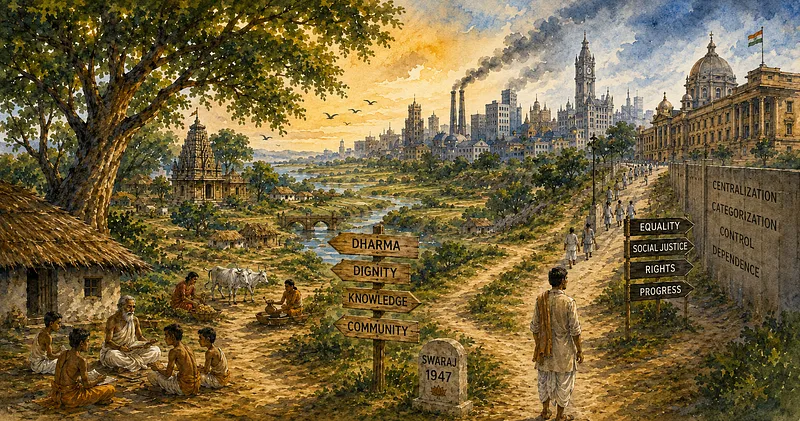
The decisive transformation came under Crown rule. Whereas Company rule often involved negotiated arrangements and layered sovereignties, Crown rule formalized de-jure political centralization. Once this shift occurred, all structures in India became subordinate to institutions operating under the Crown. What had previously been negotiable, including the balance between local and central authority, the scope for local traditions, and the autonomy of village and community life, was subsumed under centralized legal sovereignty.
The consequences were profound. The individual, village, kula, deśa, sampradāya, princely state, feudatory, and jāgir now derived legitimacy only through the Crown. Institutions no longer existed primarily to serve their own social and civilizational contexts; instead, they were increasingly reoriented toward imperial authority. This amounted to the de-jure disempowerment of local units.
This centralization also transformed law and systems of knowledge. Under earlier arrangements, civil and personal law could continue to operate through local traditions. Under Crown rule, however, collective and locally embedded legal systems were increasingly displaced by centralized codification and common-law structures. Traditions such as Dharmaśāstra, which had historically remained in dialogue with changing social realities, were interrupted and marginalized. This raises a key analytical question: if the imposed institutional structure was not continuous with the traditional Hindu social order, on what basis can that social order be held causally responsible for social outcomes produced during the century or more of centralized colonial rule?
Representation Without Autonomy
The redistribution of power under colonial rule was strategic rather than genuinely decentralizing. After the formalization of Crown rule in 1858, successive constitutional developments, including the Indian Councils Act of 1861, the Councils Act of 1892, the Morley-Minto Reforms of 1909, the Montagu-Chelmsford Reforms of 1919, and ultimately the Government of India Act of 1935, gradually expanded representation. Yet this process did not restore autonomous sovereignty. Power had first been concentrated at the top and was then redistributed in carefully controlled phases. The Crown retained the authority to determine where power would be distributed and to whom. Even princely states could only exercise authority within the framework sanctioned by imperial sovereignty. They could not independently pursue prosperity or enact policy outside imperial constraints. Representation, therefore, operated within a narrative and institutional structure established by centralized colonial rule rather than within a genuinely restored indigenous political order.
From Political Feudalism of the Marathas to Social Feudalism of the British
The Maratha approach was largely political feudalism: land grants, revenue rights, and territorial incentives were used to encourage allied groups, including the Sikhs, to expand control, reclaim territory, and collect taxes. The objective was political consolidation and territorial recovery.
British rule changed the nature of this arrangement. Through legalism, codified property rights, revenue settlements, and debt enforcement, the British tied land, labour, and obligation into a rigid social structure. Inherited debts, landlord control, and legal dependence created conditions resembling serfdom, where a person no longer had meaningful freedom to choose their profession, employer, or social position.
In the earlier Hindu social order, a person may have been bound to a patron, ruler, or master, but there remained some possibility of altering that relationship. A serf possesses more liberty than a slave, but less liberty than a free labourer.
The combined effect of older systems of enslavement under Muslim rule and the later British system of legally enforced rural dependence weakened both dignity and liberty among Hindus. Over time, society itself became increasingly feudalized, not merely in politics, but in social relations, labour, landholding, and everyday life.
Resource Management, Water Systems, and Social Tension
One of the most significant but understudied consequences of colonial restructuring lay in resource management and urban planning, particularly in relation to water systems. Many communities, including those later categorized as Scheduled Castes, may have lost more than they gained when decentralized village-level water systems were replaced by large canals and reservoirs in the twentieth century. The example of Varanasi is instructive. Earlier urban and ritual life had been supported by a large number of small and context-specific water bodies serving distinct functions such as temple use, ritual practice, laundry, burial, cultivation, and everyday domestic needs. This arrangement corresponded to a decentralized worldview in which different groups and purposes had access to distinct spaces and resources.
When such systems were replaced by fewer and larger reservoirs, communities that had once used differentiated spaces were compelled to converge upon the same sites of access. This produced tensions over ācāra, ritual purity, hygiene, and social conduct. Such tensions, in this interpretation, were generated not solely by abstract social prejudice but by a transformed system of resource organization. In other words, conflicts later remembered as purely social or moral may also be understood as administrative and infrastructural distortions produced by systemic change.
Policing, Recruitment, and the Displacement of Traditional Service Communities
A related line of inquiry concerns the transformation of policing and local service structures under British rule. In many regions, communities that had previously served in village-level security or military-support roles, including groups later categorized among Scheduled Castes and Scheduled Tribes, were displaced when indigenous policing and military arrangements were replaced by a centralized British system. As recruitment increasingly came to depend on colonial forms of literacy, credentialing, and administrative compatibility, older service communities lost access to occupations that had once anchored their place within local society.
This occupational displacement appears to have been compounded by the erosion of associated land allocations, the weakening of customary entitlements, and exclusion from local resource networks, including access to village water bodies. The broader implication is that colonial administrative rationalization did not merely replace one occupational structure with another; it redefined the criteria of legitimacy and employability in ways that marginalized communities whose roles had been embedded in older institutional orders. Thus, the rise of literacy as a criterion within colonial recruitment policy cannot be treated as a neutral marker of progress alone. It also functioned as a mechanism through which previously integrated service groups were dispossessed of vocation, land, and social standing.
Centralization, Administrative Distortion, and Misrecognition
The replacement of many small water bodies with a few large reservoirs was consistent with a broader colonial logic of centralization. Centralized systems were cheaper to maintain and easier to administer from above. Yet the social contentions generated by this restructuring were left for local community to negotiate. Over time, public discourse remembered the contention but forgot the institutional changes that had produced it. Problems that ought to have been analyzed as administrative and resource-management distortions came to be understood exclusively as social pathologies. This is one reason such issues continue to be misunderstood. Serious research into their systemic and administrative origins remains pending.
Knowledge, State Narrative, and Ideological Response
These distortions have broader intellectual and political implications. Once textbooks, media discourse, and political narratives normalize a distorted version of social history, the Indian state effectively reproduces that account before the world. External actors can then repeat the same narrative back to India while claiming merely to reflect India’s own internal self-understanding. Under such conditions, contesting those narratives becomes difficult. Therefore, this emphasizes the knowledge function of the state: if the state seeks a healthier future, it must invest in recovering factual and civilizationally grounded understandings of these historical processes. It must also ask what kind of system is appropriate to Indian society, rather than continuing to operate within the same centralized worldview inherited from colonial rule.
Many pre-independence and post-independence characterizations of Indian society were already flawed because they lacked a systemic perspective. What is often described as “feudalization” in India, for example, may not be analogous to European feudalism and may instead have been produced by state-driven institutional transformations rather than by society independently commoditizing land. Communist thinkers, in this view, often treated Indian society itself as a co-oppressor without distinguishing between a society functioning under imposed systemic constraints and one operating as the primary source of oppression. Hindutva responses, by contrast, are emotionally reactive rather than systemically analytical, and therefore insufficient for envisioning what India’s future institutional order ought to be.
Conclusion
The claim is not merely that colonialism harmed India or that historical narratives are biased. It is that India’s colonial and social history has been fundamentally misread because systemic causation has been ignored. Without such analysis, injuries produced by conquest, political centralization, transformed legal orders, broken civilizational continuity, and distorted resource management came to be interpreted as self-generated defects within Hindu society. Once this interpretation hardened, it became embedded in doctrine, policy, and public morality. The task, therefore, is not only to revisit history but to reconstruct causation, restore factual understanding, and think seriously about what kind of institutional system Indian society actually requires.
------------------------------
Part Two of this series.
Part Three of this series.
Part Four (Final) of this series.
References
- Gandhi, M. K. Hind Swaraj and Other Writings. Edited by Anthony J. Parel. Cambridge: Cambridge University Press, 1997.
- Gogate, Mahesh. The Sacred Waters of Varanasi: The Colonial Draining and Heritage Ecology. Manohar Publishers and Distributors, 2023.
- Khandavalli, Shankara Bharadwaj. “Four Level View of Systems.” Academia.edu. Accessed May 5, 2026. https://www.academia.edu/110498259/Four_Level_View_Of_Systems.
- Lal, K. S. The Legacy of Muslim Rule in India. Aditya Prakashan, 1992.
- Lal, K. S. Theory and Practice of Muslim State in India. Aditya Prakashan, 1999.
- Lal, K. S. Growth of Muslim Population in Medieval India. Research Publications in Social Sciences, 1973.
- Lal, K. S. The Growth of Scheduled Tribes and Castes in Medieval India. Aditya Prakashan, 1995.
- Mackenzie, Colin. Catalogue of Mackenzie Kaifiyats. Dev Publishers and Distributors, 2019. Accessed May 5, 2026. https://www.namami.gov.in/sites/default/files/book_pdf/kaifiyats%20complete%20book.pdf.
- Rai, Lala Lajpat. England’s Debt to India. PUBLICATIONS DIVISION, Ministry of Information and Broadcasting, Governmentof India, 1967.
- Rai, Lala Lajpat. Unhappy India. Banna Publishing Co., Calcutta, 1928.
- Madras Presidency, Public Works Department. Preliminary Report on the Investigation of Protective Irrigation Works and on Irrigation under Wells in the Madras Presidency. Madras: Government Press, 1902.
- Government of India. Report of the Indian Irrigation Commission, 1901–03. Calcutta: Superintendent of Government Printing, 1903.

.png)