Introduction
This is the third part in the four part series of looking at a systems-oriented reading of Indian social history that requires a shift away from isolating social phenomena as self-explanatory moral failures and toward understanding them as outcomes of deeper institutional, civilizational, and historical processes. The first and second parts of this broader inquiry examined the long arc from the early modern period to 1947, and then the post-1947 period, with attention to centralization of power, the consolidation of a monolithic state form, and the enabling conditions of feudal structures. Those analyses raised a central question: if the argument is that civilizational disruption, administrative centralization, and distorted incentives have driven many social pathologies, how should one understand the specifically social dimension of these problems?
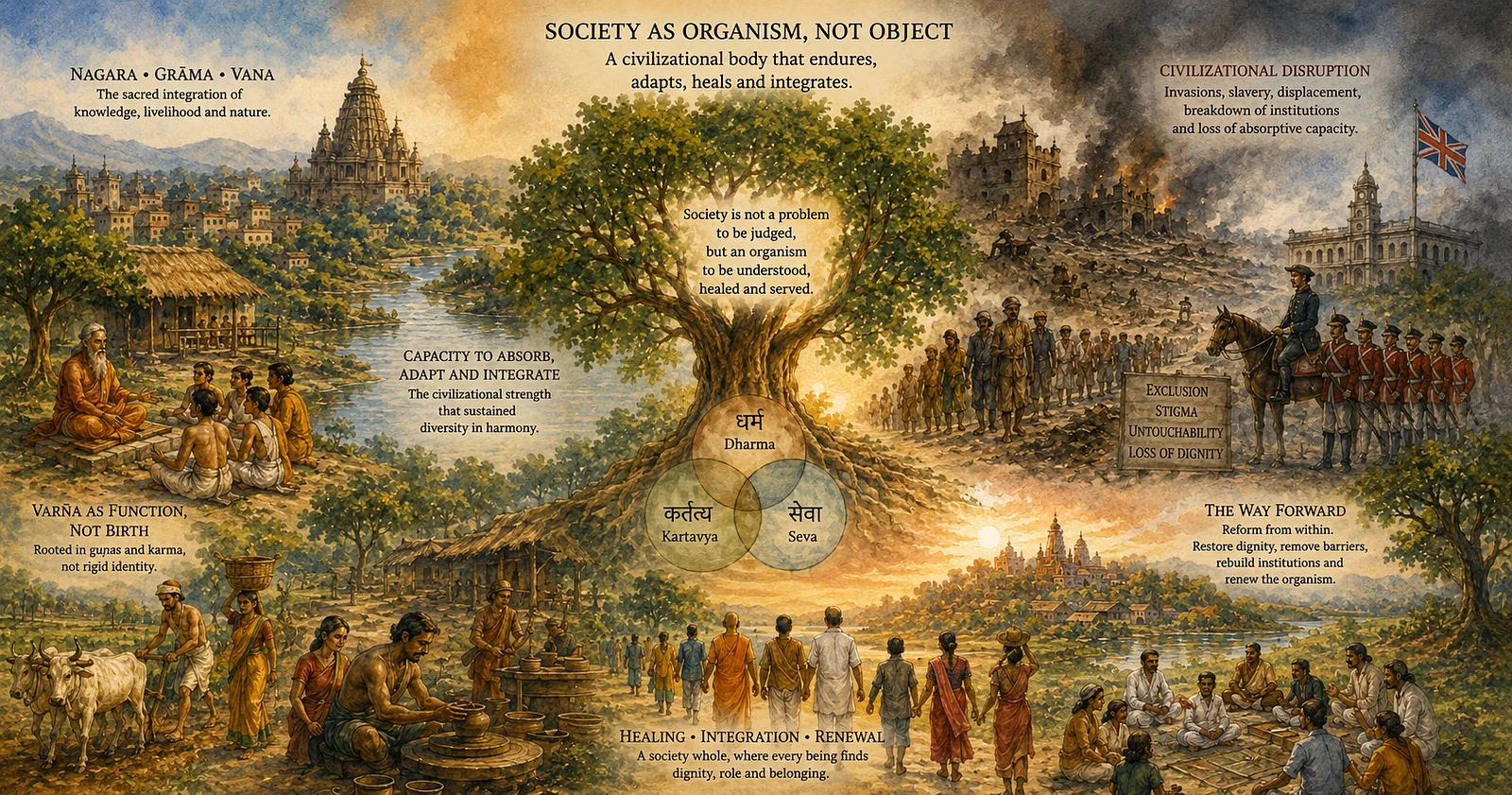
This question becomes especially pressing because any defense of a sacred civilizational core, or of the integrative relationship among nagara, grāma, and vana, can appear evasive unless it also addresses difficult matters such as caste, untouchability, exclusion, and temple access. If Hindu civilization is understood as having been held together by a sacred principle diffused across multiple pedagogical, ritual, and knowledge systems, then one must also clarify what that implies for the social order, for ethics, and for reform. The present essay addresses that issue by arguing that the relevant framework is not “society as a problem,” but “society as having problems.” This distinction is foundational. Society is not an external object to be judged and redesigned from without; it is an organism of which one is a part, and whose disorders must therefore be understood relationally and addressed from within.
Society as Organism, Not Object
The first conceptual correction required is to abandon the habit of treating society itself as inherently pathological. The social body must instead be understood as a civilizational organism that, like any organism, encounters distortions, injuries, and maladaptive responses under historical pressure. This shift in the prism is not merely rhetorical. It alters the moral and political stance of inquiry. When society is treated as an object of judgment, the reformer places himself outside it and assumes the authority to classify, condemn, and transform. When society is treated as an organism to which one belongs, the task becomes one of understanding, healing, and service.
This distinction also bears on the way inherited categories are discussed. Much of modern discourse presumes that social hierarchy in India can be straightforwardly explained through fixed and oppressive categories that are both socially exhaustive and normatively self-evident. The categories inherited from śāstra are not equivalent to modern sociological labels, and the social world historically operates through more layered and dynamic arrangements than contemporary discourse allows.
Varṇa, Mixture, and the Misframing of “Avarṇa”
From the śāstrīya perspective, there is no “fifth varṇa” in the strict sense. The fourfold varṇa schema is derived from the interplay of the three guṇas - sattva, rajas, and tamas, and corresponds to broad functional dispositions: knowledge, protection and power, wealth and abundance, and action. These are not merely social identities but expressions of underlying qualities discernible across existence. Varṇa is not a narrow social construct but a universal classificatory principle, analogous to other cosmological taxonomies such as the triguṇa and the pancamahābhūta.
Within such a framework, however, actual human groups need not map neatly onto pure or idealized forms. Since all persons embody the guṇas in mixed measure, there can be countless miśra varṇas; mixed dispositions that do not manifest any single quality in perfect form. No human being can be “without qualities”; rather, there are many mixed conditions, many liminal groups, and many communities whose location in relation to the fourfold schema is historically contingent. The category of “pancama,” therefore, has been badly conflated in modern discourse into the idea of a “fifth varna,” when in fact the original conceptual terrain was more complicated.
The figure of the Caṇḍāla illustrates this complication. Such groups do not fit neatly into a single classificatory slot, nor were they uniformly treated across contexts. Similarly, ascetics, ṛṣis, and other socially atypical categories stood outside ordinary occupational classification without thereby constituting a separate “varṇa.” Historically, Indian society possessed a significant capacity to place incoming or marginal groups somewhere within an existing social matrix and, over time, absorb them toward the center. This absorptive vitality was disrupted by prolonged civilizational stress.
Civilizational Decline and the Loss of Absorptive Capacity
The periods of Islamic and then British domination were major turning points. These periods did not merely produce political subjugation; they weakened the social organism’s absorptive capacity while simultaneously increasing the number of displaced, uprooted, and functionally invalidated communities. War, slavery, demographic influx, disruption of older occupations, and the collapse of urban-rural institutional balance all contributed to a situation in which many groups lost both social relevance and pathways of mobility. Since the society was in a shrinking rather than expanding phase, its ability to reassign and integrate such groups declined sharply.
Social mobility did historically exist, though not always in the manner modern discourse expects. Mobility did not necessarily require formal recategorization of a group’s varṇa. Political power, economic rise, and military assertion could occur without ritual transformation. Numerous ruling lineages emerged from groups that would have been classed as Śūdra, and warriorhood itself did not automatically amount to Kṣatriya status. The latter involved not merely martial function but a form of cultivated intellectual and samskārika life. Thus, the social order historically accommodated movement, but that movement was not reducible to modern notions of egalitarian mobility or formal legal reclassification.
During periods of civilizational devolution, however, even the fourfold schema itself was functionally compressed. In many regions, social life operated as though reduced to a narrower and less differentiated structure, while full ritual elevation became rare or impracticable. This is not evidence of the rigidity of the original system, but as evidence of its degradation under historical pressure. Corrective efforts in the modern period did occur, like that of Sh. Ganapat Muni who sought to recover a fourfold absorptive order. Yet such correction cannot be systematized without broader social legitimacy and institutional capacity.
Untouchability as Colonial Phenomenon and Conceptual Distortion
“Untouchability” as a singular, reified social phenomenon was a colonial construction that collapsed multiple distinct realities into one polemical category. In the śāstrīya world, sparśa and asparśa are technical and contextual matters. They may be linked to ritual time, funerary practices, observances of śauca, or mutual distinctions between communities with differing ācāra. No person is absolutely untouchable in all contexts; rather, touch and non-touch are situational, relational, and often reciprocal.
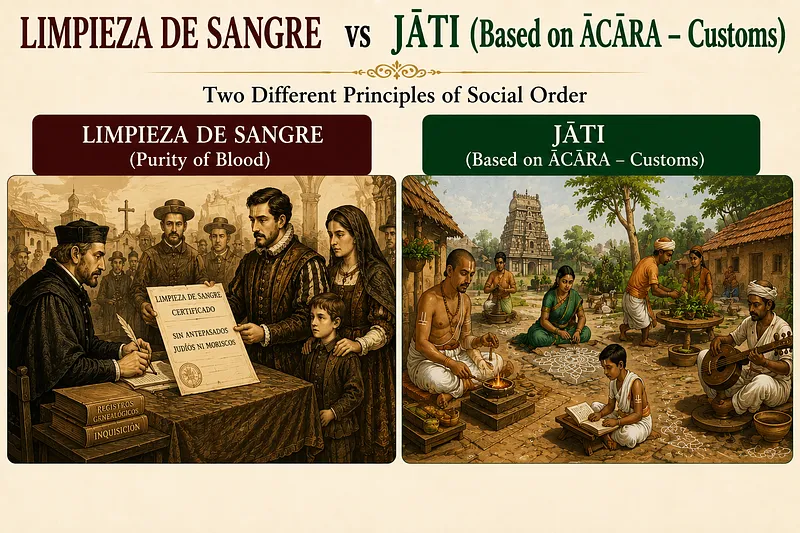
This contextuality matters because mutual non-mingling for purposes of ritual order, resource separation, or distinct communal practice is not equivalent to the modern accusatory sense of untouchability as an all-encompassing stigma. Colonial and later ideological discourse transformed a set of varied practices into a single moralized phenomenon and then used that phenomenon to define Hindu society as such. In doing so, it stripped public understanding of the spiritual and disciplinary significance of śauca and ācāra, and replaced an internal grammar of distinctions with an external grammar of oppression.
When centralized resource structures replace distributed ones, power differentials enable exclusion. If water sources are aggregated and communities are forced into competition over a smaller number of access points, stronger groups can deny access to weaker ones. In such cases, the problem is real and morally urgent. One must distinguish between a society’s maladaptive response to stress and a supposed essence of the society itself. Resource denial, subjugation, and exploitation are to be addressed as problems within society, not as proof that the entire tradition is inherently immoral.
The Failure of the Postcolonial Solution
The postcolonial state, thus, failed because it attempted to solve such problems by invalidating tradition rather than by restoring the conditions under which society could regulate itself and heal its own distortions. The assumption was that if one removed traditional practices or categories, the associated injustices would vanish. This is conceptually incoherent. So long as Hindu life continues to involve notions of śauca, discipline, ritual distinction, and differentiated practice, similar tensions will recur unless they are properly understood and institutionally mediated. Mere abolitionist language, on this view, cannot resolve the issue. Either one abolishes Hinduism itself, or one undertakes the deeper intellectual and institutional work needed to place these practices within a coherent and just framework.
As per Āyurvedic analogy, health is not achieved simply by eliminating symptoms, but by restoring the proper order of the organism. Similarly, a healthy society requires its balancing principles to be understood and re-ordered, not merely condemned. This is why the moral impulse that seeks to excise difficult portions of tradition without adequate conceptual clarity should be critiqued. Such a moral concern may be sincere, but sincerity does not substitute for root-cause analysis. Modern discourse often proceeds from “naked-eye observation” of suffering directly to the conclusion that tradition itself is the cause, while ignoring the role of civilizational breakdown, administrative centralization, and systemic distortion.
The Limits of Reformist Judgment and the Problem of Hindutva
Hindutva cannot be defined narrowly as a single ideology, but as a spectrum of movements representing the survival instinct of Hindu society over the past century. These movements emerged in response to real threats and articulated important collective anxieties. Nevertheless, they did not generate sufficient intellectual clarity about the social and civilizational questions they inherited. Repeating formulations produced a century ago without learning from subsequent developments is presented as both inadequate and dangerous.
One consequence of this lack of clarity, is the adoption of the same external, judgmental prism that colonial and left-liberal discourse used. Rather than owning society from within, many reformist approaches came to speak over society, imputing guilt and demanding transformation through shame. This was both costly and ineffective. Bottom-up moral correction of society, especially through generalized accusation, burdens the very social body that has already entrusted leadership with the task of protecting and representing it. The proper responsibility of organized leadership is not to moralize against society, but to generate the knowledge and institutions needed to solve the problems society faces.
The state compounds the problem by constructing crude legal and demographic categories. Tribal groups, caste blocs, and the remainder of society are treated in administratively flattened ways that fail to capture the actual diversity of social forms. Electoral incentives then encourage the consolidation of ever-larger identity blocs, eroding smaller, culturally precise units such as kula, deśa, and sampradāya. In this setting, conflict becomes politically profitable while fine-grained social functions wither. The result is a state structure that incentivizes social coarsening rather than civilizational refinement.
System Before Society: The Primacy of Institutional Order
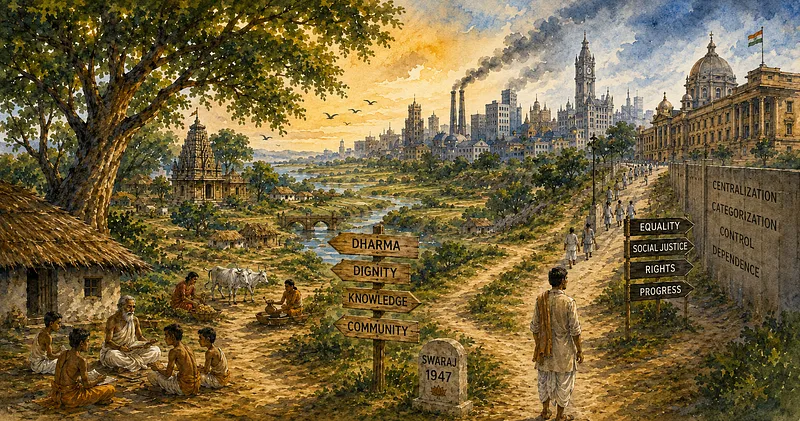
Society cannot be expected to rise before the system is corrected. The conduct of the state shapes the conduct of society. Just as corruption in an organization flows downward from leadership, social disorder is intensified when the state itself is distorted in character and purpose. The widespread tendency to demand that “society reform itself” before structural correction occurs is a backwards approach. If institutional incentives remain misaligned, society will continue to respond defensively, aggregatively, and often acrimoniously.
This is not an argument against social effort or local reform. There have been sacrifices and good faith of many social and religious movements. The question is whether the enormous social investment made in these movements is yielding the best possible outcomes. Bottom-up reform, especially when it relies on guilt and abstraction, is not only expensive but potentially counterproductive. Systemic correction: policy, institutional creation, and restoration of self-governance, is therefore a precondition for healthier social evolution.
Temple Entry, Resource Access, and Institutional Creation
Let’s distinguish between universalized accusation and localized diagnosis. Not every issue described as “temple exclusion” is religious in the same sense. Large kṣetras, tīrthas, and mass pilgrimage institutions are said not to have historically exhibited the same exclusion patterns attributed to certain village-level disputes. Where exclusion exists in the latter context, it is often bound up with resource denial, local power struggles, and the shrinking of previously diversified sacred infrastructure. If villages that once had many temples are reduced to one or two, then aggregation itself generates conflict.
The solution is neither forced homogenization nor passive traditionalism. Instead, there is a need for the creation of new institutions. If a town requires a temple or shared sacred space to which all have access, that should be built and maintained as such. The state or local institutions should create exemplary models rather than coercively rewriting existing traditions. This is more consistent with how Hindu civilization historically evolved: by synthesis, generation, and the creation of new forms rather than by flattening all existing distinctions. If such newly created institutions are compelling and functional, they will spread organically.
Institutional creation is also linked to older patterns of social adaptation, such as the emergence of larger community formations when older, more granular structures became insufficient. Social problems are best addressed by generating new vehicles that remain civilizationally intelligible, rather than by imposing abstract reforms from an external standpoint.
The “In-Prism” and Habits of Civilizational Thought
We need to contrast an “out-prism,” which judges society from an external vantage, with an “in-prism,” which approaches tradition as something one inhabits, serves, and seeks to understand from within. This is not a call for uncritical acceptance. Rather, it is a call for disciplined belonging. One must not seek validation from frameworks that are simultaneously premised on the negation of one’s own civilizational categories.
First, there must be intellectual humility before the enormity and complexity of inherited traditions. An arśa dharma cannot be mastered through superficial reading or hasty judgment. Second, there must be rigor in method, whether one proceeds through vaidika study, the vedāṇgas, ritual discipline, or more accessible lifelong pedagogies such as the Rāmāyaṇa, Mahābhārata, and Bhāgavata. Third, judgment must be suspended until one has genuinely encountered one’s own side of the story. The contemporary discourse on caste, untouchability, and discrimination is overwhelmingly shaped by outsider narratives, while the civilizational self-understanding of these phenomena remains underdeveloped. The urgent need, therefore, is not apologetics, but the recovery of indigenous categories, pramāṇas, and original questions.
Conclusion
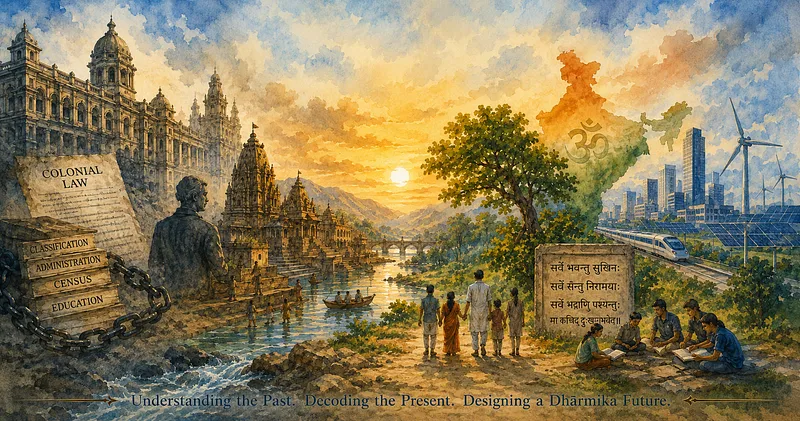
Social disorders in Hindu society cannot be understood adequately through the prevailing moralized framework that treats society itself as the problem. A systems perspective reveals instead a complex interaction of civilizational decline, political centralization, administrative distortion, conceptual mistranslation, and failed reform. Categories such as varṇa, pancama, and untouchability have been flattened and redefined in ways that obscure both their historical complexity and their relation to broader institutional breakdown. Likewise, contemporary solutions often fail because they proceed by external judgment, social shaming, or abolitionist simplification rather than by institutional creation and civilizational self-understanding.
What is required is neither denial of suffering nor romanticization of the past, but a more exacting mode of inquiry: one that owns society, distinguishes between organism and disorder, restores the primacy of systemic correction, and develops the intellectual humility necessary to think from within a living tradition. Only then can social reform avoid becoming another form of civilizational self-erasure.
References
-
Ganpat Muni, Pancha Jana Charcha
-
Ganpat Muni Panchama Mimamsa
-
Dharmashastras
-
K. S. Lal, The Legacy of Muslim Rule in India,
-
K.S. Lal, Theory and Practice of Muslim State in India
-
K.S. Lal, Growth of Muslim Population in Medieval India
-
K.S. Lal, The growth of Scheduled Tribes and Castes in Medieval India
-
M. N. Srinivas, Social Change in Modern India
-
N. Takakhav, The Life of Shivaji Maharaj - https://gathacognition.com/uploads/admin/articlefiles/Chapter_23_R2.pdf
-
Swami Karpatri Ji: The forgotten Dharma Samarat - https://pragyata.com/swami-karpatri-ji-the-forgotten-dharma-samarat/

.png)