Introduction
This is the second essay in a series that seeks to examine our history through the lens of systems, so that we may develop an original narrative - one that is neither borrowed nor received, and one that is not beholden to colonial priors.
In the first essay, we traced the trajectory from the early eighteenth century to 1947 by examining systemic questions. How should we understand, in a holistic way, the changes that took place in Indian society, particularly within Hindu society? Did some groups suddenly turn malicious? Were some groups co-opted, or did they begin co-opting others for the sake of incentives and benefits? Was it merely a historical accident? Or was it due to some fundamental weakness in theology? All these narratives are present around us. The effort, however, was to look at the issue afresh through the lens of administration, systems, and what happens when systemic change and the centralization of power take over.
The Legacy of Systemic Subjugation
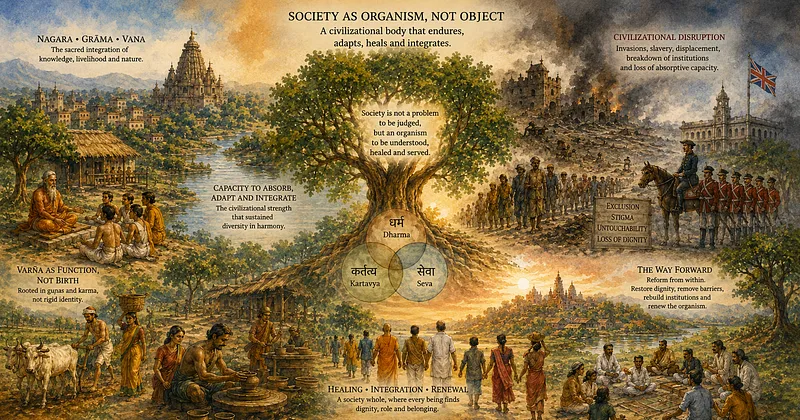
In the first part of this article series, we discussed the main components of systemic subjugation. One was the British urban system and how it replaced the civilizational continuity that spanned vana, grāma, nagara, and pattana (port town). We examined what this meant for different groups, how the breakdown occurred, how discontinuities emerged between the urban and the tribal, between those within the village and those outside it, and what this meant for access to resources. We also discussed the institutional impact of feudalization and how it took a particular form in our subcontinent. Although there were feudal trends before British rule, they were essentially political in nature, with intermediary layers of power incentivized to collect taxes as part of the Maratha reclamation of de-facto power and control. What happened under British rule was a formalization of serfdom and social feudalism, with legal binding of labor to land, inherited debts, loss of liberty to profession for the serfs, etc. We also considered the destruction of traivarṇika functions - knowledge functions, power structures, and mechanisms of wealth generation within society. Then there was the centralization of power and its phased decentralization after the Crown rule, and the manner in which power was incentivized and distributed to subversive elements. Institutional capture was thus completed. Even when power was devolved, it was devolved to people whose incentive structures remained aligned with centralization. This also led to the loss of liberty and dignity for both society and individuals. The story, therefore, should be seen as one of the systemic stripping away of dignity, access, and mutual harmony, and of the way power entrenches itself through institutions, until de jure arrangements become de facto realities in Indian society.
The Missed Priorities of Independence
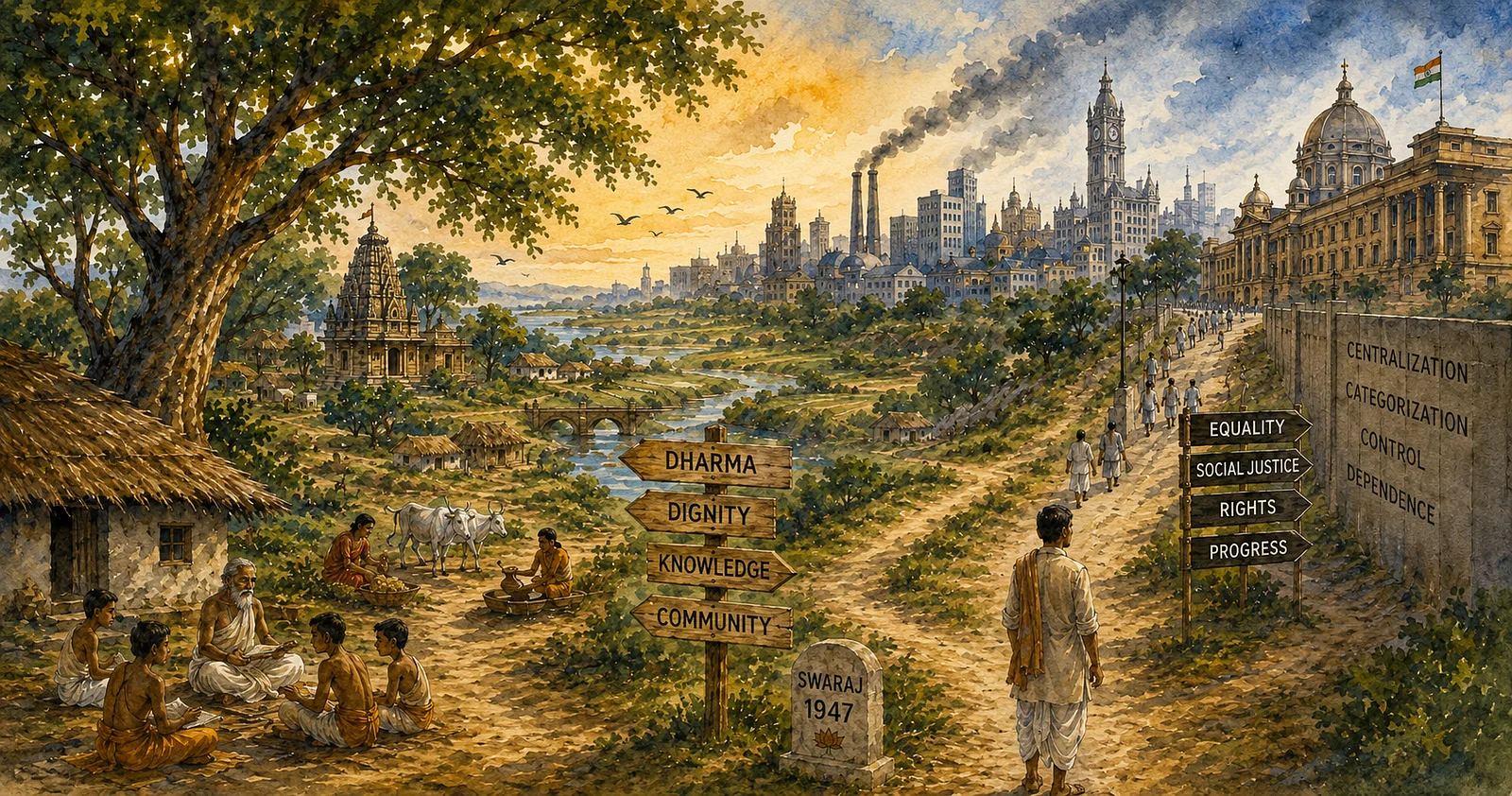
Against this backdrop, the common-sense question is this: now that we can say all this with hindsight, and accept that such a vision may not have existed at the time, what should have been done? We need that hindsight so that we may act more correctly in the present. The natural questions, then, are: how could one have corrected the loss of dignity, the erosion of traivarṇika functions, and the broader condition of subjugation? How could these have been repaired? These should have been the main priorities of the system. For a newly independent nation, one would have expected precisely such concerns to be central.
But instead, the State moved in a different direction, focusing on equality, the abolition of caste, discrimination, untouchability, and similar slogans. The accountability of the State itself was never clearly fixed. It was also assumed that the State would become noble simply because Indians were now in charge. That did not happen because the State was populated by people who had already been co-opted by the erstwhile oppressive system. The institutional design itself encouraged this continuity. Those who held power had no real incentive to give it up.
Social Categorization and the Deepening of State Control
Before this, in the 1930s, the caste census and related exercises had already taken place. The categorization of society had already begun. This deepened further in the name of social justice, which essentially meant that the State created a social ladder of its own while discarding earlier social structures and recasting them into simplified categories such as forward and backward, without any clear end goal. That was one side of the problem.
The worldview of the State did not really change, which is reflected in most institutions until much later. Yet its guiding principles were drawn from Enlightenment ideals: equality, fraternity, individual rights, and so on. To be fair, perhaps the structure adopted at that time reflected what the State's survival fitness required. We may not have been in a position to architect an entirely new State on an explicitly Hindu basis. Given the chaos of Partition and everything surrounding it, stability was understandably prioritized. Perhaps some ideas had greater currency at that moment. That is understandable. But it never became a stated goal to transform the State from that inherited base toward an Indian ideal. More importantly, what exactly that base should have been was itself never seriously addressed.
The Problem of an Unexamined State Foundation
This is deeply problematic because the State exists for society, not the other way around. Yet guilt and shame continued to be imposed using the same tools inherited from colonial rule. In the West, such models may have made sense because the nation-state was assumed to consist of one nation and one culture. It was taken for granted that people knew the society they were speaking about. Here, however, when the legacy of the British system continued, and a new State architecture was being built, the very basis of that architecture needed to be questioned. That never happened. People assumed they were simply incorporating the good parts. But the real question is not whether something is good or bad in the abstract. The question is epistemic: what fits where?
Dharmaśāstra and the Question of Civilizational Fit
A small example of what such cognizance would mean can be found in the Dharmaśāstra. It begins with a description of the land to which law is to be applied: the nature of the land, the nature of human beings, the nature of society, the different kinds of people, the kinds of lives they live, and the ideals by which they live. Only then does one create a State suited to that society. The goals of the State are clearly derived from that social reality. This is how the Dharmaśāstra is architected. Its purpose is explicitly stated. After several chapters of such description, one arrives at Rāja-dharma, which is thus articulated on the basis of the society it is meant to serve.
So, in the absence of such grounding, what was the nature of the society the postcolonial State was supposed to serve? Was it an obliterated society whose structure was no longer understood? Or was it the society as described by the British through categories such as forward and backward? In effect, the State came to be architected for a society defined by the colonizer. This is only one example, but it illustrates the broader pattern. The ideals of the State came to be shaped accordingly.
There is nothing inherently wrong with equality as an ideal. Dharma-rāja is a ‘samavartī’. The problem is that there was no ontological basis for how such equality was to be pursued within the present system. What, then, does equality actually mean? What is the trade-off between equality and justice? None of these questions was resolved. The whole framework remained arbitrary.
Colonial Continuity in the Postcolonial State
The architecture of the State retained many legacy elements. Only its declared principle was rebased, since the State was no longer loyal to the Crown. That part was expected to change. It was assumed that the new State would now serve the people and the nation. It began with “We, the people of India.” Yet the architecture still consisted of the British Indian Army, the police, criminal procedures, the jury system, and such institutions. Merely introducing a legislative body did not substantially change the colonial character of the State, even if many amendments were later made.
Feudalism, Principalities, and the Integration Dilemma
In traditional statecraft, we have concepts such as deśa droha and rāja droha. How do these compare with sedition against the Crown? How are such ideas even articulated within today’s Constitution? These are only examples. Systemically, there were real choices to be made. We had inherited a feudalism that the citizenry did not want, but that people in power wanted. There were principalities that had acted as bridges between feudal elites and the Crown, and these could perhaps have been co-opted into the new power structure, since they were erstwhile rulers and represented a form of nobility. They had legitimacy, whereas feudal structures often functioned as intermediaries facilitating oppression.
But the State did the opposite. It left feudal structures largely intact while sacrificing the nobility. The principalities were invalidated. As a result, the nobility either had to be absorbed into the new power structure or create private militias, turn rogue, or become feudal themselves. In any case, the result was a struggle for power that served nobody. While there was significant effort toward integration, national security, and the avoidance of revolt, integration is not merely about preventing sedition. The deeper question is whether one should merely “churn the ocean” or holistically design the polity. Did India simply have to integrate 565 principalities, or should it have architected a system in which those principalities became part of an organic whole through phased transformation? The assumption that monarchy is inherently bad is itself simplistic. When a republic supersedes a monarchy, such apprehensions need not dominate the process. Once again, the problem lay in not understanding our own structure in the first place.
Deśa, Jāti, and Sampradāya: Misreading Indian Society
There was, and even today there remains, what can be called as a “jāti jaundice”—a tendency to see everything through the lens of jāti. Deśa is the most important geo-cultural unit, and it is what determines our diversity. Historical evidence suggests that Bhāratavarṣa was understood through the geography of deśa, and that administrative units were meant to be carved accordingly. This was not linguistic, nor was it ethnic in the sense used by the modern nation-state. It was geo-cultural. In some ways, what is now called “bioregional” in sustainability literature comes close to this. There is also deśa-bhāṣā: the language localized to each region. Whether the kingdom was large or small - Travancore or Maratha, it was understood that no one imposed language on another deśa. Each deśa’s language and culture were meant to be honored irrespective of which administrative or political unit the deśa falls under.
The State created after independence violated this principle through linguistic reorganization and political boundaries. In Karnataka, for instance, how much cultural relevance do local subregions retain, and how much are they honored? In Bengal, how much of the Gorkha language and culture is honored? Similar discontent exists in Maharashtra. Structurally, there was a misunderstanding. As a result, deśa, jāti, and sampradāya were neither properly understood nor respected, and the Indian State was built without taking cognizance of any of them.
Why Kula May Offer Greater Precision than Jāti
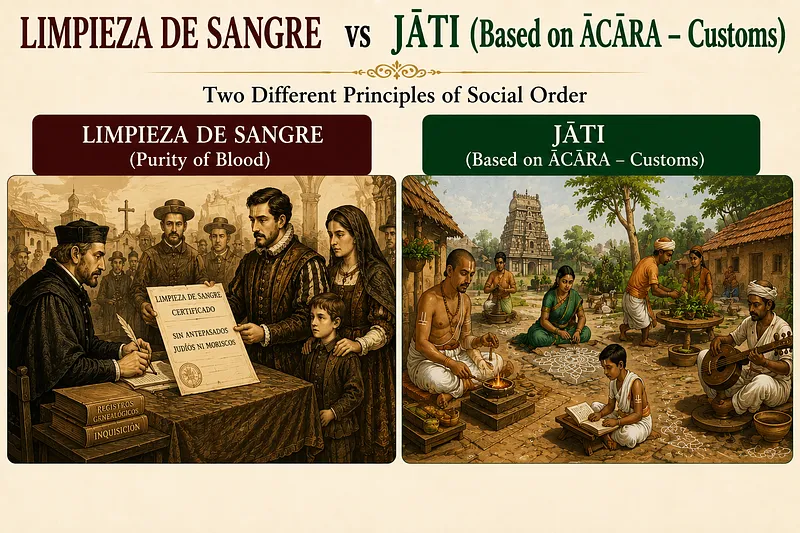
How, then, should we understand the functions of jāti and sampradāya? Deśa is relatively clear: it is a geocultural entity and therefore an organic whole. But when it comes to jāti and sampradāya, the kula is more useful than jāti, because jāti has become overloaded with many connotations, some of them highly contingent. Kula is a smaller and more precise unit: the clan. Many kulas together may become a jāti, but a jāti can also become a vague conglomerate. Today, when one speaks of jāti, the same group may be included or excluded depending on the context. There is little fidelity to the term.
Take “Naidu” as an example. Is it a jāti? We find cognates in Andhra Pradesh, Tamil Nadu, and elsewhere. There are also many kinds of Naidus: Velama Naidu, Balija Naidu, Kamma Naidu, Kapu Naidu, and so on. Is it merely a surname? No. Some of these groups also had their own kula-carita. The Balija Naidus, for instance, did. Things, therefore, overlap, and jāti has come to be used in several different ways. Politically, it has been used for an altogether different purpose. Kula is much more precise.
We do, in fact, have an ethno-cultural unit. Kula has its ācāra, which is quite clear. Varṇa has a dharma. Sampradāya is a temporal function with its own upāsanā paramparā, guru paramparā, social lineage, and related features. But within a jāti, one finds diverse ācāras -regional, cultural, and traditional. That is why we should increasingly move away from the term jāti when precision is needed. It does not allow us to arrive at clarity.
Institutions as Multi-Level Networks of Cohesion
Institutions are vehicles of human fulfillment. They are also, in another sense, different levels of reconciliation between the micro and the macro. They give access to the macro. It is not simply a matter of the individual and the State. There are many intermediate networks that generate cohesion, and these are what give groups bargaining power and collective capital. Shared affinities make possible collective pursuit and the generation of excellence within such units.
The important point is that none of this exists in isolation. The kula identity one receives is never skewed, because there is also sampradāya and deśa. A deśa may contain many kulas. Within a kula, there may be people from different sampradayās. A sampradāya, in turn, extends across deśas and jātis. These are therefore three-dimensional structures. It is a multi-level architecture in which cohesion grows across different scales. If this matrix is not appreciated, everything gets reduced to jāti or some similarly nebulous term, which then becomes an unsolvable problem. In fact, this matrix is the matrix of our integration. Our sacred geography is part of it. The deśas are part of it. Each of these historically served as a basis for integration. Today, however, all of them have become grounds for disintegration because the nation-state has recast them in that way.
The Incomplete Project of Defeudalization
Returning to feudal structures, they were not properly confronted after independence. This was one of the main reasons the Left gained such currency in the post-independence period, because its primary moral claim and legitimacy lay in its project of defeudalization. Whether it succeeded or not is another matter. The point is that it identified a real and felt problem in society, which is why it received support. The landlord system did not disappear. It was much discussed, and there was much sloganeering, but it remained. Bonded labor continued for decades because the weaponization of literacy also continued. We never created an educational system in which such weaponization would disappear, and all groups could meaningfully pursue their vocations. The same employment culture and incentive system continued.
Landholding regulations were introduced, and bonded labour was legally abolished. But in practice, these problems could not be removed because feudal structures had merged into political power. Many of today’s political leaders are the descendants or successors of feudal lords. The ‘mai-baap’ culture and its control over society persisted. Society, therefore, has not been defeudalized. Without that, no true decolonization is possible.
Industrialization Without Social Transformation
Was such a transformation even possible, given the emergence of a post-industrial society and our integration into the global economy? There was a period from the 1950s to perhaps the 1970s or 1980s, when industrialization had not yet fully occurred, and social groups were not allowed to rise beyond a point. Bureaucracy dominated. Private enterprise did not properly take off. Industrialization was driven from the top down. Even leftist scholars have observed that for the first twenty years, the State co-opted the landed class, and in the next twenty years, it co-opted the industrial class. This was the reverse of what it might have done. Feudalism should have been dismantled through the co-option of principalities, but instead, it was allowed to collaborate with the new system. Later, something similar occurred with the industrial class. Of course, one may argue that enabling markets is one function of the State, but the sequencing here remains important.
Many people claimed that earlier industrialization or modernization would have removed feudalism. But today, even after significant modernization and industrialization, feudalism persists and shows few signs of disappearing. Yet society itself continues to be blamed.
Misdiagnosing the Problem: Society as the Target
Because this transformation did not occur, collective potential remained unfulfilled. We saw private armies of feudalists, Naxalites, militant groups, and socialist mobs causing havoc. Each addressed a real issue in some way. But the State failed comprehensively because it identified the wrong problems. It framed society itself as the problem, caste as the problem, and so on. Yet all of these formations exist for a reason. The real question is how to arrange them so that they become integrated rather than disintegrated. The British policy of divide-and-rule was never truly removed. It remained embedded in State doctrine. The ‘jihadi’ problem was only one among many. These problems existed, but did not receive as much emphasis in the early decades because partition had already taken place, and it was assumed that such issues would no longer be major.
The Materialization of Social Hierarchy
If we look back further, the caste census, SC-ST incorporation, and related policies reveal something important. In the 1930s and 1940s, most groups protested being listed as SC or ST. Everyone wanted to be called forward, regardless of material status, while the State insisted on defining status materially. We taught society to fight on these terms. Yet the hierarchy in our society was never primarily material. Money, power, ańga-bala, dhana-bala, wealth, and knowledge all existed, but knowledge retained primacy. That was respected even under British rule because the British state was always seen as foreign. After independence, however, the same ideals were enforced by the Indian State. At that point, how was one to protest that the Indian state itself was not following an Indian ideal? There was some critique, but nowhere near enough for systemic transformation.
The spiritual dimension was removed entirely from the cognition of the Indian state. The new caste ladder became material. Today, one sees people competing to be called backward rather than forward - a demand for disadvantage. In the British census, seventy percent were forward. Today, seventy percent are backward. Either we have not progressed, or if we have, the shares classified as forward should have risen. But the deeper issue is not mere preservation. The State-created caste ladder prevents social institutions from elevating society. Society is meant to be elevated through good ideals, hard work, and knowledge. That is not happening because the ideals of both society and system have been invalidated by the State. This is a matter of role-modeling. Even pedagogically, we know that behavior is mimicked: what is celebrated, rewarded, and presented as exemplary is what gets reproduced.
Structurally, the problem lies in the State-defined ladder of forward and backward, in legislation such as the Atrocity Act, and in the entire framework hinging upon constitutional definitions of human dignity and equality. That is the legislative base within which all this operates.
Electoral Politics and the Consolidation of Caste Blocs
Several consequences followed. One was the emergence of right-wing social justice formations, such as the Justice Party and its successors, including the DMK and TDP. These were not communist formations; indeed, they opposed communism. But they were invested in restoring power to particular groups, often in ways that drew upon older feudal structures. Ambedkarism pursued somewhat different methods, but it too was centrally concerned with directing power toward specific groups. That was one trajectory.
A similar shift occurred a few decades later. Once the upper castes were already constitutionally enabled through their presence in bureaucracy, army, police, and government jobs, and SC/ST groups had reservations, the large remainder of the country came to be organized as backward caste. This became an easy vote bank for 'Lohia-ite' politics. Congress functioned as the political big tent. The principal opposition came from Hindutva, though its main emphasis was opposition to Muslim appeasement. At that time, cultural identity was also discussed, but the cultural identity of the nation was broadly accepted by Congress as well. Mandal came later, but the Lohia-JP stream prepared the ground for it. What the British created, therefore, was not just a divisive law later misused. The British, and later the Left, committed what may be called a major cognitive fraud: they made the victim of oppression - Hindu society - the aggressor. That cognitive fraud continues to this day. It pervades the institutional design of the Indian state and remains a reflexive basis for policymaking and lawmaking. That is why such parties keep emerging and why things worsen decade after decade. The incentive structure itself ensures it. Everyone ends up believing that society must be changed because society is bad.
For a time, the rhetoric was not about reducing majoritarianism. Nehru was content with majoritarianism so long as he had four hundred seats. Indira was similarly content so long as she had three hundred and fifty. But before backward-caste politics emerged, the majority of the country had to become backward caste because upper castes and SC/ST groups were already recognized as distinct camps. Once the backward caste category became the largest camp, electoral politics effectively became caste politics. This did not happen in the same way before the emergence of backward-caste parties. Broadly speaking, this process began in the 1970s and was consolidated by the 1990s, culminating in Mandal politics.
Resource Access, Social Engineering, and the Expansion of the State
In the absence of the cognitive anchor that society itself had been subjugated, there was never a serious effort to dismantle the actual oppressive structure. The oppressor was thought to be already known and was therefore targeted directly. But because this cognitive shift never occurred, the real problems of society were never addressed. Even today, much of the rhetoric asks whether water, burial grounds, or temples are being shared. Hardly anyone asks whether resources have actually been managed well enough that everyone has meaningful access to them. This leads to strange demands for State intervention in every domain, from food to family, as though the State must socially engineer society at the largest possible scale. The same people who oppose State intervention in markets often support massive intervention in the family. In effect, they nationalize the family.
The feudal structure and bonded labor were legally invalidated and outlawed. But what did that change in practice? What avenues of life were created in their place? How much of the village-town-city continuity was restored? How much slum elimination took place? How much continuity from forest to metropolis was recovered? How much did we begin to see ourselves once again as a civilization? That remains the central question, and it remains largely absent from the way the system is run today.
The Limits of Hindutva’s Systemic Understanding
Perhaps the saddest part of all this is that even a century of Hindutva activism, with all its rhetoric of Hindu unity, has not fully understood the systemic nature of the problem. Hindutva never properly spoke of the system. Even today, it does not. There may be commentary that policy is wrong and must be changed, but there is still no sustained conversation on the system itself. This comes from ignorance. Ultimately, if one has sufficient knowledge, one can articulate the issue so clearly that it becomes impossible to avoid. Instead, the lack of knowledge and articulation is often blamed on society’s unreadiness. Society, therefore, continues not to understand what is being said. Yet if this were presented clearly as the real problem of society, who would deny that it deserves debate? Even disagreement would at least produce serious discussion.
Rethinking the Enlightenment Framework
How much did the Enlightenment ideal really help us in all this? How much can we still derive from it? Does it need to be undone? Can the architecture of the present State be used to repair these deeper problems? We cannot even work meaningfully at the level of ideals unless we first articulate the problem properly.
Does that make it more urgent to think about these questions, or does it make the task more difficult? In fact, the present may be a more fertile moment than before. Ours is no longer merely an age of sloganeering. People are increasingly speaking in terms of deeper knowledge and technology. There is widespread uncertainty about the future and how it will unfold. The West, too, is confronting the limitations of its own ideals and systems, and this is felt here as well. In such a moment, the ground is fertile for articulating something new provided we generate the required knowledge.
Seeing Like a Civilization
What does it mean to see like a civilization? We already know what it means to see like a State. But what would it mean to see like a Hindu civilization? By extension, what would the appropriate worldview and architecture be? That is the constructive question, and it deserves a full discussion of its own. But to conclude this essay, the fundamental issue is the absence of a holistic view of society. In the absence of the prism of deśa, kula, and sampradāya, we have failed to draw upon the benefits of deśa and sampradāya, while jāti has become overloaded. Each identity should serve to correct the imbalance of another. This has happened in history. How did the Basava sampradāya unify several kulas with incompatible kula-ācāras? They came together under one sampradāya, which thereby addressed the excesses that had developed within other identity formations. That was one way of generating cohesion in that context.
Identity, Culture, and the Question of Leadership
The confusion today is that because these identities are multiple and because they are sometimes seen as conflicting, the demand is that Hindu society should abandon them and adopt a supra-identity. But each of these identities has dhārmika functions at its own level. To discard them would be absurd. Without units of culture, how can culture exist at all? It is sustained through such units. There is no abstract whole that sustains culture independently of lived practice. Culture is proximate. It is felt through one’s immediate forms of engagement -ritual, social, and cultural. Our culture survives because individuals live through kula-ācāra, deśa-ācāra, and sampradāya. There is therefore no contradiction with a higher identity. Such a higher identity is only a convenience identity. It is not absolute, and it is not theoretically precise.
The loss of our political structure meant that we had to create a new prism of leadership that saw unity outside, with all the internal diversity incorporated with the substratum of what unified all these. One cannot erase society’s identities simply to make leadership more convenient. That is not how leadership works. Leadership requires knowledge and maturity in order to serve society as it actually exists. One does not decide how society should be merely to make leadership easier. At least after so many decades, that much should be clear.
Accountability, Policy, and the Breakdown of Principle
This constant targeting of society section by section - one group as villain, another as hero, another as victim, ultimately destroys the basis for sound policy, because everything then becomes a matter of convenience. The stated principle is lost because there is no metric by which one can judge whether one is moving toward it. In the absence of such a metric, accountability cannot be built into the system. These, systemically, are the issues that must be addressed. How exactly they should be addressed can be discussed further.
Conclusion
Thus, in 1947, India inherited a structure that preserved and deepened feudal incentives already entrenched over time. It did so by setting society and its groups against each other. When change did occur, it occurred through selective means that damaged the harmony inherent in society and eroded trust. What India inherited in 1947 was, therefore, a system of mistrust, and that mistrust continued. To a large extent, it was the communists who recognized the most visible problem. Their solution may not have been better, but the problem they addressed was real and therefore resonated with society, which is why they received support. At that time, however, we lacked either the opportunity or the means to shift the cognition to adopt our own worldview, toward an understanding of what we really were. Some thinkers did articulate aspects of this problem; it was not entirely missed. But perhaps they were not empowered. Society itself retains this knowledge in some form. The real question is how best to articulate it so that it may enter the system in a de jure form. That is what matters. How can such articulation become the basis of legitimacy for leadership?
That would require understanding the nature of society - spatially, and in terms of traivarṇika order, kula, jāti, and varṇa, and the way this fractal structure historically functioned as a coherent whole, with each identity serving as a check and balance upon the excesses of another. Our separation of powers, in this sense, was not separation in the modern institutional form, but a coherence of diversity. In a holistic conception, all these are harmonious complements. The risks of bad behavior were addressed mutually through the structure itself. Sampradaya, for example, could arise to address the fallouts of jāti and varṇa. From a systems perspective, these were mutually reinforcing feedback loops and therefore self-correcting.
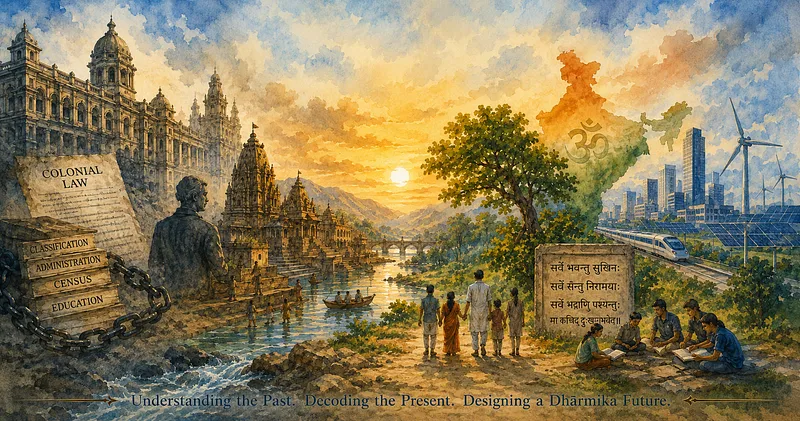
That gives us at least some sense of what an alternative architecture might look like, now that we have taken cognizance of the problem by examining roughly two hundred years of history and by looking at the inherited structure that still shapes the present. That is the perspective from which this issue must be understood.
------------------------------------
For other parts of this series:
Part Three
Part Four (Final)

.png)