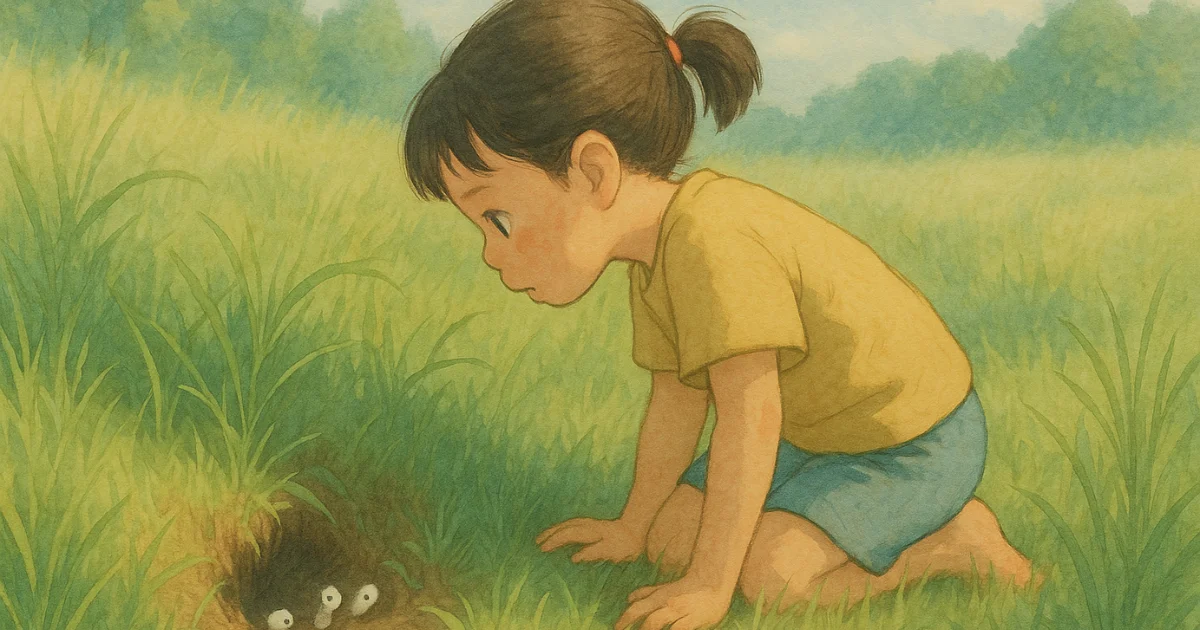
There is a particular way in which Mei, the small child in My Neighbor Totoro, bends down to peer into a hole in the grass. Her knees press into the soil, her palms steady her weight, and her face brightens with curiosity as tiny white creatures hurry past. Nothing about the moment is hurried. Nothing is explained. The world reveals itself to her at its own pace. She receives it without filters.
This quiet gesture is one of the purest images of childhood on film. It lasts only a few seconds, yet it captures something modern childhood often loses: the freedom to follow wonder wherever it leads.
Hayao Miyazaki has spent half a century building worlds where children are allowed to look and feel without correction. His young characters do not search for achievement or self-improvement. They listen. They notice. They sense danger and care simultaneously. In an age of anxiety, measurement, and over-structured childhood, Miyazaki’s films feel like letters from another time. They ask whether modern childhood, from Tokyo to New Delhi to California, has lost something essential. Something that research, anthropology, history, and philosophy all hint at in their own ways.
This essay explores Miyazaki’s vision through the eyes of thinkers who have tried to understand childhood: Piaget, Vygotsky, Alison Gopnik, Peter Gray, Margaret Mead, Yuki Imoto, Jiddu Krishnamurti, Tagore, Suzuki, Watsuji, Ariès, and even Kurosawa. Together, they help us see why Miyazaki’s work feels both magical and urgent.
The goal is not to praise Miyazaki alone but to use his films as a way to look at what childhood has become, and what it could still be.
Across Miyazaki’s works, children are not blank slates. They are alert beings with emotional and moral sensitivity. Chihiro in Spirited Away does not gain courage through instruction. She earns it by paying attention. She watches the behavior of spirits and adults, reads the room, and responds with a mix of caution and generosity.
Jean Piaget, the Swiss psychologist, believed that children construct knowledge actively, not by absorbing facts but by exploring environments and reorganizing their understanding. For him, childhood was an active process of building internal structures.
Chihiro acts exactly like a Piagetian child. She moves through the world by touching, observing, questioning, and adjusting. No one teaches her how to navigate her fear, yet she manages. Piaget would say this is because a child learns best through direct experience, rather than pre-shaped instruction.
In today’s world, Piaget’s insights stand in contrast to a very different approach. American parents often schedule childhood into blocks of supervised doing. Urban Indian families surround children with homework, coaching, and practice tests from the moment they can hold a pencil. Japanese parents worry about safety, academic pressure, and conformity. Childhood has become a corridor of adult ambitions.
Miyazaki, by contrast, trusts the child’s gaze. He trusts their inner sense-making. His films hold up a mirror to a world where children no longer get to look without purpose. Through the eyes of his young characters, he invites viewers to remember how it felt to see the world without adult scripting.
One of Miyazaki’s most radical choices is his insistence on slow scenes. In Totoro, the girls wait at a bus stop during a long rain. The water pools around them. A drop falls from an umbrella. A giant creature stands beside them, saying nothing. The scene is nearly silent, yet it hums with life.
Peter Gray, the American psychologist known for his work on play, argues that children need long stretches of unstructured time to develop resilience and creativity. Slowness is not idleness; it is the soil of imagination. When children are hurried, he warns, their ability to handle uncertainty shrinks.
Miyazaki’s slowness is a cinematic expression of Gray’s argument. In these quiet scenes, children absorb the world rather than rush through it. They practice the art of being with their own thoughts.
Yuki Imoto, who studies Japanese childhood, writes that contemporary urban childhood in Japan is shaped by safety concerns and tight supervision. Spontaneous wandering has nearly disappeared in many areas. Unstructured time is shrinking.
Yet Miyazaki’s films insist on lingering. They suggest that slowness is not a luxury. It is a childhood necessity.
Miyazaki’s worlds are filled with living forests, capricious winds, and bodies of water that pulse with agency. Nature is not a backdrop. It is a companion.
In Totoro, the forest shelters the children. In Ponyo, the sea transforms depending on emotion. In Princess Mononoke, rivers, trees, and creatures respond to human greed and tenderness with equal force. These films treat nature as a teacher.
Japanese philosopher Tetsuro Watsuji wrote about climate as a force that shapes human character. For him, the experience of wind, humidity, rain, and seasons forms a child’s sense of belonging. Miyazaki takes this insight and animates it.
Tagore, writing from Bengal, offered a similar vision. At Santiniketan, he insisted that children learn best in open-air environments, through contact with trees, sky, and light. He believed that nature trained attention far better than textbooks.
Peter Gray’s work supports this, too. He studied how children learn through sensory immersion. The feel of soil, the sound of leaves, the texture of water; these sensory encounters help emotional growth and imaginative expansion.
Modern childhood has drifted far from these ideas. A global indoor childhood is forming. A 2019 study in Japan showed that many urban children spend less than fifteen minutes outdoors on weekdays. A similar pattern appears in India’s larger cities, where long commutes and coaching classes consume daylight hours. In the United States and Europe, screen time often replaces outdoor time.
Miyazaki pushes against this tide. His films restore the idea of nature as an active participant in childhood.
One of Miyazaki’s most distinctive traits is his respect for fear. He does not mock it. He does not punish children for it. He lets them experience it fully.
Chihiro is frightened from the moment she enters the spirit world, yet she keeps going. Mei cries when she feels lost. Kiki falters when her magic weakens. Their fear is not a flaw; it is part of growth.
Childhood experts across cultures have warned that modern parenting often tries to eliminate fear rather than help children build their relationship with it. Alison Gopnik notes that children become confident not because they avoid difficulty but because they live through it at their own pace. Fear, when acknowledged and contained, becomes a source of understanding.
Jiddu Krishnamurti went further. He argued that much of what passes for education is an elaborate machinery of fear. Children learn to obey, compare, compete, and please authority. Fear becomes the silent curriculum. In his conversations with teachers and students, he spoke of fear as the root of conformity, and of the deep loneliness that comes when a child’s inner world is constantly measured.
Miyazaki’s children inhabit a different kind of education. They are not ranked or compared. They are frightened, but not shamed. Their fear is not used to control them. When Chihiro trembles, the film does not turn away. It stays with her, gently, until fear becomes attention. In that sense, Miyazaki’s work feels like an illustration of Krishnamurti’s wish: a childhood in which fear is seen clearly rather than hidden under performance.
Miyazaki’s children work. They sweep floors, fetch water, solve problems, care for parents, and contribute to their communities. Chihiro scrubs bathtubs. Sheeta and Pazu in Laputa take on heavy tasks. Kiki earns her living as a delivery girl.
These worlds contrast sharply with modern forms of childhood, where children often perform academic labor rather than household or communal labor.
Vygotsky taught that children learn best through social interaction and meaningful participation. When children feel their actions matter, they gain confidence and competence. Miyazaki illustrates this truth repeatedly.
Peter Gray uses a related phrase for this: meaningful responsibility. Not chores imposed as punishment, but tasks that help children feel capable. Miyazaki’s characters embody this idea. They learn through work, not through abstract instruction.
In India, rural childhoods once made this natural. Children helped on farms, in shops, at wells, or in kitchens. They contributed without being turned into substitute adults. Urban Indian childhood, shaped increasingly by classrooms and coaching, often lacks this intimacy with everyday work.
Miyazaki recovers this lost texture and uses it to show how dignity grows.
Miyazaki believes children possess a kind of moral sensitivity that adults often lose. His characters sense injustice, care for strangers, and treat nonhuman creatures with quiet respect.
Nausicaa responds to violence with compassion. Ashitaka seeks clarity rather than victory. Chihiro shows kindness even to spirits who alarm her.
Margaret Mead, writing after her fieldwork in Samoa, observed that children often carry a clearer understanding of empathy than adults weighed down by social expectations. She argued that children’s morality is shaped by attention rather than doctrine.
Alison Gopnik describes children as scientists testing hypotheses about the social world. Their ethical decisions emerge from observation, not indoctrination.
Miyazaki’s films embody these ideas. His children learn morality through experience, not instruction. They sense harm. They respond with care.
In an era of polarization, this view of childhood as a moral resource feels especially urgent.
Miyazaki’s girls are quiet revolutions. They are purposeful without being hardened, tender without being helpless.
Kiki struggles, doubts, and regains confidence. San in Princess Mononoke is fierce and wounded. Chihiro begins timidly but becomes steady. Sophie in Howl’s Moving Castle carries the emotional weight of entire households.
These portrayals refuse stereotypes imposed on girlhood in popular culture. They also resist pressures faced by real girls across Japan and India, where safety concerns and academic competition restrict movement and play.
Krishnamurti rarely spoke of “girls” or “boys” as separate educational categories. He spoke of conditioning. He saw how families and schools shape children into patterns of obedience, comparison, and fear. In India, that conditioning often lands harder on girls: tighter curfews, greater concern for safety, stricter expectations of modesty and responsibility. The result is a childhood where inner life is shaped by constant vigilance.
Miyazaki imagines something else. His heroines walk through forests at night. They fly alone over cities. They work, decide, argue, and care on their own terms. They are not symbols of perfection. They are in motion, like the weather. In this sense, they feel close to Krishnamurti’s ideal of a young person unafraid to look directly at life, unafraid to question what is handed down as tradition, unafraid to move from inward clarity rather than outward approval.
Tagore once said that girls should be raised in spaces where intellect and compassion are cultivated together. Miyazaki’s films make that philosophy visible.
If Miyazaki has one central belief about childhood, it is this: play is knowledge.
Mei and Satsuki learn by chasing dust sprites. Ponyo and Sosuke form relationships through play with water. Chihiro learns through tasks that blend play and labor.
Peter Gray’s research on hunter-gatherer communities shows that children learn essential skills through free play with peers, not through structured teaching. This play is cooperative, imaginative, and autonomous. It builds emotional and social intelligence.
Suzuki’s approach to music education, based on immersion rather than instruction, complements this idea. Children learn through repetition, imitation, and joy.
Miyazaki’s films show us what learning looks like when it is inseparable from play.
To understand why Miyazaki matters, we must see how childhood has been pictured across cultures.
Philippe Ariès, the French historian, argued that childhood as we know it is a relatively recent invention. Medieval art barely depicted children as distinct beings. Only in later centuries did childhood emerge as a protected stage of life.
In American culture, childhood has swung between two extremes. The free-roaming suburban child of the mid-twentieth century has given way to the over-scheduled child of the twenty-first. European childhood imagery often blends melancholy with freedom, but it, too, is shaped by economic and social pressures.
Japan carries its own visual history. Postwar films by Kurosawa offered children negotiating hardship with dignity. His sensitivity to weather, silence, and small gestures anticipated Miyazaki’s style.
Indian visual culture has changed dramatically. The open-ended childhoods of Doordarshan-era storytelling, full of neighborhood games and outdoor wandering, have been replaced in many cities by coaching classes, screens, and achievement-driven narratives.
Miyazaki draws from these histories but also offers an alternative: childhood as sensory, slow, self-guided, and porous.
Peter Gray warns that modern childhoods have been stripped of autonomy. When children are constantly supervised, scheduled, or distracted, they lose the confidence to approach the world on their own terms. He links the rise of childhood anxiety to the decline of free play.
Observing children in classrooms and on playgrounds across India, Japan, Europe, and the United States reveals similar patterns. Childhood becomes a project, not a life stage. Children are coached toward goals rather than accompanied in discovery.
Krishnamurti would recognize this immediately. For him, a child’s mind, full of potential for direct perception, is slowly trained to think in terms of marks, ranks, placements, and futures. Imagination narrows. Children stop asking their own questions and begin asking only those that promise a reward.
Miyazaki’s films push back on this. They offer imagination as a form of breathing. They show children who make sense of the world not through syllabus or achievement but through attentiveness, intuition, and relationship.
In this sense, Miyazaki is not simply a filmmaker, but a historian of childhood and a quiet critic of its transformation.
Miyazaki’s view of childhood is both old and new. It draws from traditional rhythms of life in rural Japan, and it anticipates what developmental research now insists upon.
From Piaget to Vygotsky, from Tagore to Suzuki, from Gopnik to Gray, a common idea emerges: childhood thrives when curiosity is allowed to guide learning. When nature enters the child’s senses. When play retains its mystery. When children feel that their presence matters. When adults trust them.
Krishnamurti pushed this idea to its limit. He asked whether an education that breeds fear, competition, and conformity can ever really serve the child. He dreamt of schools that protect the flame of direct perception rather than smother it under ambition.
Miyazaki shows what these ideas look like when animated. His children are not shaped by outcomes. They are shaped by encounters.
This is why his work speaks across continents. It speaks to Japanese parents who worry about safety and schooling. To Indian families worried about competition. To American families anxious about screen time. To European families balancing freedom and structure.
Miyazaki reminds all of them that childhood is not preparation. It is an experience.
In the final scene of Totoro, the girls sit in a tree, waiting to see if their mother will recover. Totoro sits with them. The camera does not rush. The moment is quiet, almost meditative. It is filled with the ordinary courage of children who are learning how to be in the world.
This is Miyazaki’s gift. He gives childhood its full dignity. He reminds us that children do not need perfection. They need presence. They need the chance to look closely, to wander, to play, to tremble, to care.
They need adults who remember what it was like to be open to the world.
Miyazaki never forgot. That is why his films feel like a refuge, a warning, and an invitation all at once.
If modern childhood has become narrow, hurried, and shaped by fear, Miyazaki offers an alternate memory: the child who could still see.

.png)