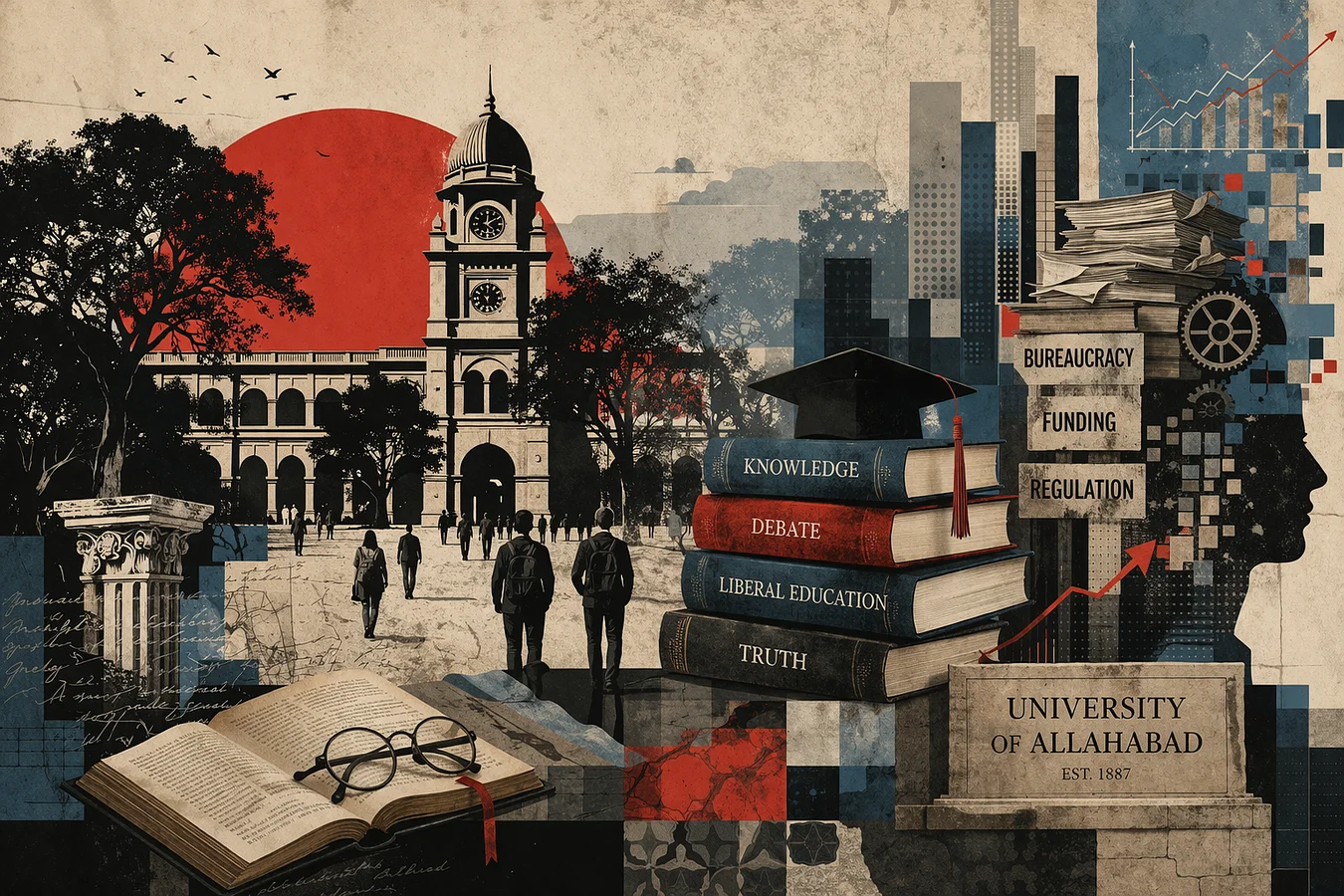
I first came to the University of Allahabad as a student of English literature, carrying more curiosity than clarity. The city was still called Allahabad then, and the university had about it a certain worn-out dignity, like a scholar who had outlived his moment but not his habits. The university campus did not announce itself; it lingered. Long corridors of Senate Hall held the afternoon light in a way that made time feel suspended, as if the past had not quite receded but settled into the walls.
During my time at the university, classes were often uneven, occasionally inspired, but always framed by something that exceeded the syllabus. A lecture on Wordsworth could drift, without warning, into a meditation on memory and loss; a discussion on colonial history might turn into an argument about language, power, and selfhood. It was not that the university was consistently rigorous. It was that it retained traces of a time when ideas were taken seriously enough to be argued over, even when they were poorly understood.
The library, with its heavy wooden tables and slow-moving fans, was less a place of study than of apprenticeship. One learned not only what to read but also how to sit with a text, endure confusion, and follow an argument to its edge. There were days when nothing seemed to make sense, and yet one returned, compelled by an intuition that something was being formed, even if it could not yet be named.
Outside, under the banyan trees, conversations stretched into the evening. Students of law, literature, and political science gathered in loose circles, rehearsing arguments that were at once earnest and theatrical. The university produced a particular kind of voice, one that was at ease with abstraction but also impatient with it. There was a certain confidence in speech, a habit of public reasoning, that marked its students long after they had left its grounds.
Only later did I begin to understand that what I had encountered was not incidental. This atmosphere, this peculiar mixture of seriousness and drift, was the residue of an institutional form that had once been central to the making of modern India. Established in 1887 under the British Raj, the university was conceived as part of a larger imperial project: to produce a class of intermediaries, trained in law, administration, and English, who could sustain the machinery of governance. Yet, like many such institutions, it exceeded its design.
What the British built as an instrument of rule became, over time, a space where that very rule could be questioned. The classrooms and corridors that once disciplined colonial subjects began to host debates on nationalism, identity, and justice. The university produced not only administrators but also critics, not only clerks but also thinkers. Its graduates moved into courts, legislatures, and literary circles, carrying with them a style of reasoning that bore the institution's imprint.
To walk through the campus, even now, is to sense this layered history. The architecture still speaks the language of empire, but the life it contains has long since moved beyond it. And yet, there is also a palpable dissonance. The same spaces that once nurtured intellectual ambition now often feel fatigued, caught between memory and inertia.
This essay begins from that tension. It is an attempt to read the University of Allahabad not only as an institution but also as a historical formation, shaped by empire, animated by nationalism, and transformed, in more recent decades, by forces that are at once social, political, and institutional. To understand what it was and what it has become is to ask a larger question about the fate of universities in postcolonial India: how institutions built to produce knowledge come, over time, to organize something else entirely.
I. The Colonial Founding: Architecture of an Elite
To understand what one encountered in those corridors, one must return to the late nineteenth century, when the University of Allahabad was established in 1887 under the British Raj, not as an isolated act of educational expansion, but as part of a carefully assembled administrative vision. The university emerged at a moment when the colonial state, having consolidated territorial control after the upheaval of 1857, turned with renewed urgency toward the question of governance. The problem was not merely how to rule, but how to produce a class of subjects capable of sustaining rule.
The answer, in part, lay in education. The earlier establishment of Muir Central College in 1872, funded through a combination of colonial patronage and indigenous elite support, provided the institutional and architectural nucleus around which the university would take shape. Its Indo-Saracenic design was not merely aesthetic; it was emblematic of a broader imperial gesture, one that sought to stabilize authority by appropriating and reconfiguring local forms within a European institutional framework. The building itself, with its arches and symmetry, enacted a subtle pedagogy. It instructed those who entered it in the grammar of order, discipline, and hierarchy.
Yet the university's deeper architecture was curricular and epistemic. The disciplines that came to define Allahabad were neither accidental nor neutral. Law occupied a central place, reflecting the colonial state’s need for a trained cadre capable of interpreting and administering codified systems that increasingly displaced customary practices. The courtroom, after all, was one of the primary theaters of colonial authority, and the university functioned as its preparatory ground.
Alongside law, English literature assumed a privileged position. This was not simply about linguistic competence. It was about cultivating a sensibility, an alignment with a certain moral and aesthetic universe. To read Wordsworth or Milton in Allahabad was to be inducted into a canon that carried with it implicit assumptions about nature, individuality, and civilization. As Thomas Babington Macaulay had earlier articulated in his famous minute, the aim was to form “a class of persons Indian in blood and color, but English in taste, in opinions, in morals, and in intellect.” The university was one of the sites where this ambition took institutional form.
History, too, played a crucial role, often presented as a progressive narrative culminating in European modernity. The past was reorganized into a sequence that rendered colonial rule intelligible, even necessary. Knowledge, in this sense, was inseparable from power. It produced not only information about the world but also a framework for interpreting and governing it.
Seen through this lens, the university can be understood as a technology of governance, in the sense later elaborated by thinkers such as Michel Foucault. It did not simply train individuals; it shaped subjectivities. It cultivated habits of thought, modes of reasoning, and forms of self-understanding that aligned, however imperfectly, with the requirements of empire. The graduate of Allahabad was expected to be more than a functionary. He was to be a mediator, capable of translating between worlds, carrying the authority of the state into the social body.
And yet, even within this tightly structured design, there were fissures. The very disciplines that were meant to stabilize colonial rule carried within them the seeds of critique. Legal reasoning could be used to challenge unjust laws. Historical inquiry could unsettle imperial narratives. Literary education could awaken forms of imagination that exceeded administrative utility. The university, in attempting to produce compliant subjects, inadvertently created conditions for intellectual autonomy.
It is in this tension between design and outcome that the institution's later life must be situated. The corridors that seemed, to a student decades later, to hold time in suspension were not merely architectural residues. They were the material traces of an epistemic project, one that sought to order minds and govern populations but which, in the process, opened up spaces for questioning the very order it sought to sustain.
II. The Intellectual Flowering: A Republic of Letters
If the university's founding belonged to the empire, its early twentieth-century flowering belonged to a more ambiguous and dynamic world. Here, Neelum Saran Gour’s Three Rivers and a Tree is indispensable. What makes Gour’s work so valuable is that it does not reduce Allahabad to administrative chronology. It reconstructs an atmosphere: the personalities, feuds, conversations, ambitions, and institutional moods that made the university more than a set of departments. Her account shows how Allahabad became not just an educational space but a civilizational threshold, where law, literature, politics, and public life continually met.
By the early decades of the twentieth century, Allahabad had begun to exceed the administrative logic of its founding. It became a site of argument. Debating societies, literary circles, hostel conversations, and public lectures created an intellectual culture in which knowledge was never simply delivered. It was contested. The lecture hall became a site of interruption. The student was no longer only a recipient but an interlocutor.
There was a paradox at work here. In one sense, the university aspired to something like the ideal articulated by Newman in The Idea of a University: a place where knowledge formed judgment, where liberal education cultivated breadth of mind rather than narrow utility. Yet Allahabad could never be Oxford. Oxford’s continuity rested on a relatively stable civilizational and institutional inheritance. Allahabad existed in a society convulsed by nationalism, social reform, the expansion of print, and political transformation. Its liberalism was therefore not inherited. It was improvised under pressure.
It is in this context that Heramb Chaturvedi’s Allahabad School of History (1915–1955) becomes so significant. Chaturvedi shows that the historians associated with Allahabad did not merely echo imperial historiography. They participated in the remaking of India’s past. This was not always radical or uniform, but it mattered. They shifted emphasis from imperial order to civilizational continuity, from colonial tutelage to historical agency. Here, Benedict Anderson’s Imagined Communities is instructive. Print culture, historical narration, and educational institutions together make the nation thinkable. Allahabad’s historians were not just chroniclers of the past. They were contributors to the mental world in which India could be imagined as a historical community.
The university’s legal culture developed in a similar way. Law remained tied to colonial forms, but legal education also produced minds capable of interrogating the law’s legitimacy. The city’s wider ecology mattered here. Allahabad’s courts, press, bar associations, and political networks extended the university into public life. Udbhav Agarwal’s A for Prayagraj: A Short Biography of Allahabad helps recover this urban setting. Allahabad was not merely the backdrop to the university. It was part of its intellectual machinery. The city and the university formed a single field of circulation, where newspapers, courtrooms, literary associations, and student discussions fed into one another.
This is also where Partha Chatterjee’s The Nation and Its Fragments becomes useful. Chatterjee reminds us that nationalist modernity in colonized societies did not simply imitate Europe. It divided the world into zones, borrowing institutional forms from the West while asserting an inner domain of cultural autonomy. Allahabad exemplified this tension. It was built through colonial structures, yet it became a site where those structures were reinterpreted in the name of nationhood. Its students learned English, read European texts, and studied in imperial classrooms, but many emerged with a sharpened sense of India as a distinct civilizational and political entity.
Literary culture also flourished in this hybrid space. Gour’s account, with its references to figures such as Harivansh Rai Bachchan and Firaq Gorakhpuri, makes clear that Allahabad was not only a university of law and administration. It was a university of sensibility. Urdu and Hindi writers associated with its milieu drew on European forms, but they transformed them through local histories, idioms, and emotional worlds. What emerged was not imitation but a layered literary modernity.
Allahabad shared some of this trajectory with the University of Calcutta, another colonial institution that became a site of nationalist thought. Yet Allahabad’s location in North India and its deep connection with legal and political life gave it a distinct public gravity. It became a republic of letters, but one in which letters were never far from legislatures, courtrooms, or political meetings.
III. The University as Lived World
If institutional histories reveal the design of the University of Allahabad, memoirs and literary traces allow one to enter its interior life, the rhythms through which knowledge was actually inhabited. To read accounts of student experience in Allahabad is to encounter a university that extended far beyond its classrooms, dispersing itself across hostels, streets, cafés, and improvised forums of exchange. What the timetable could not contain, the campus absorbed.
Hostels were perhaps the most charged of these spaces. Rooms that appeared austere in the daytime acquired, by night, a different density. Conversations that began in lectures continued there with a looseness that formal pedagogy could not sustain. Arguments were sharpened, positions revised, and alliances formed and dissolved. One did not simply study texts; one rehearsed oneself in relation to them. The distinction between learning and living became difficult to maintain.
Beyond the hostels, the university's intellectual geography expanded into the city. Tea stalls, modest cafés, and street corners functioned as informal extensions of the institution. These were not marginal spaces. They were central to the formation of voice. Students gathered in small, shifting circles, testing ideas in public, often with a performative intensity that blurred the line between conviction and display. To speak was to position oneself, not only intellectually but socially. One learned how to argue but also how to be seen arguing.
Such spaces hosted a remarkable range of activity. Poetry readings unfolded alongside political discussions; literary gatherings bled into ideological debates. In this sense, the university did not maintain a strict separation between academic and public life. It allowed for a certain permeability, through which questions of literature, history, and politics could circulate without clear boundaries. Knowledge moved, often unpredictably, between text and experience.
It is within this circulation that learning acquired an embodied form. The student was not merely a recipient of content but a participant in a process of formation. One learned to sustain attention, to endure disagreement, and to inhabit positions that were not fully resolved. There was a cultivation of disposition: a readiness to engage, a tolerance for ambiguity, a willingness to risk being wrong in public. Alongside this, a certain confidence in speech and a habit of articulation emerged, marking those who had passed through these spaces.
The literary culture associated with Allahabad captured this atmosphere with particular acuity. Writers connected to the university, whether directly or through its broader milieu, often returned to the campus as a site of memory and formation. Their accounts do not simply document events; they evoke textures. The slow accumulation of thought in the library, the charged silences before a response, and the exhilaration of an argument that briefly seemed to clarify everything, only to dissolve again into uncertainty. These are not incidental details. They are the substance of intellectual life as it was lived.
What emerges from these memoirs and literary fragments is not a portrait of an institution in the narrow sense but of a world. A world sustained by practices that rarely appear in official records: the informal mentorship of seniors, the quiet persistence of reading, and the collective labor of conversation. It is here that the university’s significance becomes most apparent. Its influence did not reside only in the degrees it conferred or the curricula it prescribed but in the forms of attention, speech, and association it made possible.
To understand Allahabad, then, one must attend to this lived world, for it is within these dispersed, often ephemeral spaces that the university’s intellectual culture took shape. Institutions endure not only through structures but also through the habits and relationships that give those structures life. When those habits weaken, the institution does not disappear. It continues, but in a different register, its forms intact, its inner life altered.
IV. Postcolonial Transition: Expansion without Renewal
Independence brought a decisive change in the university’s political location. It was no longer an arm of colonial administration. It became part of the educational apparatus of a sovereign democratic state. Access broadened. New social groups entered. The university’s constituency changed in ways that were historically necessary and morally significant.
But scale brought its own logic. Postcolonial India needed expansion. It needed more enrollment, more institutions, more credentials, and more mobility routes. Universities like Allahabad were drawn into this new order. The result was not immediate collapse but gradual thinning.
Here, Bill Readings’ The University in Ruins becomes highly illuminating. Readings argues that the modern university has lost the strong cultural and philosophical anchor that once justified its existence and increasingly survives through administrative language, managerial procedures, and abstract notions of excellence emptied of substantive content. In India, something similar occurred, though under different historical pressures. Development, democracy, and state expansion produced a university expected to do everything at once: generate knowledge, absorb mass aspirations, provide employment pathways, and advance social justice and national integration.
James Scott’s Seeing Like a State offers another useful lens. Modern states simplify in order to govern. They classify, enumerate, standardize, and render social worlds legible. Postcolonial higher education was inevitably shaped by this tendency. Administrative procedures multiplied. Regulatory structures thickened. Universities became objects of planning and management. What was lost in the process was not simply freedom, but complexity. Institutional life, once sustained through informal academic cultures, was increasingly reorganized through simplified categories: seats, posts, syllabi, compliance, and credentials.
This transformation altered the university’s internal energy. Debate did not vanish, but it became harder to sustain as a central practice. Intellectual life requires not just access but institutional time, confidence, and seriousness. These are difficult to preserve within systems dominated by throughput, examinations, procedural delay, and expanding bureaucratic oversight.
The result was paradoxical: greater access, but diminished intensity; broader participation, but weaker intellectual cohesion.
V. Theoretical Synthesis: The Fate of the Postcolonial University
The long arc traced by the University of Allahabad compels a question that exceeds the institution itself: can a university born within a colonial order ever become fully autonomous within a postcolonial democracy, or does it continue to carry, in altered and sedimented form, the architecture of its original design? The question is not only historical. It is philosophical and institutional at once. For what is at stake in Allahabad’s trajectory is not simply the decline of one university but the unstable fate of the university form itself when transferred from one civilizational setting to another and then burdened with the democratic, developmental, and representational pressures of the modern nation-state.
Postcolonial thought has long warned against any easy belief that institutions can be detached from their origins and simply repurposed for new ends. Colonial institutions do not disappear when colonial rule ends. They are inhabited, vernacularized, contested, and partially transformed, but they also continue to transmit older assumptions about authority, knowledge, and legitimacy. The university, in this sense, is not a neutral container into which successive regimes can pour fresh content. Its disciplines, procedures, languages of prestige, and hierarchies of value bear the imprint of prior histories of power. Allahabad was founded not merely to educate but to produce a particular sort of subject: literate in imperial categories, trained in administrative reason, and habituated to the moral authority of the colonial state. Later generations entered that same institutional shell with very different aspirations, yet the shell itself was never fully remade.
This historical inheritance becomes clearer when one places Allahabad against the classical European ideal of the university articulated by John Henry Newman in The Idea of a University. Newman’s university was not conceived primarily as a vocational mechanism, nor as an instrument of state administration, nor even as a site for narrow specialization. It was imagined as a place of liberal cultivation, where knowledge was pursued in its breadth, where the intellect was disciplined through exposure to multiple forms of truth, and where education meant the formation of judgment. What Newman defended was not utility in the immediate sense but a more demanding idea of intellectual enlargement: the university existed to refine the mind, to cultivate discrimination, proportion, and the capacity to relate one branch of knowledge to another.
Yet Allahabad was never granted the conditions under which Newman’s ideal could fully take root. It borrowed the outer language of liberal education, but it was inserted into a colonial project whose ends were administrative and political. In that sense, Allahabad was always marked by a constitutive split. It was asked to appear as a university in the classical sense while functioning as an apparatus of governance. This contradiction would become productive for a time, allowing the institution to generate critics where it had meant to produce intermediaries. But the contradiction never disappeared. It merely changed its form.
The sociology of institutions helps explain why. Once established, organizations accumulate routines, incentives, and procedures that outlive their founding ideology. They develop forms of inertia. Their survival increasingly depends less on the clarity of their purpose than on the reproducibility of their operations. Over time, what is administratively manageable begins to prevail over what is intellectually vital. Scale privileges simplification. Accountability privileges measurability. Governance privileges compliance. In such conditions, even reforms undertaken in the name of improvement often deepen procedural reasons' hold. The institution continues, sometimes even expands, but its inner rationale grows thinner.
It is here that Bill Readings’s The University in Ruins becomes especially illuminating. Readings argued that the modern university had lost the older cultural and philosophical foundations that once gave it coherence. The university of “culture,” which in Europe had been tied to the making of national consciousness and the transmission of civilizational value, had given way to the university of “excellence,” where excellence functioned as an empty managerial signifier. It sounded elevated but said very little about what was excellent, why it mattered, or for whom. The contemporary university, in his account, survives not because it knows what it is for, but because it has become administratively indispensable within wider circuits of bureaucracy, professionalization, and economic life.
Allahabad’s postcolonial story can be read with great clarity through this lens. The university did not simply move from colonial domination to democratic renewal. It moved from one regime of purpose to another without ever receiving a persuasive normative re-foundation. Under colonialism, knowledge was tied to governance. In postcolonial India, knowledge became tied to development, state expansion, credentialing, and social mobility. These were historically necessary shifts, especially in a democratic society marked by deep inequalities. Yet they did not answer the deeper question of what intellectual life within the university was meant to serve. As access widened and mandates multiplied, the institution became more socially important but less certain of its own meaning. It gained numbers, departments, constituencies, and administrative layers but lost some of the older density that came from being animated by a recognizable, if internally contested, idea of education.
This is why Stefan Collini’s What Are Universities For? matters so much in thinking about the University of Allahabad today. Collini offers one of the strongest recent defenses of the university against the reduction of education to economic return, immediate utility, or policy instrumentality. His claim is not that universities are useless in any simple sense, but that their most valuable work cannot be justified only through the language of measurable outcomes. Universities matter because they preserve difficult forms of thought. They sustain inquiry whose value may not be immediately visible. They protect criticism, reflection, interpretation, and the continuity of intellectual traditions that would otherwise be flattened by the short-term demands of markets and governments alike. For Collini, the university is one of the few institutions in modern society where complexity can still be given time.
That insight sharpens the predicament of Allahabad. Its crisis is not merely one of funding, governance, politicization, or even decline in standards, though all of these matter. More fundamentally, it is a crisis of justification. The university continues to perform many functions: it certifies, distributes opportunity, mediates representation, absorbs social aspiration, and hosts political contestation. But these functions, by themselves, do not amount to a compelling account of why the university exists as a distinct moral and intellectual institution. Its epistemic center, the conviction that knowledge has value beyond utility and beyond faction, has weakened. What remains is a crowded institutional life animated by multiple claims, but without a shared horizon capable of ordering them.
In Allahabad, then, Newman, Readings, and Collini do not simply offer three separate theories of the university. Together, they map its historical predicament. Newman helps us see the promise of liberal education as intellectual formation. Readings help us understand how that promise erodes when institutions drift into managerial abstraction and lose substantive purpose. Collini helps recover the claim that universities remain necessary precisely because societies require spaces where thought is not subordinated entirely to immediate ends. Allahabad’s tragedy is that it entered modernity without ever fully inhabiting the first ideal, passed through postcolonial transformation into something close to the second condition, and now urgently needs the third kind of defense.
The result, then, is not best described as simple decline. It is better understood as a transformation without a stable normative anchor. The commitment to knowledge as an end in itself has been progressively thinned, yet no equally serious alternative has emerged to replace it. The university continues, often noisily and energetically, but across competing logics: credentialing, representation, administration, procedural survival, and political mobilization. To recognize this is not to dismiss democratization, nor to deny the justice of historically excluded groups entering and reshaping the institution. It is only to insist that access, however necessary, cannot by itself answer the question of purpose. A university that no longer knows what intellectual life is for will struggle to sustain the habits that once made it vital: close reading, rigorous argument, institutional memory, scholarly seriousness, and the disciplined willingness to pursue truth even when it offers no immediate reward.
The fate of Allahabad, in this sense, is not uniquely Allahabad’s. It names a broader predicament of the postcolonial university, where inherited colonial forms, democratic expansion, and social claims upon the institution intersect without achieving synthesis. The pressing question is whether such a synthesis can still be imagined, one that neither retreats into older exclusions nor abandons the university’s deepest claim: that there must remain, within public life, at least a few institutions where knowledge matters in its own right and where the formation of mind is not wholly subordinated to the urgencies of administration, economy, or political theater.
VI. Closing Reflection: A Question, Not a Eulogy
To return to the University of Allahabad today is to encounter an institution poised in a peculiar interval, neither fully anchored in its past nor entirely reconciled to its present. The buildings remain, carrying in their stone and symmetry the residue of an earlier ambition. The memory of intellectual life, too, persists as a quiet standard against which the present is still, often unconsciously, measured. And yet, what one confronts is not continuity, but an unsettledness, a sense that the institution is still searching for a form adequate to its circumstances.
It would be easy, and perhaps emotionally satisfying, to narrate this as a story of loss. To evoke a past of seriousness, of debate, of intellectual intensity, and to contrast it with a present that appears diminished. But such a move risks simplifying what is, in fact, a far more complex historical process. The transformations that have reshaped Allahabad are not external disruptions alone; they are also the consequence of expanded access, altered social expectations, and the reconfiguration of the university’s place within a democratic society.
The question, then, is not what has been lost, but what can be rebuilt, and on what terms. What would it mean, in the present moment, to place knowledge once again at the center of the university’s life? Not knowledge as a credential or as an instrument, but as a practice that demands time, discipline, and a certain ethical seriousness. Such a reorientation cannot be achieved solely through institutional reform, though reform is necessary. It would require a deeper rethinking of the relationship between education, society, and the state: of what is expected from universities and what universities, in turn, are able to sustain.
In this sense, Allahabad's trajectory is not exceptional. It is symptomatic. Across India, institutions of higher education find themselves negotiating similar tensions between expansion and depth, between representation and rigor, and between administrative necessity and intellectual aspiration. The university, once imagined as a relatively autonomous space of thought, is increasingly entangled in demands that pull it in multiple directions at once.
What remains uncertain is whether these tensions can be held in a way that allows for the recovery, not of a past form, but of a certain commitment, to thinking seriously, to arguing carefully, to treating knowledge as something more than a means to an end. Such a recovery, if possible, will not come from policy declarations or structural adjustments alone. It will depend upon slower, less visible processes: the rebuilding of academic cultures, the cultivation of attention, and the restoration of trust in the value of thought.
To ask what a university is for, in this context, is not a rhetorical exercise. It is a practical and ethical question, one that bears directly upon the kinds of institutions that can be sustained in the future. The answer, if it emerges, will not belong to any single actor or moment. It will have to be assembled, patiently, through the collective work of those who continue to inhabit these spaces, still convinced, however faintly, that the life of the mind is worth preserving.

.png)