There is a quiet crisis in modern civic life. Across the world, the question of what we owe each other — regardless of profession, background, or social position — has become harder to answer. We celebrate individual rights, personal freedom, and the pursuit of private success. But the older question, the one that kept societies functioning for millennia, is less fashionable: what are our shared obligations? What do we all have to do, not for ourselves, but for the world we live in?
An unlikely answer comes from a Saṃskṛta political treatise written centuries ago.
The Nītisāra, composed by Kāmandaka, is one of classical India's most important texts on statecraft and social order. Less known than the Arthaśāstra of Kauṭilya to which it owes a debt, it is nonetheless a sophisticated and practical guide to how a well-ordered society should function. And tucked within its discussion of social organization is a verse that deserves far more attention than it gets:
इज्याध्ययनदानानि यथाशास्त्रं सनातनः । ब्राह्मणक्षत्रियविशां सामान्यो धर्म उच्यते ॥
ijyādhyayanadānāni yathāśāstraṃ sanātanaḥ | brāhmaṇakṣatriyaviśāṃ sāmānyo dharma ucyate ||
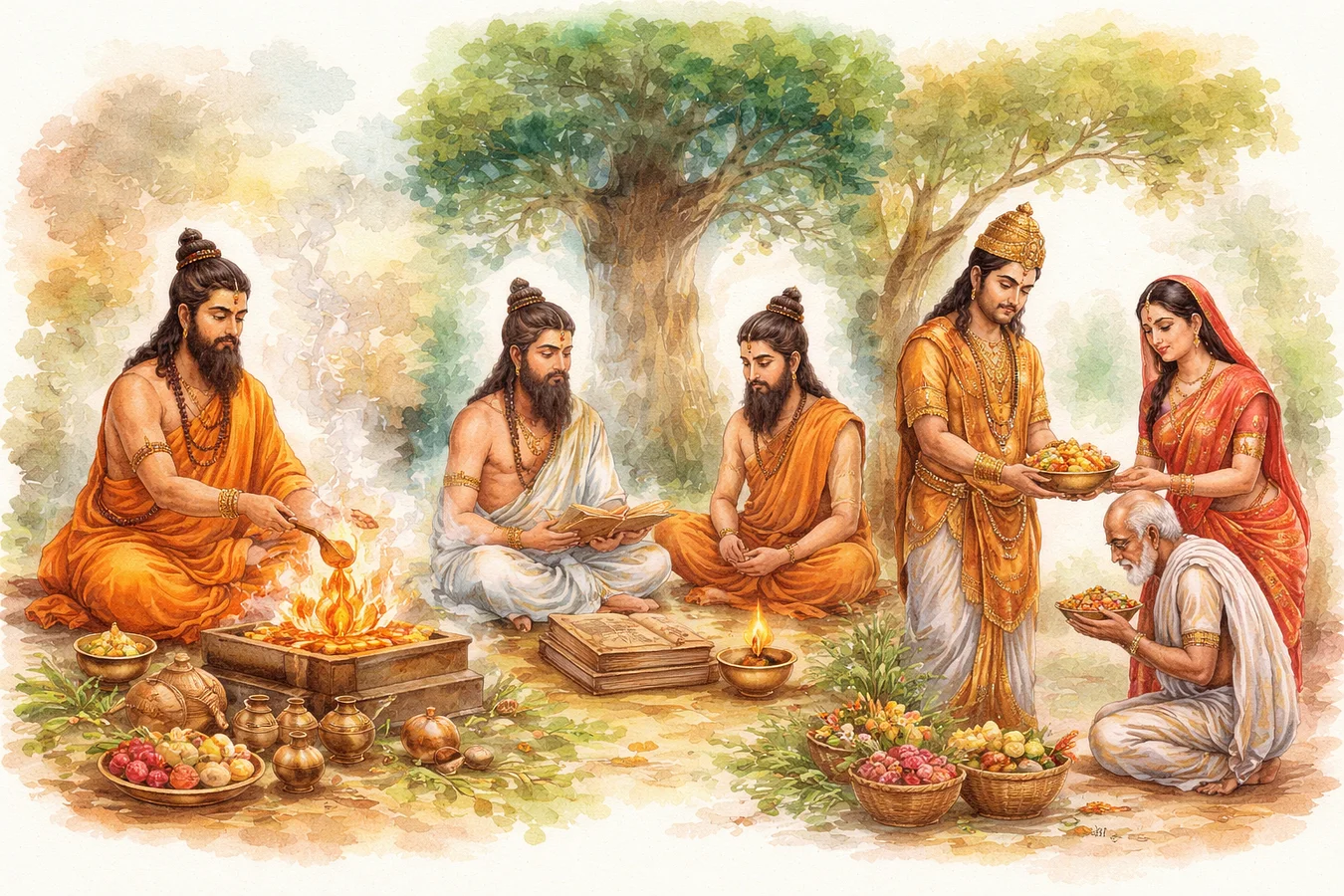
In plain terms: performing sacrifices (ijyā), studying the Vedas (adhyayana), and giving in charity (dāna) — these three, done according to scripture, are the eternal and common duties of the Brāhmaṇa, Kṣatriya, and Vaiśya.
The verse is precise, almost legislative in its economy. But what it contains is a remarkable social idea.
Not What Divides, But What Unites
The varṇa system is typically discussed in terms of what separates people — priests from warriors, merchants from laborers, each with their own prescribed role and set of rules. And much of the Nītisāra does exactly that. But this verse arrives at a pivotal moment in the text, just as the discussion turns to how society is actually organized. Before Kāmandaka elaborates on what distinguishes each group, he stops to identify what three of them hold in common.
That pause is worth noticing. It suggests that the architecture of a functioning society is not built on difference alone. It requires a shared floor — obligations that no one, regardless of their station, is exempt from.
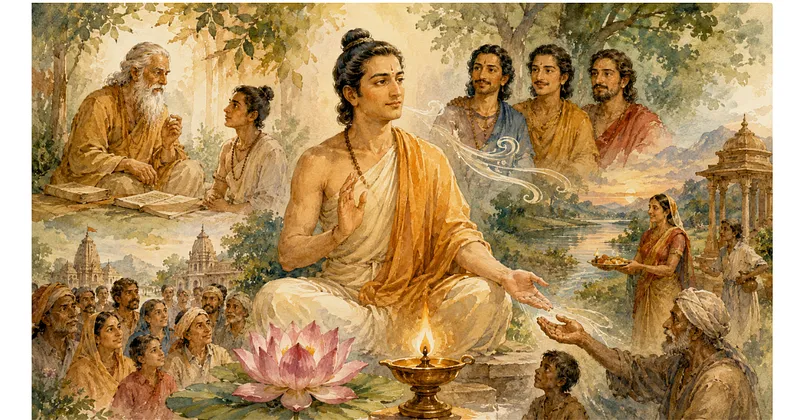
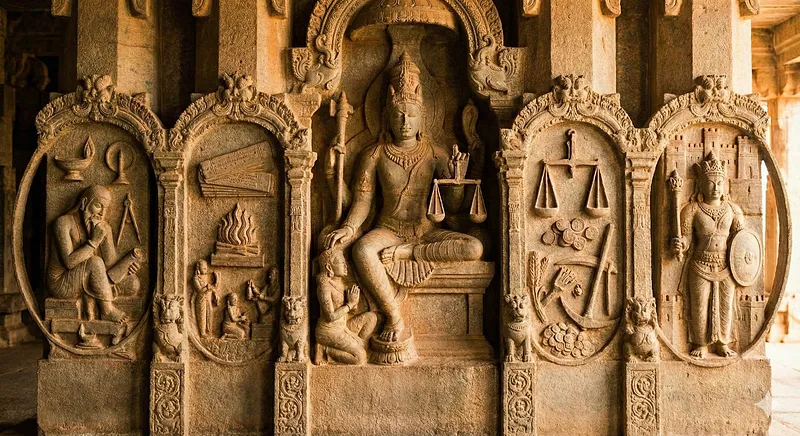
The three duties named are not arbitrary. Ijyā, ritual sacrifice, was the public enactment of one's relationship with the cosmos and the community — the Darśa-Paurṇamāsa yajñas performed at the new moon and full moon were recurring, not optional. Adhyayana, Vaidikastudy, was not mere literacy but a sustained personal investment in the knowledge that held the tradition together — specifically, the study of one's own śākhā, one's inherited branch of Vaidika learning. And dāna, charity, was the redistribution of whatever one had accumulated — given to the deserving, with the right intention, not as performance but as duty.
Crucially, all three had to conform to yathā-śāstram — to scriptural guidelines. The acts alone were not sufficient. Their quality, their sincerity, their alignment with an external standard, all of this mattered. Ritual without intention was hollow. Learning without rigor was self-indulgence. Charity without discernment was mere spending.
Eternal, Not Optional
The word sanātana — eternal — is doing serious work in this verse. These are what the Jayamaṅgalā commentary calls nitya-karma: perpetual duties, not ones that can be set aside when inconvenient. They are not peak-moment obligations, the kind reserved for festivals or crises. They are the background hum of a dhārmika life, always operative, always expected.
This stands in quiet contrast to how we tend to think about social responsibility today. Voting, donating, volunteering — these are treated as virtuous extras, admirable but optional. We do not speak of them as sanātana. We do not build social order on the assumption that everyone will do them, always, as a matter of course.
The Nītisāra does. And one of its insights is that a society in which shared duties are considered eternal rather than elective is a fundamentally different kind of society — more stable, more accountable, and more cohesive.
A Standard by Which Deviation Can Be Judged
The Upādhyāyanirapekṣā commentary on this verse adds a dimension that gives it real teeth. By establishing what all three upper varṇas share, the verse also establishes a benchmark. A common standard means that falling short of it is visible and measurable, not a matter of private conscience alone. A Kṣatriya who abandons learning, or a Vaiśya who stops giving, is not merely failing at self-improvement — they are defaulting on a social contract.
This is not punitive for its own sake. It is structural. Every functioning society needs some version of this: a clear articulation of what is owed, so that the gap between what is owed and what is delivered can be honestly named.
What This Means for Us Now
We do not live in Kāmandaka's world. The varṇa framework, with all its historical complications, cannot be imported wholesale into the present. But the underlying logic of this verse is strikingly portable.
Across very different modern contexts — democratic, secular, pluralist — the question of sāmānya-dharma, of common duty, keeps returning. What do citizens owe each other, regardless of profession or wealth? The answer, in most serious political traditions, tends to cluster around something like the three duties named here, even if the vocabulary is different. Contributing to collective ritual life (civic participation), sustaining shared knowledge (education and intellectual life), and redistributing resources to those in need (charity, taxation, welfare) — these reappear across cultures and centuries because they address something fundamental about how communities survive and hold together.
What Kāmandaka adds, that much modern thinking lacks, is the insistence on all three being simultaneous, perpetual, and subject to an external standard. You cannot opt out of one because you are particularly good at another. The merchant cannot substitute generous donations for the neglect of learning. The statesman cannot substitute public ceremony for the absence of generosity. Each duty checks and reinforces the others.
There is also something in the structure of the verse that is worth sitting with: it emphasizes shared obligation before it discusses differentiation. The common ground comes first. Whatever distinguishes us in role, capacity, or vocation, we start from the same place. That sequence — unity before distinction — is itself a kind of wisdom, and one that contemporary societies, so often organized around identity and difference, would do well to remember.
The duties change shape across time. The sacrificial fire looks different today. But the principle — that there are things we owe each other that are eternal, shared, and non-negotiable — is as urgent now as it was when Kāmandaka first set it down.