In ancient Indian political philosophy, scholars engaged in a fundamental debate about how many branches of knowledge a ruler must master to govern effectively. The Kāmandaka Nītisāra, drawing on Kauṭilya's Arthaśāstra, preserves this intellectual discussion that reveals contrasting visions of what knowledge matters most for successful statecraft and governance.
The Three-Knowledge System: Manu's Traditional View
त्रयी वार्त्ता दण्डनीतिस्तिस्रो विद्या हि मानवाः । त्रय्या एव विभागोऽयं येयमान्वीक्षिकी मता ॥
trayī vārttā daṇḍanītis-tisro vidyā hi mānavāḥ | trayyā eva vibhāgo'yaṃ yeyam ānvīkṣikī matā ||
"The Mānavas (followers of Manu) hold that there are three vidyās: Trayī, Vārtā, and Daṇḍanīti. Ānvīkṣikī is considered merely a division within Trayī itself."
According to the followers of Manu, a ruler must master three essential disciplines of statecraft. Trayī encompasses vaidika study and spiritual wisdom, providing moral authority and legitimacy. Vārtā covers agriculture, trade, and economic administration, ensuring the kingdom's material prosperity. Daṇḍanīti deals with governance, justice, and the wielding of political power.
What about logic and philosophy, known as Ānvīkṣikī? The Manu school considers it an integral part of Trayī rather than a separate field necessary for rulers. This reasoning system takes two forms, as the commentaries explain: sā ca dvividhā trayyānugāminī trayyāntarbhūtā ca—one embedded within vaidika study (like Mīmāṃsā and Nyāya that help interpret law and sacred authority), and another that follows vaidika principles independently (such as Sāṅkhya and Yoga, which guide a ruler's self-discipline and understanding).
The commentaries also reference Kauṭilya's observation: aṅgāni vedāścatvāro mīmāṃsā nyāyavistaraḥ—"The limbs of the Vedas include the four Vedas, Mīmāṃsā, and the elaboration of Nyāya." This shows how logic and reasoning are considered extensions of vaidika knowledge rather than independent disciplines.
The key insight for governance is that a ruler's knowledge must be rooted in dharma. Any philosophical inquiry that contradicts vaidika wisdom undermines legitimate authority and falls outside the scope of knowledge required for righteous rule.
The Two-Knowledge System: Bṛhaspati's Materialist Position
वार्ता च दण्डनीतिश्च द्वे विद्ये इत्यवस्थिताः । लोकस्यार्थप्रधानत्वाच्छिष्याः सुरपुरोधसः ॥
vārtā ca daṇḍanītiśca dve vidye ity-avasthitāḥ | lokasya-arthaprādhānatvāc chiṣyāḥ surapurodhasaḥ ||
"The disciples of Bṛhaspati (the preceptor of the gods) firmly hold that there are only two vidyās: Vārtā and Daṇḍanīti, because material prosperity (artha) is the primary concern of the world."
The disciples of Bṛhaspati, representing a more pragmatic approach to statecraft, argue that a ruler needs to master only two fields of knowledge. Since material prosperity and power form the foundation for effective governance, only Vārtā, for generating wealth, and Daṇḍanīti, for wielding and protecting power, deserve recognition as independent disciplines necessary for kingship.
This perspective reflects a realist philosophy of governance where spiritual and philosophical studies serve merely decorative purposes or tools of manipulation. From this viewpoint, a ruler's primary concerns are economic strength and political control. Dharma and spiritual authority matter only insofar as they help maintain order and legitimacy in the eyes of subjects.
The Bṛhaspati school sees spiritual disciplines as useful strategically, perhaps for performing rituals that satisfy the populace or for maintaining the appearance of righteousness, but not as essential domains of knowledge for exercising power. What matters is the treasury and the army, not philosophical subtleties.
The One-Knowledge System: Śukra's Governance-Centered View
एकैव दण्डनीतिस्तु विद्येत्यौशनसः स्थिताः । तस्यां हि सर्वविद्यानामारम्भाः सम्प्रतिष्ठिताः ॥
ekaiva daṇḍanītis tu vidyety auśanasaḥ sthitāḥ | tasyāṃ hi sarvavidyānām ārambhāḥ sampratiṣṭhitāḥ ||
"The followers of Uśanas (Śukra) hold that there is only one vidyā: Daṇḍanīti, because in it are established the foundations of all other branches of knowledge."
Taking the reduction even further, the followers of Uśanas (Śukra), the legendary teacher of political science in the Asura tradition, claim that a ruler needs to master only one fundamental knowledge: Daṇḍanīti—the science of wielding the rod of punishment and authority.
Their reasoning is compelling from a purely political perspective. Without the capacity to maintain order through force and law, a kingdom collapses into chaos where no other pursuit becomes possible. All other fields of knowledge either find their definitions within political texts or depend entirely on the ruler's ability to enforce stability. Philosophy, spirituality, and economics can only function when the king's authority is firmly established.
The commentaries cite a verse explaining this dependency: nītimāgaraniṣkāntāḥ kuprajāmāruteritāḥ | pṛthaktvaṃ naiva dṛśyantaṃ nānāśāstramahormayaḥ—"From the granary of nīti emerge all the great waves of various śāstras; when the kingdom is ruled poorly and blown by the winds of disorder, they lose their distinctiveness entirely."
Therefore, the science of governance stands as the sole foundational knowledge a ruler requires. Master the art of wielding power, and everything else follows. Fail at this, and all other accomplishments become irrelevant.
The Four-Knowledge System: Kauṭilya's Comprehensive Framework
विद्याश्चतस्र एवैता इति नो गुरुदर्शनम् । पृथक् पृथक् प्रसिद्ध्यर्थं यासु लोको व्यवस्थितः ॥
vidyāścatasra evaita iti no gurudarśanam | pṛthak pṛthak prasiddhyarthaṃ yāsu loko vyavasthitaḥ ||
"Our teacher's view is that there are exactly these four vidyās—distinct and separate, each established for achieving a specific purpose, and the world is organized accordingly."
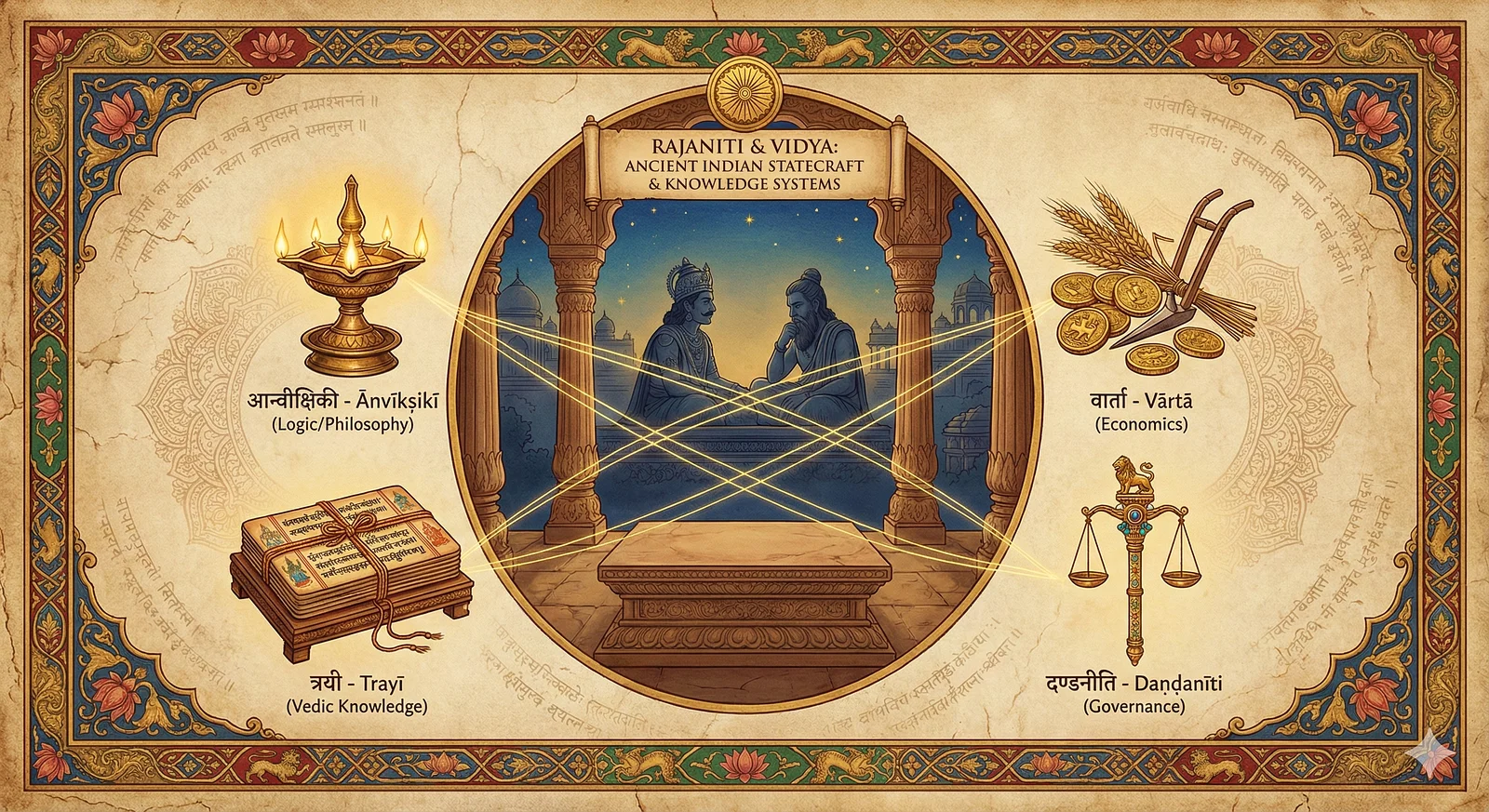
Kauṭilya, the master strategist and political philosopher, rejects all three previous positions and establishes what he considers the definitive view for effective governance: a ruler must master exactly four independent and equally essential branches of knowledge.
Ānvīkṣikī enables the critical thinking and logical analysis necessary for sound decision-making and understanding complex situations. Trayī provides the moral authority, legitimacy, and understanding of dharma that transforms mere power into righteous rule. Vārtā ensures the kingdom's economic prosperity, maintaining the treasury and satisfying the material needs of subjects. Daṇḍanīti masters the art of wielding political power, maintaining order, and protecting the realm from internal and external threats.
These four cannot be merged or reduced because each serves a unique and essential function in statecraft. They are complementary pillars supporting effective governance. A ruler skilled only in economics cannot maintain order. One versed only in force cannot win legitimacy. A king knowledgeable only in scripture cannot manage resources. Reducing the number of branches limits the distinct utility each provides to the art of ruling.
What This Debate Reveals About Governance
This ancient discussion reflects more than academic theorizing; it represents fundamentally different philosophies of statecraft and power.
The three-knowledge view prioritizes moral legitimacy, seeing effective governance as ultimately requiring dhārmika authority that binds spiritual, economic, and political power together. The two-knowledge position takes a hardheaded realist stance that economic resources and coercive power form the only real foundations of rule, with everything else being window dressing. The one-knowledge argument elevates the capacity to wield force and maintain order as the singular skill a ruler must possess, with all other concerns being derivative. And the four-knowledge framework attempts a balanced integration of reasoning, moral authority, economic management, and political control as equally necessary for sustainable governance.
Modern debates about governance and leadership continue to echo these ancient positions. Should leaders prioritize moral authority or effective results? Is economic management the key to political success? Can a state survive on military strength alone? Is philosophical sophistication relevant to practical governance?
The resolution that Kauṭilya offers, preserved through the Kāmandaka Nītisāra, suggests that successful statecraft requires multiple, distinct forms of knowledge working in concert. Critical reasoning enables sound judgment, moral authority provides legitimacy, economic skill sustains the realm, and political acumen maintains order and security.
Perhaps the enduring lesson for governance is that whenever we are tempted to declare that only one kind of knowledge truly matters for rulers—whether military prowess, economic management, moral authority, or political cunning—we should remember this ancient debate and consider whether we are missing something essential about the multifaceted challenge of statecraft. The complete ruler, according to Kauṭilya, is one who has mastered all four domains and knows when to apply each.