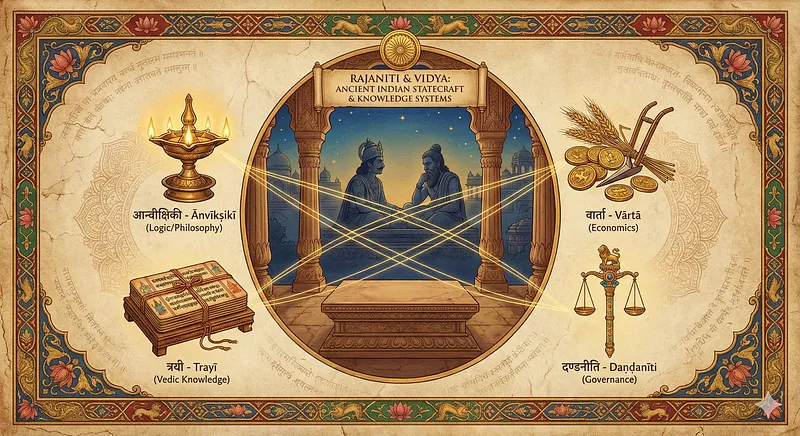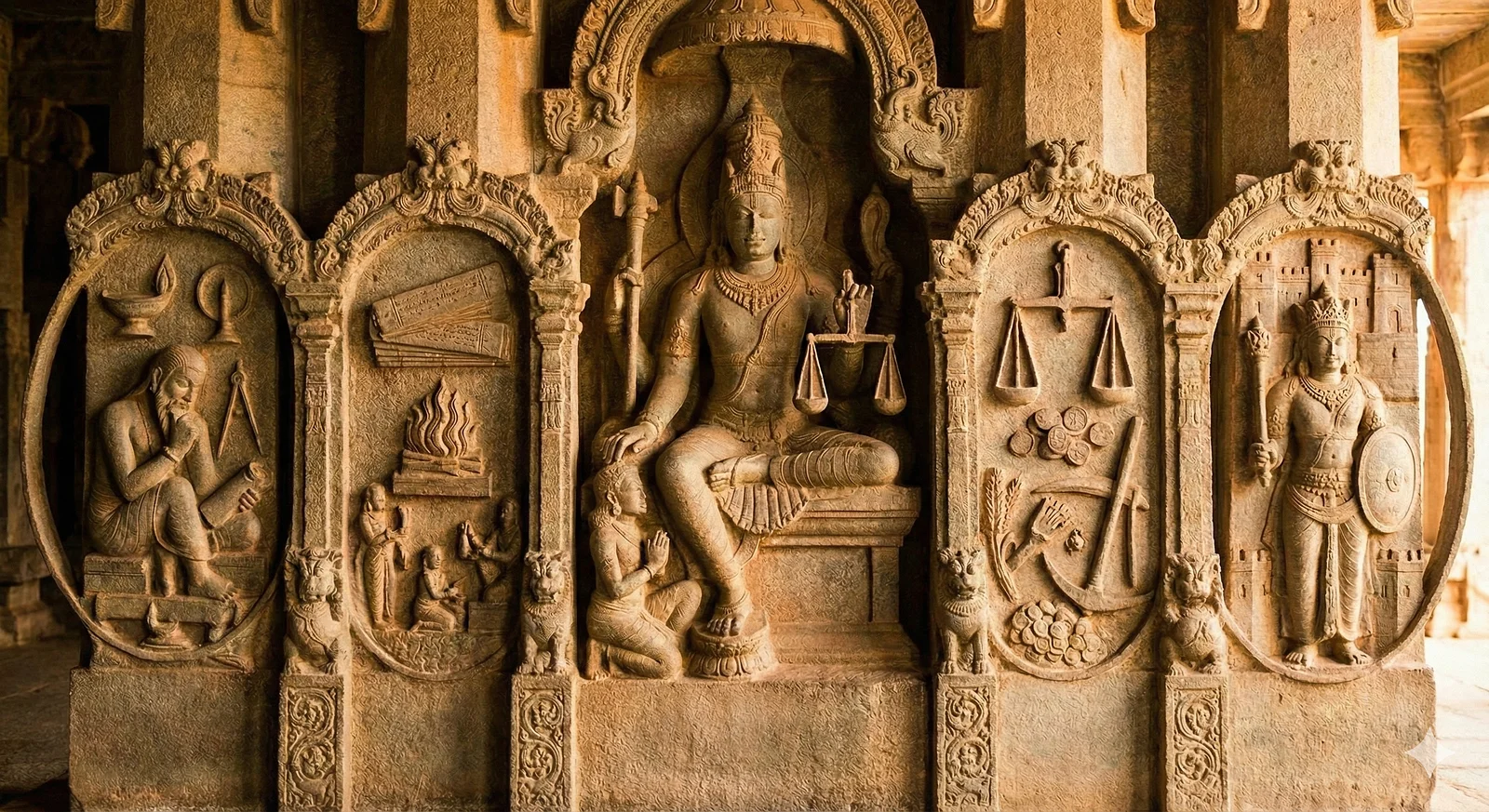
Ancient Indian political philosophy recognized that a thriving civilization rests not on a single pillar of knowledge, but on four distinct yet interconnected branches of learning. These four vidyās—Ānvīkṣikī, Trayī, Vārtā, and Daṇḍanīti—each serve unique purposes, yet together form the foundation of an ordered and prosperous society.
The Four Branches and Their Distinct Roles
A foundational verse articulates the unique outcomes of each discipline:
ānvīkṣikyātmavijñānaṁ dharmādharmau trayīsthitau | arthānarthau tu vārtāyāṁ daṇḍanītyāṁ naiyetarau || 7 ||
Each vidyā addresses a specific domain of human existence and yields its own particular fruit.
Ānvīkṣikī, the discipline of logical and philosophical inquiry, leads to self-knowledge (ātma-jñāna). Through systematic thinking and inference, it helps us understand the true nature of reality and ultimately points toward clarity and liberation. This is the realm of deep introspection and rational analysis.
Trayī, the study of sacred literature encompassing the Śruti (revealed vaidika texts), Smṛti (remembered traditions and law codes), Purāṇas (ancient cosmological and genealogical narratives), and Itihāsas (epic histories such as the Mahābhārata and Rāmāyaṇa), provides the moral compass. It teaches us to distinguish between dharma and adharma—between righteous conduct and wrongdoing. Through this comprehensive body of knowledge, society understands what actions are ethically correct: the value of sacrifice and study versus the harm of laziness and improper behavior.
Vārtā, encompassing agriculture, trade, and economics, deals with material prosperity (artha) and loss (anartha). It teaches us how wealth is generated or lost—why sowing seeds in the right season brings abundance while poor timing brings ruin. This practical knowledge ensures the economic stability essential for any civilization.
Daṇḍanīti, the science of governance and statecraft, guides leaders in applying wise policy (naya) versus misguided strategy (apanaya). It distinguishes between strategies that secure the kingdom and those that lead to instability, between governance that protects and misrule that destroys.
The Primacy of Governance
While all four branches of knowledge are valuable, the ancient texts make a striking observation about the foundational position of Daṇḍanīti:
ānvīkṣikītrayīvārttāḥ satīrvidyāḥ pracakṣate | satyo'pi hi na satyāstā daṇḍanītestu viplave || 8 ||
The other three vidyās, though valuable and valid in themselves, become ineffective when governance collapses. The phrase satyopy hi na satyāḥ—"though true, they are not truly effective"—captures a profound insight about the dependence of all knowledge systems on political order.
Imagine a society rich in philosophical wisdom, deep religious traditions drawn from the Vedas, Purāṇas, and epic narratives, and prosperous trade. Yet if law and order break down, all of this crumbles. Philosophy cannot be pursued when violence reigns. Rituals cannot be performed amid chaos. Commerce cannot flourish without security. The texts use a powerful phrase to capture this reality: these truths, though true in theory, are "no longer truly useful" when the system of governance fails.
This is not mere theoretical speculation. History has repeatedly shown us that without the structure provided by just governance, society descends into what the texts call mātsya-nyāya—the law of the fish, where the strong devour the weak without restraint.
The Virtuous Circle of Good Governance
The relationship works in reverse as well:
daṇḍanītiryadā samyaṅnetāramadhitiṣṭhati | tadā vidyāvidaḥ śeṣā vidyāḥ samyagupāsate || 9 ||
When Daṇḍanīti is properly upheld by a capable and just leader (netāram), scholars and practitioners of all other disciplines can pursue their knowledge in peace. Philosophers can inquire freely, priests can perform their duties without interruption, traders can conduct business safely, and teachers can instruct without fear.
Good governance creates the conditions for knowledge to flourish. It provides the stability, security, and order necessary for intellectual, spiritual, and economic pursuits to thrive.
The Social Contract: Protection and Obligation
This framework leads to a remarkable theory of legitimate governance and taxation:
varṇāścaivāśramāścaiva vidyāsvāsu pratiṣṭhitāḥ | rakṣet tā rakṣaṇāt tāsāṁ taddharmasyāṁśabhāṅ nṛpaḥ || 10 ||
The varṇas (social classes) and āśramas (life stages) are understood to rest upon these four vidyās. Brāhmaṇas study and preserve the sacred literature—the Śruti, Smṛti, Purāṇas, and Itihāsas—that constitute Trayī. Rulers apply the principles of Daṇḍanīti in political science. Merchants and agriculturalists engage in the economic activities of Vārtā. Seekers and philosophers pursue the inquiries of Ānvīkṣikī. Each stage of life—student, householder, forest-dweller, renunciate—finds its grounding in one or more of these knowledge systems.
The king's fundamental duty is to protect these vidyās (rakṣet tāḥ) and, by extension, the entire social order they support. In return for this protection—for maintaining the conditions under which all people can fulfill their duties and pursue their knowledge—the ruler becomes entitled to a share (ṣaṣṭhāṁśa, one-sixth) of the people's earnings.
This is not arbitrary taxation but a dharma-based social contract. The ruler's right to collect resources depends directly on the fulfillment of his protective duty. If he fails to safeguard knowledge and maintain order, if adharma spreads under his watch, his claim to public resources is forfeit.
Lessons for Today
This ancient wisdom offers insights that transcend its historical context. It reminds us that knowledge systems are interdependent and that their effectiveness depends on the broader social and political environment. It recognizes that material prosperity, moral clarity, philosophical insight, and political order are not separate pursuits but mutually reinforcing elements of civilization.
Most importantly, it articulates a vision of governance grounded in duty rather than power alone. The legitimacy of authority derives from its service to the common good—from protecting the conditions that allow all forms of human flourishing to take root and grow.
In an age where we often discuss governance, economics, ethics, and knowledge as separate domains, these ancient texts remind us of their essential unity. A society thrives not when one pillar stands tall, but when all four are maintained in proper balance, with wise governance providing the foundation upon which the others rest.