The previous part concluded with a question: How do inherited conditions influence the development and manifestation of the guṇas?
It also hinted that the Bhāgavata answers the question through its account of the Ten Guṇahetus. Let us continue our exploration.
The Ten Guṇahetus
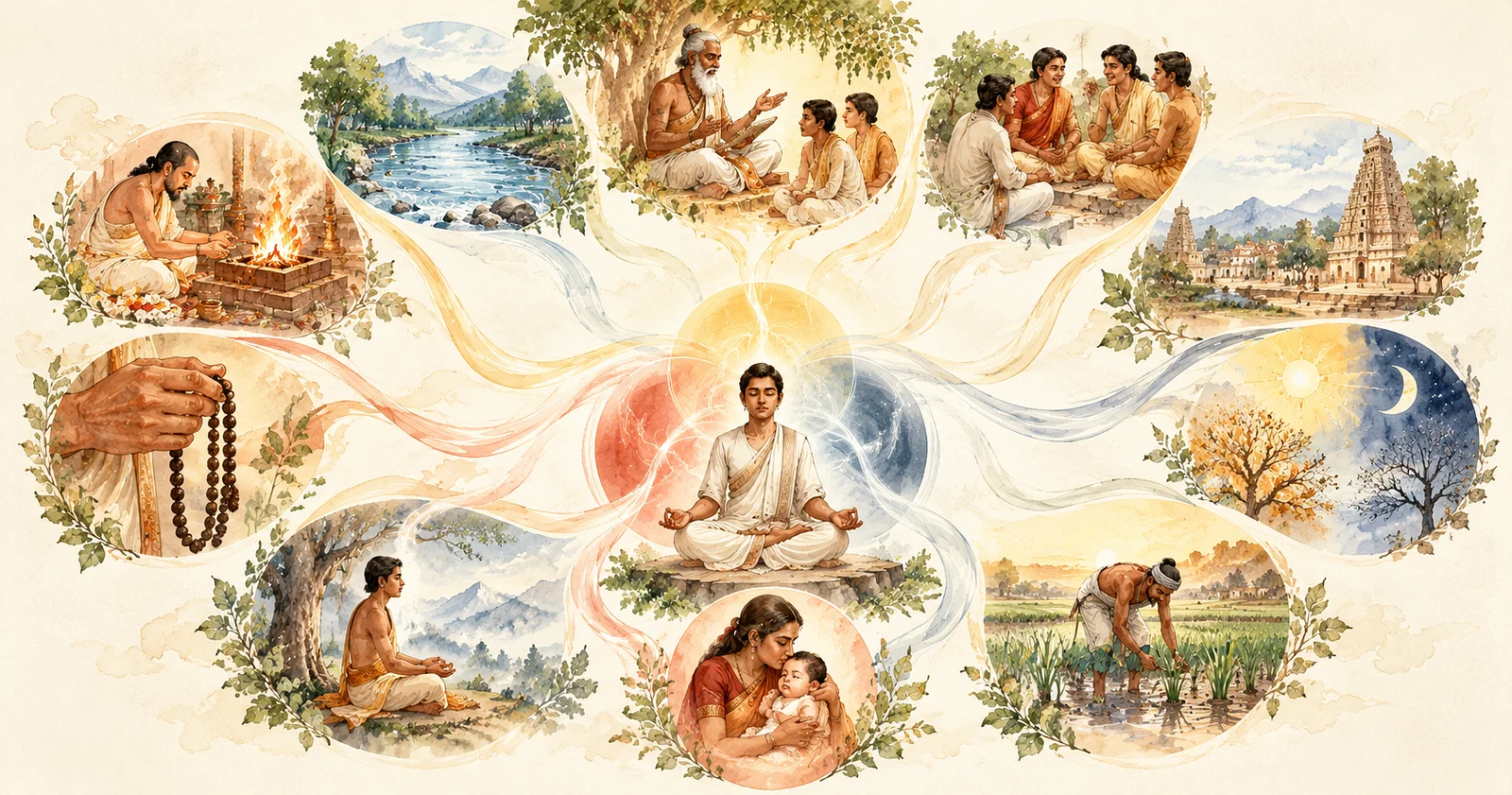
The Bhāgavata identifies ten guṇahetus. These factors do not merely contribute to the growth of the guṇas; an individual’s existing guṇas also shape how that person engages with each of them. Thus, the relationship operates in both directions: the ten factors strengthen the corresponding guṇas, while a person’s predominant guṇas influence the choices made regarding those factors.
Although the Bhāgavata presents these factors in the context of bhakti rather than as a formal procedure for determining varṇa, they may provide an interpretive framework for examining which guṇa predominates in an individual and how that predominance may relate to varṇa.
The Haṃsagītā of the Bhāgavata Purāṇa says:
आगमोऽपः प्रजा देशः कालः कर्म च जन्म च । ध्यानं मन्त्रोऽथ संस्कारो दशैते गुणहेतवः ॥
“Scriptural teaching, water, the people with whom one associates, place, time, action, birth, meditation, mantra and saṃskāra—these ten are the causes that influence the guṇas.”- Bhāgavata Purāṇa 11.13.4
The scholar Śrī Kappagantula Lakṣmaṇaśāstri explained that whichever guṇa these ten factors are associated with becomes strengthened in the individual. Mahāmahopādhyāya Śrī Vārāṇasi Subrahmaṇyam likewise observed that the respective guṇas become predominant according to such influences as one’s food, the things one sees, the books one reads and the company one keeps.[16] Therefore, an inquiry into a person’s guṇa and karma cannot be confined to an assumed psychological disposition. It must consider the total formative environment represented by these ten factors.
Some commentators interpret janma in this verse not simply as physical birth, but as a new religious birth marked by dīkṣā:
“जन्म च वैष्णवदीक्षादिलक्षणं न शाक्तक्षुद्रदीक्षारूपम् ।.” [1]
Dīkṣā means formal initiation by an authorised guru into a particular religious lineage or sampradāya. During initiation, the disciple may receive a mantra, a prescribed form of worship, rules of conduct and eligibility to participate in the practices of that tradition. Lakṣaṇa here means the defining characteristic or identifying mark of such a birth. Thus, according to this interpretation, janma includes an initiatory or spiritual birth—particularly initiation into a Vaiṣṇava tradition—rather than merely the biological event of being born.
This interpretation connects janma with āgama, mantra and saṃskāra. A person enters a particular tradition through initiation, receives its mantra and disciplines, undergoes its formative rites and adopts the conduct prescribed by its scriptures. Such initiation can consequently redirect one’s associations, practices, contemplation and habits. It is therefore not an isolated ceremony: it can simultaneously affect several of the ten factors that shape the predominance of the guṇas.
The relationship among bhāva, guṇa, karma, and the body is expressed in the Manusmṛti:
यादृशेन तु भावेन यद् यत् कर्म निषेवते ।
तादृशेन शरीरेण तत् तत् फलमुपाश्नुते ॥ १२.८१ ॥
“Whatever action a person performs with a particular disposition, he experiences its corresponding result through a body of that same character.” Medhātithi explains that an action performed with a sāttvika, rājasika, or tāmasika disposition assumes the corresponding guṇa; its fruit likewise shares that guṇa and is experienced through a body predominated by it.[7]
The Paramārthasāra similarly connects upāsanā with the worshipper’s bhāva:
सर्वाकारो भगवानुपास्यते येन येन भावेन ।
तं तं भावं भूत्वा चिन्तामणिरिव समभ्येति ॥
“Bhagavān, who assumes every form, is worshipped according to whatever bhāva the worshipper adopts. Assuming that corresponding form, He approaches the worshipper like a wish-fulfilling gem.” [8] Together, these passages connect the worshipper’s bhāva with the form of upāsanā, the guṇa of the resulting karma, and the body through which its fruit is experienced.
These passages indicate that upāsanā is an important factor in both revealing and influencing the predominant guṇa of an individual. A related interpretation appears in Arthur Avalon and Vimalānanda Svāmī’s Tantric Texts, Vol. IX, Karpūrādi Stotra (1922), which cites the Kāmadhenu Tantra in classifying different Mahāvidyās and their forms of sādhana according to the predominance of sattva, rajas, and tamas.
Introduction section:
“In the Kāmadhenu Tantra, Śiva says: ‘In the void is Kālī, who grants Kaivalya. Tārā is Sattvaguṇātmikā and Tattvavidyādāyinī; Ṣoḍaśī (Mahātripurasundarī), Bhuvaneśvarī, and Chinnamastā are Rajah-pradhāna and Sattvaguṇātmikā, and hence they grant Gauṇamukti in the form of Heaven (Svarga), Aiśvarya, and so forth. The forms of Dhūmāvatī, Bagalā, Mātaṅgī, and Kamalā are Tamah-pradhāna, and hence their Sādhana is done in Ṣaṭkarma, such as causing death to others and so forth. In short, all the ten forms of Mahādevī give Enjoyment and Liberation directly or indirectly.’”[1]
Elsewhere, Śrī Bellamkoṇḍa Rāmarāya Kavi states: “Persons established in tamas worship pretas (departed spirits), the Saptamātṛkās (Seven Divine Mothers), and other groups of supernatural beings.” [1] From Bartholomäus Ziegenbalg to the Right Reverend Henry Whitehead, numerous writers documented bhūta worship in South India, while others recorded similar practices elsewhere in India.
Thus, the upāsanā practised by each varṇa or jāti, together with the ācāra arising from it, becomes a social expression or marker of its predominant guṇa. These factors may therefore be useful in identifying the guṇas of individuals and communities. Upāsanā may reveal and strengthen particular guṇas and thereby affect the manifestation of varṇa-characteristics and ritual fitness. This does not necessarily change the individual’s birth-based jāti.
Āhāra and the Guṇas
The Veda states that āhāra, or food, contributes significantly to the guṇas. According to the Chāndogyopaniṣad:
आहारशुद्धौ सत्त्वशुद्धिः सत्त्वशुद्धौ ध्रुवा स्मृतिः ।
स्मृतिलम्भे सर्वग्रन्थीनां विप्रमोक्षस्तस्मै मृदितकषायाय तमसः पारं दर्शयति ॥
“When food is pure, the mind becomes pure. When the mind is pure, memory becomes firm. When memory is attained, all the knots of the heart are released. To one whose impurities have been removed, the way beyond darkness is revealed.” - 7.26.2
The Vedic teaching that purity of food contributes to purity of mind establishes āhāra as an important formative influence. The mind is described as being formed from anna, or food; consequently, the character of the food consumed affects mental dispositions and tendencies. Sāttvika food promotes clarity and stability, rājasika food promotes activity and restlessness, and tāmasika food promotes inertia. The relationship is reciprocal. A person’s predominant guṇas influence the kind of food preferred, while the food repeatedly consumed strengthens the corresponding guṇas.
Food habits are also transmitted through families and communities. The food consumed by parents and the food given to children consequently form part of the inherited āhāra-vihāra—the diet and way of life—through which a jāti or sampradāya preserves its ācāra. Āhāra may therefore be examined both as a cause that strengthens guṇa and as a social marker through which predominant guṇas become visible.
Sāttvika, rājasika and tāmasika paths exist not only in the selection of food but also in the acquisition of dhana, or wealth. The renunciant spiritual teacher Svāmi Jñānānanda Maharṣi indicated that the guṇas of the phalas, or results, obtained from the respective yajñas also depend upon their saṅkalpas, or underlying intentions.[1]
Avidyā, Mala, and Karma
अन्तःशरीरे ज्योतिर्मयो हि शुभ्रो यं पश्यन्ति यतयः क्षीणदोषाः ॥- Muṇḍaka Upaniṣad 3.1.5
अस्याज्ञानस्यावरणविक्षेपनामकमस्ति शक्तिद्वयम् ।
“This ignorance possesses two powers, called concealment and projection.” -Vedāntasāra 51
Importance of Karma can be understood in Brihadaranyakopanishat (1-6-3), and the Śvetāśvatara Upaniṣad
एको देवः सर्वभूतेषु गूढः सर्वव्यापी सर्वभूतान्तरात्मा । कर्माध्यक्षः सर्वभूताधिवासः साक्षी चेता केवलो निर्गुणश्च ॥ 6.11
“The one Divine Being is hidden within all beings, all-pervading and the inner Self of all. He is the overseer of karma, the indwelling presence within all beings, the witness, the knower, the absolute One, and beyond the guṇas.”[1]
Within this interpretive tradition, gurus discuss avidyā, or ignorance, and the impurities called mala, āvaraṇa and vikṣepa. These are closely connected with the triguṇas, worship and karma.
According to the śāstric framework presented here, Īśvara governs māyā, while the individual being, or jīva, is conditioned by avidyā, also called ajñāna, meaning ignorance. The impurities affecting the jīva are principally of three kinds:
-
Mala is the impurity arising from wrongful actions performed previously, including in former births. It is removed through the proper performance of varṇāśrama-dharma.
-
Vikṣepa is the restlessness and projection that distract the mind. It is controlled through upāsanā, or disciplined worship and contemplation.
-
Āvaraṇa is the covering that conceals the true nature of the ātman. It is removed through ātmajñāna, or knowledge of the Self.
This explanation demonstrates the importance of varṇāśrama-dharma and upāsanā in removing mala and controlling vikṣepa, thereby preparing the individual for ātmajñāna. These practices purify the mind and affect the guṇas through which varṇa-characteristics manifest. When āvaraṇa, or the fundamental ignorance constituting the causal body (kāraṇaśarīra), is destroyed through knowledge, the individual attains mokṣa irrespective of jāti. At that stage, however, the individual transcends varṇa rather than acquiring another varṇa.
Varṇāśrama-dharma & Saṃskāras
एवं स पृष्टो भगवान् प्राह भक्तार्तिभञ्जनः । स्ववर्णाश्रमधर्मेण तपसा गुरुतोषणात् ॥
साधनं प्रभवेत् पुंसां वैराग्यादिचतुष्टयम् । नित्यानित्यविवेकश्च इहामुत्र विरागता ॥
शमादिषट्कसम्पत्तिर्मुमुक्षा तां समभ्यसेत् ॥
“Thus questioned, the Lord, the remover of the sufferings of devotees, replied: By following one’s own varṇāśrama-dharma, practising austerity and pleasing the guru, the fourfold means beginning with detachment arise in a person. These are discrimination between the eternal and the non-eternal, detachment from enjoyments in this world and the next, possession of the six virtues beginning with tranquillity, and the desire for liberation. One should cultivate these.” -Varāhopaniṣat 11
Maladoṣas obstruct the jīva’s progress towards its ultimate goal. Varṇadharmas have been specially prescribed to remove these impurities. Duṣkarmas, or wrongful actions, are of many kinds, and the resulting impurities are likewise diverse. Therefore, the dharmas to be practised by human beings have also been classified and prescribed differently. Saṃskāras, which constitute an important part of varṇāśrama-dharma, have been prescribed to produce cittaśuddhi, or purification of the mind, and jñānayogyatā, or fitness to receive spiritual knowledge.
Paṇḍitas have stated that saṃskāras influence both the impurities accumulated over many births and the guṇas present in the respective individuals. Although a child acquires its birth-based jāti through birth into a particular lineage, the corresponding varṇa-lakṣaṇas are nourished and perfected through the prescribed saṃskāras. The śāstras call one who is devoid of the required saṃskāras a vrātya.
Brāhmaṇatva, Kṣatriyatva and other such statuses, though acquired by birth through the kāryakaraṇas (the body and Indriyas) may become impure and decline in the absence of saṃskāras. Therefore, the respective saṃskāras must be received at the proper age and performed in the manner prescribed by the śāstras. Some saṃskāras remove impurities, some cultivate desirable qualities, and some perform both functions. Through saṃskāras, a person attains the fitness for knowledge required to attain kaivalya, or liberation. Therefore, these saṃskāras must necessarily be performed.
Manu and Yājñavalkya stated that saṃskāras pacify impurities arising from bīja, the parental reproductive seed, and garbha, the embryo developing within the womb. Impurities arising from sexual union during prohibited times and similar acts are connected with bīja and are called baijika. The impurity associated with existence within the mother’s womb is connected with garbha and is called gārbhika.[13]
Through rites such as homa, and saṃskāras such as Jātakarma (the rite performed following birth), and Caula (the first-tonsure ceremony), the sins attached to the body are removed. Through Vedādhyayana (study of the Veda), Sāvitracarva (a fire-offering connected with the Sāvitrī), prātaḥ-sāyaṃ-kṛta-homas (morning and evening fire-offerings), devarṣi-pitṛ-tarpaṇas (offerings made to the deities, sages and ancestors), putrotpādana (the begetting of children), Pañcabrahmayajñas (the five great daily sacrifices), Jyotiṣṭoma (a Vedic Soma sacrifice) and other prescribed rites, as well as by avoiding honey and meat, the jīva is made fit for the attainment of Brahman.
The karmas, taught by the śāstras are of two kinds: Śrauta and Smārta. Śrauta karmas are prescribed directly in the Vedas, while Smārta karmas are laid down in the Smṛtis, which have the Vedas as their source. The Gṛhya and Dharmasūtras also form part of the Smṛtis. Although these are pauruṣeya, or composed by human authors, they follow their source, the Śruti, without deficiency or excess. Therefore, they too are accepted as pramāṇa like the Śruti. Among these works, the Dharmasūtras teach the dharmas common to the four varṇas.
When these karmas are performed niṣkāma, without desire, they produce purification of the mind and thereby facilitate the path to knowledge and liberation. When performed sakāma, with a particular desire or goal, they produce Svarga and other results.[13]
Conclusion: From Avidyā to Ātmajñāna
Upāsanā, food, way of life, methods of acquiring wealth, and the remaining factors identified in the Bhāgavata are all guṇahetus. These factors influence the gross and subtle bodies and prepare the individual for the jñāna through which causal avidyā is ultimately destroyed.
The gross body arises from śukra, the paternal reproductive substance, and śoṇita, the maternal reproductive substance, through which it receives physical characteristics from the parents. Birth into a particular lineage also places the individual within an inherited environment of upāsanā, ācāra, food, saṃskāras, and ways of life that may cultivate corresponding guṇas. It is in this sense that the śāstras connect jāti with birth.
If janma, one of the guṇahetus, is interpreted as an initiatory birth marked by dīkṣā, then the form of upāsanā received through that initiation-and the guṇas cultivated through its practice-may help in understanding the individual’s predominant guṇa. The saṃskāras prescribed by the Dharmaśāstras likewise influence and refine the guṇas.
Varṇa, therefore, cannot be assigned on the basis of any single, immediately observable characteristic. Its determination requires consideration of birth, lineage, guṇa, karma, saṃskāra, upāsanā, ācāra, bodily constitution, and way of life. Birth remains important because it places the individual within a particular bodily, familial, ritual, and formative environment. If guṇa is taken as a criterion, it cannot be inferred merely from temperament or isolated behaviour; all ten guṇahetus identified in the Bhāgavata must be considered. Among these, upāsanā and its corresponding ācāra provide especially visible and sustained markers of guṇa, since they reveal how an individual or community actually worships, acts, and lives. As discussed in the companion article, ācāra connects the metaphysical framework of varṇa with the lived practices of jāti and kula. The karmas and saṃskāras prescribed by the Dharmaśāstras also cultivate and refine the guṇas, contribute to pāpakṣaya, and produce the cittaśuddhi and jñānayogyatā required for higher knowledge. Birth and inherited ācāra are therefore especially important in determining varṇa, because through them the individual receives the lineage’s bodily dispositions, upāsanā, saṃskāras, prescribed karmas, disciplines, and established way of life.
Bibliography
-
Mylavarapu, V. N. L. Sudha Mohan. Varṇāśrama Vijñānamu. Telugu. 2025.
-
“Report of the Subcommittee Appointed by the National Education Conference at Kāśī.” Āndhrapatrika, Telugu daily, Monday, 10 September 1923.
-
Bhartṛhari. Vākyapadīyamu. Telugu translation and commentary by Peri Sūryanārāyaṇa Śāstri, Śrībhāṣyam Appalācāryulu, Pullela Śrīrāmacandruḍu, and Appalla Śrīrāma Śarma. 1974. See the Jātisamuddeśa.
-
Dharampal. Essential Writings. See Jayaprakash Narayan’s 1962 comments on organic and atomized conceptions of society, pp. 292–293.
-
Halbfass, Wilhelm. Tradition and Reflection: Explorations in Indian Thought. Albany: State University of New York Press, 1991. See “Homo Hierarchicus: The Conceptualization of the Varṇa System in Indian Thought.”
-
Kauṭilya. Kauṭilīyam Arthaśāstram. Edited by Viśvanātha Śāstrī Dātāra. Varanasi: Sampurnanand Sanskrit University, 1991. See Rājeśvara Śāstrī Drāviḍa’s Jayamaṅgalā-kroḍapatram commentary.
-
Manusmṛti 12.81, with Medhātithi’s commentary, translated by Ganganatha Jha, “Manusmṛti Verse 12.81”. wisdomlib.org
-
Gopinatha Kaviraja, ed., Tantra-Saṅgraha, Part I
-
Iyer, G. Ramachandra. Ātmavidyā.
-
Joseph, Sinu. Varṇa Vidyā: The Biological Basis of Varṇa Dharma, Especially for Women and the Śūdra Varṇa. Notion Press, 2023.
-
Paramahaṃsa Parivrājakācārya Jagadguru Siddheśvarānanda Bhāratī Svāmi, Kurtālam Pīṭham Tāntrika Prapañcam, p. 78.
-
Kāmandaka. Nītisāra of Kāmandaka. Edited by T. Gaṇapati Śāstrī. Trivandrum: Travancore Government Press, 1912.
-
Śeṣāvadhānulu, Bhāratula. Āpastambīya Pañcadaśakarmānukramaṇikā. Telugu
-
Sridhar, Nithin. Chatuh Shloki Manusmriti: An English Commentary. 1st ed. Vitasta Publishing, 2025.
-
Fárek, Martin, et al., eds. Western Foundations of the Caste System. Cham, Switzerland: Palgrave Macmillan, 2017.
-
Kappagantula Lakshmana Sastri, Mahabharata – Bhishma Parva, 1999, Telugu p. 575. & Mahopadhyaya Sri Varanasi Subrahmanyam, Astikatvamu, 1956, p. 40, Telugu 42–43