The history of caste as understood in the modern world cannot be separated from the intellectual history of Europe. To understand how Indian social distinctions came to be represented as a unified "caste system," it is necessary to examine the concepts and classificatory frameworks through which Europeans interpreted the societies they encountered.
Martin Fárek (2017) argues that when Vasco da Gama reached Calicut in 1498, the Iberian Peninsula was undergoing profound religious and social transformation. The kingdoms of Spain and Portugal had recently completed the Reconquista and had embarked upon policies aimed at creating religiously homogeneous Christian societies. Jews and Muslims were expelled, forcibly converted, or subjected to severe discrimination. Large populations of converts, known as New Christians, remained within these societies. Although many had sincerely embraced Christianity, they were often viewed with suspicion by those who claimed descent from ancient Christian families.
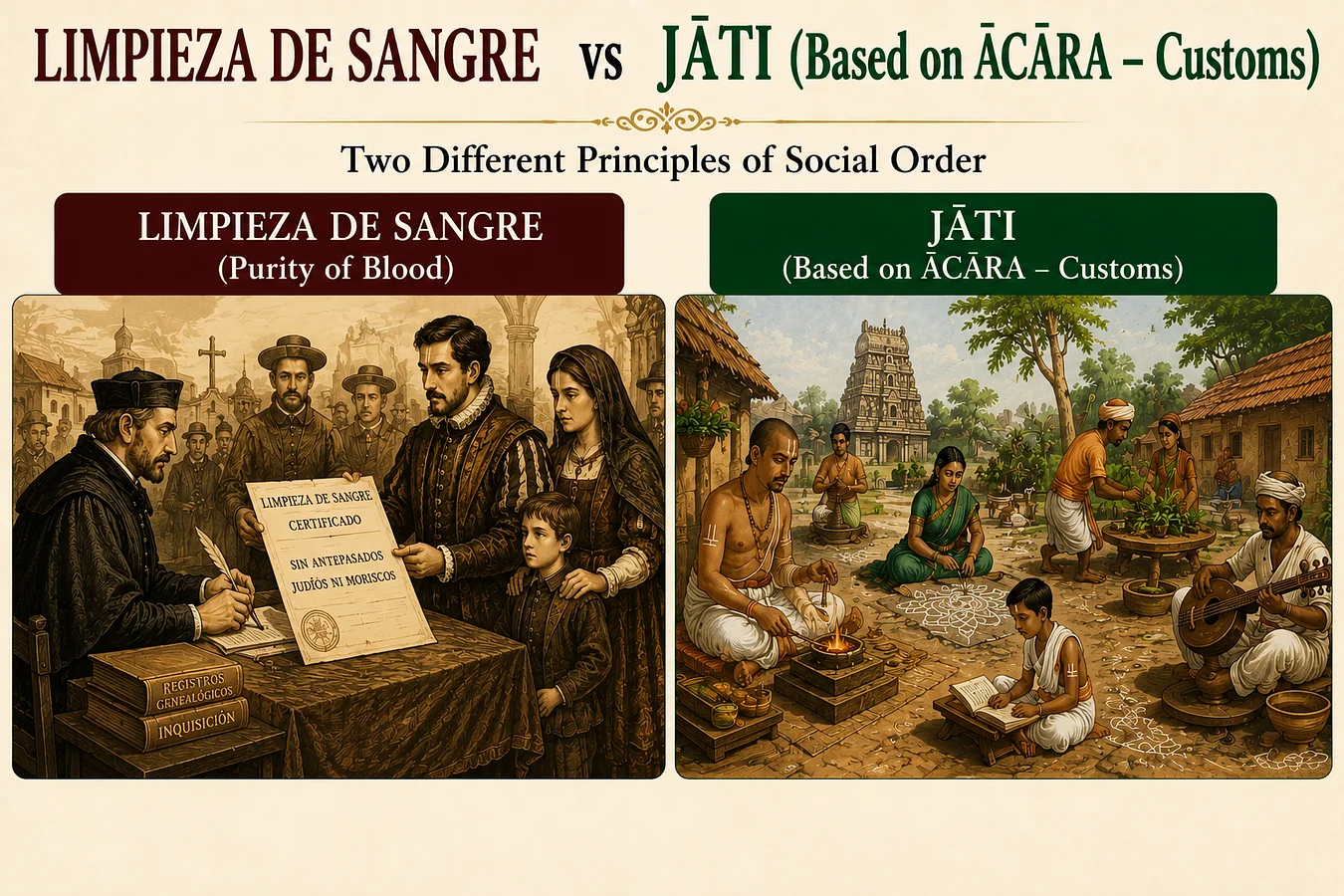
It was in this context that the doctrine of limpieza de sangre – purity of blood - emerged. According to this doctrine, a person's ancestry became a matter of social significance. Old Christians were believed to possess "pure" blood, while descendants of Jews or Muslims were regarded as carrying a hereditary stain. What mattered was not merely one's present faith or conduct, but one's lineage. Over time, this distinction became institutionalized. Access to government offices, religious orders, military appointments, and positions of prestige increasingly depended upon proof of ancestral purity. Investigations into family background became common, and social mobility was constrained by inherited status.
The emphasis on inherited descent that characterized limpieza de sangre was not unique to the Iberian world. Similar principles appeared in later racial regimes as well. A notable example is the "one-drop rule" that emerged in the United States, under which a person possessing even a single known African ancestor could be legally classified as Black. Like the purity-of-blood statutes, this principle placed ancestry above individual conduct, belief, education, or social standing. A person's status was determined not by who he was, but by who his ancestors were believed to be. Although the historical contexts differed, both systems reveal a common tendency to explain human identity through inherited lineage. This broader intellectual pattern would later find expression in nineteenth-century racial science, where descent and ancestry were increasingly treated as the primary determinants of social and cultural characteristics.
The importance of this development lies not merely in Iberian history but in the fact that it shaped the conceptual vocabulary through which Europeans interpreted the wider world. When Portuguese travellers, merchants, missionaries, and administrators encountered the diverse social formations of India, they did not arrive as neutral observers. They brought with them categories forged in the religious conflicts of Europe. The term casta, which had already been associated with lineage, descent, and purity, became the lens through which Indian society was viewed.
Scholars such as Martin Fárek (2017) have argued that early European descriptions of India reveal this process clearly. Sixteenth- and seventeenth-century writers often referred not only to the "caste of Brahmins" but also to the "caste of Christians" and the "caste of Moors." The word did not initially denote a uniquely Indian institution. Rather, it referred broadly to groups understood through the framework of hereditary religious descent. In this sense, caste was not discovered in India as a self-evident social reality; it was interpreted through concepts already familiar to European observers.
By the nineteenth century, this framework can still be seen in missionary literature. The proceedings of the Madras Missionary Conference (1850) provide a striking example. The missionaries defined caste as a distinction founded upon "birth-purity or impurity" and insisted that it was essentially a religious institution. Their concern was not primarily with occupational specialization, local custom, kinship structures, or political organization. Instead, they interpreted caste through the language of purity, pollution, and hereditary distinction. To oppose caste, they cited Biblical passages proclaiming that God had made all nations from "one blood" and that no human being should be regarded as inherently unclean.
The significance of these writings lies in what they reveal about the missionary imagination. The missionaries understood caste through categories that were already central to Christian theological debates. Their repeated references to purity, pollution, contamination, and inherited distinction suggest that they were interpreting Indian realities through concepts deeply rooted in their own intellectual tradition. Whether or not Indian communities understood themselves in those terms is a separate question. What is clear is that the European description of caste was shaped by a specifically Christian and European conceptual framework.
The interpretation of caste as a system of birth-purity and religious pollution was not confined to an isolated missionary writer. The proceedings of the Madras Conference on Caste (1850), endorsed by dozens of missionaries representing multiple Protestant denominations across South India and Ceylon, repeatedly characterized caste as a religious institution founded upon notions of birth-purity and pollution. The breadth of support for these resolutions suggests that such interpretations reflected a wider missionary consensus rather than the views of a few individuals.
The conceptual framework employed by nineteenth-century missionaries becomes even clearer in Joseph Roberts' Caste, in its Religious and Civil Character, Opposed to Christianity (1847). Although the work does not explicitly invoke the Iberian doctrine of limpieza de sangre, it repeatedly interprets caste through notions of purity, contamination, hereditary status, and restrictions on intermarriage. Rev. Miron Winslow argued that Hindu marriage negotiations were concerned with preserving the "purity of the Caste" and avoiding contamination through unions with lower castes, while caste itself was described as inseparable from ideas of pollution and holiness. More significantly, Bishop Heber attempted to explain caste by comparing it to the distinction in Spain between "old Spaniards and Castilians" and persons "of mixed blood." Such comparisons reveal that missionary writers were not approaching Indian society through indigenous categories such as jāti, kula, or ācāra, but through conceptual frameworks already familiar within European history. A detailed examination of the changing meanings attached to the term "caste" in European writings, including its association with race, tribe, occupation, religion, and social status, see Sudha Mohan (2022). The language of purity, contamination, mixed blood, hereditary distinction, and social exclusion had deep roots in earlier Christian and Iberian experiences, and these categories profoundly shaped the manner in which caste was understood, debated, and represented in colonial discourse.
The Madras Missionary Conference reflected a similar interpretive framework. Its repeated references to birth-purity, pollution, "one blood," and the abolition of distinctions between Jew and Gentile reveal how Indian social realities were translated into categories already familiar within Christian theological thought.
The interpretation of caste through the categories of purity and impurity did not remain confined to missionary literature. Throughout the colonial period, administrators, ethnographers, census officials, and later sociologists repeatedly employed similar concepts when explaining Indian social organization. Missionaries described caste as a religious institution founded upon birth-purity and pollution; colonial ethnographers frequently interpreted social hierarchy through notions of ceremonial purity and contamination; and influential twentieth-century scholars such as Louis Dumont would later place purity and pollution at the center of their explanation of caste. Although these writers differed in their methods, objectives, and historical contexts, many of them assigned a central explanatory role to notions of purity, pollution, and hereditary status when interpreting caste and social hierarchy in India. The recurrence of these categories across missionary, colonial, administrative, and academic writings raises an important question: to what extent did later theories inherit conceptual assumptions that had already become embedded within European understandings of India during the colonial period?
The missionary interpretation of caste was also shaped by another conceptual distinction that emerged from European Christian history: the separation between the religious and the civil spheres. Scholars such as Jakob De Roover and J.Sai Deepak have argued that this distinction cannot be treated as a universal feature of all societies, but arose from specific theological and political developments within Europe, particularly in the aftermath of the Reformation and the conflicts that culminated in the Peace of Westphalia. Consequently, European observers approached India with the assumption that every institution must belong either to the sphere of religion or to that of civil society. As argued by Jakob De Roover (2015) and J. Sai Deepak (2021), this distinction is clearly visible in missionary writings, which repeatedly insisted that caste was "essentially a religious institution and not a mere civil distinction." Such statements reveal less about how Indian communities necessarily understood themselves and more about the conceptual framework through which Europeans interpreted Indian society. Social practices, customary obligations, ritual observances, kinship networks, and local forms of authority were frequently compressed into categories inherited from European debates concerning religion, church, state, and civil society.
Colonial domination required not only political control but also the production of knowledge. Long before the emergence of racial anthropology, writers such as James Mill had already constructed influential narratives portraying India as a backward and stagnant civilization. However, Mill's significance lay not merely in his criticism of India. As Kundan Singh and Krishna Maheshwari (2024) argue, Mill's representation of Hindu society was fundamentally shaped by categories and concerns drawn from British society itself. The social hierarchies, political institutions, religious practices, and forms of authority that Mill condemned in India often mirrored the very features of British society that Utilitarian reformers sought to transform or abolish at home. India thus became a canvas upon which British anxieties, political debates, and reformist aspirations were projected. Frantz Fanon's later analysis of colonial discourse provides a useful lens through which to understand this process. Fanon argued that colonial domination required the production of knowledge portraying the colonized as primitive, irrational, or incapable of self-government. Seen in this light, Mill's History of British India was not merely a description of India but an act of representation that rendered India intelligible through European categories while simultaneously legitimizing colonial authority.
The tendency to interpret India through categories external to Indian experience was not limited to missionary theology or the political thought of writers such as James Mill. It formed part of a much older European intellectual tradition concerned with explaining the origins and relationships of different peoples. Before the rise of modern racial theories, European understandings of human diversity were largely organized around biblical narratives of descent and genealogy.
As Thomas Trautmann (2006) has shown, European ethnology for centuries had been organized around what he calls the "Mosaic ethnology," the biblical Tree of Nations derived from the descendants of Noah, together with the narrative of the Tower of Babel. According to this framework, the nations of the world were understood as branches of a single genealogical tree, while linguistic diversity was explained through the dispersion of peoples following the confusion of tongues at Babel. During the eighteenth and nineteenth centuries, these biblical models were gradually secularized and transformed into the emerging sciences of comparative philology, ethnology, and race. The genealogical logic remained largely intact, but the language of Noah, Babel, and sacred history increasingly gave way to the language of language families, nations, races, and scientific classification. In other words, while the theological vocabulary changed, the underlying habit of explaining people through ancestry and genealogy persisted. In this sense, many nineteenth-century racial theories represented not a complete break from earlier European thought but a reconfiguration of older biblical frameworks within a new scientific vocabulary.
Despite their differences, the doctrines of purity of blood, the Mosaic ethnology of nations, the one-drop rule, and nineteenth-century racial anthropology shared a common tendency: they sought to explain social identity, social status, and group membership primarily through inherited descent. The forms varied across time and place, but genealogy remained the central explanatory principle.
During the nineteenth century, however, a major shift occurred in European thought. Religious explanations increasingly gave way to racial explanations. The rise of anthropology, ethnology, and racial science transformed older concerns about religious descent into theories of biological inheritance. Ideas that had once been expressed through the language of blood purity were now reformulated in the language of race.
This transformation had profound consequences for colonial scholarship on India. Linguistic discoveries had established relationships between Sanskrit and several European languages, giving rise to the concept of the Indo-European language family. What began as a linguistic observation was gradually transformed into a racial theory. This transformation was facilitated by the older European habit of treating linguistic genealogy as evidence of genealogical relationships among peoples, a habit that can be traced back to the biblical ethnological frameworks described by Trautmann. The Aryan, originally a linguistic category, became a racial category. At the same time, the Dravidian category underwent a similar transformation. What had begun as classifications of language families increasingly came to be interpreted as classifications of peoples, races, and civilizations. Language, ancestry, race, and culture were treated as mutually reinforcing categories, giving rise to the influential Aryan–Dravidian racial framework that shaped much nineteenth-century colonial scholarship on India.
The racialization of the Aryan–Dravidian distinction had important implications for the colonial understanding of caste. Earlier European frameworks such as the doctrine of purity of blood and the Mosaic ethnology had already encouraged the view that social identity was fundamentally rooted in descent and ancestry. Nineteenth-century racial anthropology inherited this genealogical logic and recast it in scientific language. The language changed, but the underlying concern with hereditary descent remained. Earlier discussions of blood, lineage, and ancestral purity increasingly gave way to the vocabulary of race, racial stock, racial type, and racial mixture. Once Aryans and Dravidians came to be understood as distinct races rather than merely speakers of different language families, caste itself was increasingly interpreted as a mechanism for preserving racial descent through endogamy. Social boundaries that had previously been explained through custom, occupation, locality, ritual practice, or community tradition were now reinterpreted as evidence of racial separation. In this manner, colonial scholars increasingly viewed caste not as a network of social communities but as a system designed to maintain the purity of Aryan blood by restricting mixture with supposedly non-Aryan populations. The result was the emergence of a powerful colonial narrative in which caste appeared as a racial institution rooted in ancestry, blood, and biological descent.
The persistence of this genealogical logic can also be observed in the Census of India (1901). Ethnographic accounts reproduced in the volume referred to the preservation of "purity of blood" through restrictions on marriage with families of inferior social rank and discussed the maintenance of a "pure stock" through endogamous practices. Such language indicates that concerns with ancestry, heredity, blood, and social status were not entirely absent from colonial descriptions of Indian society. Rather, they formed part of a broader intellectual environment in which social distinctions were increasingly interpreted through the lens of descent and inherited identity. These references are particularly noteworthy because they appear within a census project often regarded as one of the most influential attempts to classify and systematize Indian society.
Within this intellectual environment, colonial ethnologists sought to explain Indian society through racial origins. Among the most influential was Herbert Risley, who attempted to classify Indian communities through anthropometric measurements. Risley believed that physical characteristics, particularly the nasal index, could reveal racial ancestry and thereby explain social hierarchy. Castes were interpreted as products of varying degrees of Aryan and non-Aryan mixture. The social complexity of India was thus recast as a biological and racial phenomenon.
Padmanabh Samarendra's study of late nineteenth- and early twentieth-century census surveys reveals that colonial understandings of caste were not uniform. He shows that district-level census reports often assessed the relative standing of communities through customs and patterns of social interaction, such as marriage practices, widow remarriage, commensality, the acceptance of water by higher castes, mourning observances, and other local usages. In these accounts, social status was inferred not from physical characteristics or racial ancestry, but from customary conduct and inherited ways of life. Risley, however, treated such indicators as unreliable, arguing that the widespread borrowing and adaptation of customs in India obscured the true basis of caste. For him, customs constituted only a superficial layer, while racial distinction formed the underlying reality. It was precisely because customs could change that Risley turned to anthropometric measurements of the head, nose, and body in an effort to uncover what he regarded as the racial foundations of Indian society. The contrast is significant: whereas many district-level accounts understood social distinctions through custom, social practice, and inherited ways of life, colonial racial anthropology increasingly sought to explain caste through blood, ancestry, and physical type.
The extent to which caste had come to be interpreted through racial descent is evident in the writings of E. A. H. Blunt. Writing before the Franchise Committee in 1932, Blunt explained the origin of the varṇa system as the result of contact and intermarriage between "races of different blood" and different levels of civilization. He argued that such contact produced groups of "pure blood" and "mixed blood," distinguished by varying degrees of racial mixture and social exclusiveness. Blunt further interpreted the four varṇas as products of an Arya–Dravidian social order and described the so-called depressed classes as descendants of the remnants of Dasyu tribes and primitive occupational groups. In this account, caste was no longer understood primarily through custom, occupation, locality, or ritual practice, but through the language of race, blood, colour, ancestry, and biological descent. The significance of Blunt's formulation lies not merely in its conclusions but in the conceptual framework it employed, one that reveals how deeply racial theories had penetrated colonial understandings of Indian society.
The racial theories developed in colonial India were not unique. Across the colonial world, European intellectuals frequently sought scientific justifications for imperial domination. In India, Risley attempted to classify communities through anthropometric measurements, especially the nasal index, treating the shape of the nose and other bodily features as evidence of racial ancestry and social rank. In French Algeria, as Frantz Fanon noted, colonial researchers similarly claimed that the Algerian was governed more by primitive regions of the brain than by the cerebral cortex, thereby portraying the colonized as inherently incapable of higher reasoning and self-government. Whether through the measurement of noses, skulls, and bodies in India, or through claims about the colonized brain in Algeria, such theories did not merely describe colonized peoples; they supplied a scientific rationale for domination. Colonial rule could then be presented not as political conquest, but as the necessary governance of supposedly inferior populations by a more advanced race.
In India, racial theories often served a similar function. The Aryan–Dravidian framework enabled colonial scholars to explain social differences through inherited racial characteristics rather than through historical, political, economic, or cultural processes. In doing so, they transformed fluid and diverse social realities into fixed categories. Census operations, ethnographic surveys, and administrative classifications further reinforced these interpretations.
At this point, an important distinction must be noted. Although both the traditional Hindu understanding of jāti and the European doctrines of purity of blood, race, and ancestry attached significance to descent, they did so in fundamentally different ways. In the Iberian doctrine of limpieza de sangre, in the American one-drop rule, and later in racial anthropology, descent itself became the principal determinant of identity. A person's status was derived primarily from lineage. What mattered was not the customs one followed, the values one embodied, or the way one lived, but the ancestry from which one descended. Even conversion, education, wealth, or personal achievement could not erase the supposed stain of inherited blood. The defining feature of these systems was the belief that identity was fundamentally rooted in biological or genealogical descent.
The traditional Hindu framework operated according to a different logic. Birth was undoubtedly important, but its significance lay primarily in the transmission of ācāra. A person entered a community through birth and inherited its customs, rituals, disciplines, forms of worship, social obligations, and cultural memory. The continuity of the community was maintained through the preservation and transmission of these shared practices. In this understanding, what was inherited was not merely blood but an entire way of life. Jāti was therefore not simply a genealogical category but a socio-cultural formation sustained through ācāra, vyavahāra, and sampradāya. This does not imply that status distinctions, exclusion, or hierarchy were absent, but rather that such distinctions were traditionally articulated through categories different from those of race, blood purity, and biological inheritance.
This distinction becomes particularly important when examining historical change. The logic of blood purity tends toward fixity because ancestry itself cannot change. By contrast, an ācāra-centered framework allows for adaptation. Customs evolve, occupations change, new rituals emerge, communities rise and decline in status, and new social formations appear over time. Traditional sources such as the Śukranīti describe jātis as numerous and continually emerging through historical processes. Likewise, legal authorities repeatedly recognized the authority of lokācāra and kulācāra, even when such customs differed from earlier textual formulations. Social continuity was preserved not through immutable biological categories but through the ongoing transmission and reinterpretation of customary practices.
The contrast is therefore not merely between two different social systems but between two different theories of human identity. The colonial frameworks of purity of blood, race, and anthropometry increasingly sought to explain social differences through inherited ancestry. The traditional varṇa–jāti–kula framework, while acknowledging the importance of birth and lineage, understood communities primarily through inherited patterns of conduct, obligation, discipline, and shared cultural practice. In the former, birth determines identity because blood determines identity. In the latter, birth matters because it transmits a living tradition. Failure to recognize this distinction can easily lead to the projection of European ideas of race and ancestry onto social institutions that were originally understood through very different categories.
This does not mean that caste, jāti, or social hierarchy were inventions of colonial rule. Nor does it mean that all European scholarship was motivated solely by political objectives. However, it does suggest that colonial knowledge was never produced in a vacuum. European observers interpreted India through intellectual traditions that had developed over centuries. First, they viewed Indian society through the lens of religious descent and purity of blood. Later, they increasingly viewed it through the lens of race and biological inheritance. In both cases, inherited ancestry became the principal explanatory factor.
Seen in this light, the history of caste discourse reveals more than the history of India. It also reveals the history of Europe itself—its religious conflicts, its doctrines of purity, its racial theories, and its colonial ambitions. The question is not whether Indian social distinctions existed before European rule; they clearly did. The more significant question is how those distinctions came to be understood, classified, and represented within a global discourse shaped by European categories of thought. It is in the search for an answer to that question that the works of Martin Fárek, postcolonial thinkers, and critics of colonial knowledge continue to offer valuable insights.
Bibliography
Fárek, Martin, et al. (eds.). 2017. Western Foundations of the Caste System.
Roberts, Joseph. 1847. Caste, in its Religious and Civil Character, Opposed to Christianity.
The Missionary Herald, 1850. Vol 46
Trautmann, Thomas R. 2006. Languages and Nations: The Dravidian Proof in Colonial Madras.
Mylavarapu VNL Sudha Mohan, 2022 Śivasya Kulam: Decoding Caste, Untouchability and the White Man's Burden & Mylavarapu VNL Sudha Mohan, 2025. Varnashrama Vignanamu (Telugu)
De Roover, Jakob. 2015. Europe, India, and the Limits of Secularism.
Sai Deepak, J. 2021. India That Is Bharat: Coloniality, Civilisation, Constitution.
Singh, Kundan, and Krishna Maheshwari. 2024. Colonial Discourse and the Suffering of Indian American Children: A Francophone Postcolonial Analysis
Samarendra, Padmanabh. 2003. “Classifying Caste: Census Surveys in India in the Late Nineteenth and Early Twentieth Centuries.”
.png)