Our Predicament
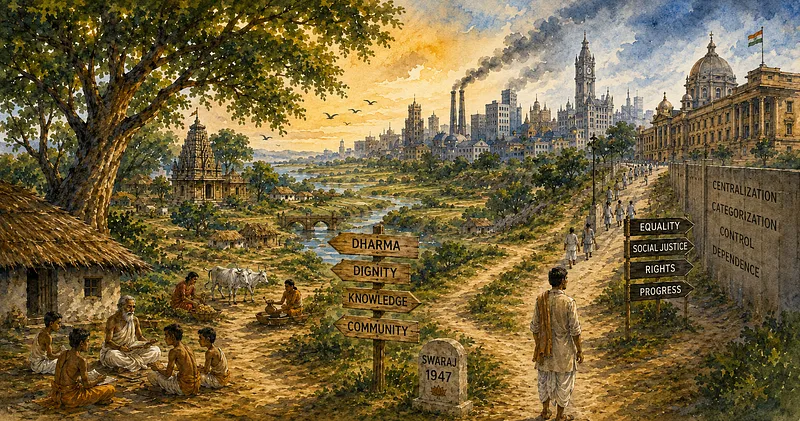
Issues concerning India and her traditions are not just limited to conversations within India but are also equally part of global discourse today. The nature of these debates is not just limited to the academic elite, but they are part of the everyday concerns of Indians, and almost every section of Indian society has something to say about it. These conversations cover a wide array of topics such as the caste system, reservation, the status of women in India, marginalized communities, nationalism, rituals, superstitions, scientific temper, Saṃskṛta, Śāstra, folklore, technology, and many more. More often, these discussions hardly reach any conclusion, even after decades. These never-ending debates, which thrive in terms of being ‘for’ or ‘against’, force people to be part of some ideological group, such as the ‘left’ and the ‘right’. As these debates remain unresolved, they continue to shape our lives and ways of thinking. One can look at discussions on Rāma Mandir, Tipū Sulṭān, Sāvarakar, caste system, etc., just to understand the prevailing situation. Nonetheless, irrespective of the cognitive merit of these debates, they also influence legal and policy decisions. Furthermore, they also influence our thoughts on how we should live, interact, and connect with the people around us.
Therefore, it becomes important to re-look at these discussions about India and her traditions and think about them by contrasting these ideas with our experience. This is important because the prevailing descriptions about India and her traditions, along with the assumptions used to talk about her people and society, and the conclusions drawn in everyday life, activism or policy based on these descriptions, often remain disconnected from our own ways of being. Yet, these descriptions continue to shape the way we think about ourselves and the way we want to shape our future. They seem to be counterproductive, as they distance us from our own experience instead of helping us connect with and make sense of our own ways of being.
The Example of Rote Learning
Let me elaborate on the claims I have made by way of some illustrations. Some of the claims I am making require clarifications and illustrations. Let me take an example and examine the claims. If we start with the contemporary discussion on ‘rote learning’ to understand this point, we will probably be able to see what I am hinting at. In India, memorizing something has always been considered an important part of the learning process. When we memorize multiplication tables or some śloka, it was never our experience that memorization prevented conceptual learning. However, today, when we discuss ‘rote learning’, memorization is often spoken of as though it is an obstacle to conceptual understanding. Why is it so? If one goes into these descriptions historically, it is not difficult at all for us to see that the genesis of these descriptions is located in the way Europeans understood Indian teaching-learning practices a couple of centuries ago.
When British education was introduced in India close to 200 years ago, Europeans began to closely observe how Indian students learned. They saw “memorization” as the main obstacle in Indian methods of teaching and learning. However, across India, memorization played a central role in all forms of learning. In other words, memorization was at the heart of the learning traditions of Indian culture, which had continuously produced knowledge for thousands of years. There is something interesting about the way Europeans saw learning here. What made Europeans see memorization as something that hinders learning, whereas it was the most useful method in different Indian traditions for centuries? Whether British or any other Europeans had any evidence to say that memorization is affecting the ability of Indian students or was it their experience of how they understood Indian traditions? It is amply clear that they did not have any specific evidence against memorization; of course, they had some other specific understanding of what it means to teach and learn, which is part of their experience in Europe.
One can only argue then that the way Indians were learning, using memorization as a predominant way, appeared problematic to the Europeans when they saw the education of all kinds in India. They are the ones who gave it the name “rote learning.” Europeans, especially Protestants, believed that this ‘rote learning’ was an obstacle to conceptual learning and therefore a problem for producing knowledge. What made Europeans think in this manner? Obviously, they must have something in their culture that made them talk about Indian ways of learning as rote learning. What elements in European culture made them think so? This requires some elaboration.
When Europeans came to India and started managing the political affairs of India, they had to make many decisions across domains, including education. Obviously, they did not have access to any knowledge about Indian culture. The only way they started addressing the issue of a lack of understanding about Indian culture was by studying Indian traditions and drawing from their own cultural experience to arrive at some understanding. When they were looking at education in India, they already had some background assumptions about the teaching-learning situation within the European world. What was the cultural experience of one culture eventually became the universal truth about human beings and societies all over the world. In the European cultural background, eradicating rote learning from the educational system was a major concern. Coming from such a background, the Europeans saw the memorization practices they encountered in India as “rote learning”, a variant of what they had already dealt with in Europe, and tried to eradicate it. Europeans, in their own culture, had problems with learning by memorization. This was because there had long been a practice among Catholics of learning the Bible through memorization. One of the major criticisms Protestants made against Catholics was that they did not properly understand the scriptures because they memorized them mechanically without understanding them. When Protestant Christianity became dominant in Europe, these Catholic methods of learning the scriptures were heavily criticized. In this way, Catholic memorization came to be seen as “rote learning” and was criticized as a bad practice that was believed to prevent conceptual understanding of the scriptures. These ideas were then superimposed onto Indian society. This European experience of “rote learning” shaped the way the British thought about building an education system in India.
Indian methods of learning through memorization were criticized and described as “rote learning,” as though they had prevented conceptual understanding for centuries. Though these descriptions were about India, they tell us more about Europeans than about India, because these descriptions were superimposing ideas from their cultural background onto Indian society. Though they saw memorization, what was actually described was rote learning, which was part of their cultural experience. Initially, these discussions were part of the discussions within the European world, and they became commonplace ideas once they found coherence within European ideas. Since then, the idea that rote learning should be eliminated from educational practices has become a standard description of Indian society and continues even today.
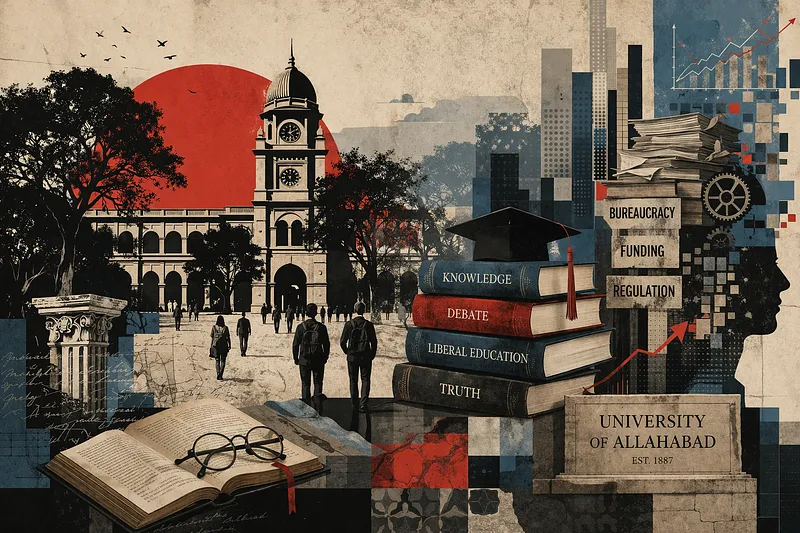
Today, the eradication of memorization continues to remain a goal of Indian educational policy, even after the end of British rule. Even our recent education policy documents emphasize bringing ‘smṛti’ (memorization) back to the center of education, while at the same time presenting the elimination of “rote learning” as an important concern. How can both exist at the same time? Despite the obvious contradiction between these positions, our discussions fail to recognize that the eradication of rote learning, in essence, also becomes the eradication of memorization itself.
This contradiction regarding memorization reflects the kind of discussion I was emphasizing earlier, which is about our predicament in thinking and discussing our society and culture, and in deciding what is suitable for our people. Why should a two-century-old story from European experience continue to guide our country’s educational policy today? Either the European descriptions of Indians are true about India, or they are true in their experience. Obviously, they can’t be descriptions of Indian traditions; then, one must acknowledge that there is a problem in the way we understand these descriptions. One can simply put it in another way. The European descriptions of India have become obstacles to thinking about our ‘Sva’ (self). Yet, these descriptions continue to shape our everyday conversations, public discourse, and the teaching-learning systems in schools and universities.
Sva and Para in experience
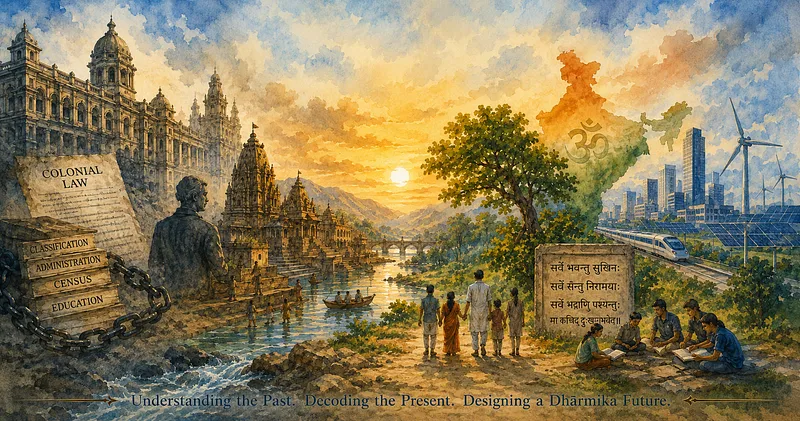
Reflections on Sva-tantra or Sva-Rājya (self-technique and self-governance/home-rule) emerged during the Indian independence movement, when Indian thinkers were trying to understand the nature of colonial rule. They sought to understand what was unfolding around them, the new ideas and ways of an alien system (Para-Tantra), and how it disrupted the native ways of being (Sva-Tantra). Thinkers of the independence movement realized that European descriptions of India created serious obstacles in accessing our ‘Sva’ and in gaining freedom from ‘para-tantra’ and its descriptions of India.
For the British, Indian methods of learning through memorization appeared inferior and were described as rote learning. But in India, these ways of learning were never seen as an obstacle to learning. Although memorization was not the only method within Indian approaches to learning, it held an important place that functions as a learning system with an entire range of other methods. Even though this has been our experience with memorization, we have continued to retain European descriptions in our policymaking, which directs us towards eliminating such practices that have been part of our ‘Sva-tantra’. Suddenly, practices that had long been part of our ways of teaching and learning began to appear as problems that need eradication from the culture itself. Without the European descriptions mentioned above, it is difficult to make sense of this shift in our attitudes. It appears that we are unable to think about ourselves, and we have been doing futile exercises in fitting ourselves into this framework through which Europeans described us. It seems that even after a century of political independence, ‘Sva-Tantra’ has still not been achieved.
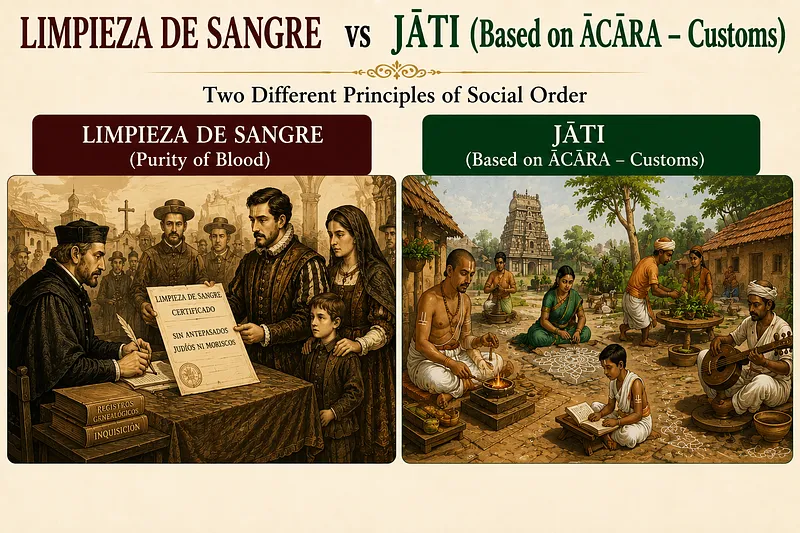
Just as we demonstrated through the example of “rote learning,” one can show hundreds of such examples that show how our cognition continues to be shaped by European descriptions. This gets reflected in our daily conversations, behavior, policymaking, academic theorizing, to public discourse. Two centuries of European colonial thinking have alienated us from our own experience. Today, in India, we can see countless debates that have their foundations in European experience, even though they are taking place in India. For instance, colonial thought has shaped contemporary public debates about the “Hindu religion” and its “caste system.” One group claims that the biggest problem in India is the “Hindu religion” and calls for its eradication. Another group argues that there is a need to “return to the Vedas” as a solution to many issues. Yet both sides don't realize that they draw their arguments from European descriptions without recognizing that “Hinduism” itself emerged from the European experience of India and has nothing to do with Hindus or Indians themselves.
What we see in such debates is the fact that both parties, those who want to romanticize or glorify India and those who want to condemn or portray Indian culture negatively, often borrow their arguments from the European experience of India. It appears that many of these debates and ideological positions would not have emerged in the absence of such colonial descriptions of India. For the colonized, regardless of the position they take, whether in favor of Indian culture or against it, European descriptions continue to appear as socio-scientific descriptions of India (and not as the experience of one culture over the other). In fact, these descriptions provide the framework within which Indians make policies and engage in never-ending debates among themselves.
The question now is how to overcome this problem and reflect on our own experience. Can we simply discard these European descriptions that have now become part of commonplace ideas and an essential part of the secular corpus of literature today? If we discard the European description of “rote learning,” will we be able to move beyond today’s commonplace idea that memorization impedes conceptual learning? Probably the answer is not straightforward. Then what is the way out?
As we saw in the example of rote learning, the European descriptions of India tell us about Europe and nothing about India, as they were shaped by the superimposition of ideas from Europe’s cultural background onto Indian society. The primary task, then, is to understand what structured the European experience of India that later became our commonplace ideas. Only then can a separation between the European experience of India and our own experience become possible. This task enables us to think about India outside the European framework, from our experience.
Making Sense of the Problem: Adhyāsa
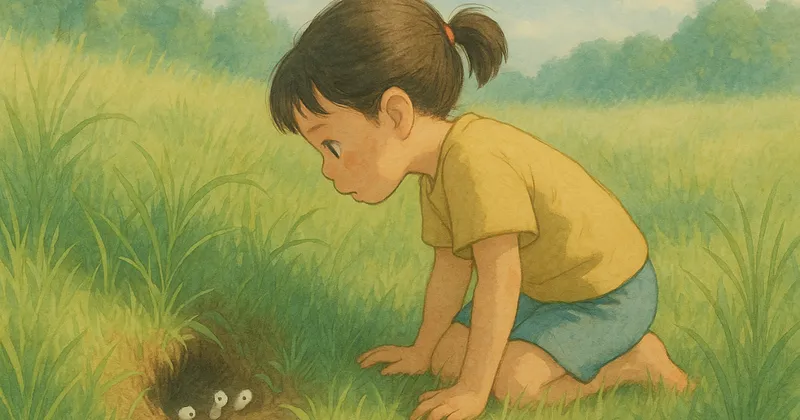
To understand our situation more clearly, the concept of Adhyāsa used by Ādi Śaṅkarācarya is particularly fruitful. According to Śaṅkara, Adhyāsa refers to the superimposition of the characteristics of one object on another. He explains in detail, especially in his commentary on the Brahma Sūtras, how such superimposition becomes an obstacle to knowledge. Adhyāsa is often illustrated through the famous analogy of the serpent and rope (Sarpa–Rajju–Nyāya). Imagine a person walking along a path at dusk who sees a rope lying on the ground but mistakes it for a serpent. Although the object before him remains only a rope, he reacts physiologically and psychologically to the perceived danger: he may experience fear, panic, or attempt to avoid the imagined snake. The consequences of the experience are therefore real, but they arise from ignorance. What is superimposed is not actually present in the object itself; the snake exists only in one’s mistaken understanding, while the reality before one is merely a rope.
This example can be used to understand the present condition of Indians. If we imagine India as the “rope,” Europeans experienced and described it as a “snake”. Over time, extensive discussions emerged around this “snake,” and our educational institutions also began systematically teaching these descriptions. Even after independence, Indian scholars continued to have elaborate explanations of the same “snake” seen by Europeans. As long as we fail to recognize that, our task is to study the rope, that is, Indian society itself, and not the snake, the debates about this “snake” that is superimposed on “rope” will continue, assuming that it is about the rope despite it being a description of a non-existent snake.
If we extend this analogy to the present discussion on “rote learning,” we can say that memorization (smṛti), which is the “rope,” has been mistaken by Europeans as “rote learning,” the “snake.” Later, Indian educationists and policymakers adopted this adhyāsa as experienced by Europeans and began treating memorization itself as a problem. As a result, for decades, there have been continuous attempts to eradicate so-called rote learning from Indian education. However, this effort overlooks an important question: whether what is criticized as “rote learning” actually corresponds to the Indian practice of memorization (smṛti). From the Indian experience, memorization has been central to learning traditions and has played an important role in the preservation, transmission, and generation of knowledge. By confusing memorization with the European idea of “rote learning,” educational reforms often end up attacking the rope (memorization) while believing they are removing the snake (rote learning). This example illustrates how, even after more than seventy-five years of independence, our understanding continues to remain within the grasp of European experience (para-tantra), while our ability to develop sva-tantra (understanding grounded in our own experience and understandings) remains limited.
.png)