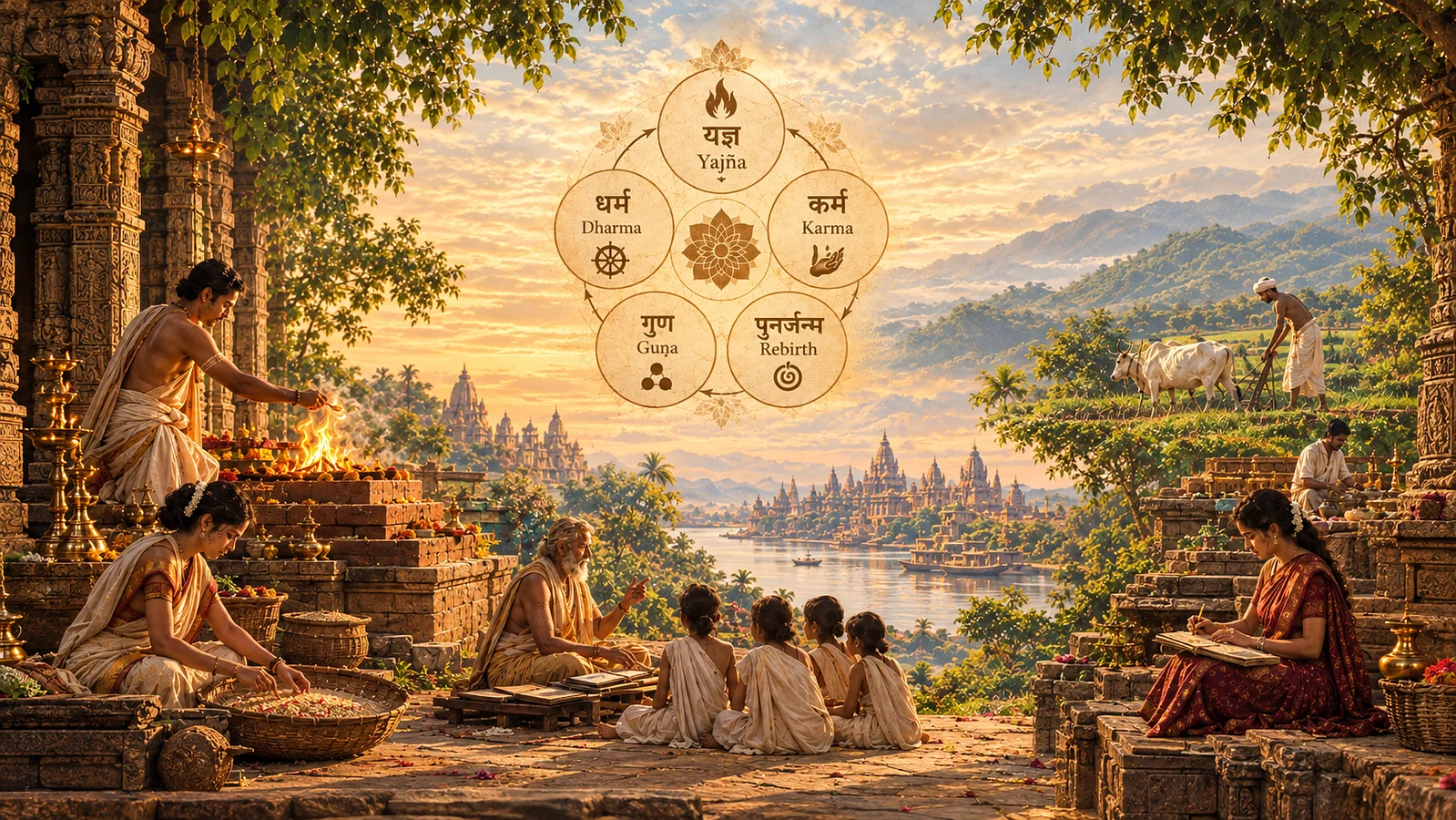
Modern ideologies such as liberalism, utilitarianism, and Marxism emerged largely in recent centuries. Despite proclaiming equality, many operate through centralized structures that concentrate wealth and political power, create new hierarchies, and weaken spiritual institutions that teach self-restraint and place limits upon worldly authority. Hegelian dialectical thought, which profoundly influenced subsequent Western thought and Marxist communism, understands development through an opposition between thesis and antithesis. It therefore interprets society through dvandvas, or opposing forces, whose conflict produces further change. Sanātana Dharma, by contrast, teaches sthitaprajñatā—a state of steady wisdom attained by transcending such dualities. This transcendence of dualities occupies a central place in Indian thought.
Applying modern Hegelian thought and its intellectual offshoots directly to varṇa is therefore problematic. Sanātana Dharma did not operate under a single centralized religious authority; dharma was understood and practised according to deśa, kāla, and pātra—place, time, and individual qualifications or circumstances. Varṇa must consequently be understood within its own metaphysical, karmic, and yogic framework.
According to the śāstras, varṇa belongs to the realm of avidyā and karmically conditioned embodiment. Paramātmā’s consciousness appears to manifest differently through various material forms or upādhis, including the human body. When the subtle body (sūkṣmaśarīra) obtains a suitable gross body (sthūlaśarīra), consciousness manifests through it accordingly.
The śāstras prescribe sustained practices for refining the body and mind. Among these, saṃskāras, upāsanā, and prescribed karma contribute to the gradual formation, manifestation, and refinement of varṇa-qualifications, while Brahmavidyā culminates this process by destroying avidyā and leading the individual beyond varṇa. This article examines the often-neglected relationship between varṇa, avidyā, and upāsanā.
Varṇa and the Problem of “Caste”
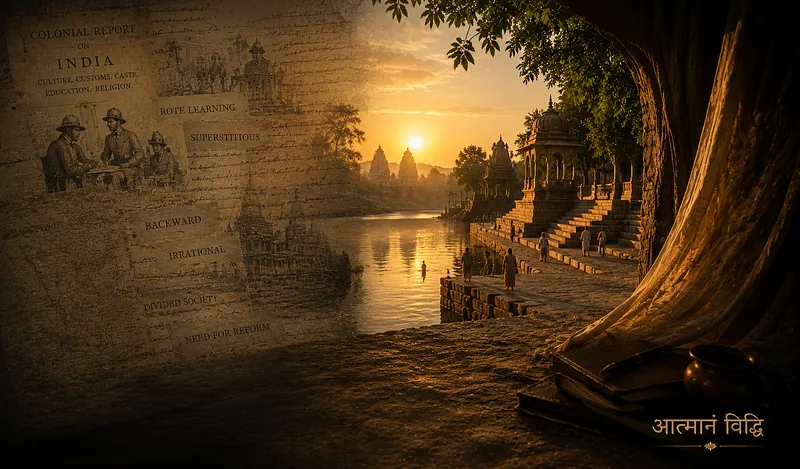
Varṇa belongs to a cosmological order involving dharma, karma, rebirth, guṇa, yajña, and liberation. Yet, while acknowledging this, some interpretations continue to translate it as “caste” and explain it primarily through social hierarchy, occupation, status, and power. This assumes that varṇa, jāti, kula, lineage, occupation, sect, and ritual status are parts of one institution called the “caste system,” without first demonstrating what unifies them. [5] Balagangadhara challenges this assumption by arguing that the caste system is a conceptual entity constructed through the Western experience of India rather than an indigenous institution experienced by Indians in the same terms.[15]
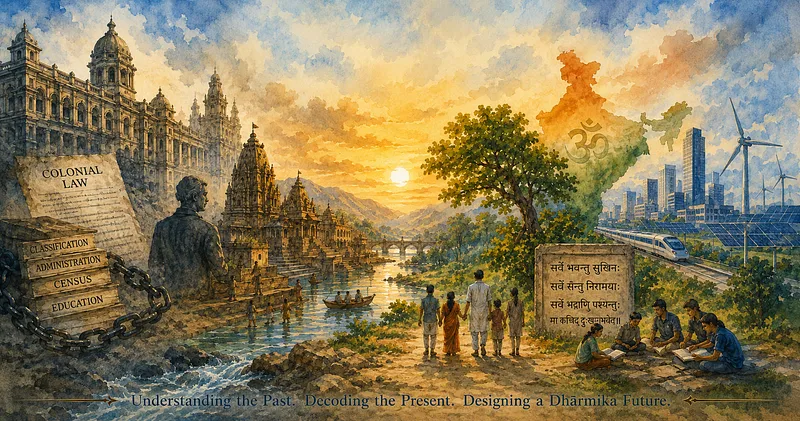
At times, varṇa is evaluated through the modern ideals of equality, liberty, and fraternity, which arose from particular European struggles concerning social and political power within centralized systems of governance. The śāstric framework, by contrast, understands differences in dharma, karma, puṇya, and pāpa through karmically conditioned embodiment and the wider cosmological order. Applying these modern ideals directly to varṇa, without first examining its distinct cosmological, karmic, ritual, and decentralized framework, risks judging one tradition exclusively through categories produced by another. It is, in effect, a comparison of fundamentally different worldviews.
The textual evidence itself distinguishes varṇa from jāti, although their usages sometimes overlap. Manu limits the number of varṇas to four while recognizing numerous jātis, and Yājñavalkya mentions the two separately. References to jātidharma, deśadharma, and kuladharma indicate the distinct norms of communities, regions, and lineages. This plurality may represent a decentralized normative order rather than subdivisions of a single caste system. Similarly, bāhya and bāhyatara may indicate distance from Vedic authority and ritual eligibility, not positions within a universal social hierarchy.
Concepts such as dharma, adharma, sukha, duḥkha, and jñānaiśvaryābhivyakti describe different conditions of embodied existence within a karmic cosmos, not merely degrees of social prestige. Likewise, separating ethical conduct and ācāra from occupation misunderstands svadharma, because the proper performance of one’s prescribed function is itself ethically and karmically significant. Here, ācāra includes not only moral conduct but also the customary, ritual, familial, and community-specific practices through which dharma is lived. Such ācāra shapes an individual’s worldview, dispositions, and choices, including the choice of occupation. Occupational activity therefore arises within this wider framework and, through its proper performance, acquires ethical and karmic significance.
The Puruṣasūkta presents the four varṇas as differentiated parts of an organic and yajñic totality, rather than merely as positions within a political hierarchy. Yajña is a cosmological process involving offering, transformation, reciprocity, and the maintenance of order. The Puruṣasūkta extends this yajñic vision to society by presenting the four varṇas as differentiated parts of the cosmic Puruṣa. Social organization is therefore not separate from cosmology but an expression of it; the error lies in interpreting this arrangement merely as a humanly constructed political or sociological hierarchy. Buddhist criticisms of varṇa, although historically important, proceed from different premises concerning the ātman, Vedic authority, the guṇas, yajña, and inherited ritual duties. They therefore constitute external philosophical challenges rather than internal demonstrations that the śāstric conception of varṇa is inconsistent.
The fundamental problem lies in separating cosmology, ritual, ethics, politics, and society into independent domains. Within the śāstric worldview, the individual, family, community, devatās, nature, and cosmos participate in a connected order maintained through dharma, ācāra, and yajña. Interpreting varṇa mainly through the modern categories of caste, stratification, occupation, privilege, and power removes this cosmological and soteriological foundation. Such an approach may describe certain social consequences, but it cannot adequately explain the śāstric conception of varṇa on its own terms.
Varṇa, Yajña, and Karma:
To understand varṇa, we must begin with the purpose for which it was created. The Puruṣasūkta explains material creation, including the emergence of the four varṇas, in the context of yajña. Similarly, the Mahābhārata and the Viṣṇumahāpurāṇa explicitly state that the four varṇas were created for the purpose of yajña-
चातुर्वर्ण्यस्य कर्माणि चातुर्वर्ण्यं च केवलम् । असृजत् स हि यज्ञार्थे पूर्वमेव प्रजापतिः ॥
- Mahābhārata, Anuśāsanaparva 48.3
“Prajāpati originally created the four varṇas, together with their respective duties, for the purpose of yajña.”
The Viṣṇumahāpurāṇa similarly states:-
यज्ञनिष्पत्तये सर्वमेतद् ब्रह्मा चकार वै । चातुर्वर्ण्यं महाभाग यज्ञसाधनमुत्तमम् ॥
“O illustrious one, Brahmā created this entire fourfold varṇa system for the accomplishment of yajña, as the foremost means by which yajña is carried out.”
These passages indicate that qualified Brāhmaṇas perform an integral function in Vedic sacrificial yajñas. The śāstras broadly identify twelve types of yajña, within which most human activities may be understood. Thus, yajña forms a foundation of Sanātana Dharma, and it is through this yajñic framework that dhārmikas understand the cosmos and society. According to the gurus, a Hindu is a yajña-jīvanudu—one who lives a life centred on yajña.
Bṛhadāraṇyaka Upaniṣad (4.4.22) says-
तमेतं वेदानुवचनेन ब्राह्मणा विविदिषन्ति यज्ञेन दानेन तपसाऽनाशकेन ॥
“The Brāhmaṇas seek to realize It through the study of the Vedas, through sacrifices, through gifts and through austerity which does not lead to annihilation”
Here, yajña signifies the performance of duties and sacrificial rites prescribed by the śāstras (vidhyukta-karmācaraṇa). The passage teaches that spiritual knowledge is pursued through Vedic study and the disciplined performance of prescribed karmas, including yajña, charity, and austerity.
It is therefore important to understand the principle underlying yajña. In a yajña, the participants collectively perform tyāga—the relinquishment of havis, or sacrificial offerings, into the sacred fire—and thereby direct the śakti of the offerings toward the devatās. Dharma similarly requires individuals to practise tyāga by fulfilling their respective kartavyas, or prescribed duties, thereby maintaining balance in nature and sustaining social institutions understood as expressions of the wider cosmic order.
A rights-based approach focuses on what individuals are entitled to receive and often assigns the state the duty of protecting those rights. A dhārmic approach begins with the kartavyas that each person must perform for the preservation of the larger order. When these kartavyas are transferred primarily to the state, power tends to become centralized. The yajñic approach, by contrast, distributes kartavyas among individuals, families, communities, and institutions, thereby supporting a more decentralized social order.
This distinction between a rights-centred conception of society and one centred on kartavya was articulated by Sri Jayaprakash Narayan (1962), as quoted by Sri Dharampal [3]:
“As I look at it, there are two entirely different concepts of society involved here. Even though not clearly expressed, this is implicit throughout Gandhiji’s discussion on the subject. One concept is that put forward by Dr. Ambedkar, and accepted as the basis of the Constitution, namely, the atomised and inorganic view of society. It is this view that governs political theory and practice in the West today. The most important reason for that is that Western society itself has become, as a result of a certain form of industrialisation and economic order, an atomised mass society. Political democracy is reduced to the counting of heads. It is further natural in these circumstances for political parties, built around competing power-groups, to be formed, leading to the establishment not of government by people, but of government by party: in other words, by one or another power-group.
The other is the organic or communitarian view. This view treats man not as a particle of sand in an inorganic heap, but as a living cell in a larger organic entity. It is natural that in this view the emphasis should be laid more on responsibility than on right, just as in the inorganic view it is natural that it should be the opposite. When the individual lives in community with others, his rights flow from his responsibilities. It cannot be otherwise. That is why, in Gandhiji’s sociological thought, the emphasis is always laid upon responsibility.”
Narayan’s distinction supports the argument presented here. Within an organic and yajñic conception of society, rights are not denied; rather, they arise within a network of reciprocal kartavyas through which individuals and communities sustain the larger social and cosmic order.
But this yajña-based understanding has been criticized by both Western and Indian scholars. Nevertheless, it remains essential to the śāstric account because the Itihāsas and Purāṇas explicitly explain varṇa in the context of yajña.
Dimensions of Varṇa
Paramātmā’s śakti radiates through matter. As the upādhis, or material conditions through which it manifests, change, the character of this radiance also changes. Several scholars and gurus have explained this process. Sinu Joseph, in Varna Vidya (2023), argues that varṇa may signify tejas or varcas—radiance or brilliance [10]. Several descriptions similarly associate varṇa with a form of radiance.
(या मे शक्तिः सदा जीवन् समाकर्षति माप्नोति । तदेव तेजः सम्प्रोक्तं यतो वेदान्तपारगैः ॥ “That power which constantly attracts and reaches me while I live is described as tejas (spiritual brilliance or vital energy) by those thoroughly versed in Vedānta.”). [1]
Paramahaṃsa Parivrājakācārya Jagadguru Śrī Siddheśvarānanda Bhāratī Svāmi (Kurtālam Pīṭham) writes [11]: “The subtle body generally shines brilliantly, although there may be slight differences in its colour. The colour of that form depends upon the qualities and character of the individual. The subtle body of a sāttvika person shines clearly and radiantly white. That of a person possessing rājasika characteristics appears with a reddish hue, while that of an ignorant person enveloped by the darkness of tamas appears black.
Since most people possess a mixture of qualities, their subtle bodies display various colours and shades. A yogi capable of seeing the subtle body can understand a person’s nature without any further inquiry. In accordance with the guṇas and karmas of human beings, their subtle bodies shine with different combinations of colours.
If the statement of the Gītā—‘The fourfold varṇa was created by Me according to the division of guṇa and karma’—is understood from this perspective, an appropriate and truthful meaning emerges. The social system of varṇa may exist or disappear. If society no longer requires that old and decaying system, it may be abolished. However, no one can abolish the system of colours in the subtle realm that arises naturally from the division of guṇa and karma.”
Thus, he explained the concept of tejas in relation to the colours of the subtle body and the guṇas and karmas of the individual.

Adding to this discussion, Nithin Sridhar argued that although guṇa and karma are fundamental to understanding varṇa, interpreting them merely as psychological temperament and occupational division is too simplistic. This criticism is valid to the extent that temperaments and character traits may change over time and may be interpreted differently by different observers. Likewise, the division-of-labour interpretation is inadequate because the Upaniṣads and Smṛtis do not explicitly define varṇa merely as occupational specialization. Many varṇa-specific duties are prescribed with reference to birth, while their proper performance also requires the relevant qualifications and saṃskāras. If varṇa were determined solely by occupation, every change of occupation would entail a corresponding change of varṇa. A closer examination of the prescribed lives of Brāhmaṇas, Kṣatriyas, Vaiśyas and Śūdras reveals that varṇa encompasses much more than occupation.
For example, a Brāhmaṇa is born subject to sacred obligations that must be discharged through study, yajña and progeny:
जायमानो वै ब्राह्मणस्त्रिभिरृणवा जायते—ब्रह्मचर्येणर्षिभ्यो यज्ञेन देवेभ्यः प्रजया पितृभ्यः ।
एष वा अनृणो यः पुत्री यज्वा ब्रह्मचारिवासी ॥
“A Brāhmaṇa is born with three debts: First debt to the ṛṣis, discharged through brahmacarya and Vedic study; second to the gods, discharged through yajña; and third to the ancestors, discharged through progeny. One who has children, performs yajñas and lives as a student of the Veda becomes free from these debts.” (Taittirīya Saṃhitā 6.3.10.5).
These obligations are understood as his birth-based kartavyas. Consistent with this framework, the Smṛtis prescribe the six duties known as ṣaṭkarma for Brāhmaṇas and corresponding duties for the other varṇas.
Nithin Sridhar (Chatuh Shloki Manusmriti, 2025) presents a multifaceted understanding of varṇa [14]. In this account, varṇa encompasses:
-
svabhāva, the innate nature shaped by the saṃskāras of previous births;
-
svadharma, the corresponding division of prescribed human activities and duties;
-
the jīvātman’s embodiment through birth to parents belonging to a particular varṇa;
-
the manifestation of the corresponding varṇa-devatās; and
-
the individual’s ritual status, which is developed and made manifest through the prescribed saṃskāras
(स्वभावस्तु स्वो भावः । स्वभावोऽविद्यालक्षणा प्रकृतिर्माया प्रवर्तते, “दैवी ह्येषा गुणमयी” इत्यादिना वक्ष्यमाणा । & जन्मान्तरकृतो धर्मादिसंस्कारो मरणकालेऽभिव्यक्तः स्वभाव उच्यते । -Gita Shankara Bhashya 17.2)
The preceding explanations establish a connection between varṇa and birth, which is further confirmed by various other sources.
Varṇa and the Importance of Birth:
Mahāmahopādhyāya Śrī Vārāṇasi Subrahmaṇya Śāstri cited the following verse from the Vyākaraṇa Mahābhāṣya:
तपः श्रुतं च योनिश्चेत्येतद् ब्राह्मण्यकारकम् । तपःश्रुताभ्यां यो हीनो जातिब्राह्मण एव सः ॥
“Austerity, sacred learning, and birth—these constitute Brāhmaṇahood. One who lacks austerity and sacred learning is merely a Brāhmaṇa by birth.”
This verse indicates that birth is an important factor in determining Brāhmaṇatva, though it is not sufficient by itself to perfect it. The Dharmaśāstras employ the bīja-kṣetra-nyāya—in determining varṇa. In this context, Mahāmahopādhyāya Śrī Vārāṇasi Subrahmaṇya Śāstri invoked the maxim, “For what purpose was he brought into existence?” This directs attention to the purpose and duties connected with a person’s birth.
The Jayamaṅgalā-kroḍapatra, a supplementary commentary to Kauṭilya’s Arthaśāstra, states: “Brāhmaṇatva is not of one kind but fourfold”:
-
Hereditary Brāhmaṇatva: It becomes manifest in a Brāhmaṇa who inherits it through lineage.
-
Primordial Brāhmaṇatva: It exists in the original Brāhmaṇas who were present at the beginning of creation.
-
Acquired Brāhmaṇatva: It becomes manifest when learning, austerity, yoga, and samādhi transform the bodily constituents of one’s original jāti into those capable of producing a Brāhmaṇa body, as in the case of Viśvāmitra.
-
Generational Brāhmaṇatva: It arises in the fifth or seventh generation through anuloma marriage.”[6]
Here again, birth is considered an important aspect of varṇa.
From a Sāṅkhya perspective, this hereditary relationship may be interpreted through satkāryavāda, according to which the effect exists potentially within its material cause. Applied to the relationship between parents and child, this provides one possible philosophical explanation for the transmission of varṇa through birth. Vedic statements such as “Ātmā vai putranāmāsi”—which express the idea that the husband is reborn as the son through his wife’s womb—further strengthen this view. [1]
Āyurveda discusses the mātṛja and pitṛja aspects of a child—that is, the particular physical characteristics inherited from the mother and father, respectively. Thus, birth is an important factor that cannot be overlooked in understanding dharma, the nature and functions of the gross body (sthūladeha-dharma), or the transmission of varṇa from parents to child. If the parents possess predominantly sāttvika bodily and mental dispositions, the child may be more likely to inherit corresponding dispositions. Moreover, when the parents consistently embody the corresponding values through ācāra, the child is raised within that way of life and is more likely to practise those values through ācāra.
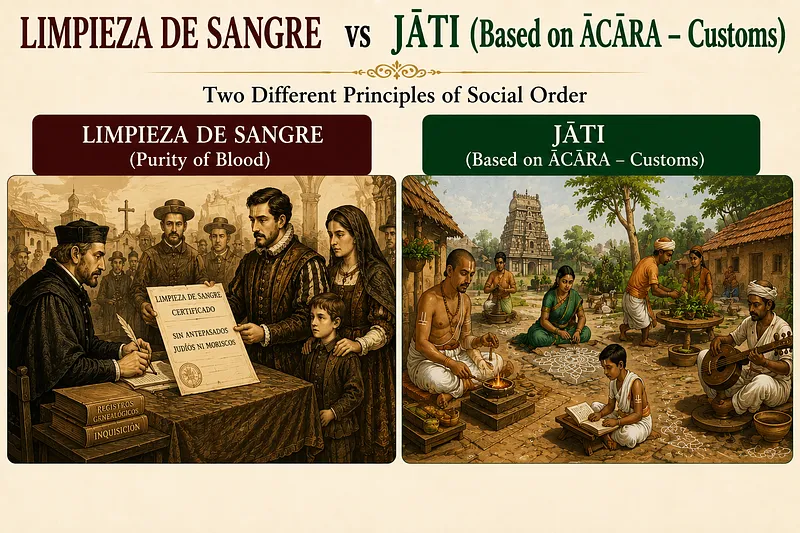
Birth within this framework should not be understood through the European concept of racial or biological “purity of blood.” The relevant concern is continuity of the corresponding varṇa-dharma, bodily and ritual fitness, inherited ācāra, saṃskāras, and upāsanā, together with the familial consequences associated with puṇya and pāpa. In the contexts discussed below, purity concerns bodily or hereditary defects, disease-producing conditions, ritual impurities, and the effects of wrongful conduct - not the preservation of a racially pure substance in the blood. This does not necessarily mean that the parents’ personal karma is literally transferred to the child. Rather, their bodily condition, conduct, and circumstances help shape the body, family environment, practices, and karmic conditions into which the child is born.
An objection may nevertheless be raised: Brāhmaṇa characteristics can sometimes be observed in a person born into a Śūdra lineage, while Śūdra characteristics may appear in a person born into a Brāhmaṇa lineage. Mahāmahopādhyāya Śrī Vārāṇasi Subrahmaṇyam explained that within each of the four varṇas acquired by birth, there exists a further fourfold classification based on the guṇas (qualities). In support of this, he cited the following statement from the Sarvasiddhāntasaṅgraha:-
एकस्मिन् वर्णे तु चातुर्वर्ण्यं गुणात्मकम् ।.
“Within each single varṇa, there is a fourfold classification based on the guṇas.”
Thus, within the Brāhmaṇa varṇa, for example, there may be a Brāhmaṇa-Brāhmaṇa, Brāhmaṇa-Kṣatriya, Brāhmaṇa-Vaiśya or Brāhmaṇa-Śūdra; corresponding guṇa-based distinctions also exist within the other birth-based varṇas. Birth-based identity and presently manifested characteristics therefore operate at different levels: birth establishes jāti, while the predominance of particular guṇas influences the manner in which varṇa-characteristics become manifest in the individual.
These distinctions also explain why jāti alone does not determine an individual’s worthiness of reverence. Vidura, Dharmavyādha, and others commanded reverence while observing the dharmas of their respective jātis. Jāti identifies the inherited framework within which svadharma and activities pertaining to this world and the next are followed, but it is not an exhaustive measure of individual excellence.
The Śukranīti expresses this distinction:
कर्मशीलगुणाः पूज्यास्तथा जातिकुले न हि । न जात्या न कुलेनैव श्रेष्ठत्वं प्रतिपद्यते । विवाहे भोजने चैव जातिकुलविवेचनम् ॥ —2.55
Excellence derives from virtuous deeds, good conduct, and qualities, rather than from jāti or kula alone. The distinction here is between worthiness of reverence and the observance of jāti and kula distinctions in dining and marriage.
The verse distinguishes personal excellence from the practical observance of jāti and kula. It challenges the colonial representation of caste as a fixed hierarchy in which birth alone determines human excellence. Vidura and Dharmavyādha exemplify how individuals could command reverence while observing their respective jāti-dharmas. Inherited identity therefore cannot be treated as an exhaustive measure of an individual’s worth. [1]
The distinction between inherited identity and individually manifested qualities raises a philosophical question: how can a common jāti coexist with differences in its individual expression? Bhartṛhari’s discussion of jāti and śakti in the Vākyapadīya provides one possible framework for exploring this question [3]. A jāti may be understood as a common universal or manifesting power present in individual members, while its expression varies according to the conditions through which it becomes manifest. Applied to the present discussion, Brāhmaṇatva may exist as a common jāti-based potential without all Brāhmaṇa characteristics being manifested equally in every individual. The individual’s guṇas, saṃskāras, learning, conduct, and other conditions influence the degree and form of its manifestation.
The Vākyapadīya does not by itself establish that such jāti is transmitted through birth; however, when read together with śāstric statements connecting jāti with birth and lineage, it offers a possible explanation of the relationship among Brāhmaṇatva, jāti, birth, and the varying manifestation of guṇas.
It is in this context that the Sūtasaṃhitā states:
सर्वेषां जन्मना जातिर्नान्यथा कर्मकोटिभिः । पश्वादीनां यथा जातिर्जन्मनैव न चान्यथा ॥
“For all beings, jāti is determined by birth and not otherwise. Just as the jāti of animals and other beings is determined by birth alone, so too it is not determined in any other way.” [1]
The Sūtasaṃhitā presents birth as the ordinary rule governing the transmission of jāti, whereas the Jayamaṅgalā-kroḍapatra recognizes hereditary, primordial, yogically acquired, and generational forms of Brāhmaṇatva. The latter three may be understood as exceptional modes of origin or transformation that qualify, rather than simply negate, the general birth-based rule.
Under the ordinary birth-based rule stated by the Sūtasaṃhitā, the presence of a particular guṇa or characteristic does not change an individual’s inherited jāti. It instead indicates guṇa-based differentiation within that jāti and shows how characteristics associated with different varṇas may become manifest in its individual members. Ācāra, however, means more than the momentary display of such characteristics; it involves embodying them consistently in one’s conduct and way of life.
Jāti, Inherited Vidyā, and Ācāra
Although the Sūtasaṃhitā states that jāti is acquired by birth, this birth-based identity also carries particular functions within a cosmologically grounded social order, together with inherited practices, duties, and forms of knowledge.
The Śukranītisāra connects jāti with the knowledge and practical skills preserved by particular communities:
विद्याकलाश्रयेणैव तन्नाम्ना जातिरुच्यते
“A jāti is designated by vidyā or kalā upon which it is based.”
The text explains that the number of vidyās and kalās is unlimited, although thirty-two principal vidyās and sixty-four kalās are traditionally recognized:
यद् यत् स्याद् वाचिकं सम्यक् कर्म विद्याभिसंज्ञकम्। शक्तो मूकोऽपि यत् कर्त्त कलासंज्ञन्तु तत् स्मृतम्॥
“Every properly performed activity that depends upon verbal knowledge is designated as vidyā. That which even a person unable to speak is capable of performing is known as kalā.” [1]
The text subsequently lists the Vedic śāstras classified as vidyās and practical arts or technical disciplines classified as kalās. Since the transmission of many such vidyās, particularly Vedic learning, depends upon the disciplined mastery and correct articulation of śabda from an early age, parental ācāra and the inherited household environment become especially important. The kalās, by contrast, encompass practical skills that may be learned and performed without depending primarily upon verbal articulation.
The Kāmandakīya Nītisāra similarly recognizes knowledge as fundamental to the maintenance of social and cosmic order [12]. It identifies four principal branches of knowledge:
आन्वीक्षिकी त्रयी वार्ता दण्डनीतिश्च शाश्वती । विद्याश्चतस्र एवैताः लोकसंस्थितिहेतवः ॥
“Ānvīkṣikī, Trayī, Vārtā, and Daṇḍanīti are the four enduring branches of knowledge that sustain the order of the world.”
The text further states: वर्णाश्चैवाश्रमाश्चैव विद्याश्चासु प्रतिष्ठिताः ।
“The varṇas, āśramas, and branches of knowledge are established within these.”
Read together with the Śukranītisāra, this indicates that vidyā and kalā were not merely occupations but bodies of knowledge and practice through which communities performed their functions within the wider cosmic order. Since the text describes the four vidyās as lokasaṃsthitihetavaḥ—causes sustaining the order of the world—social life is presented as part of cosmic life rather than as a separate human arrangement.
The śāstras also distinguish aparāvidyā from parāvidyā. Aparāvidyā encompasses scriptural, ritual, intellectual, and practical knowledge functioning within embodied life, whereas parāvidyā is the higher knowledge through which Brahman is realized. The inherited vidyās and kalās discussed here belong mainly to the former domain: they sustain ācāra, svadharma, and the wider cosmic order while preparing the individual for higher knowledge.
This understanding continued into the modern period. In 1923, a subcommittee appointed by the National Education Conference at Kāśī prepared a proposed national educational policy incorporating aparāvidyā and parāvidyā.[2] It viewed education as preparation for worldly and dhārmic responsibilities while ultimately directing the individual toward mokṣa. Thus, it maintained continuity with India’s civilizational ethos, in which education integrated material, social, ethical, and spiritual development. This broader understanding also shows why vidyā and kalā cannot be reduced merely to occupational training.
Jāti identifies a lineage, while its inherited vidyā, kalā, and ācāra provide the practices through which the corresponding varṇa-qualification may be cultivated and manifested.
Birth-based jāti is therefore connected with inherited ācāra, vidyā, kalā, and the family’s way of life, all of which the individual receives through birth and upbringing. The child also inherits the bodily and material conditions created by the parents. For example, a child born to parents devoted to bhoga, or worldly enjoyment, may inherit that lifestyle and its dispositions, while a child born into poverty inherits the limitations associated with that condition. These consequences are tangible and help shape the circumstances within which the child’s guṇas and karmas become manifest.
Less tangible are the familial or collective consequences arising from the dharma, puṇya, and pāpa of the parents. Although karma belongs primarily to the person who performs it, the child may nevertheless experience consequences produced by the actions and circumstances of the family. These may manifest immediately or later in life through ādhidaivika factors, attributed to divine or cosmic agencies; ādhibhautika factors, arising from other beings and the external world; or ādhyātmika factors, arising within the body and mind.
Thus, birth does not transmit an empty social label. It places the individual within a lineage possessing particular bodily dispositions, material circumstances, relationships, obligations, ācāras, vidyās, kalās, and saṃskāras. These inherited conditions shape the person’s knowledge, practices, habits, associations, and way of life, thereby providing the context within which the individual’s guṇas, karmas, and corresponding varṇa-qualification are cultivated and manifested.
According to the śāstras, guṇa is an important factor in understanding varṇa. Guṇa, however, should not be understood merely as a person’s presently observable temperament or as a collection of subjective character traits. Since sattva, rajas, and tamas exist in different proportions and may increase or diminish under different influences, their determination requires an examination of the factors that strengthen them. This raises the question of how inherited conditions influence the development and manifestation of the guṇas. The Bhāgavata addresses this question through its account of ten guṇahetus, or factors influencing the guṇas. We shall explore these in the next part of this series.
Bibliography
-
Mylavarapu, V. N. L. Sudha Mohan. Varṇāśrama Vijñānamu. Telugu. 2025.
-
“Report of the Subcommittee Appointed by the National Education Conference at Kāśī.” Āndhrapatrika, Telugu daily, Monday, 10 September 1923.
-
Bhartṛhari. Vākyapadīyamu. Telugu translation and commentary by Peri Sūryanārāyaṇa Śāstri, Śrībhāṣyam Appalācāryulu, Pullela Śrīrāmacandruḍu, and Appalla Śrīrāma Śarma. 1974. See the Jātisamuddeśa.
-
Dharampal. Essential Writings. See Jayaprakash Narayan’s 1962 comments on organic and atomized conceptions of society, pp. 292–293.
-
Halbfass, Wilhelm. Tradition and Reflection: Explorations in Indian Thought. Albany: State University of New York Press, 1991. See “Homo Hierarchicus: The Conceptualization of the Varṇa System in Indian Thought.”
-
Kauṭilya. Kauṭilīyam Arthaśāstram. Edited by Viśvanātha Śāstrī Dātāra. Varanasi: Sampurnanand Sanskrit University, 1991. See Rājeśvara Śāstrī Drāviḍa’s Jayamaṅgalā-kroḍapatram commentary.
-
Manusmṛti 12.81, with Medhātithi’s commentary, translated by Ganganatha Jha, “Manusmṛti Verse 12.81”. wisdomlib.org
-
Gopinatha Kaviraja, ed., Tantra-Saṅgraha, Part I
-
Iyer, G. Ramachandra. Ātmavidyā.
-
Joseph, Sinu. Varṇa Vidyā: The Biological Basis of Varṇa Dharma, Especially for Women and the Śūdra Varṇa. Notion Press, 2023.
-
Paramahaṃsa Parivrājakācārya Jagadguru Siddheśvarānanda Bhāratī Svāmi, Kurtālam Pīṭham Tāntrika Prapañcam, p. 78.
-
Kāmandaka. Nītisāra of Kāmandaka. Edited by T. Gaṇapati Śāstrī. Trivandrum: Travancore Government Press, 1912.
-
Śeṣāvadhānulu, Bhāratula. Āpastambīya Pañcadaśakarmānukramaṇikā. Telugu
-
Sridhar, Nithin. Chatuh Shloki Manusmriti: An English Commentary. 1st ed. Vitasta Publishing, 2025.
-
Fárek, Martin, et al., eds. Western Foundations of the Caste System. Cham, Switzerland: Palgrave Macmillan, 2017.
-
Kappagantula Lakshmana Sastri, Mahabharata – Bhishma Parva, 1999, Telugu p. 575. & Mahopadhyaya Sri Varanasi Subrahmanyam, Astikatvamu, 1956, p. 40, Telugu 42–43
.png)