.png)
Last year, on a late July evening, the road near the old Delhi railway station, had turned into a shallow canal. A plastic bottle drifted past a parked scooter. The smell of sewage rose in small, warm bursts each time a bus pushed through the water and sent a wave toward the pavement. The rain had stopped an hour ago, but the water had nowhere to go. A man in rolled-up trousers was trying to unclog a storm drain with a length of bamboo. He pushed it in, twisted it, pulled it out again. A slurry of black water and polythene rose up, then settled back into stillness. Nothing moved.
A little further down the road, half hidden behind a row of shops selling mobile covers and cheap toys, stood the entrance to an old stepwell. Most people walked past it without noticing. A concrete ring had been built around its mouth. Inside, the steps were dry, dusty, and cracked. A stray dog slept on the third landing. Someone had thrown a plastic chair into the bottom chamber. The air was cooler there, but the well itself had been cut off from the earth around it. The groundwater that once fed it now flowed somewhere else, blocked or diverted by foundations, pipes, and asphalt.
Standing between the flooded street and the silent stepwell, it was difficult not to feel that something more than infrastructure had broken. The city had not simply lost drains or tanks. It had lost a way of thinking about water.
When Water Was Not a Problem
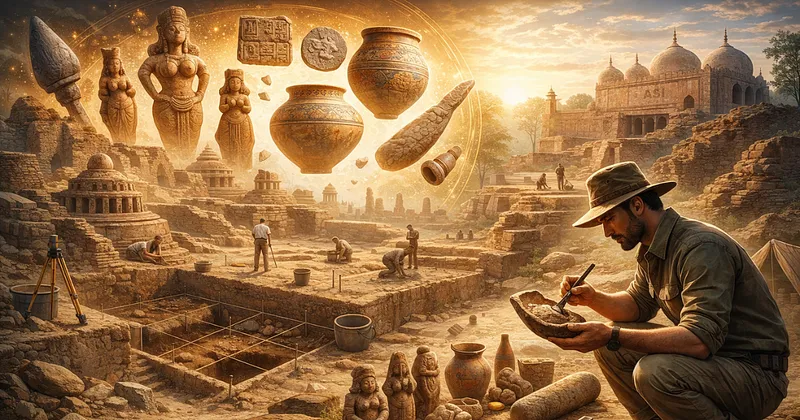
For much of the subcontinent’s history, settlements were not built in defiance of water, but in conversation with it. Archaeological excavations of the Indus cities show that drainage channels, wells, bathing platforms, and reservoirs were not add-ons. They were the very grammar of urban life. In cities such as Dholavira, the geometry of streets, reservoirs, and embankments reveals a mind that thought in terms of seasonal flows, storage, and reuse. Rain was not an event to be disposed of. It was an arrival to be welcomed, slowed, filtered, and stored in a sequence of spaces.
This logic continued across centuries and regions, taking different forms in different ecologies. In peninsular India, temple towns were organized around vast tank systems. In Rajasthan, where rain came rarely and left quickly, people shaped the land into a series of small catchments: johads, kunds, and baoris. In the floodplains of eastern India, networks of ahars and pynes guided excess water into storage channels and ponds. These were not isolated structures. They were linked systems, each feeding the other, each part of a seasonal choreography.
Anupam Mishra, in his luminous work on desert water traditions, once wrote that these systems were “not built by engineers alone, but by entire societies.” The statement is easy to romanticize, but its implications are technical as much as cultural. Every water structure was embedded in a web of occupations, rituals, and rights. Potters shaped the storage vessels. Stone masons carved steps and channels. Specific castes cleaned tanks before the monsoon. Priests marked the opening of the rainy season with rituals at the water’s edge. Farmers adjusted cropping patterns according to the expected level of tanks.
Water, in this sense, was not a commodity moving through pipes. It was a social presence, with its own rhythms and expectations.
The Geometry of the Stepwell
In the old towns of Gujarat, the stepwell was not just a source of water. It was a civic space, a refuge from heat, a place for conversation and rest. The stepwell’s architecture reveals a subtle understanding of groundwater movement. Built deep into the earth, often along natural aquifers, these structures allowed water to collect slowly. Their stepped geometry reduced evaporation, shaded the water, and allowed access even as the water level fell.
The famous stepwell at Patan, often admired for its carvings, was also a hydrological instrument. Its long corridor of steps followed the slope of the water table. Its chambers cooled the air. Its sculptures of deities were not ornamental excess. They marked the well as sacred, discouraging misuse and reminding visitors that water was not merely a utility.
Anthropologists who have studied such spaces often remark on how the sacred and the technical were not separate categories. A ritual boundary was also a protective mechanism. A taboo was also a conservation practice. To call a spring the abode of a deity was, in practical terms, to prevent contamination.
Tanks and Temple Cities
In the temple towns of Tamil Nadu, the tank was the city’s heart. It stored rainwater, recharged wells, moderated temperature, and hosted festivals. The temple itself often faced the tank, not the other way around. The annual cleaning of the tank was both a ritual and a civic duty.
Historical accounts from the Chola and Pandya periods describe elaborate systems of tank management. Local assemblies maintained embankments, monitored silt levels, and coordinated water distribution. The tank was not an anonymous public asset. It belonged to the community in a very literal sense. Its health reflected the moral and ecological health of the settlement.
Dharampal’s archival work, based on colonial records, reveals that many of these systems continued into the eighteenth and early nineteenth centuries. British administrators often expressed surprise at the density and sophistication of local water networks. Yet, within decades, many of these tanks fell into disrepair. The reasons were not technological, but institutional.
The Map and the Canal
The colonial state approached water through a different lens. Rivers became lines on maps. Water became a quantifiable resource to be controlled through large canals and barrages. This was a vision shaped by European engineering traditions and the fiscal needs of empire.
Canal colonies in Punjab, for instance, were designed as instruments of revenue and settlement. They were impressive in scale, but they also replaced thousands of small, locally managed systems. The colonial surveyor’s map flattened the complexity of local hydrology into neat lines and grids.
Scholars of political ecology have often pointed out that this abstraction of water was not just a technical shift. It was also a political one. When water became a state-managed commodity, local institutions lost authority. Ritual obligations, caste duties, and community rights were gradually replaced by bureaucratic rules.
James Scott’s work on state simplifications helps illuminate this process. Complex, locally adapted systems are often replaced by standardized schemes that are easier to administer but less resilient. In the Indian case, the shift from distributed tanks and wells to centralized canals and dams marked such a transformation.
The Tribal Watershed
In the forested hills of central India, water was rarely stored in grand structures. Instead, it was guided through small, almost invisible interventions. A shallow trench along a slope. A line of stones across a stream. A grove left untouched near a spring.
Among several Janjatiya communities, springs are treated as living beings. There are rules about who can approach them, what can be washed there, and when they can be cleaned. These spiritual beliefs form ecological governance in these regions.
In parts of Meghalaya, bamboo drip irrigation channels carry water from springs to fields, using gravity alone. The system is delicate, seasonal, and constantly adjusted. It requires attention rather than large capital. It also assumes that water is not to be hoarded, but shared in measured flows.
Anthropologists who have spent time in such communities often note a particular sensitivity to seasonal signals: the smell of the first rain, the direction of winds, the behavior of insects. These are forms of hydrological knowledge, but they are not written in manuals. They are carried in stories, songs, and practices.
The Postcolonial Continuity
Independence did not fully reverse the colonial approach to water. Large dams became symbols of national development. Cities expanded rapidly, often swallowing wetlands, tanks, and floodplains. Master plans treated these spaces as empty land, waiting to be built upon.
In many cities, stormwater drains were laid without reference to old tank systems. Natural channels were straightened or covered. The memory of seasonal water paths was lost. When heavy rains came, water simply returned to the routes it had always known, flooding roads, basements, and markets.
Environmental historians have described this as a form of civilizational amnesia. The city forgets the slope of its own land. It forgets where water once rested. It forgets how long the monsoon lingers in the soil.
Dilip da Cunha’s reflections on wetness offer a useful lens here. He argues that rain is not merely an input to be drained away. It creates a condition of widespread wetness that cities must learn to live with. When planners treat water as something that belongs only in rivers and pipes, they ignore this wider presence.
The Desert That Listens
In the villages of Rajasthan, people still speak of rain as a guest. The arrival of the first cloud is watched carefully. The soil is touched, smelled, tasted. Johads are repaired before the monsoon. The catchment is cleared of debris. The embankment is strengthened.
Anupam Mishra described these landscapes as places where people “knew how to wait.” Waiting, in this context, was not passivity. It was a disciplined attentiveness to the rhythms of rain. Crops were chosen according to expected rainfall. Houses were oriented to catch breezes and avoid runoff. Even the color of walls reflected heat and moisture patterns.
Such practices may appear modest compared to the spectacle of dams and canals. Yet they created a dense, resilient water culture. Every village had multiple sources: a tank, a well, a johad, a kund. If one failed, another might still hold water.
Remembering the Slow Intelligence
What the older systems offer is not a ready-made blueprint. They belong to specific ecologies and social worlds. Yet they do offer a different way of thinking. They suggest that water is best managed through many small interventions rather than a few grand ones. They remind us that infrastructure is also culture. A tank survives not only because of its masonry, but because of the rituals and institutions that maintain it.
Elinor Ostrom’s work on common-pool resources echoes this insight. Communities often develop sophisticated rules to manage shared resources, but these rules are fragile. When external authorities override them, the system can collapse.
In India, the erosion of local water institutions has left a vacuum. Municipal bodies struggle to maintain drains and pipelines. Citizens treat water as a private commodity. The shared ethic that once sustained tanks and wells has thinned.
A City That Listens Again
In some places, small acts of recovery are underway. An old tank is desilted. A stepwell is restored. A spring in a tribal village is protected by a new set of customary rules. These efforts are modest, often local, sometimes fragile. Yet they hint at another possibility.
Imagine a city that studies the slope of its land before laying a road. A city that maps its old tanks and restores their catchments. A city that treats rain not as an enemy, but as a seasonal companion. Such a city would not eliminate floods or droughts. But it might learn to live with water rather than fight it at every turn.