Introduction
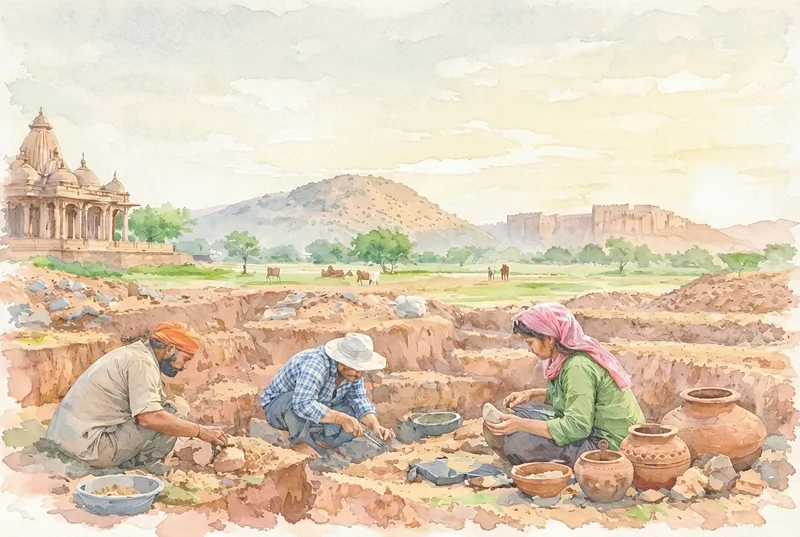
In the second part (Archaeology of Pilgrimage), we observed the archaeological challenges of this area. Over the years, many archaeologists have conducted explorations across various sites in the Braj region, and finally, Dr. Vinay conducted the great excavations at Bahaj, revealing some interesting facts about our civilization. In this part, let us see how some of these earlier excavations formed a critical precursor to this great discovery, and what similarities and differences between them contributed to understanding the civilizational continuity.
Archaeological Survey of India Excavations at Katra Keshavdev (1954)
 Destroyed part of the Katra mound in 1972 - © ASI
 done in a very limited area. The site for the excavation was selected for its rich tradition in terms of literature, culture, inscriptions, coins, terracottas, sculptures, and the surface find of plain grey ware (hereafter referred to as PGW)1 sherds. The excavators were inclined to excavate the site also because of two rings of mud-ramparts, one elliptically-shaped and the other quadrangular, suggesting a citadel.
The excavators laid a small trench at a distance of about 500 feet to the north of the superimposed mosque of Idgah. The natural soil was touched at a depth of 42 feet, and their last point was the portion of earth composed of hard clay and kankar (gravel) bands. The most striking finding of the excavation was the presence of handmade potsherds besides the natural soil. No fragment of PGW was found in the layers, although some pieces were collected as surface finds. It was possibly because of the very limited area of excavation. The six-foot deposit above the natural soil revealed PGW and black slipped ware (hereafter referred to as BSW)2 pottery types, along with normal red ware3 pottery. This phase would have dated to the pre-600 BCE period. No NBPW4 sherds were found in this deposit. The other antiquities from this layer included terracotta discs, balls, beads, a boat-shaped bird, and perforated pottery.
The next period was distinguished by the occurrence of NBPW, and in the chronological sequence, it can be divided into three periods. The earliest remains include bamboo and reed huts with slightly baked or unbaked bricks, bone styli or needles, carnelian amulets, and beads. The terracotta objects included grey mother goddess figurines and animal figurines, including a dog in red color. The ring-wells also came into existence at the site for the first time in this level. The second phase of finds was characterized by square copper coins, cylindrical terracotta beads, ear ornaments, etched carnelian beads, copper antimony rods, terracotta mother goddess figurines in grey color with appliqué treated girdle, elephant figurines with lozenge-shaped eyes and bodies decorated with punched, stamped, or notched circlets, and monkeys with three legs (mostly in red color). No complete plan of a house had come to light. But well-laid-out walls, drains, and ring-wells suggest a high degree of planning. This period can be assigned a date ranging between the sixth century BCE and the third century BCE.
The site was deserted for a very short period of a few years after the late second century BCE, as the sealed ring-wells indicated. The third period is typified by a large variety of beads made from semi-precious stones such as agate, carnelian, lapis lazuli, jasper, and amethyst, as well as beads of shell, faience, and copper coins, some of which belonged to the Kushan period. Stone caskets and a turquoise blue glazed finial were also found in this period. The fourth period, assignable from 100 CE to 300 CE, is to be identified by the terracotta figurines of dwarfs prepared by using the double mold technique. The fifth and the last period belonged to the Gupta period as evidenced by coins, terracotta, sealings, Naigmeṣa, elephant, and horse-rider figurines.
Mathura Excavations (1973-77)
 Pit Markings at Mathura Excavation Site - © ASI
Under the supervision of M.C. Joshi, ASI conducted excavations in Mathura from 1973-74 to 1976-77 at nearly fourteen sites in different parts of the city (Joshi 1989: 165-170). These excavations unfolded a cultural sequence divisible into the following five periods:
-
Period I: from circa the sixth century BCE to the closing decades of the fourth century BCE
-
Period II: from the closing decades of the fourth century BCE to the second century BCE
-
Period III: from circa the second century BCE to about the end of the first century BCE
-
Period IV: from the beginning of the first century CE to about the third century CE
-
Period V: from circa the fourth century CE to the close of the sixth century CE
Some later remains and antiquities were also found in a very limited area, but the excavators could not find a regular sequence of post-Gupta cultures.
 Levels and depth of Excavation - © ASI
Period I:
The excavated data suggested the beginning of the settlement at Mathura right on the natural soil in the form of a small habitation during Period IA around Ambarish Tila (MTR-8), close to the Yamuna, towards the northern end of the present city. The community used the PGW and associated pottery, including BSW, though in a small quantity. The early settlers of Mathura lived in small huts and, in some cases, built them on mud platforms. Evidence from the later levels of Period I (Period IB) indicated slight, although insignificant, growth of settlement. A notable feature of the sub-period was the emergence of nearly 17 sherds of NBPW along with PGW, with some new designs suggesting an overlap of the two classes of pottery.
During sub-period IB, the availability of antiquities like terracotta discs decorated with painted parallel strokes or incision along the edges, gamesmen suggesting some kind of indoor game, terracotta ghaṭa-shaped and semi-precious stone beads, and a pestle, antimony rods of copper, a few iron implements, bone arrowheads and a circular object (ear-ornament) of a greenish glass were indicative of some general improvement in the living conditions of the community.
Period II:
 Mud House Remains- © ASI
It has been associated by Joshi with the process of urbanization, as the mud fortification wall with a moat running by the side of it came into existence during this period. The most significant pottery of the period was plain grey ware and NBPW. Several terracotta mother goddess figurines and animal figurines were found in this period’s deposit. Other antiquities of note, other than semi-precious stone beads, were: square punch-marked copper coins, terracotta discs, beads, gamesmen, skin-rubbers, bone arrowheads, a legged quern carved with triratna motif, stone pestles, and a variety of copper and iron objects, especially arrowheads. The size of the settlement was as extensive as 3.9 square km during this period. Use of mud bricks was quite popular in this period, while the burnt bricks were used for a few selected structures.
Period III:
Joshi termed Period III as the period of urban refinement. The archaeological material of this period shows certain signs of urban prosperity, such as the use of lime plaster for floors and tiles for roofing. This period witnessed the last phase of ring-wells, NBPW, and grey ware. Red ware was used as the main ceramic industry, some with stamped marks. Most of the items of household use continued with the addition of some sculptures, inscriptions, etc.
Period IV:
Joshi termed this the period of cosmopolitanism. This period saw the all-round development in terms of material culture, as is suggested by many Kushan coins, sculptures, inscriptions, etc. Sprinkler, as a new pottery type, came into use.
Excavations at Sonkh (1966-73)
 PGW type Pottery incurred from excavations at Sonkh
A German excavation team under the leadership of Dr. Herbert Hartel excavated the site of Sonkh about 24 km south-west of Mathura. It was one of the better-preserved mounds in District Mathura with fewer disturbances. The excavation work at the site started in the year 1966 and ended in the year 1973. The site provided a continuous sequence from the PGW period to the late medieval (Jat) periods without any significant break. The report of the Sonkh excavation is one of the best compiled excavation reports in India. The concise framework of various periods at Sonkh (Hartel 1993) is as follows:
Period I:
The excavator termed it the PGW and BRW period. The main pottery type of the period was PGW and, to a lesser extent, BRW5. Other important pottery types were BSW, ordinary red, and red-slipped ware. Vessels were partly decorated with incised, impressed, or applied patterns. At the end of the period, coarse grey ware was observed.
Period II:
It was observed in the levels 29-36. The excavator divided it into sub-periods of Pre and Early Maurya, Maurya, and the Śuṅga cultural phase. The exclusive pottery of the period was NBPW, along with coarse grey ware, BSW, and ordinary red ware.
Period III:
This period belongs to the Mitras and was observed in the levels 25-28. The pottery included red ware continuing from the previous tradition. Some new shapes, especially ovoid-shaped storage jars with appliqué cordons and symbols (svastika, nandyāvarta), came into use. Some handles in the shape of monkeys were also found. Ring-wells and structures of baked brick came into existence.
Period IV:
This period, belonging to the Kṣatrapas and Rāmadatta, was observed in the levels 23 and 24. The typical pottery of this period was red ware, characterized by definite differences in shapes, such as a globular water jar, a small goblet, and a beaker. At the end of this period, the fashion of stamping the vessels with symbols began.
Period V:
This period belonged to the Kushans and was observed in the levels 16-22. The pottery includes red ware with the characteristic Kushan stamping on storage vessels, jars, etc., with symbolic, floral, and geometric ornaments. Moulded small bowls and spouted water jars were also observed in good numbers.
Period VI:
Levels 12-15 of this period were ascribed to the Gupta and early medieval period. Red, mostly red slipped ware was the main pottery of the period, which was delicately thrown and had a smooth surface with distinct black horizontal stripes. Later on, black-painted swans and floral motifs were observed. Other important pottery types of this period included moulded bowls with relief ornaments, a goblet with molded bowl and stem, bottles with sprinkler necks and spouts.
Period VII:
The medieval period was observed in the levels 8-11. In this period, the quantity of pottery reduced considerably. Decoration was mainly of black-painted stripes, swans, and peacocks. The cone lid with knob replaces the bell-shaped lid as well as the bowl lid. Besides the appearance of thin grey ware with white slip, an incised and painted variety was observed.
Period VIII:
This period, found in levels 1-7, belonged to the Late Fortress levels of the Mughals and Jāts. The main pottery was black-on-red painted pottery. In levels 6, 7, and 8, molded grey and red jars and bottles with relief decoration were found. The appearance of the hookah was a new, significant feature of this period.
In the next part, we will discuss the objectives and excavations at Bahaj carried out by Dr. Vinay and his team. The subsequent parts will present the key findings of this excavation and conclude with its significance and future relevance.
Footnotes:
-
The term "PGW" refers to the Painted Grey Ware culture, an Iron Age culture in Northern India from approximately 1200 to 600 BCE. It is known for its distinctive, fine grey pottery with black painted geometric designs and is associated with the Later Vedic Period.
-
Black-slipped ware is a type of pottery with a black coating applied to its surface, common in the Indian subcontinent and the Middle East. It is characterized by its black slip, which is achieved through specific firing techniques. BSW is a precursor to Northern Black Polished Ware (NBPW).
-
Red ware pottery is a broad term for earthenware made from reddish clay, common in ancient cultures (such as Harappan, Vedic India, Roman), known for its porous, natural properties that keep water cool and enhance food flavor.
-
NBPW stands for Northern Black Polished Ware, a highly lustrous, fine pottery from ancient India, known for its smooth, glossy finish, often black or metallic, used as deluxe tableware by elites, reflecting advanced urban life and societal stratification.
-
Black-and-Red Ware (BRW) is a distinctive ceramic tradition identified by its black interior and rim with a red exterior, produced through a controlled firing technique that creates this dual coloration.
Sources:
-
Image 3 - Excavated Pottery from Sonkh; Courtesy - Mathura Museum
-
Agrawala, Prithvi Kumar. The Early Indian Mother-Goddess Votive Discs. East and West, Vol. 29, No. 1/4, December 1979, 75-111.
-
Agrawala, R.C. and Vijay Kumar. Ganeshwar-Jodhpura Culture: New Traits in Indian Archaeology. Harappan Civilization-A Contemporary Perspective, Oxford & IBH Publishing Co., New Delhi, Bombay, Calcutta, 1982, 125-134.
-
Archaeological Survey Reports (A.S.R.) Nos. I, III, XVII, XX.
-
Archaeological Survey of India Annual Report (A.S.I.A.R.) for the year 1910-11 and 1911-12.
-
Chakrabarti, D.K. et.al. Bateshwar, Mathura and Ahar: Sites in the Agra-Mathura-Aligarh-Bulandshahr Sector of the Upper Ganga-Yamuna Doab in U.P. South Asian Studies, Vol. 20, 2004, pp. 57-69.
-
Chaturvedi, Vasudeva Krishna. 1987. “Vedon mein Braj” Braj-Vibhav (Hindi). Ed. Gopal Prasad Vyas. Delhi.
-
Gaur, R. C. Excavations at Atranjikhera, Delhi, 1983.
-
Gupta, Vinay Kumar. Mathura: An Art and Archaeological Study. Delhi. 2013.
-
Gupta, Vinay Kumar. Identification of Ancient Places and Towns in and around Mathura (Based on Correlation of Archaeological Findings with the Places Mentioned in Ancient Literature and Epigraphs). Heritage: Journal of Multidisciplinary Studies in Archaeology 8.2 (2020): 324-337.
-
Growse, F.S. 1883. Mathura: A District Memoir. Delhi.
-
Joshi, E.B. 1968. U.P. District Gazetteers- Mathura. Vol. 12. Lucknow.
-
Joshi, M.C. 1989. “Mathura as an Ancient Settlement”, Mathura: The Cultural Heritage. Ed. D.M. Srinivasan. AIIS, Delhi: 165-170.
-
Katre, S.M. 1969. Dictionary of Pāṇini, Part III. Poona: Deccan College.
-
Mani, B.R. and V.K. Gupta. 2014. “Rajagriha” History of Ancient India, Vol. VII. Eds. D.K.
-
Chakrabarti and Makkhan Lal. Delhi: 599-608.
-
Mittal, Prabhu Dayal. 1966. Braj Kā Sānskritik Itihās (Hindi). Delhi: Rajkamal.
-
Hartel, Herbert. Excavations at Sonkh. Berlin, 1993.
-
Indian Archaeology 1954-55-A Review
-
Indian Archaeology 1963-64-A Review.
-
Indian Archaeology 1964-65-A Review.
-
Indian Archaeology 1965-66-A Review.
-
Indian Archaeology 1966-67-A Review.
-
Indian Archaeology 1970-71-A Review.
-
Indian Archaeology 1980-81-A Review.
-
Sahi, M.D.N. Aspects of Indian Archaeology. Jaipur, 1993.
-
Sankalia, H.D., S.B. Deo and Z.D. Ansari, Excavations at Ahar (Timbavati). Deccan College, Pune, 1969.
-
Sharma, R.C. 1984. Buddhist Art of Mathura. Delhi: Agam Kala Prakashan.
-
Shesh, Chunni Lal. 1959. “Braj Yātrā kī Paramparā”. Braj aur Braj Yatrā (Hindi). Eds. Govindadas and Ram Narayan Agrawal. Delhi: 91-117.
-
Singh, Purushottam. Excavations at Narhan (1984-1989). Delhi, 1994.
-
Varma, Dhirendra.1954. Brajbhasha (Hindi). Allahabad: Hindostani Academy.