Think about how often you hear the word nautanki in everyday conversation. Someone is being overly dramatic, and a friend laughs, “Ab bas, nautanki mat karo.” The phrase is tossed lightly, but pause for a moment. What does it mean that this word for a folk theater form still survives in speech, long after the stages have dimmed and the troupes have dispersed? Words that last usually carry the memory of worlds gone by. Nautanki is one such word, alive in language because it once lived so vividly in performance.
I. When the Stage Was the World
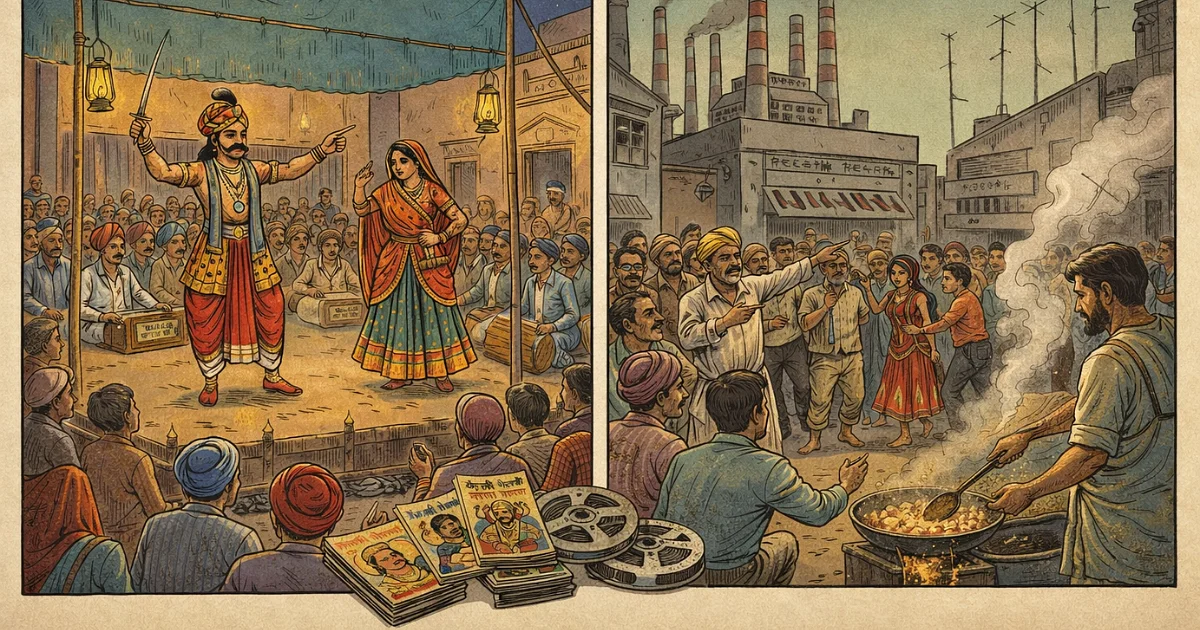
Imagine an open courtyard in Uttar Pradesh, lanterns hung on bamboo poles, the hum of a crowd settling into the night. The harmonium player strikes the first notes, the dholak picks up a rhythm, and a voice announces the opening of the nautanki. The actors step out, their gestures bold, their voices pitched high enough to reach the last row of listeners. Men sit in front, women veiled at the edges, children squeezed in wherever they can find space. Everyone is part of this theater without walls. These were familiar scenes across villages and towns in Uttar Pradesh in the 60s, and more so in the industrial town of Kanpur.
Anthropologists like Victor Turner called such events “social dramas” because they were not separate from everyday life; they staged society’s tensions in full public view. Richard Schechner spoke of performance as “restored behavior,” a way of re-enacting familiar patterns in heightened form. For the weavers, tannery workers, and railway laborers of Kanpur, the nautanki was exactly this: a chance to see their own struggles re-enacted with humor, satire, and song.
II. From Village Squares to the Industrial City
Like the migrants who came to Kanpur in the late 19th and early 20th centuries to work in its leather tanneries and textile mills, nautanki itself was an arrival. It carried with it the echoes of swang, the folk theater tradition of north India, but in the city it grew bolder, louder, more theatrical, adapting itself to the restless energy of an industrial audience.
In the villages of Uttar Pradesh and Rajasthan, nautanki was staged in courtyards, under mango trees, on the margins of religious fairs. It drew on epics, local legends, and moral tales, its songs travelling from one district to another through the voices of itinerant performers. But Kanpur was different. Here, you had an audience that came off twelve-hour shifts at Lal Imli or Elgin Mills, whose leisure was rare and precious. A performance had to be gripping enough to make a man forget the ache in his spine.
The city also gave nautanki new spaces: the mela grounds near the Ganga, school fields in Colonelganj, the narrow lanes behind Meston Road, where makeshift stages appeared during festival season. The air would become thick with the smell of fried kachoris from street vendors who did brisk business during the interval. And always, there was the crowd: watchful, participatory, quick to cheer a sharp dialogue or hiss at an onstage betrayal.
In Kanpur, nautanki became both more commercial and more politically charged. As industrial labor movements gathered force in the mid-20th century, scripts began to carry sly jabs at corrupt officials and exploitative bosses, hidden inside tales of kings and ministers. The stage became a place where the working class could see its frustrations dramatized; not in pamphlets or party speeches, but in rhyming couplets and songs that everyone could hum on the way home.
III. Kanpur’s Golden Age of Nautanki
By the 1940s and 50s, Kanpur had become one of the beating hearts of nautanki in north India. This was not only because of its audiences, but because of the city’s printing presses. Alongside industrial goods, Kanpur produced the cheap, hand-sized nautanki songbooks that were sold for a few annas outside performance grounds. Printed on low-grade paper, their covers were splashed with vivid illustrations: a veiled heroine standing defiantly against a tyrant, a bandit framed against the moon, a palace guard caught mid-betrayal.
These booklets were the scripts, the marketing, and the archive all at once. Even if you could not make it to a performance, you could buy the songs, memorize them, and sing them at home. Performers travelled with trunks full of these prints, and Kanpur’s presses, drawing on a long tradition of popular print culture, kept their supply steady.
It was during this period that many nautanki performers became household names in the city. Posters of their troupes would be plastered along the walls of Meston Road and Parade, and the announcement of their arrival was enough to fill a ground two nights in a row. Among these performers were the likes of Gulab Bai, who could command silence with just the lift of her eyebrow; a gift that early Hindi cinema would soon poach, along with much else from nautanki.
Indeed, the influence ran deep. When you watch the moral universe of early Hindi films — where virtue is imperilled but ultimately triumphant, where villains are extravagant in their cruelty, and where music drives the plot — you are seeing the afterimage of nautanki. Many of the screenwriters, songwriters, and actors of 1930s and 40s Bombay had cut their teeth on this stage. Kanpur, in its heyday, was one of their training grounds.
IV. The Slow Fading of the Stage
By the late 1970s, the nagada’s thump no longer carried as far into the Kanpur night. Television antennas began to sprout on rooftops in neighborhoods like Civil Lines and Arya Nagar. Even in the mill-worker colonies, someone would have a TV, and soon evenings were reorganized around Doordarshan’s broadcast schedule.
In a 1985 interview with Navbharat Times, veteran nautanki singer Satyavathi Bai — who had performed across Uttar Pradesh for four decades — lamented,
“Earlier, the crowd would walk miles to see a play. Now, they can sit at home and watch moving pictures. The stage waits, but the audience is busy.”
Her words carried the weight of a generation that had built its lives around an art form now competing with a flickering screen in the corner of the living room.
The economics shifted, too. Employers who once sponsored nautanki troupes for festival seasons were now more likely to fund cricket matches or political rallies. The mills, themselves in slow decline, could no longer be the cultural patrons they had been. As the industrial base of Kanpur eroded through the 1980s and 90s, so did the informal infrastructure that had kept nautanki alive.
By the time Dainik Jagran ran its 1998 feature “Kanpur ki Aakhri Nautanki” (“Kanpur’s Last Nautanki”), performances had become rare enough to be newsworthy. The article followed a small troupe performing in Chakeri to a sparse audience. The troupe leader, Ramesh “Nautankiwala” Yadav, told the reporter,
“When I started, I would sing four shows a week. Now it is once every two months, and mostly for weddings. The younger boys in my troupe are leaving for Mumbai or Delhi to do chorus work in films and TV serials. Here, there is no future.”
V. The Archive Remembers
Even as the live stage dimmed, its traces persisted; in songbooks gathering dust in second-hand bookshops on Meston Road, in the cassettes that All India Radio Kanpur once recorded for its “Lok Rangmanch” program, in the fading memory of newspaper columns.
One particularly striking recording, aired in 1972 on AIR, captures Gulab Bai speaking to announcer Shyama Devi. In her crisp Bundelkhandi, she explains:
“The stage gives you respect and food, but it also takes your youth. We travel at night, sing until dawn, and sleep in the day. The audience only sees the colour and glitter, but life is discipline, and the voice must survive.”
Her words, broadcast to an invisible audience of listeners across Uttar Pradesh, now read like a eulogy for a form already beginning to recede.
Print, too, served as an unintentional chronicle. In the back pages of 1960s and 70s Kanpur newspapers, small ads announced nautanki performances alongside wrestling matches and magic shows. These fragments, more than official histories, give us a sense of how deeply nautanki was embedded in the rhythms of the city; not as a special event, but as a recurring, almost everyday entertainment.
VI. A Ghost in the Grammar of Cinema
Today, the most visible remains of nautanki are not in Kanpur’s empty mela grounds but in the DNA of Indian cinema. The heightened moral stakes, the sudden shift from tragedy to comedy, the choreographed confrontation between hero and villain; these are nautanki’s gifts, reframed on a larger screen.
Film historian Ravi Vasudevan, in a 2003 radio interview on Vividh Bharati, argued that—
“The grammar of nautanki; its episodic structure, its climactic duels, its coupling of song with narrative, is the ancestor of the masala film. We do not watch nautanki anymore, but it is in our bodies when we watch a certain kind of Hindi movie.”
This ghostly survival makes nautanki at once absent and omnipresent. The form has vanished from its stages, yet its instincts, to thrill, to moralize, to draw the viewer into complicity, continue to animate popular culture.