This is part 3 of our detailer on the out-of-India model of Indo-European linguistic origins and dispersals. In this concluding section we examine archaeological and genetic evidence on the matter before detailing 'true' Āryan history. Part 1 can be read here, and Part 2 here.
Archaeological
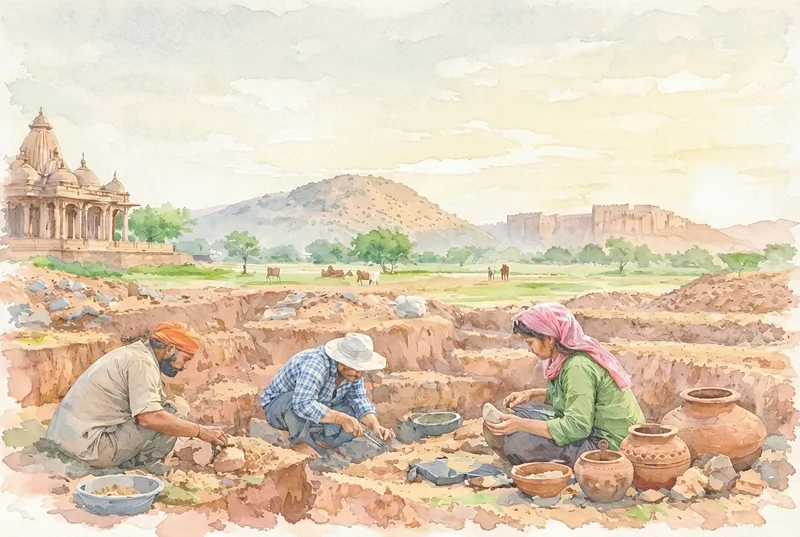
Decades of work has failed to provide any evidence of an invasion into north India. Even any purported migration from the west has not been found in the archaeological record. Compare this with the situation in Europe, mentioned previously, where there are clear archaeological markers of invasion by a foreign population from the east. The origin of this population has been posited as the Pontic Steppe, but nothing precludes the Pontic people (or their language/ culture) from having originated further east. Even genetic evidence that talks of Steppe Pastoralists confesses that their own ancestry is unknown.
Indian civilisation shows continuity from Mesolithic/Neolithic stages to Bronze and Iron Age cultures without a break in the record, accompanied by wholly indigenous development of agriculture and metallurgy. The archaeology veteran, BB Lal, who first associated the Painted Grey Ware culture with Aryans, later confessed this to be a false conclusion based on a priori narratives. He has since been at the forefront of establishing India’s deep archaeological continuity. The skeletal and cranial record in India does not show any break from at least 4500 BC.
Archaeology has found horse remains and fire altars in the Harappan civilisation, which address some of the primary points AIT has clung to over the years. Again, evidence such as this is denied by reputationists. The Bactria Margiana Archaeological Complex (BMAC), found north of India in Afghanistan, Turkmenistan, Uzbekistan and Tajikistan was considered Indo-Iranian by its original excavator. Further, genetics has shown that it was not a source of ancestry for Indians. This completely overturns the existing paradigm that BMAC was a stopping point for Indo-Iranians on their way from the Steppe, before their split and eventual entry into India and Iran.
It’s now been proven that while bos indicus, the Indian cow, has no admixture of genes from bos taurus, the Taurine Cow of Europe, the converse is true. This means that the Indian cow went west, but no cows came east to India. To continue to plead AIT in this case means pleading that human migration was in opposite direction to domesticated cattle migration! Using Mallory-Adams’ terminology, it means that Neolithic PIE-people who were intimate with domesticated cattle brought not a single cow with them, and instead somehow chose horses as totem which they were only “somewhat familiar with.”
Similarly the domestic mouse, associated with the advent and spread of agriculture, has been found to have originated in India. Tangentially, this implies that agriculture spread from India to the west and not the other way around. Or at least food grains did, for the domestic mouse follows grain storage facilities.
Alexander Semenenko has shown that the vaunted horse-chariots of the Steppe cultures, once associated with Aryans, were in fact simple horse-drawn carts. Contrast this with the discovery of a true chariot in Sinauli, UP dated to at least 1900 BC- four centuries before the Aryans were said to have come to India. A fully-formed chariot in 1900 BC should anyway lead us to assume antecedents from at least a few centuries prior, so we know that horse-drawn carts would have been known in India 2300-1900 BC.
Some archaeological limitations will always exist. We still need more DNA data from the Harappan civilisation, but finding it from the Gangetic Plains will be difficult given the ancient practice of cremation. The Gangetic Plains have been continuously inhabited for at least 10,000 years, and the ravages of time and monsoons have removed much of the ancient wood-based archaeological evidence. Even the palace of someone as late as Candragupta Maurya was said to have been made of wood, and is unlikely to ever be conclusively found.
A final point can be made on the larger picture about migrations and invasions in general. History did not begin at 1500 BC, nor at 3000 BC nor even at 8000 BC. Humans have been living in Eurasia for many thousands of years, and the national borders of today were non existent. Through the Hindu Kush, via passes such as Khyber and Bolan, humanity has always travelled to and from India. North of Kashmir, passes through Tajikistan open the doors to east China and Central Asia. Long coastlines on either side have allowed Indian seamen to built great trading empires. Indian tradition holds memories of many groups migrating out of India, and later of Central Asians coming in large numbers. For the Harappan civilisation that matures by 2500 BC, we now have antecedents in the form of pre-Harappan cultures, indicating that it did not evolve out of a vacuum. All of this tells us that of course humans could have migrated to and from India in 1500 BC, in 3000 BC, or before, and that surely this did not happen just once.
Denying the AIT does not mean denying human migration itself, nor does it mean denying that a PIE language existed. Specifically, denying AIT means denying the foreign origin of Saṃskṛta and Vedic culture on the basis of textual, linguistic and archaeological evidence. Further, using all of these a robust out-of-India case can be built, and in its full form it has yet to be disproven even as its acceptance in academic circles is hindered by a mix of naive Hindu traditionalism and rabid Hinduphobia, with a destructive feedback loop between them creating impenetrable echo chambers. As a complete theory of Indo-European origins, OIT has implications for all of humanity. But in the Indian context all we do is prove that the people who called themselves Ārya and composed the Ṛgveda were wholly indigenous to India. Beyond that, if it is proven tomorrow that proto-PIE speakers migrated to India, say in 8000 BC, it would have no bearing on Vedic and Saṃskṛta indigenity whatsoever.
There is also the matter of the Nostratic language theory which opens up a new layer of questions on human cultures, origins and migrations. Nostratic doesn’t have broad scholarly consensus, but it has indeed put together more than 200 root words that are common to the descendant languages. Dated to the 7-6th millennia BC, the language is placed usually around the Fertile Crescent, and Indian tradition could have answers here too. We could speculate that the era of Pṛthu Vainya in ~6500 BC represents the chief Nostratic dispersal event. This is of course pure speculation, but it indicates that the larger story of human languages and families is far from closed.
This is easy to see when we shed modern reductions of the ancient civilisational world. Evidence mounts that the ancient humans were more civilised and connected than we give them credit for, and Dravidian and Austroasiatic languages could have a deep history of maritime dispersals and cultural diffusals. We are yet to scratch at the surface of these things, but we can be certain that the culture represented by Vedic literature was born on the Sarasvatī, was wholly indigenous to the land around it and can be reasonably dated in time. The larger PIE sprachbund, or language area, could have spanned an area ranging to Tajikistan and Uzbekistan in the north and Iran in the east, putting it in the neighbourhood of a variety of different cultures and language families. Similar attempts are done with the Dravidian language family, where evidence of it in modern Balochistan or Iraq is used to posit an outside-India origin for it. This too ignores all evidence of Dravidian’s deep roots in the Indian subcontinent. When it comes to India, it seems that our history is only that of what invaded/migrated/trickled in, and to even suggest an opposite direction is both revisionism and chauvinism! This when genetically India is emerging as humanity’s second primordial homeland, outside of Africa.
Archaeological and textual evidence on the AIT table is also brought by Avestan and Mitanni. The Zend Avesta is the primary document of Zoroastrians, and Avestan language is considered a near dialect to Vedic Saṃskṛta. Attested in inscriptions in the Middle East in 1500 BC, Mitanni evidences the presence of Indo-Aryans there from at least 1900 BC. Here the work of Talageri has quite irrefutably won the debate, but mainstream scholarship tends to side-step his evidence. The primary narrative of the Indian-Iranian-Mitanni connection is that PIE-speakers dispersed from their original homeland, reached Anatolia and the Fertile Crescent where the Mitanni and their descendants split up, proceeded towards Iran where the Iranian language split, and finally reached India where manifested the Indo-Aryan language family.
We must understand the necessary implications of this interpretation, which stand refuted when Ṛgvedic internal chronology is considered. The implication is that in the earliest layers of the Ṛgveda we must find the most common elements between Indo-Aryan, Mitanni and Iranian. Whatever was shared between these cultures must by definition fade over time, such that its incidence in the Ṛgveda should be descending. What does Ṛgvedic internal chronology suggest?
Talageri has analysed the incidence of linguistic indicators, i.e. of names and geography, to show that Ṛgvedic internal chronology paints an entirely different picture than mainstream conjecture. Common elements with Mitanni, such as name suffixes –aśva, -ratha, -sen and prefixes bṛhad-, sapta- and abhi- are found exclusively in the later books and are completely absent in the early books. Similar is the case when common elements with Zend Avesta are considered, including the consideration of meters. If the PIE people originated outside India, split towards Mitanni first, Iranian second and finally to Indo-Aryan, then we should find common elements between these cultures in the earliest layers of the Ṛgveda. Instead we find an opposite scenario. Names and geography that share common elements are found in the later books of the Ṛgveda, indicating that the split happened near the Sarasvatī valley.
This approach is criticised on some extremely flimsy grounds that evade the primary implications it asserts. Fournaut reminds us that names carry through the ages, and that names in any age can be rendered into a singular linguistic style. This is true and salient for an absolute chronology of the Ṛgveda. But Talageri’s analysis relies on its internal chronology, which is well established among scholars. The chronological division between early and later books is not his imagination, and if particular naming styles, suffixes and prefixes exist only in one division but not the other, then it gives us relevant historical information. If common elements with Mitanni and Avestan are found only in the later books, we’re forced to accept that in the early period these linguistic groups were unseparated.
As previously mentioned, Witzel criticises Talageri’s analysis on the strawman grounds that it takes a chronology of the maṇḍalas as linear progression. For one, Talageri does not do this. But secondly, Witzel’s intellectual dishonesty is curiously problematic. He criticises Talageri’s reliance on anukramaṇīs when 1- he accepts that their data is part of the original Ṛgvedic tape-recording and 2- the anukramaṇīs are not salient to Talageri’s conclusions from internal chronology. In fact, the typical reputationist playbook that Witzel uses against any kind of out-of-India scenario is this:
- Begin with discrediting the agenda. So such works are first declared indigenist or revisionist to imply that objectivity is compromised.
- Discredit the author of that work. So Talageri is just a bank clerk who does not understand linguistics. Koenraad Elst’s understanding of philology is poor, and Nicholas Kazanas did not properly understand PIE reconstructions.
- Engage in pedantic undermining, so that it becomes more pertinent whether we call it “Slavic,” “Slavonic” or “Balto-Slavic” than what the relevant conclusions are.
- As a corollary of the above, establish one’s own supreme and complete expertise of the linguistic field.
- Nitpick or make strawman arguments that ignore the real points. So Talageri is criticised for using anukramaṇīs (though their data is accepted to be a part of the Ṛgveda) and Kazanas for misunderstanding Saptasaindhava. But no refutation is given of Talageri’s analysis through internal chronology, or of Kazanas’ Preservation Principle.
- Deny/dismiss/refute all non-linguistic arguments such as horses, fire-altars, Sarasvatī. The reputationist suddenly understands archaeology, geology and equid anthropology better than experts of those fields, all the while dismissing those who (allegedly) do not comprehend his own.
- Falsify data, which Witzel did do in a notorious case of “Amāvasu went west.” He accepted it as an innocent error when challenged. Of course, when revisionists make errors it’s due to their agenda. When reputationists do they’re inadvertent. Witzel also claims that RV 7-33-1 to 7-33-3 indicate that Vasiṣṭha crossed the Sindhu from the west- thus indicating that he was a migrant into India. But anyone can check this. These verses are, figuratively, uttered by Indra. He says that Vasiṣṭha invited him here, across the Sindhu.
But sindhu is used here in a general sense as river, and the river in question is later clarified as Yamunā. There are in fact no references to Sindhu in all of maṇḍala 7, and in any case it’s Indra who appears the migrant. Why would this not be used to support AIT instead, that Indra was a migrant into India? Doing so would have to refute Kazanas’ principle and explain why Indra hasn’t been preserved in his homelands.
Having considered all the above, the story of AIT- which occupies a fixed point in time and can be explored linguistically, textually and archaeologically- deserves to be discarded. But a final word is called for by a relatively new entrant to the scene- genetics.
Genetic
As a field of hard, scientific data, genetics stands alone. To project it on history we need to provide a robust base built on textual, archaeological and linguistic evidence. The AIT in its current form is the Indian implication of a linguistically accepted theory on the PIE homeland. But AIT has no textual or archaeological evidence, and linguistic analysis along a Preservation Principle can argue for an Indian origin of PIE. There are and can be many arguments in this field, but between genetics and the AIT there is strictly no connection. Language and genes may originate the same way- through fact of who we are born to- but they evolve and disperse very differently. Genetic analysis of a thousand years from now cannot reveal what language you spoke at your deathbed. It can only supplement a contextual base of your life- where you lived, when, who your parents were, whether you left any writings behind, etc. These facts understood, in a paper titled The Formation of Human Populations in South and Central Asia, the genetic diversity of India has been shown to be composed of three genetic groups:
- First Indians- A band of humans that arrived from Africa 65,000 years ago.
- Second Indians- A second band that arrived somewhere around 7000 BC.
- Third Indians- A primarily male population that arrived in the 2nd millennium BC.
There are conceptual problems in the paper’s terminology, which equates genetics with cultural lifestyles to an unsubstantiated degree. For example, the third Indians are named “Steppe Pastoralists” on the common assumption of the Yamnaya Culture as the PIE homeland. But the researchers concede that the path by which this ancestry arrived in India is uncertain. Further, the researchers admit that the location of the initial formation of Yamnaya ancestry is uncertain. In other words, all we know is that some people arrived in India in the 2nd millennium BC, we know neither that they were pastoralists nor that they truly came from the Steppe! Genetic data here has clearly been fit to an existing paradigm on PIE origins and AIT.
We’re fortunate that the researchers found no evidence of a BMAC ancestry in Indian genetics, for such an occurrence would surely have been taken as confirmation of the theory that Indo-Iranians stopped at BMAC for a few generations before splitting up and proceeding to India and Iran. When we understand the terminology this way we can see why it’s better to talk of genetics as genetics alone, unless it has true supplements in fundamental fields. For example, Indian literature will readily attest to an influx of primarily male populations from central Asia in the 2nd and 1st millenniums BC. It will relate how these populations merged with local culture and language and were completely Indianised, explaining the lack of archaeological evidence. It also makes obvious that this influx was directed towards India and not Iran, which explains why this “Yamnaya ancestry” is not found in Iranian populations (which it should be if it were truly migrating Aryans).
In the context of AIT this third band of Indians is the problematic point, for it’s equated with the arrival of Aryans into India. But we understand by now that any attempt to equate genetics with language is fraught with issues. Under extreme critique it harks to race science, now discarded as a legitimate field. But genes are real while races were not, so this does give genetics greater weight. Yet when genetics is mapped to language and culture it does essentially the same thing that racism does, especially because it does so under a priori narratives. Only when equipped with a prior narrative for the arrival of Central Asians in India in the 2nd millennium (bringing Saṃskṛta and the Vedas) would one equate a genetic influx with it. A true examination reveals Saṃskṛta and the Ṛgveda to be indigenous to India in 2500 BC, and make such equations immediately untenable. Only a prejudice to find Dravidians in Dāsas and invaders in Āryas equates the Second Indians with Harappans and Third Indians with Aryans. Honest research shows the utter vacuity of an Aryan vs. Dravidian clash on all counts- textual, linguistic, and archaeological. Similar reasons make other terminology like Ancestral North Indians and Ancestral South Indians distasteful, giving unnecessary colour to the genetic truths that do exist.
Notice also the other inconsistencies in such a conclusion. The Steppe Pastoralists went to Europe first, in 3000 BC, where their ancestry can be found today to be >50%. The people then came to India after 2000 BC and the ancestry here is less than 25%. Where the genes went the most, language is attested later and culture is non-existent. Where the genes went the least, language is attested earlier and the culture appears in full bloom. Do we need any other evidence to delink genetics, language and culture?
These points alone should preclude further discussion into yDNA, mtDNA or haplogroups. Not because this isn’t science, or because it tells us nothing about the story of humanity. But because when discussing a purely linguistic theory and its application to India in the absence of any textual or archaeological evidence, whatever we search for will not be found in genetics. We started this paper by explaining that AIT is the Indian implication of a larger linguistic theory on the PIE homeland. For readers interested to know more about existing PIE homeland theories, Maria Gimbutas’s Kurgan hypothesis and Colin Renfrew’s Anatolian agriculture hypothesis are narratives to look at. The first has the Pontic Steppe as the PIE homeland, while the latter places it in Anatolia and links language dispersal with the spread of agriculture. The Pontic Steppe is an untenable homeland for a variety of reasons discussed above. With the discovery of indigenously developed agriculture in the Indian subcontinent, the transmission of agriculture from Anatolia/Iran also has no archaeological support. These are simple reductions of important theories, but they articulate primary reasons why they’re incompatible with Indian history. Colin Renfrew has indeed agreed that there seems to be no reason to consider the Harappan and the Vedic as mutually exclusive cultures. We thus conclude with a quote from him which summarises what this paper seeks to establish:
“When Wheeler speaks of the Aryan invasion of the Land of Seven Rivers, he has no warranty at all, so far as I can see. If one checks the dozen references in the Ṛgveda to the seven rivers, there is nothing in any of them that to me implies an invasion. Despite Wheeler’s comments, it is difficult to see what is particularly non-Aryan about the Indus Valley.”
True Aryan History
While linguists such as Mallory-Adams concede that no certainties can be assigned regarding the PIE homeland, we must consider the psychological reason why out-of-India theories appear distasteful or motivated.
Of all possible locations for the PIE homeland, India is the only place where the posited source culture survives. Anatolian homeland theories have no modern Anatolians to speak on their behalf. Ancient horse-riders from the Pontic Steppe do not appear on the academic landscape to argue for a Steppe homeland. When Maria Gimbutas speaks of the Kurgan hypothesis or Colin Renfrew of Anatolian origins we are a priori assured that there’s no nationalism and/or chauvinism at play. Only in the case of India, owed to the continuity of its civilisation, can there be Indians still following some kind of Aryan culture and arguing for an Indian homeland- both. Modern sensibilities are obviously alerted to subjectivity and bias. When a Shrikant Talageri or Subhash Kak speak of Indian origins to PIE we are conditioned to suspect mischief. But for a Talageri there’s an Elst, for a Kak there’s Kazanas, Frawley and Semenenko, and before a Muller was a Voltaire. Why do these people place the homeland in India, in all violation of the principle that the homeland is usually near the author’s native land?
When we look beyond this filter and consider the Indian- homeland scenario with an open mind, we find little that actually refutes it linguistically and a whole lot that affirms it archaeologically and textually. As was previously detailed, some linguists now think Anatolian was a sister language to PIE, and before proto-Anatolian- PIE existed Nostratic. Remarkably alike to how we talk of hominid species, we can talk of language families and evolution only in broad periods with no possible hard dates for the birth/split of lineages. Talageri’s analysis is correct because it takes the Ṛgvedic picture as it appears- various IE-speaking tribes in a state of conflict, which in phases triggers outward migrations. Of course, as is suggested by linguistic family trees, the ancestors of these people would have spoken PIE. But that the Ṛgveda shows a post-PIE state is not Talageri’s fault. What the reputationists cannot digest is Talageri’s conclusions from internal chronology- that the Ṛgvedic people moved east-to-west, implying that the hypothesised PIE homeland is to the east of Sarasvatī, not to its west. While there is no consensus on precise timelines or waves, three broad dispersal events/periods are accepted for PIE:
- Dispersal of Anatolian and Tocharian, in that order. But Anatolian likely dispersed much earlier, such that some linguists think it was sister to PIE and not daughter. Remember- we do not really know when PIE became Anatolian. Did Anatolian arise at the PIE homeland and migrate to its geographically attested location, did PIE migrate there and birth Anatolian, or did Anatolian originate somewhere between the home and final lands? Answers to this are not at all neat for any language.
- Dispersal of Italic, Celtic, Germanic, Baltic and Slavic. This implies that after Anatolian and Tocharian separated from PIE it continued to evolve for a period of time before these family groups originated. The PIE that Anatolian dispersed from is obviously very different to the PIE these languages disperse from.
- Dispersal of Albanian, Greek, Armenian, Iranian and Indo- Aryan. Again implying that PIE continued to evolve after previous families separated. Clearly after the previous dispersals we must speak of a kind of post-PIE, because it’s not the PIE that Anatolian separated from. And what happened to PIE after this stage? Once all language families were birthed, where did PIE itself go?
This last point is important on the Aryan question. PIE was preceded by a mother language of some kind, would have existed alongside sister languages, and interacted with foreign languages. Why do we assume that all of PIE-related culture and religion originated within a single window of time, under PIE speaking people? The PIE cultural kit obviously would have inherited a lot from its mother and evolved through interactions with sisters and foreigners. Part of PIE culture thus originated from somewhere outside the PIE homeland- wherever the homeland of its mother was. The mother’s culture in turn inherited elements from the grandmother’s homeland. Linguists are right when they tell us that the PIE theory is scientifically correct. They self-aggrandise when they insist that this science can tell us everything about people, culture, religions, lifestyles, practices and migrations.
The best that any PIE homeland scenario can linguistically posit is a situation that offers compatible dispersal events, and both Talageri and Tonoyan-Belyayev articulate this out of India with great detail. The placement of PIE daughters in the PIE homeland before their dispersal is not a negation of the linguistic hypothesis like Fournet considers it to be. The true PIE story is that its homeland covered modern Pakistan, eastern Iran, Afghanistan and northern India. Given the range of PIE lexicon that Mallory-Adams detail on flora, fauna, climate and geography we must assume that the PIE homeland covered a wide base. The lexicon suggests a Neolithic population that’s familiar with agriculture, animal husbandry, settled living in wattle- and-daub structures, as well as semi-nomadic and pre-rural cultural states.
PIE chronologies are thrown into disarray when archaeological evidence is considered. In Anatolia as well as Indo-Iran, the Neolithic transition to animal husbandry and agriculture is evidenced in the 7th and 6th millenniums BC. Does this indicate that PIE was spoken then? Or was it pre-PIE? Or pre-Anatolian-PIE? Or Nostratic as some linguists propose? Should we really let linguists and hypothesised languages dictate all history? If we do, why is it that no German, French or Italic book exists with the title ‘Which of Us are Aryans’? The reality is that even if we point to one location on the map and call it the PIE homeland, linguistics cannot conclusively say that PIE did not exist at that time in any neighbouring location. Before Indo- Aryan is pre-Indo-Iranian, before which is PIE, preceded by pre- Anatolian-PIE, and before that a Nostratic in the hypothesised family tree.
The gravitational center of languages thus has shifted over time, across the spans of human inhabitation. In a broad correlation with genetic movements, languages have followed human migrations and evolved in a multi-faceted wave-like manner. There might have been a time when human tribes migrated from the Fertile Crescent to the Indian subcontinent, a time when the converse happened, and periods where both happened simultaneously. Some journeys would have made a lasting linguistic and genetic impact while others not. Colin Renfrew’s Anatolian hypothesis places PIE in around 7000 BC, while the Nostratic theory championed by Allan Bomhard places Nostratic around the same time in the same location. PIE experts place its split in around 3500 BC, long after Renfrew’s suggestion. When we see these problems resolved by positing pre-languages and post-languages of all degrees hypothetical, we must realise that history is not the domain of linguistics.
Reputationists criticise this line of attack. They believe pointing out to uncertainties and inner debates in the field is akin to dismissing the field, which is clearly not the case. Any number of debates abound in physics regarding the origin of our universe, and the 2020 Nobel physics laureate Roger Penrose has speculated that there was something before the Big Bang. This allows us to be skeptical of current physics’ models of origin, but that does not mean we dismiss physics entirely. Such is the case with linguistics as well. Throwing the baby out with the bathwater is not the revisionist’s playbook at all but the reputationists’, which is why the Purāṇas are never brought to bear on Indian history by them.
In the case of India we know that agriculture and animal husbandry are indigenous. We know also that it was, as it still is, a demographic heavyweight throughout history. Historically recent incursions into India by Scythians, Greeks, Hunas, Mongols and Turks overshadow the weighty record of population groups migrating out from the fertile and populated Sindhu-Sarasvatī-Gaṅgā plains in prehistory. Indian tradition readily attests to the flow of nomadic populations throughout the 8th-4th millenniums BC. Any number of these scenarios lend themselves to Nostratic and PIE homeland speculations.
We must therefore focus on the primary meaning of Ārya and the implication of AIT- that Vedic culture and Saṃskṛta were foreign imports into India. If our focus reveals an out-of-India PIE scenario then so be it. Of all the Eurasian probables for a PIE homeland, India happens to be the only one supported by a mounting body of archaeological and textual evidence. All of PIE flora, fauna and geography are compatible with valid Saṃskṛta words, and PIE climate, material culture and kinship are compatible with parts of India in 7000-3000 BC.
Saṃskṛta is thus indigenous to this land. Even if its ancestor came from abroad, over a longer period that ancestor was anyway varyingly proto-Indo-European, proto-Anatolian-PIE, Nostratic or a yet to by hypothesised pre/post-something. And given that we talk of several millennia, linguistic gravitational and dispersal centers would have obviously shifted. The linguistic event horizon itself does not go beyond the last 10,000 odd years, prior to which no reasonable linguistic hypothesis is possible. But that language, culture, ethnicity and genetics have far deeper routes should be obvious to all. Funnily enough, the historical landscape beyond the linguistic horizon, which is now being revealed by genetics, finds echoes in the Indian tradition academia has always ignored- the Purāṇas.
The Ṛgvedic evidence is of course unmistakable. The people who composed Ṛgvedic hymns lived near the Sarasvatī’s banks, which correspond roughly to modern Delhi, Haryana and western UP including parts of Punjab and Rajasthan at the periphery. Even if we imagine that their ancestors once roamed the Steppe (we have no evidence to do so) the concepts, ideas and events expressed in the Ṛgveda decidedly happen within this geography. And these are the people, along with proto-Iranians, who call themselves Aryans. Maybe they carry ancestry of some “Iranian Agriculturalists” from 7000 BC. Maybe they have other genetic strains yet to be discovered. They spoke a form of archaic Saṃskṛta which originated in this land, though of course this Saṃskṛta was the post-something of a pre- something-language.
Whether it was spoken in 1500 BC or 3000 BC, Saṃskṛta was obviously very different from its ancestor language spoken even 500 years before that. Maybe that ancestor language came from elsewhere, or maybe its mother or daughter did. Maybe a single Central Asian tribe of shepherds in 8000 BC interned in the Kabul valley one season and transferred the entire cultural kit to early Daitya-Āditya tribes! But war chariots were not introduced to India from outside. Horse species of all kinds are located peripheral to the greater Indian subcontinent, including the true horse. Fire altars are attested in India long before the arrival of any “Aryans” in the 2nd millennium BC. So whether it was through the Z93 R1a haplogroup, through a single Afghan tribe interning in the winter, or through a trickle of Central Asian tribes migrating over centuries- what exactly in Vedic and Indian culture did they bring from outside, and why should we think of them as Aryan in any sense?
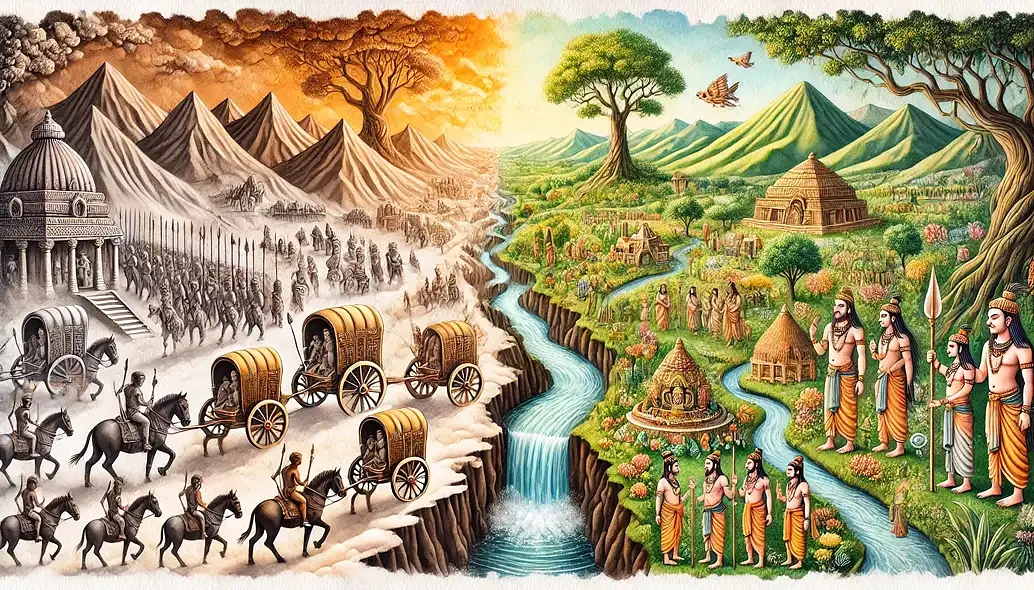
Indians moved from nomadic to settled states without significant invasions or migrations from abroad, and while all kinds of cultural, genetic and linguistic exchange can be found the language, culture and worldview evidenced among Aryans- people of the Ṛgveda- is undoubtedly homegrown. There was never an invasion. No migrations. Many ‘singular tribes’ who interned but not the transfer of an Aryan kit from abroad. No foreign Aryans who pushed southwards an urban Dravidian populace. No male elite dominance that defined Indian religion and social organisation for millennia to come. No usurping of indigenous property rights by a foreign populace. The Aryans were Indians. They were your ancestors and mine. Tamil is my heritage and Saṃskṛta yours, and the reverse is equally true. The tiniest goddess-idol on an isolated Andamanese island is our culture as much as the greatest myth of Indra is. This in fact is the true Aryan history.
A final point is driven home by considering the term Drāviḍa. Quite like the word ārya it never had any racial connotations. Further, while Ārya was still a kind of ethnic denomination among some tribes, Drāviḍa was purely a geographic one. In their paper The A of ABC of Indian Chronology, Manogna Sastry and Megh Kalyanasundaram compile Ārya and Drāviḍa as they occur in Indian texts. It’s not surprising that in a survey of Indo-Aryan texts the ratio of Ārya to Drāviḍa is more than 10:1. What’s clinching is that in the oldest surviving works of Tamil literature- Ezhuttadikaram, Solladikaram and Poruladikaram- not a single instance of the word Drāviḍa is found! So much for Aryans vs. Dravidians.
A Note on the Title
Witzel’s notorious “rebuttal” to Talageri came in the form of condescension, evident from the title containing ‘incredible wanderlust.’ Right off the bat, Witzel seeks to show how ridiculous Talageri’s proposition is. He suggests, sarcastically, that for it to be true, the Ṛgvedic tribes must have possessed an incredible wanderlust! It’s a great example of Western scholarship’s a priori disdain for traditional Indian narratives, for look how ridiculous Witzel’s position actually is:
- Were the proto-Indo-Europeans already not possessed with an incredible wanderlust? If not, what propelled them to spread from a central spot in Eurasia to two ends of it? If there can be other factors than “wanderlust,” what makes Witzel project wanderlust exclusively onto the prospect of migrants out of India?
- Mainstream narratives point to several migrations into India by Central Asian tribes. Are we allowed to lampoon this proposition, simply by cynically pointing to an imagined “wanderlust” in the Steppe? If not, why are words and notions that suffice to dismiss “indigenist” models not equivalently enough to dismiss reputationist models?
- And what of Indian narratives, which speak/know of migrations out of India beginning from the 1st manvantara itself, with Priyavrata the elder son of Svāyambhuva Manu?
- And what of genetic evidence that shows prehistoric India to have been humanity’s second primordial homeland, outside of Africa? Clearly prehistoric Indians possessed a “wanderlust.”
For these reasons I elect to lampoon Witzel’s title in turn, and reaffirm the ancient and enduring Bhāratīya wanderlust. Yes, we had it. Yes, our sons and daughters reached your lands and conquered you- in a manner of speaking. Go ahead, take your time trying to come to terms with this. Till then, despite Koenraad Elst’s dismay at the Hindu apathy towards the larger PIE/IE debate, we can’t actually bring ourselves to care. This, more than anything else, explains even the ignorant Hindu’s dismissal of AIT. It simply doesn’t matter, though if it does, we have enough evidence in our armoury.
References
- Cavalli-Sforza, LL et al. The History and Geography of Human Genes. Princeton University Press.
- van Driem, G. The Prehistoric Peopling of Southeast Asia.
- Danino, M. The Indo-European Cloudland.
- Mallory, JP and Adams, DQ. The Oxford Introduction to PIE and the PIE World. Oxford University Press.
- Talageri, S. The Rigveda and the Aryan Theory: A Rational Perspective.
- Kazanas, N. Indo-Aryan Origins and Other Vedic Issues. Aditya Prakashan.
- Elst, K. Ever Closer to Bhāropīyasthān- State of the Art of Out of India Debate. Etudes Classiques vol.88, Université de Namur 2020, p.85-108.
- Talageri, S. The Chronological Gulf Between the Old Rigveda and the New Rigveda.
- Tonoyan-Belyayev, IA. In Search of the Oldest Common Indo-European Urheimat: Preliminary Linguistic Evidence from Dravidian.
- Tonoyan-Belyayev, IA. A Note on PIE and Nuclear Nostratic - Preliminary Report.
- Sudarshan, TN and Madhusudan, TN. The Science and Nescience of Comparative Linguistics. Fount of Culture, Proceedings of Swadeshi Indology Conference Series, 2017.
- Witzel, M. The Incredible Wanderlust of the Rigvedic Tribes Exposed by S Talageri.
- Arnaud Fournet. Review of Rigveda and Avesta: The Final Evidence.
- Lal, BB. Testing Ancient Indian Traditions: On the Touchstone of Archaeology. Aryan Books International.
- Narasimhan, VM et al. The Formation of Human Populations in South and Central Asia.
- Sastry and Kalyanasundaram. The A of ABC of Indian Chronology: Dimensions of the Aryan Problem. Svadeshi Indology Conference, 2017.
- Elst, K. AIT and the Science of Linguistics. Pragyata, 2018.