Excavations at Bahaj
The site of Bahaj (27 47’14.14” N and 77 37' 37.130” E, Pl. 1) is located 4 km east of the District headquarters in Deeg, Rajasthan. The sacred Govardhan hill and Mathura are situated 6 km and 30 km east of the site, respectively (Map 1). The previously mentioned famous archaeological site of Sonkh (Hartel 1993) is situated about 15 km to the north-east of Bahaj. The area is generally flat and fertile. Some isolated hillocks are located towards the north-west of the site. The hills are part of the Aravallis.

The site has been reported in Indian Archaeology: A Review, first by the Rajasthan State Archaeology department in 1970 as a red ware yielding site (IAR 1970-71:31) and then by B. S. Negi of Delhi Circle of the Survey as a Painted Grey Ware site (IAR 80-81:55). Prof. Dilip Kumar Chakrabarti along with the author also explored this area in 2003 and identified it as a huge early historic settlement (Chakrabarti 2004:57-69). Subsequently, the author designated the site as a Painted Grey Ware yielding site (Gupta 2013:97) and was able to associate the ancient town of Vajanagara, mentioned in Jaina inscriptions from Kankali Tila, Mathura, with the Bahaj site (Gupta 2020:327). The local tradition believes that the site is the old place of Vajranābha, the great-grandson of Bhagavān Śrī Kṛṣṇa, credited with the revival of Braj spots after Śrī Kṛṣṇa returned to his abode with his Yādava companions. Based on this belief, the mound is known as Vajranābha-ka-Khera.

Objectives
Since Bahaj lies just 6 km west of the famous pilgrimage site of Govardhan, 4 km east of the ancient PGW site of Deeg Fort, and 15 km north-east of Sonkh and as there is another extensive mound at Gantholi between Bahaj and Govardhan, the site seemed to be a promising one to take up for excavation. Explorations conducted by the author also suggested that the area of Deeg and Kumher tehsils is extremely rich in terms of ancient sites (Gupta 2013). Therefore, it was highly likely that Bahaj could shed light on the chronology of the Braj region as well as the PGW culture, since it is situated in close proximity to important PGW and Early Historic sites. This assumption, however, could only be verified through excavation. It was also probable that a pre-PGW or OCP culture was present at this site, as it had a remarkably thick deposit. Besides this, Bahaj is well-associated with local Braj legends and also lies on the ancient pilgrimage route of Braj 84 Kos Parikramā, further strengthening its position as an important site on a historical and cultural map. The overall cultural deposit was expected to help in understanding various periods of Indian culture and the overall antiquity of the Braj region and Mathura.Excavations
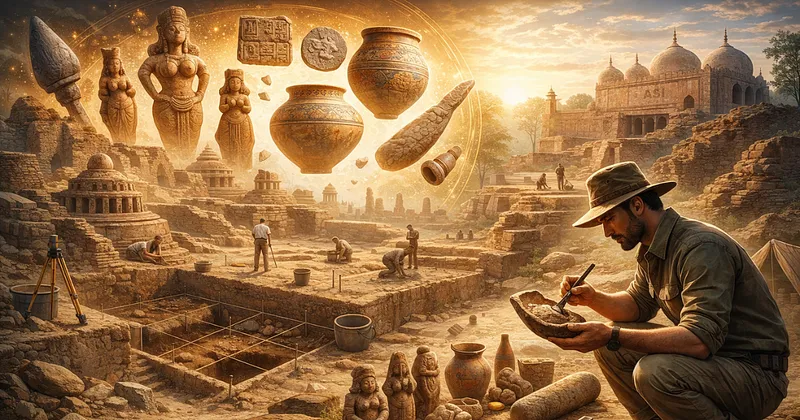
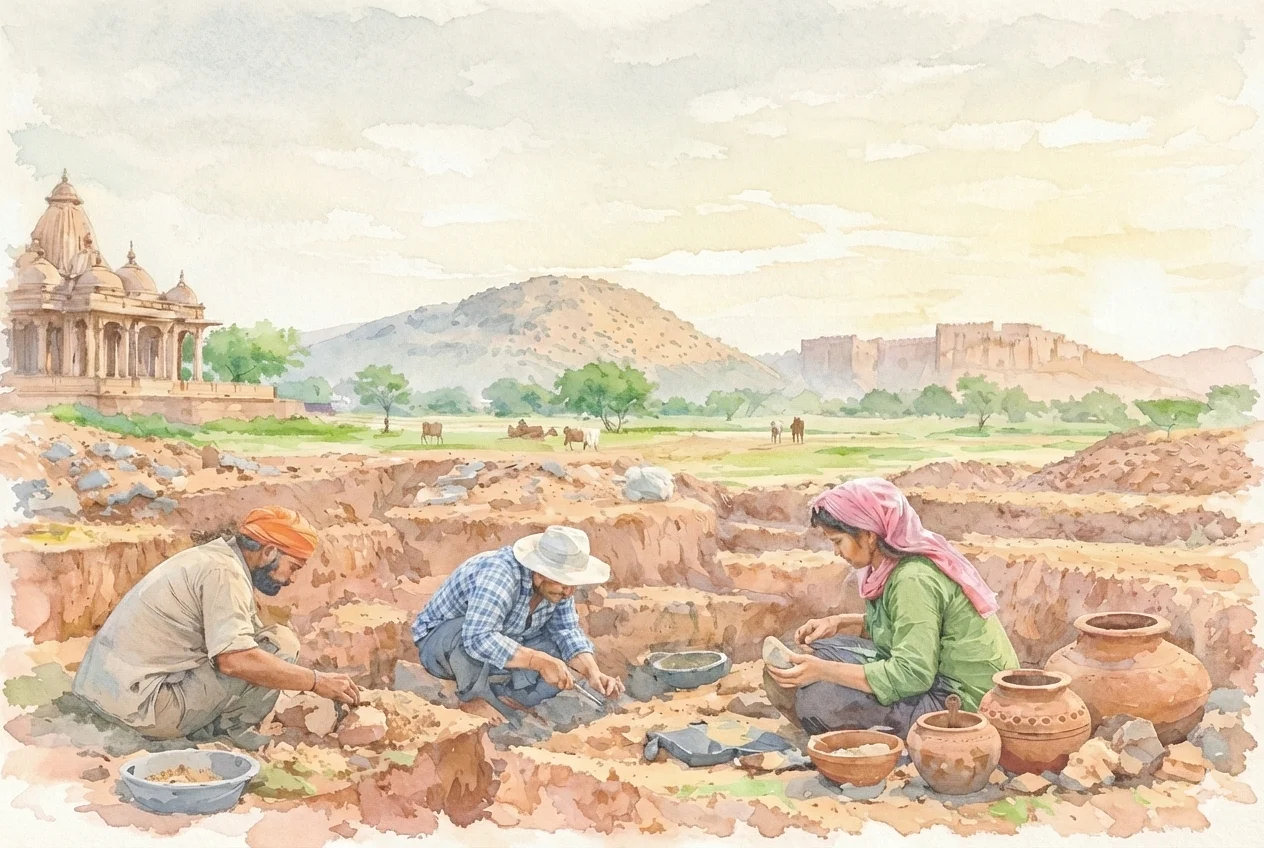
The site was taken up for excavation for two seasons between January 2024 and July 2025 (Fig. 1). During the first season of excavation, 14 quadrants each measuring 4.25 x 4.25 m forming part of different trenches- namely, XB8, ZA7, ZB9- were taken up for excavation. In the second season of excavation, 15 trenches comprising 50 quadrants were excavated; the most important among them were Trenches XB9, ZB6, XG3, XG4 and XF3. The site provided an uninterrupted cultural sequence from recent times/ medieval period to the earliest cultural period of the area. The trenches at the centre of the mound during the first season provided information on cultures from the Medieval period to Post-Gupta, Gupta, Kushan, Śuṅga, Mauryan, Pre-Mauryan and PGW period, with the occurrence of BRW and OCP in the lowest deposits of PGW culture. In another area towards the periphery (contour 211 m) of the mound, the cultural sequence starts from the Śuṅga period and goes down to the OCP period. The layers run almost horizontally all over the site with limited disturbances. The overall deposit helps in understanding the socio-cultural life in relation to the climate of the area. Various cultural phases are marked by the occurrence of Red Ware, Grey Ware, Painted Grey Ware, Black Slipped Ware, Northern Black Polished Ware, Black-&-Red Ware and Ochre Coloured Pottery (OCP), indicating various historic to proto-historic periods.
Stratigraphy (Fig. A):
Period I: Palaeolithic Period (Middle and Upper Palaeolithic tools found in the lowest deposit)
Period II: Govardhan-Bahaj Culture/OCP Period (deposit 1 m to 2.5 m)
Period III: BRW-PGW Period (deposit 30 cm to 70 cm)
Period IV: PGW Period (deposit 3 m to 7.75 m)
Period V: NBPW Period (deposit 80 cm to 1 m)
Period VI: Pre-Mauryan and Mauryan Period (deposit 80 cm to 1.5 m)
Period VII: Śuṅga Period (deposit 1 m to 2.25 m)
Period VIII: Kushan Period (deposit 60 cm to 2.75 m)
Period IX: Gupta Period (deposit 80 cm to 1.5 m)
Period X: Early Medieval Period (deposit 1 m to 1.25 m)
Period XI: Late Medieval Period (deposit 1.5 m approx.)

Sources
-
Image 3 - Excavated Pottery from Sonkh; Courtesy - Mathura Museum
-
Agrawala, Prithvi Kumar. The Early Indian Mother-Goddess Votive Discs. East and West, Vol. 29, No. 1/4, December 1979, 75-111.
-
Agrawala, R.C. and Vijay Kumar. Ganeshwar-Jodhpura Culture: New Traits in Indian Archaeology. Harappan Civilization-A Contemporary Perspective, Oxford & IBH Publishing Co., New Delhi, Bombay, Calcutta, 1982, 125-134.
-
Archaeological Survey Reports (A.S.R.) Nos. I, III, XVII, XX.
-
Archaeological Survey of India Annual Report (A.S.I.A.R.) for the year 1910-11 and 1911-12.
-
Chakrabarti, D.K. et.al. Bateshwar, Mathura and Ahar: Sites in the Agra-Mathura-Aligarh-Bulandshahr Sector of the Upper Ganga-Yamuna Doab in U.P. South Asian Studies, Vol. 20, 2004, pp. 57-69.
-
Chaturvedi, Vasudeva Krishna. 1987. “Vedon mein Braj” Braj-Vibhav (Hindi). Ed. Gopal Prasad Vyas. Delhi.
-
Gaur, R. C. Excavations at Atranjikhera, Delhi, 1983.
-
Gupta, Vinay Kumar. Mathura: An Art and Archaeological Study. Delhi. 2013.
-
Gupta, Vinay Kumar. Identification of Ancient Places and Towns in and around Mathura (Based on Correlation of Archaeological Findings with the Places Mentioned in Ancient Literature and Epigraphs). Heritage: Journal of Multidisciplinary Studies in Archaeology 8.2 (2020): 324-337.
-
Growse, F.S. 1883. Mathura: A District Memoir. Delhi.
-
Joshi, E.B. 1968. U.P. District Gazetteers- Mathura. Vol. 12. Lucknow.
-
Joshi, M.C. 1989. “Mathura as an Ancient Settlement”, Mathura: The Cultural Heritage. Ed. D.M. Srinivasan. AIIS, Delhi: 165-170.
-
Katre, S.M. 1969. Dictionary of Pāṇini, Part III. Poona: Deccan College.
-
Mani, B.R. and V.K. Gupta. 2014. “Rajagriha” History of Ancient India, Vol. VII. Eds. D.K.
-
Chakrabarti and Makkhan Lal. Delhi: 599-608.
-
Mittal, Prabhu Dayal. 1966. Braj Kā Sānskritik Itihās (Hindi). Delhi: Rajkamal.
-
Hartel, Herbert. Excavations at Sonkh. Berlin, 1993.
-
Indian Archaeology 1954-55-A Review
-
Indian Archaeology 1963-64-A Review.
-
Indian Archaeology 1964-65-A Review.
-
Indian Archaeology 1965-66-A Review.
-
Indian Archaeology 1966-67-A Review.
-
Indian Archaeology 1970-71-A Review.
-
Indian Archaeology 1980-81-A Review.
-
Sahi, M.D.N. Aspects of Indian Archaeology. Jaipur, 1993.
-
Sankalia, H.D., S.B. Deo and Z.D. Ansari, Excavations at Ahar (Timbavati). Deccan College, Pune, 1969.
-
Sharma, R.C. 1984. Buddhist Art of Mathura. Delhi: Agam Kala Prakashan.
-
Shesh, Chunni Lal. 1959. “Braj Yātrā kī Paramparā”. Braj aur Braj Yatrā (Hindi). Eds. Govindadas and Ram Narayan Agrawal. Delhi: 91-117.
-
Singh, Purushottam. Excavations at Narhan (1984-1989). Delhi, 1994.
-
Varma, Dhirendra.1954. Brajbhasha (Hindi). Allahabad: Hindostani Academy.
-
Vogel, J.Ph. 1972. Indian Serpent Lore. Varanasi & Delhi.