In the early nineteenth century, before the empire revealed its presence through annexation treaties and battle reports, it often infiltrated regions through financial ledgers. Conquest did not begin with cannon fire but with credit, supply contracts, and the slow withdrawal of trust from regimes that depended on commerce yet refused to dignify those who sustained it. Sindh, on the eve of British annexation in 1843, offers a precise example of this process. At the centre of this history stood a Hindu mercantile world that had grown wealthy without ever becoming sovereign and a trader whose decisions would later be reduced to a single word: collaboration.
The name most closely associated with this turning point is Seth Naomal Hotchand. In popular retellings, Naomal appears abruptly, almost opportunistically, as a man who aided the British against the Talpur Mirs and helped deliver Sindh into colonial hands. This framing satisfies moral instinct but evades historical explanation. To understand why Naomal acted as he did, one must reconstruct the merchant civilization that preceded him, the insults that shaped his political imagination, and the structural limits under which Hindu commercial life functioned long before British troops crossed the Indus.
A Merchant City Before a State
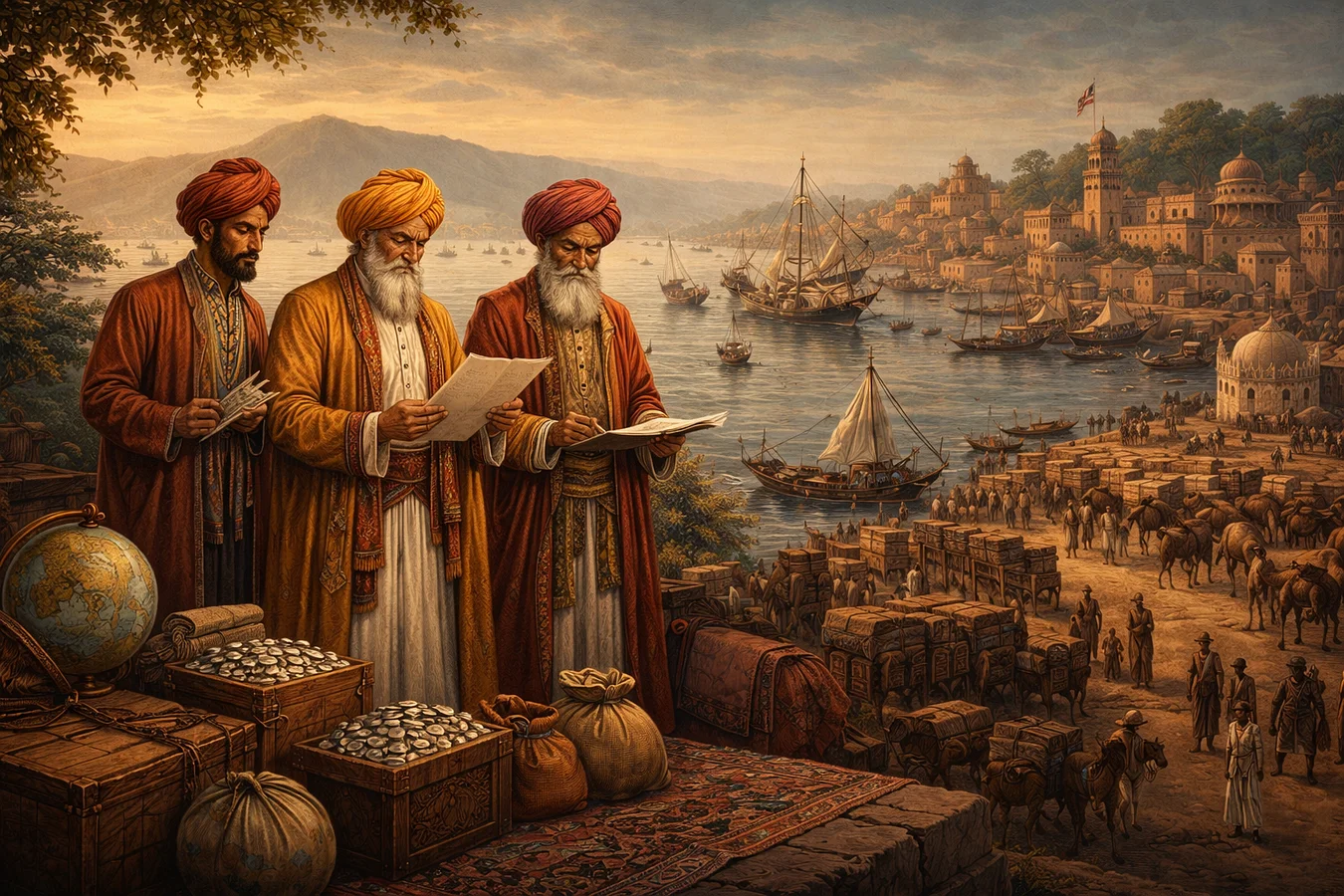
Karachi did not begin as a capital. It began as a port shaped by traders. In the early eighteenth century, when Bhojomal, Naomal’s great-grandfather, is remembered as having laid the foundations of the town around 1729, there was no sovereign proclamation marking its birth. The city emerged because trade made it necessary. Warehouses appeared before walls. Routes mattered more than boundaries. Capital moved with the rhythm of monsoon winds rather than the commands of courts.
This pattern was not unique to Karachi. Across Sindh, Hindu merchants had built an economy that functioned alongside political authority rather than within it. The great merchant town of Shikarpur, further inland, connected Central Asia to the Indian Ocean through a dense web of caravan routes and bills of exchange. Hundis issued in Sindh circulated in Bukhara, Isfahan, Astrakhan, Muscat, and later Bombay. These traders were not provincial intermediaries. They were participants in a commercial world that stretched from the Caspian to the Arabian Sea.
Yet this reach came with a condition. Merchant power was economic, not political. Hindu traders financed states they did not govern and supplied armies they did not command. Their security depended less on law than on custom, and custom could dissolve quickly under pressure. Mobility was their principal safeguard. Capital could move when dignity failed.
The Talpur Mirs ruled Sindh by the time Seth Naomal was born in 1804. The Talpur Mirs derived their authority from land grants, military allegiance, and Islamic legitimacy. Hindu merchants were indispensable to revenue collection, credit circulation, and provisioning. They were also outsiders to power. Wealth granted access to taxation, not to counsel. Merchants could fund the court without ever belonging to it.
Outsiders noted this contradiction with unusual clarity. James Burnes, who visited Sindh in the 1830s, observed that much of the region’s revenue lay in Hindu hands. Yet he also emphasized that this wealth offered little protection in courtly life. Hindu merchants remained vulnerable to arbitrary treatment, popular hostility, and ritual exclusion.
Burnes records a remark attributed to Mir Murad Ali that circulated widely among the merchant community. Hindus, the Mir is said to have remarked, were all rascals. The importance of this sentence lies not in its exact phrasing but in its performance. It was a public declaration of hierarchy. It reminded merchants that economic utility would not be translated into honor. In a society where dignity functioned as a political currency, such remarks were not casual insults. They were signals.
When Vulnerability Becomes Personal
For Seth Naomal’s family, vulnerability did not remain abstract. A Muslim mob once seized his father, Hotchand, a wealthy Hindu merchant, with the intention of forcing him to convert. The Mir eventually intervened and secured his release. Yet intervention after capture does not erase the fact of exposure. It merely confirms it.
The episode travelled quickly through the merchant community. Forced conversion struck at the core of Hindu mercantile life, where lineage, ritual continuity, and community trust underpinned credit itself. For Hotchand, the conclusion was unmistakable. Sindh could no longer be treated as a secure base. He exiled himself to Kutch, following a pattern well established among Hindu trading families. When honor could no longer be protected, exit became a strategy.
Exile did not dissolve memory. It sharpened it. Seth Naomal grew up with these stories not as distant events but as family knowledge. The sense that wealth did not guarantee safety became part of his political education.
Another incident, recorded later by Claude Markovits, deepened this formation. During a period of communal violence in Karachi, Naomal was beaten by one of his teachers. Education, often imagined as neutral, revealed its embedded hierarchies. Authority entered the body. Discipline became punishment. The classroom mirrored the street.
Such moments mattered. They taught young merchants that vulnerability was not episodic but structural. They also taught them that loyalty to a regime that could not guarantee dignity was a fragile bond.
The British as a Calculated Alternative
By the late 1830s, the British East India Company had already established itself as a dominant presence along India’s western coast. Bombay had become a commercial hub whose courts, though uneven, offered procedural predictability. For merchants accustomed to arbitrary power, predictability itself was a form of protection.
Seth Naomal’s engagement with the British did not begin with a military alliance. It began with supply. He provided goods, arranged transport, and extended credit. He translated between administrative cultures. Gradually, his role expanded. He became an army contractor, a position that tied his fortunes to the British movement and his safety to British success.
This pattern was not exceptional. Across South Asia, merchants had long collaborated with whichever authority appeared most capable of enforcing contracts and restraining violence. Under the Mughals, under Afghan governors, and under regional dynasties, traders supplied power without commanding it. Collaboration was not a moral deviation. It was a habit formed under conditions where sovereignty often failed to reciprocate loyalty.
British officials understood this well. Military correspondence from the period reveals repeated anxieties about supply. Armies stalled without grain, bullocks, boats, and advance credit. Local cooperation determined the pace of conquest. In Sindh, these resources lay largely in Hindu hands. Without men like Naomal, British power remained aspirational rather than operational.
As tensions between the Company and the Talpur Mirs escalated, Naomal’s role shifted from supplier to broker. He worked within Sindh’s fractured political structure, persuading jagirdars to withdraw loyalty at critical moments. This was not an ideological conversion. It was transactional politics conducted through money, obligation, and calculation.
When British forces under Charles James Napier advanced, they encountered less resistance than expected. The defeat of Mir Sher Muhammad Talpur at Dubbo on 24 March 1843 marked the formal collapse of Talpur rule. Yet by the time cannons fired, much of the political economy of Sindh had already shifted. Credit had moved. Supplies had been rerouted. Allegiances had thinned.
Dubbo and the Silence of Merchants
People often narrate the Battle of Dubbo as a battle of arms, where discipline triumphed over valor. Such accounts miss the quieter preconditions of victory. Dubbo was loud, but the work of conquest had been largely silent. It unfolded through withdrawal rather than confrontation, through hesitation rather than resistance.
For Seth Naomal, British victory brought security and recognition denied under the Mirs. His position improved. His wealth became legible to power. Yet the outcome was not a story of uncomplicated ascent. Colonial rule imposed its limits on Indian agency. Merchants gained protection but lost autonomy. The terms of collaboration shifted, and the space for negotiation narrowed.
Naomal’s legacy thus resists easy judgment. He was neither a simple traitor nor a romantic hero. He was a merchant navigating a world where economic centrality did not translate into political dignity and where insult accumulated faster than obligation.
A Recurring Condition
What makes Naomal’s story enduring is not its singularity but its repetition. Across South and Southeast Asia, Hindu merchant communities faced similar calculations. Marwari financiers in Bengal, Chettiar moneylenders in Burma, and Gujarati traders in Muscat and Zanzibar all learned to read political vulnerability early. Some attached themselves to colonial power. Others withdrew into the diaspora. A few attempted accommodation with local rulers. What united them was not ideology but sensitivity to the moment when protection failed.
Colonial rule did not invent this condition. It exploited it. British administrators recognized that collaboration with merchant elites could substitute for local legitimacy. They also recognized that humiliation and exclusion had already done much of the work. Empires entered societies already fractured by hierarchies of faith, access, and honor.
Afterlives
Seth Naomal lived long enough to see Karachi transformed into a colonial port integrated into global trade networks. Hindu merchants continued to operate, though increasingly oriented toward Bombay and beyond. A century later, Partition would empty Karachi of its Hindu commercial class. Once again, capital moved faster than power. Once again, those who had built the city departed without sovereignty to protect them.
What remains are fragments: memoirs, travel accounts, and administrative records. Read together, they reveal how insult accumulates, how loyalty erodes, and how collaboration becomes thinkable long before conquest is declared.
History often invites verdicts. This story demands attention. It shows how an empire is prepared not only by armies but also by the failure of states to recognize the dignity of those who sustain them.
References
Burnes, J. (1839). A Narrative of a Visit to the Court of Sinde. London: John Murray.
Hotchand, N. (1887). Memoirs of Seth Naomal Hotchand. Karachi: privately printed.
Markovits, C. (2000). The Global World of Indian Merchants, 1750–1947: Traders of Sindh from Bukhara to Panama. Cambridge: Cambridge University Press.
Talbot, I. (2002). Sindh and the British: Political Economy and Society, 1843–1947. Oxford: Oxford University Press.
Subrahmanyam, S. (1990). Merchants, Markets, and the State in Early Modern India. Delhi: Oxford University Press.