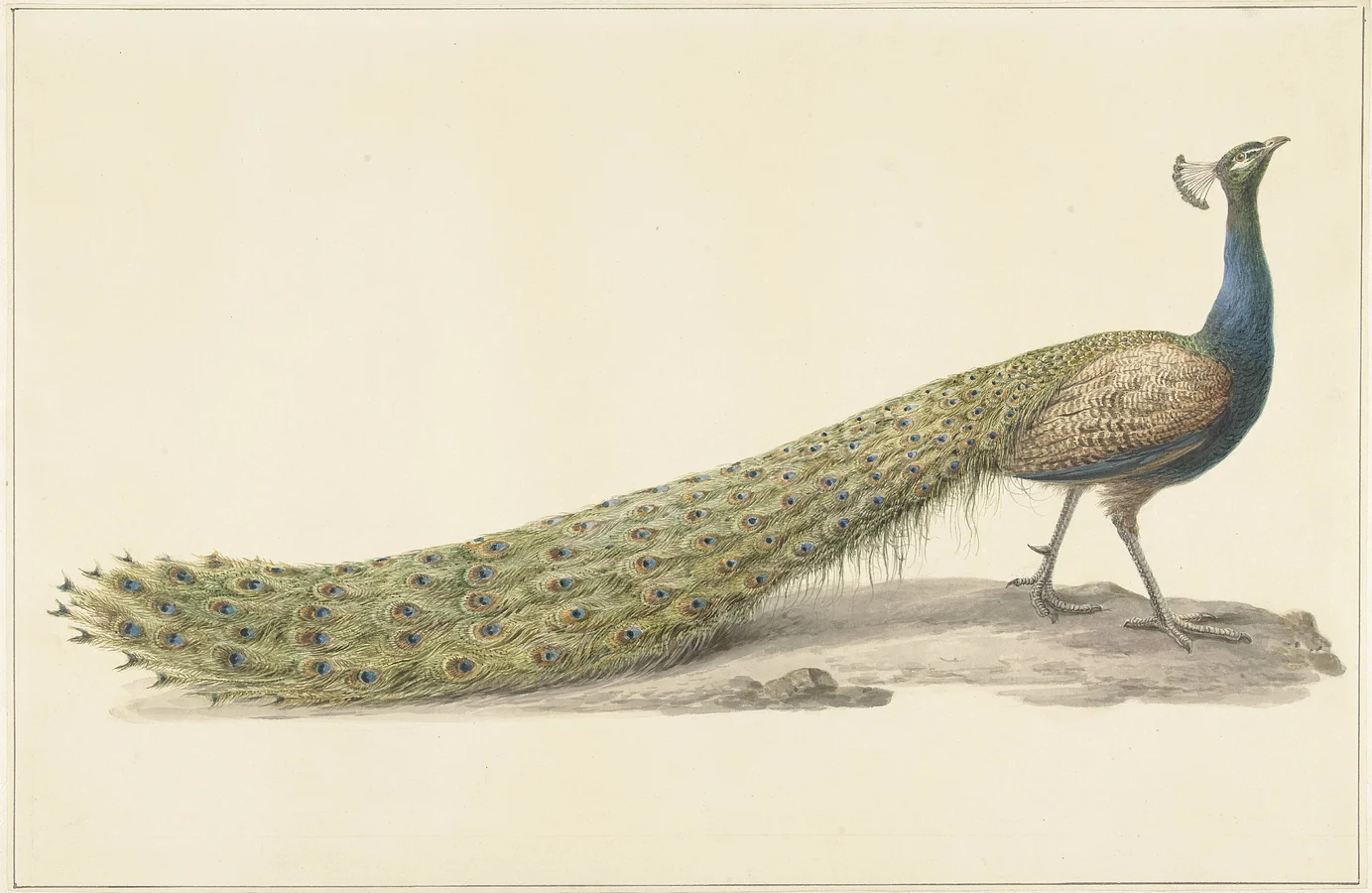
IntroductionIn the universe of Indian myth and imagination, few creatures capture the imagination as the layered symbolism as the peacock. The epics tell us that the eyes of the peacock’s shimmering plumage were the gift of Indra, Lord of the heavens. It is said that when the god took refuge beneath the peacock’s fan-like wings during a storm of demons, he blessed it in gratitude, leaving behind the very marks of his thousand eyes. Due to the peacock’s aesthetic splendor, the bird is woven through the subcontinent’s ritual, folklore, and esoteric traditions.
Ancient belief held that its feathers could ward off poison, cure illness, and even undo the venom of serpents. During the Vedic era, the flesh of the bird was consumed both for medicinal value and as a delicacy. Tribes such as the Khonds and Koyas venerate the bird as the very form of the Mother Goddess, honored through periodic offerings during festivals like Dīpāvali. Among the Dravidians (1) as well, the peacock was Mother Earth herself, and over time, this deified bird transfigured into Murugan — the beloved Tamil God of youth, war, and wisdom — whose mount is the peacock, one of the most profound examples of India’s mythopoetic imagination at work.
Though rarely central in sculpture or coinage, the peacock’s presence pervades Indian art in subtler, sacred ways: as the mount of Skanda or Kārtikeya, as the feather adorning Kṛṣṇa's crown — a mark of playful divinity that binds the god to earth’s beauty. From the seals of Harappa to Tamil village shrines, from epigraphs to living rituals, the worship of the peacock has endured through millennia.
 Silver Drachm of Skanda Gupta featuring a fan-tailed peacock, c. 450-475 AD
The peacock remains a creature of reverence — that India has claimed it as her National Bird is not a convenient symbolic act; it is a gesture of fidelity to her own civilizational imagination — one that sees in beauty itself a form of worship. To follow the peacock’s trail through India’s sacred imagination is to move from myth into medicine, from symbol into lived ritual.
Silver Drachm of Skanda Gupta featuring a fan-tailed peacock, c. 450-475 AD
The peacock remains a creature of reverence — that India has claimed it as her National Bird is not a convenient symbolic act; it is a gesture of fidelity to her own civilizational imagination — one that sees in beauty itself a form of worship. To follow the peacock’s trail through India’s sacred imagination is to move from myth into medicine, from symbol into lived ritual.
Silver Drachm of Skanda Gupta featuring a fan-tailed peacock, c. 450-475 AD
The peacock remains a creature of reverence — that India has claimed it as her National Bird is not a convenient symbolic act; it is a gesture of fidelity to her own civilizational imagination — one that sees in beauty itself a form of worship. To follow the peacock’s trail through India’s sacred imagination is to move from myth into medicine, from symbol into lived ritual.
Early Cultural HistoryIn India’s long cultural memory, the peacock holds special significance. The Vedic corpus itself bears witness to this continuum. The ancient seers, having observed the bird’s fearlessness before serpents and scorpions, endowed the creature with curative virtue, capable of neutralizing venom. Both the Ṛgveda and Atharvaveda make mention of this association. Across India’s landscape, oral traditions embroidered further wonder into the peacock’s form: myriad tales were born of how it earned its jeweled plumage, how the tuft upon its head came to be, etc. When the monsoon clouds gather, the peacock’s dance heralds the onset of rains, its iridescent plume outshining the rainbow that follows. These stories, varied as the dialects they travel in, reflect a single cultural intuition — that beauty, in the Indian imagination, is never incidental. It is always the vestige of a divine encounter.
The ocelli or the eye-designs on the feathers of the peacock have fascinated the imagination of the Romans, Greeks and tribes of India. So have its flamboyant courtship antics, when it displays its wonderful golden, blue and green feathery train, arresting the imagination of people all over the world. In Greece, the peacock belonged to Hera, “Argus of the Hundred Eyes,” the goddess who saw all things. As A. S. Barnes observed, the peacock’s dance — so often portrayed in classical, folk, and cinematic traditions — is unlike the Pavane, the European “dance of appearance.” The bird, in the fullness of its display, enacts the drama of the cosmos: the chromatic unfolding of creation, the turning of ego outward toward the world.
Medicinal Value of the Peacock
Vedic and early Dharmaśāstric texts did not prohibit the consumption of peacock meat, and its flesh was often recommended for its supposed medicinal value. The Caraka Saṃhitā describes peacock meat as “exceedingly beneficial for the eye, the ear, intelligence, the digestive fire, the consequences of age, complexion, voice, and period of life. It is, besides, strength-giving and wind-destroying. It also increases the semen.” The Āpastamba, Gautama, and Vasiṣṭha Dharmasūtras contain no explicit prohibition against consuming peacock meat, while the Baudhāyana Dharmasūtra explicitly allows it. Neither Manu nor Yājñavalkya includes the peacock among forbidden foods. Epic and Purāṇic texts corroborate this: the Rāmāyaṇa refers to peacock meat served in Rāvaṇa’s banquet hall. Buddhaghosa too records that the flesh of the peafowl was considered a delicacy in the Madhyadeśa, including in the Magadhan region.
In Āyurveda, mayūrapiccha — the peacock feather— is prescribed in kaṣāyams for its powers of purification and protection. In the traditional apothecaries of Kerala and Tamil Nadu, these feathers are still stocked as curatives. In Punjab, the belief runs deeper still: the feathers are smoked through a pipe as a defense against snakebite. In parts of South India, the ashes of burnt peacock feathers are employed in traditional remedies against vomiting, testifying to the bird’s continued association with healing properties.
Ritual and Cultural Uses of the Peacock and Its FeathersThe peacock’s feathers occupy a distinctive place in the ritual and ceremonial practices of India, particularly in the South. In the temple festivals of Kerala, they form an indispensable part of the visual and ritual ensemble. A traditional procession is marked by elephants adorned in ornate caparisons, bearing golden umbrellas, while attendants fan ālavaṭṭams—circular fans made of peacock feathers mounted on silver handles—and wave fly whisks made of yak tails. For instance, the peacock dance Mayilāṭṭam, or Mayilnṛtam—literally “the peacock dance”—is a ritual performance native to the Subramanya temples of South Kerala. It is performed by artists adorned in elaborate peacock costumes, complete with resplendent feathered trains and crested headpieces, evoking the bird that serves as the divine vāhana of Lord Muruga. The dancers imitate the movements and grace of the peacock through rhythmic steps and sweeping gestures, merging devotion and artistry in a vivid expression of sacred mimicry. Closely related in spirit to other ritual folk forms like Kummatti, found in Wayanad, Thrissur, and Palakkad, Mayilattam exemplifies Kerala’s living tradition of devotional performance where myth, nature, and dance coalesce.
 Mayilāṭṭam or Peacock dance
Beyond the temple precinct, the peacock feather also serves ritual, symbolic, and medicinal purposes in various regional and tribal contexts. In Banaras, the priest of Bhaironath (or Kaal Bhairav Mandir) traditionally wields a wand of peacock feathers, used both to chastise and absolve worshippers of their pāpa (sins). Among the Varlis, a forest tribe of Maharashtra, peacock feathers fixed in a brass pot represent Hirva, a domestic deity, around which ritual dances are performed. The nomadic Bauris or Bawarias, known historically for counterfeiting coins and engaging in banditry, were reported to keep small relic bundles called Devakadana (“god’s grain”), containing wheat, sandal seeds, and a tuft of peacock feathers as talismans of protection. All over India, tufts of peacock feathers are waved to dispel demons and banish disease and misfortune.
Mayilāṭṭam or Peacock dance
Beyond the temple precinct, the peacock feather also serves ritual, symbolic, and medicinal purposes in various regional and tribal contexts. In Banaras, the priest of Bhaironath (or Kaal Bhairav Mandir) traditionally wields a wand of peacock feathers, used both to chastise and absolve worshippers of their pāpa (sins). Among the Varlis, a forest tribe of Maharashtra, peacock feathers fixed in a brass pot represent Hirva, a domestic deity, around which ritual dances are performed. The nomadic Bauris or Bawarias, known historically for counterfeiting coins and engaging in banditry, were reported to keep small relic bundles called Devakadana (“god’s grain”), containing wheat, sandal seeds, and a tuft of peacock feathers as talismans of protection. All over India, tufts of peacock feathers are waved to dispel demons and banish disease and misfortune.
 'Morchal', a peacock feather whisk made of bunched peacock feathers attached to a silver handle. The bunch of peacock feathers are tied with silver and gold wires and tinsel. From 19th century Murshidabad. Victoria and Albert Museum
Totemic and Mythological DimensionsThe peacock was one of the products exported from the ancient Kerala port of Muciṟi (anglicized as Muziris), whose name— muyiricode, likely derived from Mayilincadu, “land of peacocks”—reflects the bird’s local abundance. The Maurya dynasty appears to have regarded the peacock as a totemic emblem, an association reflected in their coinage and continued by the Guptas. As Mahāsena, the Commander of the army of the Gods, he was the favourite deity of the northern war-like republics like the Yaudheyas and warlike dynasties like the Guptas, the Chalukyas, the Kadambas, etc. Iconographic representation of Skanda is seen on the coins of the Kushana Emperor Huvishka and the Yaudheya coins. In legend, peacocks were believed to guard royal palaces, as in the story of Queen Koklan (see note 2), further attesting to the bird’s symbolic role as protector and emblem of auspiciousness.
The peacock’s most enduring association, however, has been in art and sculpture as the vehicle (vāhana) of Kārtikeya—also known as Subrahmaṇya, Skanda, or Śaṇmukha—who is rarely represented without. The worship of the peacock (pavolatry) has deep roots, especially among Dravidian peoples, for whom the bird served as a totemic emblem long before its absorption into pan-Indian religious symbolism. Archaeological findings from the Indus Valley civilization—such as clay bird models and peacock motifs painted on pottery from Mohenjo-Daro—suggest that peacock worship is ancient. Among Dravidian tribes across central and southern India, Kārtikeya was venerated as a God of war.
 Kārttikeya seated on peacock, Barhkhedi, Madhya Pradesh, dated 700-999 CE. Presently in Bhopal, at the Birla Museum. From the Virtual Museum of Images and Sounds (VMIS) run by the American Institute of Indian Studies (AIIS).
Kārttikeya seated on peacock, Barhkhedi, Madhya Pradesh, dated 700-999 CE. Presently in Bhopal, at the Birla Museum. From the Virtual Museum of Images and Sounds (VMIS) run by the American Institute of Indian Studies (AIIS).
The Śaivāgamas enumerate seventeen distinct forms of Subrahmaṇya, among which Kārtikeya, Śaṇmugha, Krauñcabhedana, and Vāyudhiśiskanda are specifically described as having the peacock as their vehicle. Famed Indian archeologist and epigraphist T. A. Gopinatha Rao surmised that Kārtikeya may represent the deification of the peacock itself. According to iconographic prescriptions, the seated form of Subrahmaṇya may either rest upon a lotus pedestal (padmāsana) or be enthroned upon a peacock. When depicted seated, the god should possess two arms; when standing, four; and when shown seated upon the peacock, as many as six, eight, or twelve. His dvārapālakas or gatekeepers are Sūrya and Śiva (identified in this context with Agni or Rudra), further linking his symbolism to solar attributes.
Several textual sources strengthen the argument that Subrahmaṇya’s mythic structure is solar in origin. A dhyāna-śloka recited in parts of South India directly identifies him with the sun. His six heads are interpreted as representing the six ṛtus or seasons, and his twelve arms the twelve months of the year. The kukkuṭa (cock), which accompanies him, heralds the dawn, while the peacock—with its iridescent plumage blending every hue of light—is seen as a terrestrial manifestation of the sun’s radiance. Even his weapon, the śaktyāyudha or spear, is read as a solar emblem.
The Śrītattvanidhi offers a detailed description: Kārtikeya should have one face with three eyes, ten arms, and the complexion of the rising sun. He bears on his head a bilva leaf or fruit and holds in his right hands the śūla, chetaka, aṅkuśa, vajra, and varada symbols. In another variant, Śaṇmukha’s body is described as kumkuma-coloured (saffron-hued) and seated upon a peacock.
 Subrahmaṇya accompanied by a grandly sculpted peacock, a granite sculpture from 1200-1299 CE Colamaṇḍala Sirkali, Mayiladuthurai District, Tamil Nadu. From the Virtual Museum of Images and Sounds (VMIS) run by the American Institute of Indian Studies (AIIS).
Subrahmaṇya accompanied by a grandly sculpted peacock, a granite sculpture from 1200-1299 CE Colamaṇḍala Sirkali, Mayiladuthurai District, Tamil Nadu. From the Virtual Museum of Images and Sounds (VMIS) run by the American Institute of Indian Studies (AIIS).
Kārtikeya’s emergence is also tied to the destruction of the demon Tāraka, whose penance had rendered him invincible to the gods. As recounted by Dowson, Kārtikeya was born to defeat Tāraka and is shown riding a peacock named Paravāṇi, bearing a bow and arrow, accompanied by his consorts.
Iconography and Artistic RepresentationsSculptural and artistic evidence across centuries underscores the peacock’s enduring role in the visual representation of Kārtikeya. In Western India, six- or twelve-armed images of the deity were particularly popular, reflecting his character as a martial god within Aryanized traditions. A notable example from the Art Institute of Chicago shows a six-headed, twelve-armed Kārtikeya, with the peacock positioned beneath him.
 Kārttikeya from the Ganga Period, about 12th century Madanapalle, Andhra Pradesh. Art Institute of Chicago
As Bhattacharya notes, the peacock maintained its prominence across successive artistic periods, functioning simultaneously as divine vehicle, aesthetic motif, and emblem of royal splendor. In early medieval sculpture, it appears both independently and as Skanda’s vāhana. A 7th-century relief in the Bharat Kala Bhavan exemplifies the harmonious rendering of the deity with his bird, while a 9th–10th century figure from the Somesvara Temple at Mukhalingam demonstrates remarkable craftsmanship in the carving of the peacock’s fan-tail, complete with delicately incised eyelets.
Kārttikeya from the Ganga Period, about 12th century Madanapalle, Andhra Pradesh. Art Institute of Chicago
As Bhattacharya notes, the peacock maintained its prominence across successive artistic periods, functioning simultaneously as divine vehicle, aesthetic motif, and emblem of royal splendor. In early medieval sculpture, it appears both independently and as Skanda’s vāhana. A 7th-century relief in the Bharat Kala Bhavan exemplifies the harmonious rendering of the deity with his bird, while a 9th–10th century figure from the Somesvara Temple at Mukhalingam demonstrates remarkable craftsmanship in the carving of the peacock’s fan-tail, complete with delicately incised eyelets.
Kārttikeya from the Ganga Period, about 12th century Madanapalle, Andhra Pradesh. Art Institute of Chicago
As Bhattacharya notes, the peacock maintained its prominence across successive artistic periods, functioning simultaneously as divine vehicle, aesthetic motif, and emblem of royal splendor. In early medieval sculpture, it appears both independently and as Skanda’s vāhana. A 7th-century relief in the Bharat Kala Bhavan exemplifies the harmonious rendering of the deity with his bird, while a 9th–10th century figure from the Somesvara Temple at Mukhalingam demonstrates remarkable craftsmanship in the carving of the peacock’s fan-tail, complete with delicately incised eyelets.During the Chola period (10th century CE), bronze icons of Skanda further refined this motif, depicting the peacock standing with regal composure, often shown gripping a serpent in its beak—a symbolic triumph of light over darkness. In the Vijayanagara art of the 14th–15th centuries, Kārtikeya continued to be portrayed riding a splendid, fanned-tailed peacock, consolidating an iconographic lineage that had spanned nearly two millennia by then.
 A bronze figure of Kārthikeya seated on his peacock Tamil Nadu, circa 15th century
The Peacock in Classical LiteratureThe peacock has long inspired India’s literary imagination, appearing prominently in Saṃskṛta epics, classical poetry, and later Tamil compositions. From Vālmīki and Bhavabhūti to Kālidāsa and Bhāravi—the bird is consistently praised for its vibrant plumage, rhythmic gait, and as a harbinger of rain, serving as a metaphor for nature’s aesthetic delight. Śrī Aurobindo observes that, unlike the English literary tendency to perceive the bird as “absurd,” the Hindu literary tradition emphasizes its charm and grace for poetic imagery.
A bronze figure of Kārthikeya seated on his peacock Tamil Nadu, circa 15th century
The Peacock in Classical LiteratureThe peacock has long inspired India’s literary imagination, appearing prominently in Saṃskṛta epics, classical poetry, and later Tamil compositions. From Vālmīki and Bhavabhūti to Kālidāsa and Bhāravi—the bird is consistently praised for its vibrant plumage, rhythmic gait, and as a harbinger of rain, serving as a metaphor for nature’s aesthetic delight. Śrī Aurobindo observes that, unlike the English literary tendency to perceive the bird as “absurd,” the Hindu literary tradition emphasizes its charm and grace for poetic imagery.
A bronze figure of Kārthikeya seated on his peacock Tamil Nadu, circa 15th century
The Peacock in Classical LiteratureThe peacock has long inspired India’s literary imagination, appearing prominently in Saṃskṛta epics, classical poetry, and later Tamil compositions. From Vālmīki and Bhavabhūti to Kālidāsa and Bhāravi—the bird is consistently praised for its vibrant plumage, rhythmic gait, and as a harbinger of rain, serving as a metaphor for nature’s aesthetic delight. Śrī Aurobindo observes that, unlike the English literary tendency to perceive the bird as “absurd,” the Hindu literary tradition emphasizes its charm and grace for poetic imagery."Peacock crown, why preen on gaining Krishna's head?You'll soon be tumbling to his feet when you hear of Radha's wrathful mood." Bihārī’s Satsaī, trans. Rupert Snell, verse 387
 Kṛṣṇa admonishes Rādha for her pride. Udaipur, Rajasthan, 1719. Linden-Museum Stuttgart
In the Rāmāyaṇa, Vālmīki depicts the peacock both in its natural habitat and in relation to human emotion. During Rama’s exile, the peacock’s courtship and dance enhance the forest’s scenic beauty and amplify Rama’s pangs of separation from Sita. The narrative repeatedly aligns the peacock with affection, loyalty, and filial-like constancy, portraying the bird as a mirror to human sentiment. Kālidāsa references the peacock in works such as Ṛtu Saṁhāra, Raghuvaṁśa, and Meghadūta. In Ṛtu Saṁhāra, he chronicles the bird’s seasonal activities, portraying the rains as a trigger for its jubilant dance and noting its interactions with adversaries such as snakes and bees. In Meghadūta, the peacock functions as both a domestic and symbolic presence, performing for lovers or acting as a visual metaphor for the beloved’s beauty. The peacock also appears in regional poetic traditions as a messenger of love and a consoling presence to the sorrowful. In Udaya’s Mayūra Sandeśa, the bird conveys the anguish of a separated lover, while in Subhāṣita Ratna Bhandagara, it is praised for its pleasing song and resplendent feathers, likened to the locks of women adorned with flowers. Classical Sanskrit and vernacular literature has long established the peacock as a dynamic participant in the cultural, emotional, and symbolic landscape of India, and not merely as a visual or ornamental motif.
Kṛṣṇa admonishes Rādha for her pride. Udaipur, Rajasthan, 1719. Linden-Museum Stuttgart
In the Rāmāyaṇa, Vālmīki depicts the peacock both in its natural habitat and in relation to human emotion. During Rama’s exile, the peacock’s courtship and dance enhance the forest’s scenic beauty and amplify Rama’s pangs of separation from Sita. The narrative repeatedly aligns the peacock with affection, loyalty, and filial-like constancy, portraying the bird as a mirror to human sentiment. Kālidāsa references the peacock in works such as Ṛtu Saṁhāra, Raghuvaṁśa, and Meghadūta. In Ṛtu Saṁhāra, he chronicles the bird’s seasonal activities, portraying the rains as a trigger for its jubilant dance and noting its interactions with adversaries such as snakes and bees. In Meghadūta, the peacock functions as both a domestic and symbolic presence, performing for lovers or acting as a visual metaphor for the beloved’s beauty. The peacock also appears in regional poetic traditions as a messenger of love and a consoling presence to the sorrowful. In Udaya’s Mayūra Sandeśa, the bird conveys the anguish of a separated lover, while in Subhāṣita Ratna Bhandagara, it is praised for its pleasing song and resplendent feathers, likened to the locks of women adorned with flowers. Classical Sanskrit and vernacular literature has long established the peacock as a dynamic participant in the cultural, emotional, and symbolic landscape of India, and not merely as a visual or ornamental motif.
 Kṛṣṇa taking the gopis across the river Yamuna, making the crossing in a 'morpankhi', or vessel with a peacock prow. 19th century Calcutta, British Museum
The Peacock in Indian Music, Dance, and Visual ArtsIn Indian aesthetics, the peacock has long inspired musical, artistic and visual expression. In classical music, it is integral to the character of seasonal rāgas, particularly Malhar and Vasantā, where it symbolizes love, longing, and the arrival of monsoon rains. Musical treatises link the peacock to the Ṣaḍja note (C in the European scale), described as “that which originates from or touches six positions or organs connected with utterance; the nose, throat, tongue, palate and the teeth”. Instruments such as the Mayūrī and vīṇās with peacock-shaped heads further reflect the bird’s influence on musical culture.
Dance traditions similarly draw upon the peacock’s graceful movements. Classical forms like Kathak, tribal dances, and Bhutanese folk performances emulate the bird’s gestures, and cinematic renditions by artists such as Sitara Devi and Vyjayanthimala popularized the peacock-inspired dance. In Indian erotic aesthetics, the bird also embodies the absent lover, representing yearning and devotion, as in the Madhumādhavī Rāgini, where the heroine fondles a peacock symbolizing her beloved.
 Rāgini Madhumādhavi, A folio of a Rāgamāla set from Jaipur, Rajasthan c. 1750-1770. The text of this Rāgini tells of peacocks that cry at the threat of rain — shown as the roiling black clouds and blue horizon. Thinking that the peacock’s cry comes from hunger, the nāyika offers food.
The visual arts have similarly consistently employed the peacock as a motif to enhance themes of love, courtship, rain, and separation. In miniature and Rāgamālā paintings, the bird appears alongside lovers, amidst forested or monsoon landscapes, reinforcing the emotional tenor of the scene. Basohlī and Kāṅgrā paintings depict peacocks amid storm clouds, gardens, and seasonal settings, often interacting with human figures to heighten narrative effect. The peacock features heavily in compositions of the Rāgas and Rāgiṇīs, as an essential part of 'melody'. Symbolizing thirst for love and dancing at the roaring clouds, the peacock forms an important motif in the Malhar Rāga. The Rāga Vasantā is not complete without the plumage of the peacock decorating the crown of Kṛṣṇa.
Rāgini Madhumādhavi, A folio of a Rāgamāla set from Jaipur, Rajasthan c. 1750-1770. The text of this Rāgini tells of peacocks that cry at the threat of rain — shown as the roiling black clouds and blue horizon. Thinking that the peacock’s cry comes from hunger, the nāyika offers food.
The visual arts have similarly consistently employed the peacock as a motif to enhance themes of love, courtship, rain, and separation. In miniature and Rāgamālā paintings, the bird appears alongside lovers, amidst forested or monsoon landscapes, reinforcing the emotional tenor of the scene. Basohlī and Kāṅgrā paintings depict peacocks amid storm clouds, gardens, and seasonal settings, often interacting with human figures to heighten narrative effect. The peacock features heavily in compositions of the Rāgas and Rāgiṇīs, as an essential part of 'melody'. Symbolizing thirst for love and dancing at the roaring clouds, the peacock forms an important motif in the Malhar Rāga. The Rāga Vasantā is not complete without the plumage of the peacock decorating the crown of Kṛṣṇa.
 Vasanta Rāgiṇi: Kṛṣṇa presented with flowers during the Holi season, surrounded by female musicians, dancers, maidens spraying dye. Amber, circa 1700.
Rāgini Madhumādhavi, A folio of a Rāgamāla set from Jaipur, Rajasthan c. 1750-1770. The text of this Rāgini tells of peacocks that cry at the threat of rain — shown as the roiling black clouds and blue horizon. Thinking that the peacock’s cry comes from hunger, the nāyika offers food.
The visual arts have similarly consistently employed the peacock as a motif to enhance themes of love, courtship, rain, and separation. In miniature and Rāgamālā paintings, the bird appears alongside lovers, amidst forested or monsoon landscapes, reinforcing the emotional tenor of the scene. Basohlī and Kāṅgrā paintings depict peacocks amid storm clouds, gardens, and seasonal settings, often interacting with human figures to heighten narrative effect. The peacock features heavily in compositions of the Rāgas and Rāgiṇīs, as an essential part of 'melody'. Symbolizing thirst for love and dancing at the roaring clouds, the peacock forms an important motif in the Malhar Rāga. The Rāga Vasantā is not complete without the plumage of the peacock decorating the crown of Kṛṣṇa.
Vasanta Rāgiṇi: Kṛṣṇa presented with flowers during the Holi season, surrounded by female musicians, dancers, maidens spraying dye. Amber, circa 1700.
A nāyikā separated from her lover pines for her lord: "The rains are showering uninterruptedly. The peacocks have indulged in the dance. Either my Lord or the God of Death himself can put an end to my sorrow".
Daṇḍin, a foremost authority on Indian aesthetics, writes,
mandalikrtya barhani kanthair madhuragitibhih |kalapinah prantyanti kale jimutamalini || (Kāvyādarśa 1.70)They display a full circle of feathers,their throats let out a mellifluous trill—peacocks pirouette in the seasonwhen the sky is circled by clouds.
The oppressive summer dust and blazing sun render the monsoon showers particularly welcome, offering relief and rejuvenation. In visual depictions of the Megha Rāga, associated with post-monsoon exuberance, artists consistently illustrate peacocks performing their elegant dance amidst forests, often accompanied by deer and a cloudy sky. The Kakubha Rāgiṇī depicts a maiden flanked by one or more peacocks, a motif found in miniature paintings since the 7th century.
 Kakubha Rāgini, ca. 1820 Rajasthan. Rijks Museum
Kakubha Rāgini, ca. 1820 Rajasthan. Rijks Museum
In the Kāmasūtra, the peacock symbolizes the absent lover, before whom the beloved prepares and waits in silent longing. The Madhumādhavī Rāgiṇī (pictured earlier) exemplifies this, depicting the heroine fondling or feeding a peacock to represent her beloved. The Gem Palace Rāgamālā paintings from 17th-century Mevāḍa, preserved in the National Museum, illustrate the heroine in this rāga, her attachment to the hero conveyed symbolically through her interaction with the bird. Here, the hero is suggested through the peacock, contrasting with compositions where he is physically present.
Although the peacock is not a codified motif in any single school of Indian painting, artists frequently incorporate it to enrich themes of love, rain, and separation. In landscapes, its inclusion is considered essential for narrative completeness. The work Kāṅgrā Paintings on Love by M. S. Randhawa prominently features the bird in depictions of lovers’ longing, monsoon joy, and grief.
The peacock’s association extends to seasonal symbolism. Months such as Magha, Srāvaṇa, and Bhādõ echo with its calls alongside those of pigeons, koels, and papiha.
The streams look so lovely as they rush to meet the sea, The creepers enchant the eye embracing young trees lovingly. The lightning flashes restlessly as she sports with rolling clouds. The peacocks with their shrill cries announce the matings of earth and sky. All lovers meet in this month of Savah, why forsake me then, love? (from Kavipriya of Keśava Dāsa)
In Basohlī paintings, sawan is the month of lovers, where Rādha and Kṛṣṇa admire storm-lit skies and golden mangoes while a peacock atop a cornice calls for its mate.
 An Illustration from a Barahmasa Series: The month of Śravaṇa; Chamba, mid 18th c. Rādha and Kṛṣṇa watch as a storm approaches; Rādha pulls her red veil to protect her eyes as lightning streaks across the dark night sky, while two female musicians enhance the mood.
In most works depicting Kṛṣṇa lifting Govardhana, the landscape teems with peacocks.
An Illustration from a Barahmasa Series: The month of Śravaṇa; Chamba, mid 18th c. Rādha and Kṛṣṇa watch as a storm approaches; Rādha pulls her red veil to protect her eyes as lightning streaks across the dark night sky, while two female musicians enhance the mood.
In most works depicting Kṛṣṇa lifting Govardhana, the landscape teems with peacocks.
 Krṣṇa lifts mount Govardhana, c. 1825 Mandi, Himachal Pradesh
An Illustration from a Barahmasa Series: The month of Śravaṇa; Chamba, mid 18th c. Rādha and Kṛṣṇa watch as a storm approaches; Rādha pulls her red veil to protect her eyes as lightning streaks across the dark night sky, while two female musicians enhance the mood.
In most works depicting Kṛṣṇa lifting Govardhana, the landscape teems with peacocks.
Krṣṇa lifts mount Govardhana, c. 1825 Mandi, Himachal Pradesh
The applied arts reflect a similar fascination. Ivory, glass, and metal objects frequently bear peacock motifs, including carved boats, miniature chariots, and paperknife tops. The Mayūrī (Taūs), akin to the sitar, derives its name from its peacock-shaped resonator, while vīṇās with peacock heads remain popular. Bengal legends recount Mayūrapankhi boats, while the textile arts in Kathiawar and Saurashtra feature peacocks prominently, often with outspread tails.
_-_MET_MI89.4.163.jpg) Taūs or mayūri with a peacock shaped resonator, late 19th century. The Metropolitan Museum of Art
Taūs or mayūri with a peacock shaped resonator, late 19th century. The Metropolitan Museum of Art
Taūs or mayūri with a peacock shaped resonator, late 19th century. The Metropolitan Museum of Art
In Folklore and Song
The peacock occupies a significant place in Indian folklore, yet a systematic collection of these oral traditions or a compilation of material from vernacular periodicals has not been undertaken. In Saṃskṛta literature, the bird’s call is termed a kekā, composed of the two syllables ke and ka, and is onomatopoetic (Keyavāṇī Mayūrasya). While tribal communities perceive the call as melodious, naturalists describe it as a "loud shriek." The peacock’s voice is traditionally believed to herald the rainy season, its affinity for clouds reflected in verse: Bharit neh nau nir nit basarat suras athor; Jayati apurab ghan kau, lakhi nachat men mor. “Glory to the cloud which is full of moisture and sheds the refreshing rain. Whatever that wondrous cloud may be, my heart dances with joy beholding it.” The Borda Hills resonate with its calls: “Lightning gleams in the dark clouds, The sky is overcast with dense clouds, Peacocks are cooing in the Borda Hill!” Among the Rabaris, cattle breeders of Pachhatardi in Bhanwal Mahal, Gujarat, the call is described as “cooing.” Each village maintains a sanctified space dedicated to Jog Māyā, the supreme deity, and peacock feathers are carried by the dhupedis during the madh collection ceremony. The madh ritual invokes the goddess, while dhupedis gather contributions. The Rabaris celebrate with the circular folk dance ras, accompanied by songs praising the peacock.
Divination in rural India sometimes involves drawing a peacock figure and directing the inquirer to place a blade of grass on a specific part. The resulting verse predicts outcomes: Chonch dukh, punchh dhan, mastak pawe raj; Jo shubh lakshaen pag pare, ghar baithe mangal char. “If the person making the test puts the grass on the bill of the bird, he will be put to trouble; if on the feathers he will die; if on the throat he will meet with success; if on the stomach he will get food; if on the tail he will get riches; if on the head he will be a Raja; if on the feet there will be rejoicings at his house.”
In Bhojpuri folk songs, the peacock represents an ideal lover. Ganesh Chaubey notes the term mor appears in various forms as a refrain: “Behind my house is a bamboo clump, There a wild peacock is crying, O wild peacock! Don't kill my peacock with brick-bats, The pair will be parted, O wild peacock.” During Āśvina Navarātri, songs in praise of the Mother Goddess—one of the six sisters of Jagadambā—are sung with drums and cymbals, recounting: “Oh, the mother took with her the seven hundred witches. She went to hunt deer. Mother did not kill deer, did not kill partridges, Searching, searching she killed the peacock. The wild pea-hen began to weep, bewail: Oh mother, revive my vermilion. Oh, pea-hen, if I revive your vermilion, what gift will you give me? During the whole night I will show you my dance. In the morning I will let you hear my song.” Although the text does not specify whether the goddess revived the bird, popular belief maintains that the peacock was restored, celebrating the charm of its dance and song.
Another song depicts the plaintive peacock cry stirring the longing of a young bride, urging her father to expedite her marriage rites: “From the eastern country comes a goldsmith. He is burning the charcoal in the courtyard. Burning the charcoal, blazing the gold, Bit by bit he is making the bracelet. I wore the bracelet and went to the market. In the forest the peacock is crying, The peacock crying and tempting my heart, O when my father will do my gauna. Have patience, patience this year, O my daughter. In the month of Phagun I shall do your gauna. Bangles have braced, the slip has tightened. In my father's house to what extent do I have to remain modest?” This song eloquently conveys the innermost emotions of a bashful newlywed, exemplifying some of the finest Bhojpuri erotic verse.
Notably, the people of Magadha (modern southern Bihar) depict the peacock as an ideal lover in Bhojpuri songs, contrasting sharply with the bird’s polygamous habits and aggressive behavior toward chicks. In the Rāmāyaṇa, Sīta is described as dancing with joy like a peacock; it is plausible that the bird was her favorite, reflecting the Bhojpuri poets’ imaginative reinterpretation.
Conclusion
 .
.
.
The peacock occupies a remarkable position in the cultural, artistic, and spiritual life of India, embodying both aesthetic beauty and sacred symbolism. Its presence is woven through music, dance, and visual art, where it evokes love, longing, monsoon joy, and natural splendor. Whether in the lyrical cry of a folk song or the ceremonial observances of temple and tribe, the peacock embodies the intimate interweaving of the natural, the cultural, and the sacred.
References:
- Nair, P. Thankappan. “The Peacock Cult in Asia.” Asian Folklore Studies 33, no. 2 (1974): 93–170. https://doi.org/10.2307/1177550.
- A Lasting Vision: Dandin's Mirror in the World of Asian Letters. United States: Oxford University Press, 2023.
- Poems from the Satsai / Biharilal; translated by Rupert Snell. Harvard University Press, 2018.
Footnotes:
1 drāv (fluid - ocean) + iḍa (place in Tamil) = drāviḍa (refers to peninsular southern India); Saundaryalaharī is one of the places where Ādi Śaṅkarācārya used the term: ‘dayāvatyā dattaṃ draviḍaśiśurāsvādya tava yat’
2 Queen Koklan is the heroine of one of the Punjabi folktales from the long legend of Raja Rasalu, a semi-mythic Rajput prince celebrated across Punjab and parts of north-west India. It is one of the stories collected by Rev. Charles Swynnerton in The Adventures of the Panjáb Hero Rájá Rasálu: And Other Folk-tales of the Panjáb (1884). Queen Koklan was raised in a closely guarded fortress with eighty parrots, eighty-six minas, and eighty peacocks, who guarded her both night and day, and who, like all living things in those days, had the gift of speech.