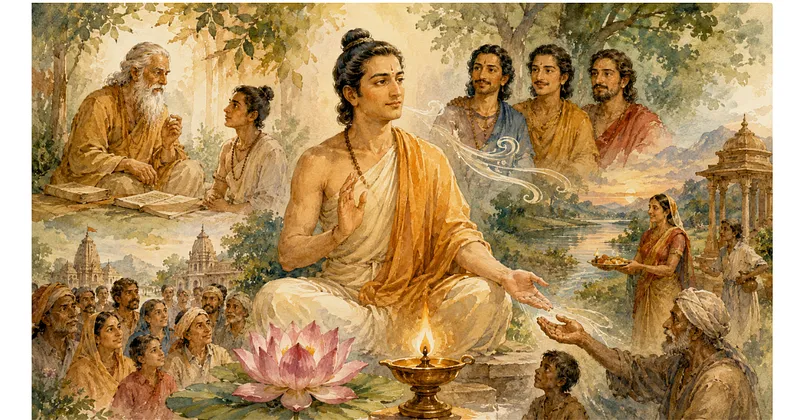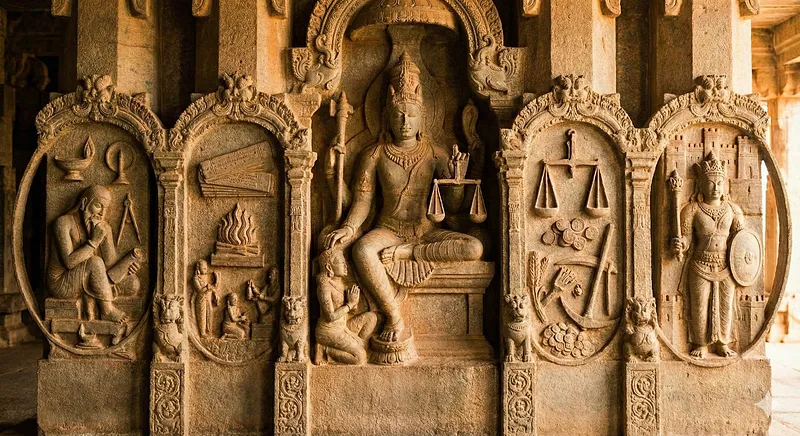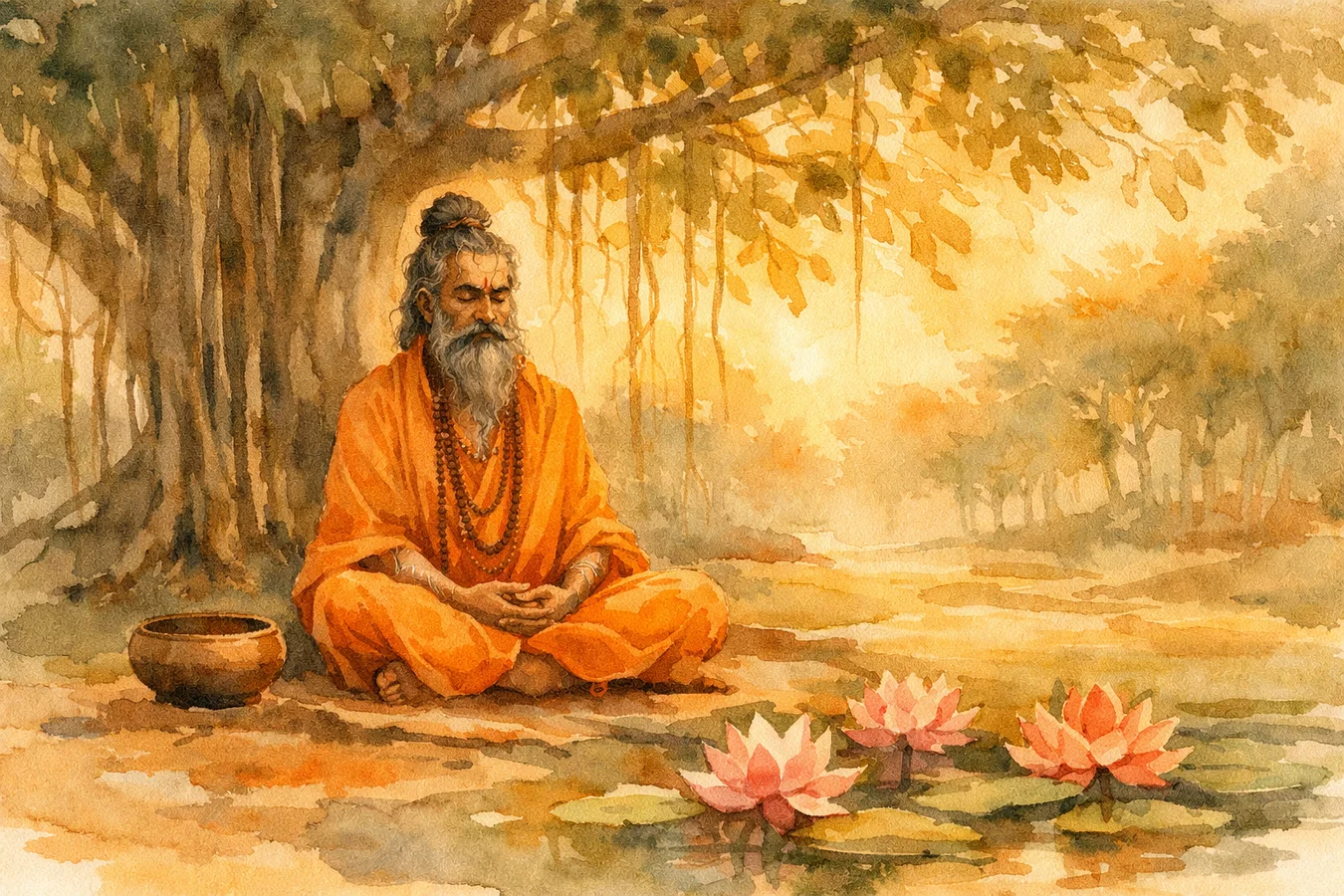
In the spiritual traditions of India, the path of sannyāsa represents the pinnacle of renunciation and inner discipline. The sannyāsī—a wandering renunciate who has transcended worldly attachments—embodies a life devoted entirely to spiritual realization. Drawing from ancient commentarial traditions, this article explores the threefold framework that defines the dharma of a parivrājaka (wandering renunciate): external renunciation, inner virtues, and yogika discipline.
These teachings, preserved through centuries of contemplative practice and scholarly commentary, offer a comprehensive vision of what it means to live as one who has truly let go of the world.
The Foundation: External Renunciation
The first dimension of sannyāsī dharma concerns the visible, outward expressions of renunciation. These are not mere formalities but deliberate choices that reshape one's entire relationship with the material world.
Abandonment of All Undertakings
Sarvārambhaparityāga—the renunciation of all beginnings—stands at the forefront. This principle extends beyond merely giving up worldly pursuits. According to classical commentaries, the sannyāsī abandons even religious rituals and ceremonies not prescribed for their stage of life. This includes traditional yajñas (sacrificial rites) and elaborate worship practices. The emphasis falls on abstaining from actions beyond what is strictly necessary for survival and spiritual practice.
The depth of this renunciation becomes clear when we understand that even actions traditionally considered meritorious—offerings of flowers, sacred grass, or ritual implements—are to be relinquished. The sannyāsī moves beyond the framework of accumulating merit through action, recognizing that attachment to spiritual accomplishments can be as binding as attachment to worldly achievements.
Living on Alms
Bhaikṣāśyaṃ—subsisting on alms—represents more than an economic arrangement. It embodies profound humility and radical dependence on providence. The sannyāsī accepts only what comes spontaneously, without request or demand. This practice cultivates a disposition of gratitude and non-entitlement, breaking the subtle pride that can arise from self-sufficiency.
The classical commentaries emphasize that this food must be obtained through bhikṣā alone—never from stored provisions or specially prepared meals. This discipline ensures that the renunciate remains free from the anxieties of acquisition and storage, living entirely in the present moment.
Dwelling at Tree Roots
Vṛkṣamūlitā—taking shelter at the base of trees—symbolizes complete detachment from constructed comforts. The forest becomes the sannyāsī's dwelling, with nature providing minimal shelter. This lifestyle reinforces separation from human habitation and the social structures that bind ordinary householders. It is a return to simplicity, where the boundary between self and environment dissolves in the absence of walls and possessions.
Non-Possession and Non-Harming
Niṣparigrahatā—non-possession—extends the principle of renunciation into every corner of life. According to the Upādhyāyanirapekṣā commentary, this means total non-acceptance of possessions, including books, mats, and even basic comforts like bedding. The sannyāsī carries only the absolute minimum required for survival, resisting the human tendency to accumulate and claim ownership.
Closely related is adroha—absence of hostility. This represents ahiṃsā (non-violence) in its most subtle form: not merely refraining from physical harm, but cultivating a state where the desire to harm any being—physically, verbally, or mentally—has been completely uprooted. The sannyāsī embodies harmlessness as a natural expression of inner peace.
Equanimity Toward All Creatures
Samatā sarvajantuṣu—equality of vision toward all beings—represents the psychological fruit of renunciation. The sannyāsī sees no fundamental difference between superior and inferior creatures, between those who help and those who hurt. This equal vision transcends conventional hierarchies and personal preferences, recognizing the same divine essence in all manifestations of life.
The Inner Dimension: Cultivation of Virtue
While external renunciation creates the conditions for spiritual practice, inner virtues constitute the psychological transformation that makes renunciation meaningful. Without these internal shifts, outer austerity remains merely an empty shell.
Transcending Dualities
Priyāpriyāpariṣvaṅga—detachment from both the pleasant and unpleasant—marks the beginning of inner freedom. The commentaries describe this as the renunciation of attachment (saṅga) toward both liked and disliked objects or persons. The sannyāsī cultivates a stance of neutrality, observing preferences arise and pass without grasping or rejecting.
Similarly, sukhaduḥkhāvikāritā—remaining unperturbed by pleasure and pain—describes a state where experiences of joy and sorrow no longer provoke emotional fluctuations. The Jayamaṅgalā commentary emphasizes that delight (harṣa) and grief (śoka) cease to arise in response to changing circumstances. This is not emotional numbness but rather a profound equanimity rooted in witness consciousness.
Dual Purity: External and Internal
Sabāhyābhyantaraṃ śaucam—purity both external and internal—recognizes that cleanliness operates on multiple levels. External purity (bāhya śauca) is maintained through physical hygiene practices using earth and water, removing impurities and maintaining bodily cleanliness.
But the tradition places greater emphasis on internal purity (ābhyantara śauca). The Upādhyāyanirapekṣā commentary beautifully describes this as a mental state rooted in compassion and the desire for the welfare of all beings. It represents the cleansing of the mind from impurities like greed, hatred, delusion, jealousy, and pride—the subtle contaminants that cloud perception and bind the soul.
Restraint of Speech and Observance of Vows
Vāgyama—control of speech—represents mastery over one of the most difficult instruments of action. The commentaries describe this as maunaṃ—silence or restraint in speech. The sannyāsī speaks only what is necessary and truthful, or observes complete silence as a spiritual discipline. This practice conserves energy otherwise dissipated through idle talk, gossip, or argumentative discourse.
Vratacāritā—observance of vows—refers to conducting life in accordance with sacred commitments. This particularly emphasizes brahmacarya—celibacy and self-restraint—as well as other disciplines freely undertaken to channel energy toward spiritual realization. Vows provide structure and accountability, transforming abstract ideals into concrete practices.
The Pinnacle: Yogika Discipline and Meditative Absorption
The final dimension of sannyāsī dharma concerns the direct practices of consciousness transformation—the yogika disciplines that lead to realization of the Self.
Withdrawal of the Senses
Sarvendriyasamāhāra—the gathering or withdrawal of all the senses—corresponds to pratyāhāra in classical yoga terminology. The Jayamaṅgalā commentary describes this as alolupendriyatva—freedom from craving or indulgence through the sense organs. The senses, normally turned outward toward objects of desire, are redirected inward toward the Self.
This is not mere suppression but a masterful redirection of attention. The Upādhyāyanirapekṣā commentary notes this as ātmani eva yojanaṃ—the yoking of the senses to the Self alone. Through this practice, the sannyāsī achieves mastery over the instruments of perception.
Concentration and Meditation
Dhāraṇā—concentration—represents the ability to hold the mind or vital energy (prāṇa) steadily in a specific region or on a particular object. The Upādhyāyanirapekṣā commentary quotes a traditional definition: "Holding the breath or mind in a specific place with steady effort, free from strain, is called dhāraṇā." This practice represents manasaḥ nirodha—restraint and focused placement of the mind.
Dhyānayuktatā—steadiness in meditation—builds upon concentration. The commentaries distinguish between two forms of meditation:
-
Kāmya dhyāna (desire-based meditation): Used for material aims, such as influencing others or achieving worldly objectives. This is considered a lower form of practice.
-
Mokṣārtha dhyāna (liberation-oriented meditation): Directed at dissolving the individual self into the Supreme Reality. The commentary offers beautiful formulations: "The universe is pervaded by the Supreme Self—dissolve yourself there" and "Let the mind itself be the object of contemplation, dissolving into its own source."
True meditation for the sannyāsī belongs to the second category—a contemplative absorption aimed solely at liberation, not worldly attainment.
Purity of Inner Disposition
Bhāvasaṃśuddhi—purity of inner disposition—represents the culmination of practice. The Jayamaṅgalā commentary defines this as avicikitsā—absence of doubt—along with inner clarity in intention and attitude. The Upādhyāyanirapekṣā commentary emphasizes this as prāṇiṣu adrohabuddhi—a mind free from the intention to harm any living being.
This purity represents the flowering of all previous practices. When the senses are withdrawn, the mind concentrated, and meditation established, what remains is a consciousness unmarred by impurity, doubt, or ill-will—a transparent awareness resting in its own nature.
The Integrated Path
These three verses paint a comprehensive portrait of the sannyāsī's life—a portrait remarkable for its integration of outer and inner, action and contemplation, discipline and spontaneity. The path begins with visible renunciation: giving up possessions, dwelling in nature, living on alms, and practicing non-violence. These external changes create the necessary conditions for deeper transformation.
The journey continues through the cultivation of inner virtues: transcending preferences and aversions, maintaining purity in body and mind, restraining speech, and observing sacred vows. These practices refine the psychological instrument, making it capable of sustaining higher states of awareness.
Finally, the path culminates in yogika disciplines: withdrawal of senses, concentration, meditation, and ultimate purity of being. Through these practices, the sannyāsī realizes what the tradition calls jīvanmukti—liberation while living. This is one who acts without ego, lives without clinging, and sees the Self in all beings.
The commentarial traditions emphasize that these are not sequential stages but interpenetrating dimensions of a unified life. External renunciation supports inner transformation; inner purity enables deeper meditation; meditative insight reinforces renunciation. Each aspect strengthens the others in a spiral of progressive refinement.
What emerges from these teachings is not a life of mere negation or escape, but a profound affirmation of the human capacity for complete freedom. The sannyāsī demonstrates that it is possible to live entirely in the present, free from the anxieties of acquisition and the burdens of ownership, relating to all beings with equal compassion, absorbed in the direct contemplation of Reality itself.
In an age characterized by endless accumulation, chronic distraction, and pervasive anxiety, these ancient teachings offer an alternative vision—a reminder that simplicity, silence, and stillness remain viable paths to genuine fulfillment. While few may be called to adopt the full discipline of sannyāsa, the principles embedded in these verses speak to universal human aspirations: the longing for freedom from craving, the quest for inner peace, and the search for that which transcends the fleeting pleasures and pains of ordinary existence.
The path of the sannyāsī thus stands as both a radical life choice and a timeless teaching—an invitation to discover what remains when everything unnecessary has been released, and what emerges when the mind turns fully toward its own luminous nature.