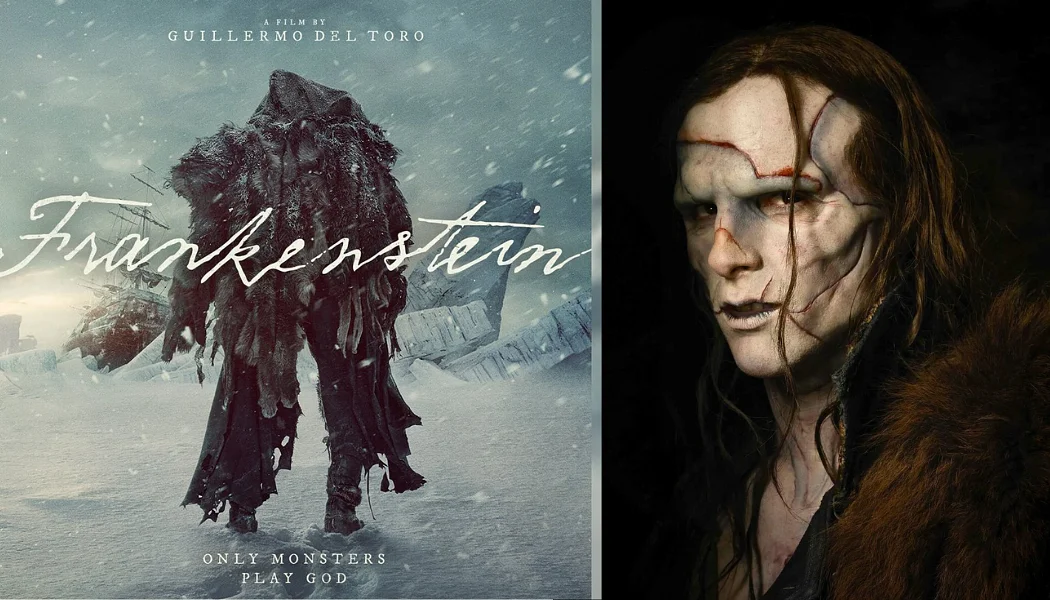
Guillermo del Toro’s Frankenstein reconfigures the narrative from one of transgressive creation to one of ethical abandonment within fractured relational orders. It foregrounds a deeper failure: not the act of making life, but the cI had been awaiting Guillermo del Toro’s Frankenstein in a way that felt less like ordinary anticipation than like the slow return of an unresolved philosophical question. Unlike other films, Del Toro’s tend to arrive as atmospheres. They gather around one’s imagination long before the first frame appears. One does not simply watch his films but inhabits them and afterward finds that they continue to live in thought.
The film’s beginning was measured, almost reverential, as though the scene itself were aware of the burden it carried. And then a quiet unease took shape. It was not fear and not quite dread. It was closer to recognition before the object of recognition had fully declared itself.
What unsettled me was not the creature alone. It was the space of thought the creature opened.
It is common to approach Frankenstein as a story about overreach, about the dangers of transgressing natural or divine limits, about the arrogance of human beings who seek to “play God.” Such readings have the comfort of clarity. They locate the problem in the act of creation itself. Del Toro’s film, however, shifts the ground. The deeper problem is not that Victor creates life. It is what follows from creation, or more precisely, what fails to follow.
When the creature first stirs, the scene is marked not by triumph but by fragility. There is no sense of completion, no intellectual victory, no completed experiment. Victor looks upon what he has made, and in that look, something falters. Intention and outcome break apart. Almost immediately, he withdraws.
That withdrawal becomes the moral center of the film.
The creature does not enter a world prepared to receive it. It enters a vacuum. It is not welcomed, named, instructed, or held within any relation. It is left. In that sense, this is not fundamentally a story about monstrosity. It is a story about abandonment.
Once that shift in emphasis occurs, a different cluster of questions emerges. What does it mean to create something one is unwilling to remain with? What does responsibility look like when it extends beyond intention into consequence? At what point does making become inseparable from the obligation to care? These questions go beyond the narrative. They speak not only to Victor Frankenstein but also to modern forms of creation more broadly: technologies, institutions, systems, and even relationships. The film becomes a meditation on a recurring pattern in modern life: our ability to bring things into existence more quickly than our willingness to sustain relations with them.
As the creature moves through the world, another problem surfaces. It is not only rejected. Its rejection appears nearly inevitable. Something in its form forecloses recognition before recognition can begin. This opens an older and more disturbing question: what allows us to see another being as human, not biologically but morally? What threshold must be crossed before a being is granted care, acknowledgment, and ethical standing?
The creature hovers just beyond that threshold. It is close enough to unsettle us, yet too far for most, to be embraced. In that uneasy proximity, the familiar categories begin to loosen. The monster no longer appears as a clear exception. The human no longer appears as a stable or self-evident category. It begins to seem contingent, dependent on recognition, relation, and conditions that can always be withdrawn. What the film finally stages, then, is not simply the making of a creature, but the conditions under which being is acknowledged at all.
Section I: The Creature and the Question of the Human
Philosophy has repeatedly sought to stabilize the category of the human. It has tried to define it, separate it from the animal, the divine, the mechanical, and the monstrous, and secure it as a meaningful center of moral thought. Yet each attempt reveals a certain instability. The line does not hold as firmly as it promises to.
Rousseau imagined the human in an original state as compassionate and uncorrupted, later deformed by comparison, vanity, and social inequality. Hobbes, by contrast, saw human beings as driven by fear, insecurity, and competition, requiring strong authority to contain mutual violence. These positions are often treated as opposites, but they share a common premise: that there is something identifiable and relatively stable that can be called human nature.
Del Toro’s creature unsettles that premise. It does not enter the world bearing a fixed moral essence. It is not born either innocent or depraved. It becomes what it is through encounter. Its first gestures are exploratory rather than violent. It reaches outward in curiosity. There is something deeply vulnerable in its early movement, something almost childlike. Yet this openness meets resistance almost at once. Hesitation gives way to fear, and fear to rejection.
The creature learns, but what it learns first is not merely what the world is. It learns how the world sees it.
Here Levinas becomes illuminating. For Levinas, ethics begins in the face-to-face encounter with the Other. The face of the other places a claim upon me before deliberation, before rules, before systems. But Frankenstein forces a difficult question into this framework: what happens when the face fails to summon responsibility and instead evokes recoil? The creature’s face does not awaken obligation in those who encounter it. It interrupts it. The ethical relation collapses at the point where it should have begun.
The consequence is severe. The creature is not merely excluded from society. It is excluded from the moral field through which society recognizes obligation.
And yet it feels real. It suffers. It longs. The more closely one attends to the creature, the harder it becomes to deny its inner life. What is alien is not its sentience but its appearance. This pushes Western philosophy toward a question it has often left unresolved: is humanity grounded in essence, or is it constituted through relation?
Indian philosophical traditions approach this question with a different sensibility. The idea of ātman points not to outer form but to an inner principle of sentience, presence, and being. To recognize ātman is to acknowledge that moral significance cannot be reduced to bodily appearance. The narrative worlds of the Itihāsa and Purāṇa are filled with beings whose forms vary widely but whose moral standing is not thereby voided. Vānaras, nāgas, and rākṣasas are not outside the moral universe simply because they are not human in appearance. They act, choose, err, and suffer within a shared cosmos of significance.
Within such a framework, moral worth is not simply determined by form. The creature in Frankenstein appears to belong to this broader field of sentient beings, yet it is denied entry into it. Its form serves as the basis for disqualification. That fact tells us less about the creature than about the limits of our own moral imagination.
If a being can suffer, desire, remember, and seek relation, on what grounds do we deny it humanity? The question remains difficult because it reveals the fragility of the boundary we had thought secure. The creature is not merely a deviation from the human. It is a mirror held up to the contingency of the human.
Section II: Creation as Sacrifice, Puruṣa Sūkta, and the Ethics of Making
One of the most compelling aspects of Del Toro’s film is how it reorients the meaning of creation. In the laboratory scenes, creation feels like mere fulfillment. It feels like an interruption. Not simply an interruption of nature, but of order. The room is full of instruments, measurements, and control, yet it seems to have forgotten something essential. The missing element is not technical. It is relational.
This is where the Puruṣa Sūkta offers a striking counterpoint. In that Vaidika hymn, creation does not occur through fabrication or mechanical assembly. It unfolds through yajña, through sacrifice and offering, and through the transformation of primordial being into world. Puruṣa is not external to creation. Creation proceeds through a profound act of participation. From that offering emerges not only matter but also order, ṛta, the sustaining rhythm through which the cosmos coheres.
The contrast with Victor Frankenstein is philosophically revealing. Victor’s creation is brilliant, but solitary. It is marked by precision and control, but not by offering. It brings life into being without establishing the bonds through which life becomes intelligible and sustainable. Once the creature is alive, Victor withdraws, as though creation were complete once animation had been achieved.
That assumption is precisely what the film interrogates.
Within the vision implied by the Puruṣa Sūkta, creation inaugurates relation. The creator is not finished when the act is done. The act binds the maker to what has been brought forth. Creation carries continuity within it. Victor’s act, by contrast, is severed from continuity. The creature lives, but it is not held within any sustaining order.
That absence becomes clearer when read through the Dharmaśāstra. Dharma is often translated as 'duty,' but the term is broader and deeper. Dharma is that which sustains, upholds, and gives form to relationships. It names not only obligation but order, placement, and the ethical texture of existence. To act is already to enter into dharma. To create is to deepen that entry.
Victor’s failure, then, is not simply that he overreaches. It is that he refuses the dhārmika relation that follows from his own act. He creates a being and then abandons the very bond that would sustain it. The creature is left without recognition, guidance, or placement. Its existence becomes a form of dislocation.
This is why the creature’s later violence should not be read only as a descent into evil. It is also a response to a world that has offered it no stable place within moral order. It is not, by nature, outside cosmic order. It is denied entry into it. The tragedy lies here. Victor sought to create life through mastery, yet the life he creates turns out to require not mastery but relation.
The film widens this insight into a reflection on modernity itself. Ours is an age remarkably adept at creation. We create systems, technologies, platforms, institutions, and increasingly autonomous forms of artificial and biological life. Yet the ethical frameworks that bind creation to care have thinned. Frankenstein begins to look less like a warning against excess and more like a diagnosis of a recurring modern tendency: the ease of making and the difficulty of remaining answerable to what has been made.
Section III: The Aesthetics of the Other
Before any overt violence occurs in Frankenstein, another violence is already at work. It resides in the gaze. The creature appears, and before it can speak, before it can gesture, before it can be known, it is judged.
This judgment is immediate and effective. Something in the creature’s body resists familiar categories. It does not “fit.” The proportions are unsettling, the surface unfamiliar, the face unresolved. Aesthetic disturbance hardens into moral distance.
Kant’s account of judgment helps clarify this. Beauty, for Kant, arises from a felt harmony between imagination and understanding. The beautiful object seems to accord with our faculties. The creature does the opposite. It disrupts harmony. Perception falters. Imagination struggles to assimilate what it sees. Nietzsche deepens the problem by reminding us that judgments of beauty and ugliness are shaped by historical patterns of valuation. What appears ordered and harmonious is often treated as morally elevated, while what appears disfigured becomes suspect.
The creature reveals how fragile this linkage is. It is not rejected first because of its deeds but because of its appearance. Its body precedes its moral biography. The film thereby raises a difficult question: how much of our ethical judgment is covertly governed by aesthetics?
Indian aesthetic theory offers a more transformative framework here. The concept of rasa does not reduce art to pleasing form. It concerns the cultivation of feeling. The spectator is not simply a judge but a participant in emotional and ethical attunement. Among the rasas, karuṇā, or compassion, is especially relevant. Compassion does not arise from beauty alone. It arises from the recognition of suffering. It asks the spectator to remain with what is difficult rather than turn away.
Del Toro’s film invites precisely this discipline of perception. It does not make the creature conventionally beautiful. It asks us instead to revise our gaze. As the viewer stays with the creature, sees its hesitation, longing, and vulnerability, the source of unease begins to shift. The problem no longer seems to lie simply in the creature’s body. It begins to lie within the limits of our own perception.
To see ethically, the film suggests, is not merely to look. It is to remain open to revision.
Section IV: Loneliness, Recognition, and the Desire to Belong
If the creature’s body is the site of rejection, its loneliness is the condition in which that rejection settles into being. Its suffering is not only that it is alone. It is that it remains unacknowledged. Again and again, the film shows the creature watching from a distance: a shared meal, a human exchange, a small scene of ordinary belonging. These moments are devastating because they reveal exclusion. The creature is close enough to witness the relationship, but not close enough to enter it.
Sartre’s account of the gaze is useful here. To be seen is to be placed within another’s world, to become legible within a field of meaning beyond oneself. But the creature’s predicament is harsher. It is seen and refused. The gaze does not confer standing but negates it.
Camus wrote of the absurd as the confrontation between human longing and a silent world. The creature’s world is not silent. It answers, but with rejection. And yet the longing to belong persists. That persistence is one of the most moving features of the film. The creature does not immediately collapse into indifference. It continues to hope for recognition.
Indian thought again offers a suggestive contrast through the idea of darśana. In temple practice, to see is also to be seen. The encounter is reciprocal. Presence is stabilized through acknowledgment. The creature is denied such reciprocity. No gaze meets it without fear. No relation secures its place in the world.
Its loneliness is therefore not merely emotional. It is ontological. It exists, but its existence is not affirmed. That is why its violence, when it comes, feels less like origin than distortion. Denied ordinary languages of belonging, the creature turns to destructive forms of expression. The tragedy lies not simply in what it becomes, but in the fact that it is left with no viable language through which to express its need for recognition.
Section V: Society and the Making of the Monstrous
As the film progresses, it becomes harder to locate monstrosity solely in the creature. Monstrosity begins to appear as a social production rather than a natural fact. The creature does not arrive as a monster. It is received as one.
Mary Douglas showed how societies maintain order by drawing lines between what belongs and what does not. What falls outside these classificatory systems becomes threatening because it destabilizes the order itself. The creature inhabits such a threshold. It is neither fully assimilable nor fully outside. For that reason, it becomes a site of anxiety.
Girard’s account of scapegoating sharpens the point. Communities often resolve internal unease by projecting it onto a figure whose exclusion promises restored order. The creature gradually becomes such a figure. It is treated not only as a being but also as a problem to be expelled.
The film shows how this process unfolds through ordinary acts: a closed door, a recoiling body, a refusal to listen. These are small acts, but repetition gives them force. Over time, they shape the creature’s understanding of itself. Violence emerges here not simply as a trait but as a learned language within a social field that has narrowed every other possibility.
This insight resonates beyond the narrative. Societies regularly produce outsiders through the reading of bodies, names, occupations, lineages, accents, and inherited markers of belonging. The film’s deepest claim may be that the monster is not outside society. It is constituted within it.
Section VI: Time, Tragedy, and Cosmic Order
By the film's final movement, an uncomfortable quiet settles in. Recognition comes, but it comes too late. Aristotle called this anagnorisis: the moment in tragedy when truth becomes visible, along with the painful knowledge of what might have been otherwise had it been seen earlier. Victor begins to recognize the creature not as a failed object but as a being bound to his own abandonment. The creature, too, acquires a terrible recognition of what it has become.
But recognition does not become reconciliation.
The film’s temporality is therefore deeply tragic. Each action narrows what can follow. No return to the first moment is possible. The irreversibility of this sequence stands in tension with Hindu cosmological understandings of cyclical time, in which creation, preservation, and dissolution recur within a larger rhythm. In such a view, what is broken may re-enter order in a different way. But Frankenstein resists such restoration. Its world is one in which a relationship, once fractured, does not easily return to wholeness.
That is why the absence of ṛta matters so much. Creation here is severed from sustaining rhythm. The creature comes into being without ritual incorporation, ethical placement, or cosmological holding. The result is temporal dislocation. The creature exists in a present shaped by repetition: rejection, longing, response. Victor’s late awareness offers no new beginning. It reveals only the depth of what has already been neglected.
The film leaves us not with the question of whether tragedy could have been avoided in some abstract sense, but with a more demanding one: under what conditions might recognition arrive in time?
Conclusion: A Philosophical Return
When the film ended, the room remained outwardly unchanged, yet it no longer felt the same. The light was the same, the furniture unchanged, the silence intact. But something had shifted inwardly. The creature watching from a distance, Victor’s faltering gaze, and the repeated moments in which a relation might have been possible but was not, these remained with me.
What lingered was not a neat interpretation but a set of questions. Questions about creation as relation rather than mere production. Questions about responsibility as sustained presence rather than abstract intention. Questions about recognition and the fragile conditions under which a being is admitted into the moral world.
It is always possible to return Frankenstein to the familiar language of hubris and forbidden ambition. Del Toro’s film makes that return harder. It shifts our attention from the act of creation itself to the ethical burden that begins once creation occurs. In a world increasingly defined by its ability to generate new forms of life, intelligence, and social structure, that shift matters.
The pressing question is no longer whether human beings can create. It is whether we know how to remain in relation to what we create.