There is a quiet crisis unfolding in modern marriages. Divorce rates climb steadily across the world, couples report feeling emotionally disconnected even while sharing the same roof, and the institution of marriage itself is increasingly described as a "contract" to be renegotiated or dissolved when inconvenient. Relationship therapists speak of "emotional unavailability," "the invisible workload," and "loss of shared purpose" as the leading causes of marital breakdown. What is striking is that these failures are not failures of love alone — they are failures of structure, of ritual, and of shared meaning.
Centuries before modern psychology coined its vocabulary, the Indian political and ethical philosopher Kāmandaka had already mapped the terrain of a flourishing household life in his Nītisāra. In the second sarga, two compact verses outline the duties of the gṛhastha — the householder — with a precision that feels less like religious prescription and more like distilled wisdom about what actually makes domestic life sustainable and dignified. Strip away the ritual nomenclature, and what emerges is a framework startlingly relevant to the married couple of today.
Ritual as Routine: The Forgotten Architecture of Home Life
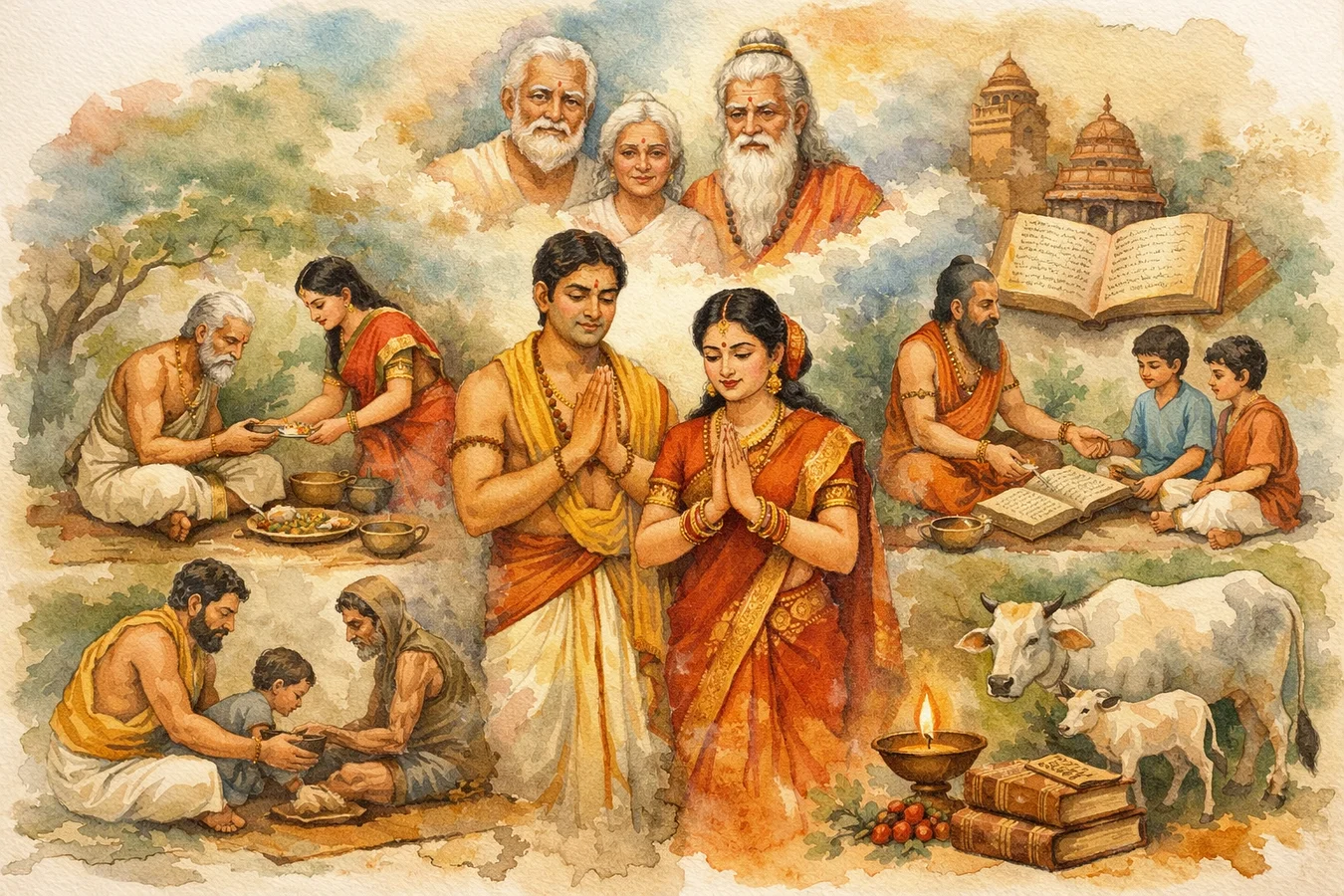
The first principle Kāmandaka places at the center of the householder's life is the Agnihotra — the daily fire offering. For those not steeped in Vaidika tradition, this can sound archaic. But consider what it actually represents in structural terms: a daily shared practice, performed at a fixed time, that anchors the household in something larger than itself.
Modern research on marital satisfaction consistently highlights the role of shared rituals — a morning coffee together before the world intrudes, a weekly dinner without screens, a nightly conversation before sleep. These are not superstitions. They are the connective tissue of a shared life. The Agnihotra was, in essence, the ancient equivalent: a non-negotiable daily act that said, this home has a centre, and we return to it together.
What contemporary couples often lose — especially in the relentless productivity culture of dual-income households — is precisely this. There is no altar, no fixed point of return. Each partner becomes an island of individual schedules and personal optimization. Kāmandaka's insistence on ritual is not a call to light fires but a call to build shared rhythm into married life, to resist the centrifugal force of modern busyness.
Earning With Integrity: The Ethical Foundation of Domestic Peace
The second principle — jīvanam ca svakarmabhiḥ, earning one's livelihood through one's own prescribed occupation — speaks directly to the question of self-respect and dignity within a household. Each person, regardless of social role, is expected to contribute meaningfully and honestly. The household is not a refuge from ethical life; it is where ethical life is most visibly tested.
This is a principle that resurfaces with urgency today. A marriage corroded by financial dishonesty, by one partner's exploitation of the other's labour, or by a persistent sense that one's own contribution is devalued or invisible — is a marriage under chronic stress. The extraordinary rise in financial conflict as a driver of divorce is well-documented. Kāmandaka's framework insists that economic life within a household must be grounded in integrity and reciprocity. Each member contributes according to their capacity; none exploits the other.
More profoundly, the phrase svakarmabhiḥ — through one's own work — implies a dignity of self-sufficiency. Neither partner should feel like a financial burden, nor weaponize the other's dependence. In this sense, the ancient prescription of vocational integrity translates directly into the modern principle of mutual economic respect.
Conjugal Life as Discipline, Not Deprivation
Perhaps the most misread aspect of classical Indian ethics is its guidance on conjugal relations, which is too often presented as restrictive or prudish. Kāmandaka's framing is actually something quite different. The text prescribes that physical intimacy be with one's lawfully wedded, healthy partner, and that it be guided by consideration of time and circumstance — specifically, avoiding sacred days and being attentive to the wife's physical state.
Read past the specific ritual calendar, and the underlying principle is one of mindful attentiveness to the other person. Physical intimacy, the text insists, should not be driven purely by personal desire without regard for the partner's readiness, health, or emotional state. The concept of ṛtu-kāla — appropriate time — is not merely biological; it implies that one must be present and responsive to the other.
This is precisely the language of modern intimacy research. John Gottman's decades of marriage studies identify bids for connection and responsiveness to a partner's emotional and physical states as among the strongest predictors of long-term marital happiness. The failure of modern couples is very often not a failure of attraction but a failure of attentiveness — treating the partner as an always-available resource rather than a person whose needs must be noticed and honoured.
Kāmandaka's approach reframes conjugal life as something that must be earned through attentiveness, not assumed as a right. That is not a restriction. That is respect.
The Five Pillars of the Householder Facing Outward
The twenty-sixth verse turns from the interior of the marriage to its relationship with the world. The gṛhastha is charged with worship of gods, ancestors, and guests; with compassion toward the needy; and with grounding one's life in the wisdom of received ethical tradition. Each of these, read carefully, is a prescription against the pathologies most damaging to modern marriages.
Worship of ancestors (pitṛpūjā) is, in psychological terms, an acknowledgement of continuity — a marriage is not two isolated individuals but two family histories, two lineages of experience and wound and gift. Modern couples who have no practice of acknowledging where they came from — no śrāddha of any kind, metaphorical or literal — often find themselves blindsided by inherited patterns of behaviour they never examined. The ancient practice of ancestor-remembrance is, at its core, a practice of intergenerational self-awareness.
Hospitality to guests (atithipūjā) preserves the household from becoming a sealed, self-referential unit. One of the quieter disasters of contemporary marriage is the couple that becomes entirely self-enclosed, losing friendships, withdrawing from community, circling each other with mounting intensity until every frustration becomes existential. The ancient insistence that the home must remain open to the world — that the guest must be honoured — is a safeguard against this suffocating insularity.
Compassion toward the needy (dīna-anukampanam) points outward still further. A household with shared purpose beyond itself — whether that is care for elderly parents, volunteering, mentoring younger people, or community work — is a household with a reason to exist beyond individual happiness. Research on what psychologists call "self-transcendent" purpose consistently shows it as a buffer against the narcissistic grievance-collecting that destroys many modern partnerships.
Scriptural Grounding and the Loss of Shared Ethical Language
The final principle of the twenty-sixth verse — śruti-smṛti-artha-saṃsthānam, grounding one's life in the meanings of received ethical wisdom — addresses what may be the deepest wound of contemporary marriage: the absence of a shared moral vocabulary.
Modern couples frequently enter marriage from entirely different ethical frameworks, shaped by different families, cultures, and individual philosophies, having never discussed what they actually believe about loyalty, sacrifice, forgiveness, or the proper ends of a shared life. The ancient householder was embedded in a tradition — not always comfortable or without its inequities, but a tradition that gave both partners a common reference point, a shared language for navigating conflict and making meaning of difficulty.
Today, many couples substitute therapy for tradition, which is valuable but incomplete. Therapy can name what has broken; it cannot always supply what was never there — a shared vision of what marriage is for. Kāmandaka's insistence on scriptural grounding is, translated to secular terms, a call for couples to consciously build a shared ethical language — to decide together what they believe about commitment, about forgiveness, about how to handle failure, before crisis forces the question.
What the Verses Are Really Saying
Taken together, these two verses from the Nītisāra sketch a portrait of a household that is simultaneously inward-disciplined and outward-generous: anchored in shared ritual and honest livelihood, attentive within the intimacy of the marriage, and radiating care outward toward ancestors, guests, the poor, and the larger moral tradition.
This is not a household sustained by romance alone, nor by legal contract alone. It is sustained by practice — daily, repeated, embodied choices that build a life together over time. The Saṃskṛtaword gṛhamedhin — the true householder — is notably distinct from simply vivāhita, the married man. A gṛhamedhin is one who actively maintains the household as a sacred and social unit. The word implies agency, not mere status.
The crisis of modern marriage is in no small part a crisis of this maintenance. We enter marriages expecting them to sustain themselves on the strength of initial feeling, and we are perpetually surprised when they require, instead, the kind of careful, unglamorous, daily tending that Kāmandaka describes. The fires of the Agnihotra did not stay lit by themselves. Neither do the fires of a household.
The ancient teacher was not handing down restrictions. He was handing down a practice manual — and the practice it describes is one of constant, conscious, outward-facing, inward-disciplined love. That is not a relic. That is still the work.