There is a quiet crisis unfolding in the lives of people who have spent decades being indispensable. The executive who cannot stop checking emails on vacation. The retired surgeon who grows visibly smaller without a scalpel in his hand. The mother whose identity dissolves the moment her last child leaves home. In each case, the problem is not one of resources or health — it is the absence of a framework for withdrawal. Modern civilization, for all its sophistication, has never quite figured out how to retire gracefully. We know how to accumulate. We have almost no idea how to let go.
Kāmaṇḍaka's Nītisāra offers something unexpectedly urgent. The second sarga of this text, which draws heavily on the older tradition of the four āśramas (stages of life), describes in considerable detail the life of the vānaprastha: the forest-dweller. Verses 27 and 28 lay out the disciplines of this third stage of life with the kind of precision we associate with a good operating manual. And if we resist the temptation to read these verses as museum pieces — as instructions for a vanished world of deer-skins and sacred fires — we find something remarkably alive in them.
The Third Stage as a Design Principle
The classical Hindu framework divided life into four stages: brahmacarya (studentship), gārhasthya (householdership), vānaprastha (forest-dwelling), and sannyāsa (complete renunciation). The logic was architectural. Each stage had its own obligations, its own textures, and — crucially — its own moment of completion. Life was not meant to be one long undifferentiated grind from birth to death. It had chapters, and the chapters had endings.
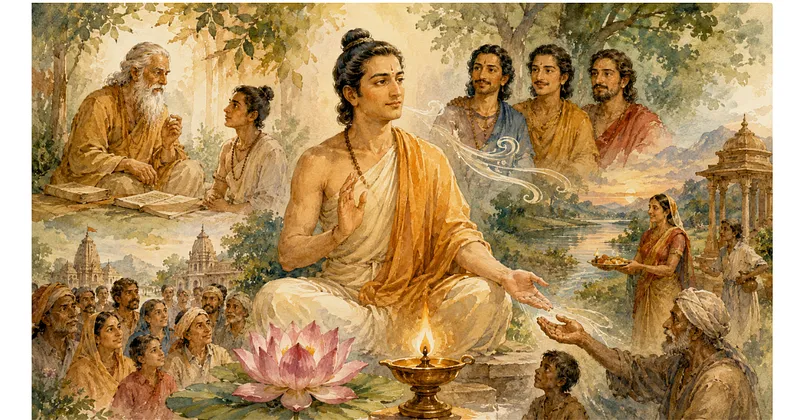
The vānaprastha stage was the designed transition between the world of doing and the world of being. After a lifetime of managing a household, raising children, discharging social obligations, and participating in the economy of the community, the individual was expected — not merely permitted, but expected — to begin the long process of disentanglement. The forest, in this schema, is not a place of defeat or exile. It is a place of graduation.
Kamandaka, writing within this tradition, is doing what all good political and ethical thinkers do: he is translating the inherited wisdom of his culture into a form that can be practically applied. The Nītisāra is fundamentally a text about governance and conduct. Its treatment of the āśrama system reflects a conviction that ordered withdrawal from power and activity is not a personal indulgence but a civic and moral necessity. A world in which no one ever retires — in which the old never make room for the young, in which accumulated authority is never surrendered — is a world in chronic dysfunction. The forest-dweller's retreat is, in this sense, a political act.
What the Verses Actually Prescribe
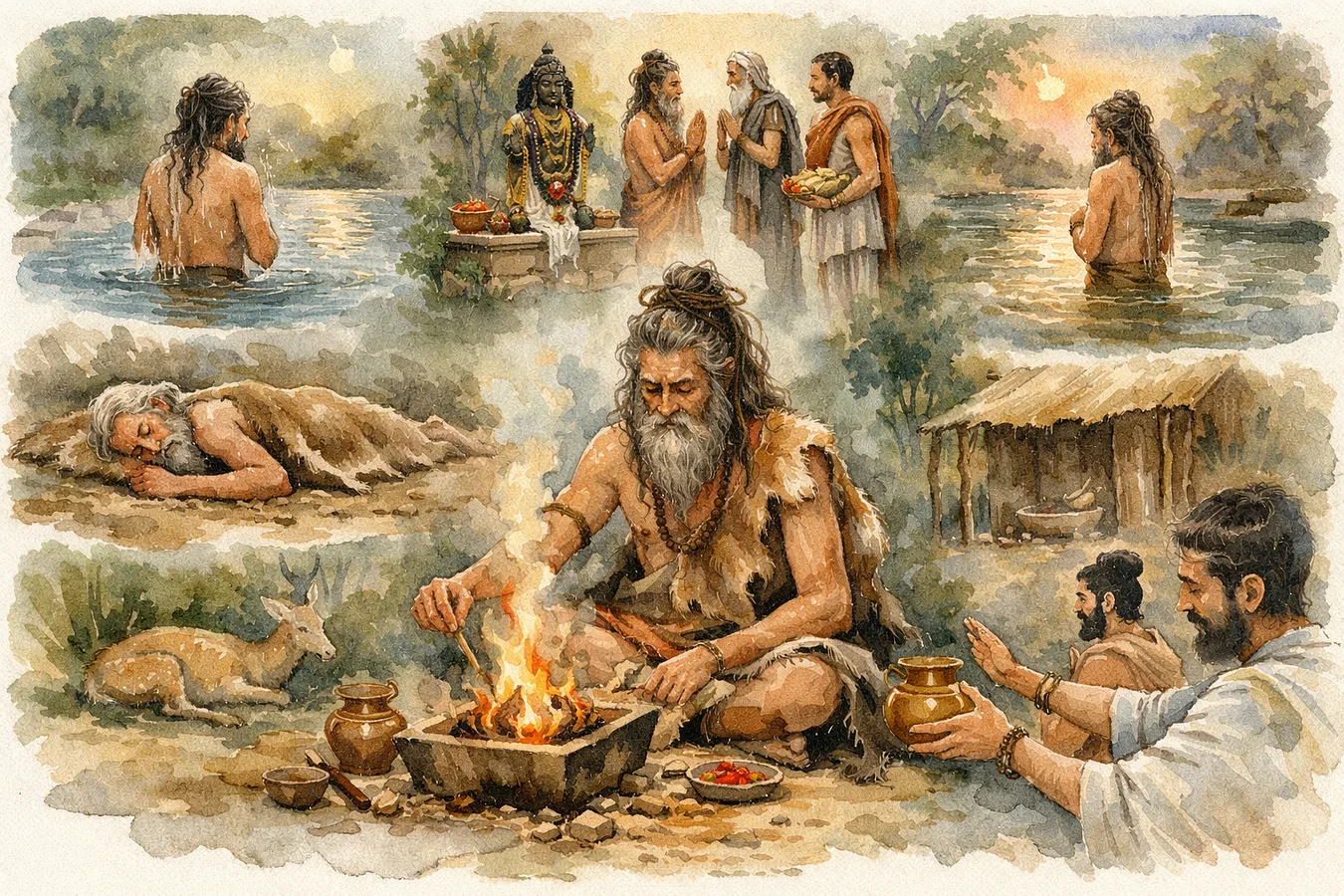
Verse 27 opens with jaṭitvam — the letting-go of groomed hair, the surrender of the careful self-presentation that active social life demands. This is a detail that rewards reflection. The vānaprastha stops performing for an audience. The matted locks are not a fashion statement; they are an announcement that the business of impression management is over. In a culture saturated by personal branding, LinkedIn profiles, and the relentless curation of one's public image, jaṭitvam reads almost as a manifesto.
The verse then specifies that the Agnihotra ritual — the daily fire offering — must be continued. This is the detail that saves the whole prescription from becoming mere escapism. The vānaprastha does not abandon all responsibility. He carries with him the sacred obligations that formed the core of his earlier life. He simply refuses to carry the rest. This is a crucial distinction: withdrawal is not abdication. The forest-dweller is not checked out. He has identified what is essential and shed what is merely habitual.
Bhūśayyā — sleeping on the bare ground — and ajina-dhāraṇam — wearing a deer-skin — are the verse's prescriptions for radical simplicity in material life. The commentarial tradition clarifies that these practices are about removing the cushioning, literal and metaphorical, that dulls one's sensitivity. There is something here that resonates with what psychologists sometimes call voluntary discomfort: the deliberate reduction of comfort as a way of restoring one's relationship with the essentials. The retiree who downsizes, who gives up the corner office and the company car, not because they must but because they choose to, is practicing a version of this.
The dietary prescriptions — water, roots, wild rice, and fruits — are even more pointed. Both commentaries stress that the vānaprastha must give up cultivated food: anything that depends on the apparatus of agriculture, trade, and domestic cooking. This is, symbolically, a severance from the economy of production and consumption that defined the householder's life. The contemporary parallel is not literal — nobody is suggesting retired executives forage for berries — but the principle is profound. At some point, one must step out of the cycle of producing and consuming that has organized decades of one's existence. The question of what you eat, in the context of these verses, is really a question of what systems you are still entangled in and which of those entanglements are now unnecessary.
Verse 28: The Inner Work of Withdrawal
If verse 27 describes the external conditions of the vānaprastha's life, verse 28 turns to the internal disciplines. Pratigraha-nivṛtti — renouncing the receipt of gifts — is perhaps the most psychologically sophisticated element of the whole prescription. The ability to receive, to be the beneficiary of others' generosity and labor, is central to the householder's identity. Parents receive the love and care of their children. Executives receive the deference of their staff. Community leaders receive the trust and resources of their communities. The vānaprastha gives this up — not out of ingratitude, but as a necessary step toward a different kind of freedom. Dependency, even gracious dependency, keeps one tethered.
The instruction around vratacāritā — the keeping of vows, including celibacy — is interesting precisely because the commentaries acknowledge that the vānaprastha may still be living with his wife. The point is not physical separation but a transformation of the quality of one's attachments. The relationship continues; the possessiveness and urgency that can color intimate life in its earlier phases are meant to be gradually released. This is, in essence, a prescription for what we might now call non-attachment within relationship — a concept that has found its way into both couples therapy and contemplative practice.
Triḥ-snāna — bathing three times daily at dawn, noon, and dusk — enforces a rhythm structured not by appointments and deadlines but by the movements of the sun. This reorientation of time is one of the most radical aspects of the vānaprastha discipline. The householder's time is organized around obligation and productivity. The forest-dweller's time is organized around nature and inner practice. The shift from one to the other is not automatic; it requires a new set of anchors, a new scaffolding for the day. Many people who struggle in retirement are struggling precisely with this: the sudden collapse of a temporal structure that had organized their entire adult life.
Finally, deva-atithi pūjā — the continuing worship of gods and the honoring of guests — establishes that the forest-dweller has not abandoned the relationship. He has changed its nature. The guest who arrives in the forest is not a contact to be networked or a favor to be leveraged; she is to be received as sacred. The deities to be worshipped are not petitioned for worldly benefit; they are to be honored as an ongoing practice of gratitude and attention. This is an active life of a different quality — presence without agenda.
The Forest as a State of Mind
The contemporary relevance of these verses does not depend on anyone actually going to a forest. The forest is a metaphor for the condition of productive withdrawal: being somewhere other than the center of things, not in order to be irrelevant, but in order to see more clearly. Many of the wisest transitions in public life have followed this structure. The scientist who steps back from leading a lab to write the book that synthesizes a career's worth of insight. The politician who leaves office and finds, in the absence of power, a more genuine kind of influence. The parent who releases control over grown children and discovers, for the first time, a real friendship with them.
What Kāmaṇḍaka's Nītisāra offers — and what makes these two verses worth sitting with seriously — is a framework that takes the transition out of active life as seriously as it takes the active life itself. The same intelligence that was applied to statecraft, to the management of a household, to the raising of children, must now be applied to the art of stepping back. This is not a diminishment. It is, the text insists, a discipline with its own rigors, its own beauty, and its own indispensability.
The matted hair is grown with intention. The fire is still kept. The roots and fruits are gathered with care. The guest is still welcome. The vānaprastha is not absent from the world. He has simply changed his relationship to it — and in doing so, he models for everyone around him what it looks like to age without grasping, to release without collapse, to step back without disappearing.
In an era that has made a near-religion of productivity and relevance, that is a deeply countercultural act. It may also be one of the most necessary ones.