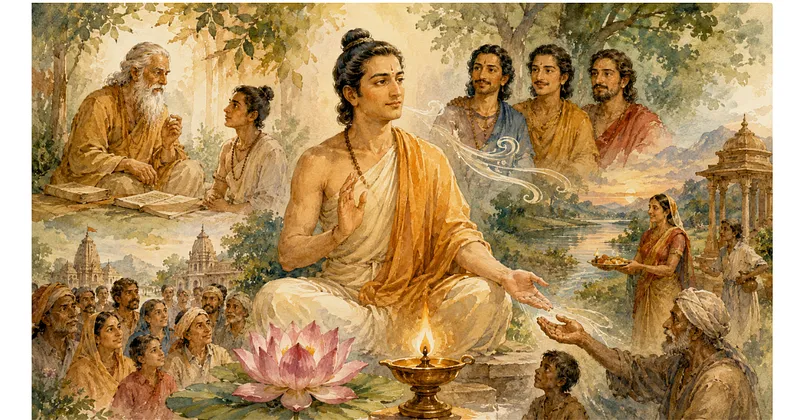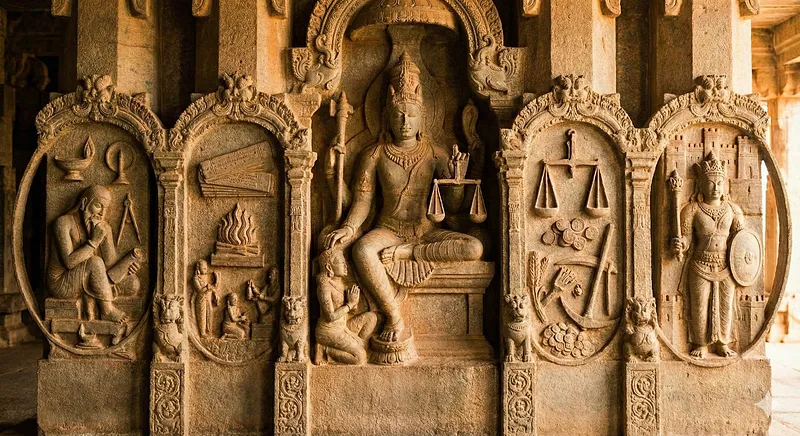
Scroll through any college campus forum today and you will find the same recurring anxieties: distraction, purposelessness, burnout, the creeping sense that four or five years of higher education are slipping by without leaving any real mark on the person living through them. Students have access to more information than any generation in history, yet the complaint of not knowing how to be a student—how to actually inhabit that role with intention—seems more common than ever.
It is in this context that a Saṃskṛta political treatise speaks with surprising directness. Kāmandaka's Nītisāra is best known as a manual of statecraft, a successor to Kauṭilya's Arthaśāstra. But its second chapter steps back from kings and courts to address something more foundational: what it means to be a student, and what disciplines make that time of life genuinely transformative.
Three verses in particular (22, 23, and 24 of the second sarga) lay out, with remarkable precision, the duties of the brahmacārī—the student in the Vaidika educational system. Read without prejudice, these verses are not merely a religious prescription. They are a philosophy of formation.
The Core Idea: Studenthood Is a Vocation
The first and most radical claim of this section is that being a student is not a passive condition—it is an āśrama, a recognized stage of life with its own dharma, its own set of duties and disciplines. The word āśrama itself carries the sense of a place of exertion, of effort. Studenthood, in this framework, is something you do, not merely something you are while waiting to become an adult.
This reframing alone is worth sitting with. Modern culture tends to treat the student years as a kind of holding pattern—education as preparation for "real life." Kāmandaka inverts this. The student phase is not pre-life. It is a complete and demanding life in itself, with its own integrity and its own measures of success.
Seven Disciplines, and What They Mean Today
Verse 22 lists the practical duties of the brahmacārī. Let us take them one by one, not as antiquarian curiosities, but as principles that carry genuine weight.
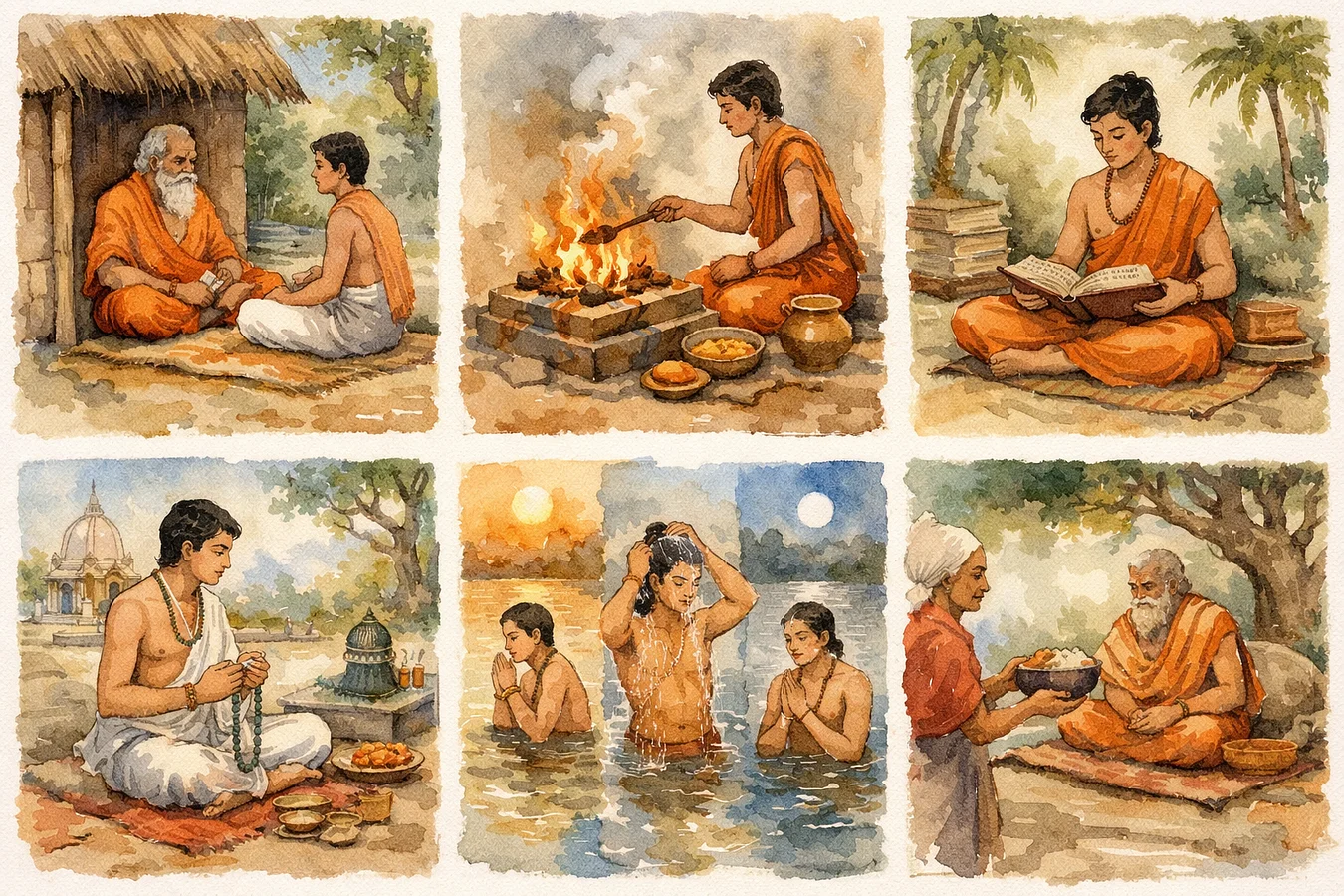
Gurau vāsaḥ — Live close to your teacher. The ideal of the gurukula was residential precisely because learning was understood to be more than the transfer of information. It was observational, relational, environmental. You absorbed not just what the teacher said but how they thought, how they handled difficulty, how they moved through the world. The modern equivalent is not simply attending lectures. It is finding mentors, sitting in office hours, not because you need something, but because proximity to a developed mind is itself an education. It is choosing, wherever possible, to be in rooms where mastery is present.
Agni-śuśrūṣā — Tend the sacred fire. The brahmacārī was responsible for maintaining the ritual fire—building it, feeding it, ensuring it did not go out. As a daily discipline, this cultivated attentiveness and a sense of custodianship over something larger than oneself. For a student today, the equivalent might be understood as stewardship: of a project, a practice, a community, a skill. It is the habit of showing up for something consistently, not because you feel like it on a given morning, but because it is your responsibility and things will degrade if you do not.
Svādhyāya — Daily self-study of one's own branch. The commentary specifies that the student studies the particular śākhā (branch) of the Veda they have undertaken—not everything, but their thing, deeply. This is a rebuke to the anxiety of breadth that plagues many students today, the compulsive accumulation of courses, skills, and credentials that produces wide shallowness rather than genuine competence. Svādhyāya asks you to go deep into what you have chosen, to return to it daily, and to develop genuine intimacy with a body of knowledge.
Vratacāraṇam — Observing your vows. Vows here refer to the code of discipline the teacher prescribes—celibacy, simplicity, truth-telling, and moderation. At its core, this is about the relationship between self-regulation and intellectual growth. Kāmandaka's implicit argument is that you cannot think clearly when you are constantly at the mercy of appetite. The student who cannot say no to anything—not to distraction, not to comfort, not to social obligation—cannot build the sustained attention that serious learning requires. Whatever your personal code, the principle holds: identify it explicitly, and keep it.
Trikāla-snāna — Bathe three times a day. Ritual bathing at dawn, noon, and dusk—the three sandhyās, the junctions of the day—was not merely about hygiene. It was about rhythm. It structured the day around natural transitions, marking the passage of time with a physical act of renewal. Students who have no structure to their day—who sleep arbitrarily, eat arbitrarily, work when the mood strikes—know intuitively what this discipline addresses. The body's rhythms and the mind's capacity for concentration are not independent. Regular, intentional rhythm in daily life is not a luxury; it is a cognitive tool.
Bhaikṣya-bhojana — Eat only what you have gathered through alms. The brahmacārī collected food from a single household's alms—not from many, not from indulgence, not from desire. He ate what was given, not what he craved. This practice cultivated humility, gratitude, and detachment from consumption. The contemporary resonance is less about literal alms and more about the discipline of sufficiency: learning to distinguish genuine need from appetite-driven want, and not allowing the pursuit of comfort to become the organizing principle of your life.
Gurau prāṇāntikī sthitiḥ — For the deeply committed, remain with the teacher until the end. This final duty applies specifically to the naiṣṭhika brahmacārī—the one who chooses lifelong celibacy and study. It is the most demanding form of commitment: not a fixed-term course of study, but an open-ended devotion to learning as such. Most students will not choose this path, nor are they expected to. But the ideal points to something important: that at the apex of intellectual seriousness is the willingness to give up the comfortable exit, the defined endpoint, the certainty of graduation. Some forms of learning are not finished projects. They are how you choose to live.
The Wisdom of Alternatives
Verses 23 and 24 of the sarga are equally interesting for what they reveal about the tradition's attitude toward flexibility. If the teacher is absent, the student may continue with the teacher's son; failing that, with a fellow student of the same discipline. And if the student does not wish to continue as a lifelong brahmacārī, transition to the next stage of life is not a failure—it is a legitimate choice, explicitly sanctioned.
This is a tradition that takes discipline seriously without being punitive about it. The framework is demanding, but not totalizing. It recognizes that people have different callings, different capacities, different seasons of life. The student who completes their studies and enters the householder stage is not a dropout from the ideal—they are following their own svadharma, their own appropriate path.
The word kāmataḥ—"by one's own desire" or "voluntarily"—appears in this context with full dignity. You may choose to leave brahmacarya. The system respects that choice. What it does not respect is the student who neither commits fully to the present stage nor transitions honestly to the next—who lingers in a kind of purposeless in-between, doing neither with intention.
What the Brahmacārī Ideal Offers Us
No one is suggesting that students today should beg for their meals or sleep on their professor's couch. The gurukula as a social institution belongs to a specific historical and cultural context that cannot simply be transplanted.
But the structure beneath these verses—the insistence on proximity to mastery, on daily practice, on self-discipline, on the structuring of time, on simplicity as a cognitive strategy, on committed presence in a single stage of life before moving to the next—this structure is not historically parochial. It is, in many respects, what every serious tradition of learning has independently discovered.
The student years are among the few periods in life when the primary obligation is to become: to form the habits of mind and character that will carry everything else. Kāmandaka understood this with unusual clarity. The brahmacārī's disciplines were not arbitrary austerities. They were technologies of formation, carefully calibrated to produce not just a learned person, but a disciplined, humble, attentive, and purposeful one.
That is still, after centuries, a good description of what education is for.