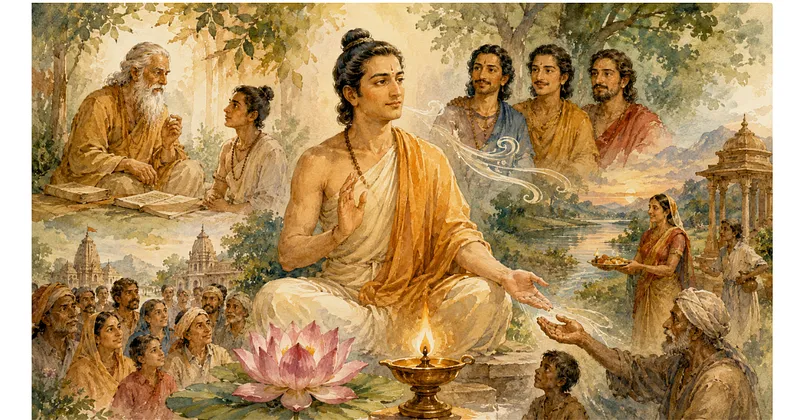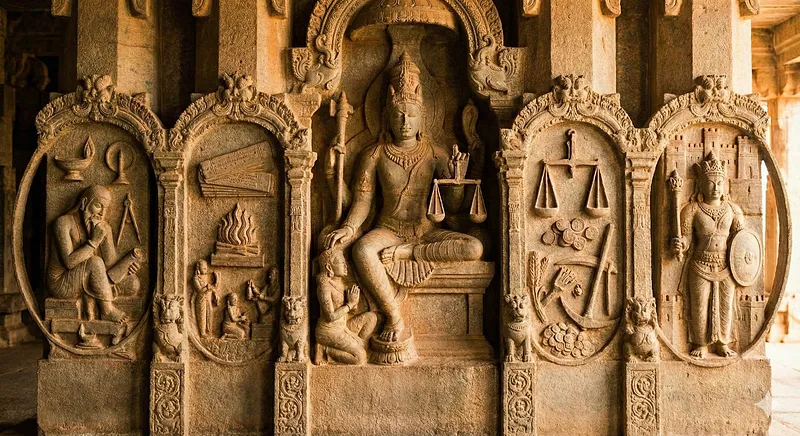
In an era where conversations around purpose-driven work, role specialization, and the ethics of profession dominate corporate boardrooms and policy seminars alike, an ancient Saṃskṛta treatise offers a surprisingly structured — and philosophically rich — framework for thinking about vocation. The Kāmandakīya Nītisāra, a foundational text of Indian political and social philosophy, dedicates careful attention not merely to statecraft, but to the dhārmika grounding of every human occupation. Three verses in particular — verses 19, 20, and 21, of the 2nd Sarga — articulate a theory of vṛtti (livelihood) that is far more nuanced than it first appears, and far more relevant than one might expect.
The Brāhmaṇa's Vocation: Knowledge as Responsibility
Verse 19 opens with a triad that defines the vṛtti of the jyeṣṭha-varṇin — the senior-most varṇa, the Brāhmaṇa:
याजनाध्यापने शुद्धे विशुद्धिः च प्रतिग्रहः । वृत्तित्रयम् इदं प्रोक्तं मुनिभिर्ज्येष्ठवर्णिनः ॥
Yājana-adhyāpane śuddhe viśuddhī ca pratigrahaḥ | Vṛtti-trayam idaṃ proktaṃ munibhir jyeṣṭha-varṇinaḥ ||
Three legitimate occupations are enumerated: yājana (conducting Vaidika rituals for others), adhyāpana (teaching the Vedas), and pratigraha (the acceptance of gifts). These are described as asāmānya-dharma — duties that are not general or universal but exclusive to this particular role. Critically, both the Jayamaṅgalā and Upādhyāyanirapekṣā commentaries insist on the centrality of śuddha — a quality of purity in conduct, discipline, and personal integrity — as the essential qualifying condition. Without it, these vocations lose their legitimacy.
The word viśuddhi applied specifically to pratigraha is telling. Receiving gifts — what might look simply like compensation — is permissible only when the receiver is untainted, not fallen from dharma, and free from corruption. The commentaries further emphasize that yājana and adhyāpana must not be performed for profit alone (artha-mātra), but in a spirit of dhārmika selflessness. This is not merely idealism. It is a structural argument: the custodian of knowledge and ritual bears a fiduciary responsibility to society, and the moment that responsibility becomes purely transactional, the role is compromised at its root.
The parallel with modern professions built around public trust — medicine, law, education, the judiciary — is not incidental. We recognize today that a judge who dispenses justice only for compensation, or a teacher who teaches only for salary, has already failed something essential in their vocation. Kāmandaka, drawing from the sages (munibhiḥ proktam), had already theorized this distinction.
The Kṣatriya's Vocation: Protection as Dharma, Not Just Profession
Verse 20 turns to the rājanya — the ruler, the wielder of śastra:
शस्त्रेणाजीवनं राज्ञो भूतानां चाभिरक्षणम् । पाशुपाल्यं कृषिः पण्यं वैश्यस्याजीवनं स्मृतम् ॥
Śastreṇājīvanaṃ rājño bhūtānāṃ cābhirakṣaṇam | Pāśupālyaṃ kṛṣiḥ paṇyaṃ vaiśyasyājīvanaṃ smṛtam ||
The Kṣatriya's livelihood is śastreṇa ājīvanam — living by the sword — but the verse is careful to immediately qualify this: the purpose is bhūtānām abhirakṣaṇam, the protection of all living beings. The Jayamaṅgalā commentary makes a crucial distinction here that deserves to be read slowly: even if the Kṣatriya earns his livelihood through his protective function, the duty of protection itself is not contingent on that earning. Protection must be rendered regardless of material return. The Upādhyāyanirapekṣā commentary adds that śastreṇa ājīvanam encompasses the righteous punishment of wrongdoers (kaṇṭaka-nigraha) and service to the community (sevā), framing the vocation in terms of both artha (material stability of governance) and dharma (the moral imperative to protect life and order).
This is a sophisticated theory of the state's obligation. The ruler does not merely have a job — he has a dharma, and the two are not the same thing. His material livelihood may come from the exercise of power, but the ethical core of his role is unconditional. A king who protects only those who can compensate him has ceased to be a rājā in the proper sense and become something closer to a mercenary. Contemporary readers might recognize this in debates around the obligations of the state to provide security, justice, and welfare irrespective of a citizen's economic contribution.
For the Vaiśya, the verse identifies three domains: pāśupālya (animal husbandry), kṛṣi (agriculture), and paṇya (trade and commerce). Together, these constitute vārtā — the ancient Indian category of economic activity concerned with the management and growth of material wealth. What unites them is their orientation toward productivity and exchange, the sustenance of the material world. The Vaiśya's dharma is essentially economic stewardship, and its legitimacy rests in the honest conduct of these activities, as the smṛti texts affirm.
The Śūdra's Vocation: Service, Craft, and the Art of Making
Verse 21 addresses the Śūdra's dharma with an important structural sophistication:
शूद्रस्य धर्मः शुश्रूषा द्विजानामनुपूर्वशः । शुद्धा च वृत्तिस्तत्सेवा कारुचारणकर्म च ॥
Śūdrasya dharmaḥ śuśrūṣā dvijānām anupūrvaśaḥ | Śuddhā ca vṛttis tat-sevā kāru-cāraṇa-karma ca ||
Śuśrūṣā — the eager desire to serve, attentive assistance — directed toward the dvija-s (the three upper varṇa-s) in proper hierarchical order (anupūrvaśaḥ). But śuśrūṣā is not a debasing word. In Saṃskṛta usage, it denotes a disposition of devoted, disciplined service that is also applied in the context of a student's service to a teacher, or a devotee's service to the divine. The quality of the act matters as much as the act itself.
More importantly, the verse opens the door to two additional and quite different categories of livelihood. Kāru-karma encompasses skilled artisan work — carpentry, metal-smithing, sculpture, masonry. Cāraṇa-karma covers the performing arts — music, dance, drama, public entertainment. These are not inferior roles appended as afterthoughts; they are śuddhā vṛtti, pure and sanctioned livelihoods, placed on the same legitimate footing as service to the dvija-s. The commentaries note that these are permissible so long as they are conducted without deception or harm — again, the ethical condition circumscribes the occupational one.
There is something remarkable in recognizing that the Nītisāra tradition envisioned the sculptor, the musician, and the carpenter as occupying dhārmika roles in the social fabric, their crafts as legitimate expressions of vṛtti. In a world that still tends to hierarchize cognitive labor over manual and artistic work, this is worth pausing over.
Conclusion: Dharma, Śuddhi, and the Ethics of Role
Read together, these three verses articulate what we might call an ethics of role. Kāmandaka is not simply cataloguing social positions. He is insisting that every occupational role carries within it a set of ethical conditions — conditions of śuddhi, of intent, of conduct — without which the role becomes hollow or actively harmful. The Brāhmaṇa who teaches only for profit, the king who protects only for reward, the merchant who trades without honesty — all have technically occupied their varṇa positions but abandoned their dharma.
This is a concept with urgent purchase in the present. We live in a moment of deep confusion about the ethics of professional life: about when a doctor's obligation ends, whether a soldier's duty is to the state or to conscience, what responsibilities a tech entrepreneur bears to the communities their platforms affect. Ancient texts do not give us answers to these specific questions, but frameworks like Kāmandaka's remind us that the question itself — what does this role demand of me beyond mere function? — is not modern at all. It is perennial.
The Nītisāra tradition, rooted in the ancient wisdom of sages (munibhiḥ proktam), offers a vision in which society is a system of interdependent vocations, each meaningful, each bound by ethics, and none legitimate without śuddhi — that quality of inner and outer purity that makes any human role worthy of the name dharma.