Part One of the study examined the Advaita reading on the subject of the Anāśramī and his pathways to mokṣa. Part Two explores the Viśiṣṭādvaita opinion on the same.
Prapatti: A Vidyā in its Own Right.
Deśika presents prapatti as a Vedic vidyā in its own right, the nyāsa-vidyā of the Mahānārāyaṇa Upaniṣad, a complete means of attaining Brahman. The Upaniṣad first sets nyāsa above truth, austerity and the other disciplines, then says:
nyāsa ity āhur manīṣiṇo brahmāṇam.
“The wise call nyāsa Brahman.” Why does an act bear the name of Brahman? Brahmāṇam is the masculine accusative, not the neuter brahma, and Deśika’s commentary gives the sense: prapadanasya brahmopāyatvam, surrender is the means to Brahman. Nyāsa bears the name of the Brahman it attains. The Upaniṣad concludes:
tasmān nyāsam eṣāṃ tapasām atiriktam āhuḥ.
“Therefore they declare nyāsa to surpass all these austerities.”
Bhagavān is the siddhopāya, the means already established. Bhakti-yoga and prapatti are sādhyopāyas, means enjoined by śāstra and performed. Each saves only because it wins His grace, and prapatti wins it for the akiñcana, the one who has no other means fit for his need.
The nyāsa-vidyā differs from the upāsanā of Brahma Sūtra 3.4 in form and in eligibility. Upāsanā is a meditation sustained until death and open to the twice-born; nyāsa is a single act of self-entrustment, open to all. Both are complete sādhyopāyas. Nyāsa needs no further vidyā to produce mokṣa. The one who cannot take up bhakti-yoga is therefore not excluded from liberating knowledge. He takes up a different vidyā.
How can a Vedic vidyā be open to one without Vedic adhikāra? Prapatti is Vedic in source and authority, but its performance does not rest on the aspirant’s own Vedic study, which is what upanayana governs. Its universal eligibility rests on the Lord’s own teaching in the Gītā and the Rāmāyaṇa. The aspirant learns the act from the ācārya.
In the Rahasyatrayasāra, Deśika names four kinds of aspirants for whom prapatti is the direct means:
-
one unable to undertake bhakti-yoga;
-
one who lacks the knowledge it requires;
-
one whom śāstra bars from it;
-
one who is qualified for it but cannot endure any delay.
The bhakti-yogī also performs prapatti, but as a limb of his upāsanā. The akiñcana performs it as the whole means. The fourth case shows that prapatti is no fallback for the incapable. The capable man who cannot bear delay is also akiñcana: he has no means that gives the fruit when he needs it.
For the seekers who stand outside the āśramas, the grounds for adopting prapatti differ. The person outside the twice-born varṇas is barred by śāstra. One never taught lacks the knowledge; one whose strength fails is unable. The anāśramī proper, qualified yet without an āśrama, pursues bhakti-yoga with fewer supporting duties, and a station with fewer duties does not have equal effect (3.4.39). The delay of that slower discipline may be more than he can endure, and then he too is akiñcana.
Two conditions define the prapanna:
-
Ākiñcanya: recognition that one has no other means fit to secure liberation.
-
Ananyagatitva: having Bhagavān as one’s sole refuge.
Both require understanding, the desire for liberation and an actual turning to the Lord; chapter 10 of the Rahasyatrayasāra admits all who have them, without distinction of caste or āśrama, from the brāhmaṇa to the caṇḍāla.
What Prapatti Accomplishes
Bhakti-yoga carries a delay. The Chāndogya Upaniṣad says of the knower:
tasya tāvad eva ciraṃ yāvan na vimokṣye ’tha sampatsye.
“For him the delay lasts only so long as he is not released; then he attains” (6.14.2). The first-person verbs carry a third-person sense, by a Vedic change of person.
Rāmānuja reads the release as release from the karma that has begun to bear fruit, not merely from the present body. Sudarśana Sūri’s Śrutaprakāśikā fixes the scope of “body” in that reading:
śarīram iti ekavacanam api jātiviṣayam,
“the word ‘body’, though singular, denotes the class.”
Brahma Sūtra 4.1.19 states the consequence:
bhogena tv itare kṣapayitvā sampadyate.
“But having exhausted the other two, merit and demerit that have begun to bear fruit, by experiencing them, he attains.” If prārabdha does not run out in the present body, further births follow until it does. That is the bhakti-yogī’s position.
Prapatti breaks this rule. Deśika writes in the Nyāsaviṃśati:
karma prārabdhakāryaṃ prapadanamahimadhvastaśeṣaṃ dvirūpaṃ
bhuktvā svābhīṣṭakāle viśati bhagavataḥ pādamūlaṃ prapannaḥ.
“Having experienced the karma, of both kinds, whose effect has begun, its remainder destroyed by the greatness of surrender, the prapanna enters the root of Bhagavān’s feet at the time he desires” (20). What would have run across many bodies is destroyed, and only the portion the prapanna has accepted to undergo in this body remains.
Deśika distinguishes two prapannas. The dṛpta is content to finish the present body and is released at its end. The ārta cannot bear even that delay; for him, the Nyāsatilaka says, surrender is swift in fruit (ārteṣv āśuphalā), and the Lord ends his embodiment soon after the surrender. In both cases no further birth remains.
The bhakti-yogī must also remember the Lord at the moment of death. For the prapanna the Lord takes this upon Himself. In the Varāha Purāṇa He says to Bhūdevī:
sthite manasi susvasthe śarīre sati yo naraḥ |
dhātusāmye sthite smartā viśvarūpaṃ ca mām ajam ||
tatas taṃ mriyamāṇaṃ tu kāṣṭhapāṣāṇasannibham |
ahaṃ smarāmi madbhaktaṃ nayāmi paramāṃ gatim ||
“When a man, while his mind is steady, his body sound and its elements in balance, remembers Me, the unborn whose body is the universe, then, as he lies dying like a log or a stone, I remember My devotee and lead him to the highest goal.” Deśika cites it among the Lord’s own words establishing prapatti. The last remembrance the bhakti-yogī must supply, the Lord supplies for the prapanna.
Śrī and the Act of Self-entrustment
To whom is the surrender made? Rāmānuja’s Śaraṇāgatigadya first seeks refuge in Śrī, mother of all and refuge of those without refuge, and only then approaches Śrīman Nārāyaṇa. The Dvaya, the mantra of prapatti, states the doctrine:
śrīmannārāyaṇacaraṇau śaraṇaṃ prapadye |
śrīmate nārāyaṇāya namaḥ ||
“I take refuge at the feet of Nārāyaṇa who is with Śrī; to Nārāyaṇa with Śrī, obeisance.” The first half seeks refuge; the second asks for service. Śrī appears in both. For Deśika She is the puruṣakāra, the mediator who turns the Lord’s compassion towards the offender. She is also, with Him, the refuge sought and the one served.
What does the act contain? The Ahirbudhnya Saṃhitā enumerates it:
ānukūlyasya saṅkalpaḥ prātikūlyasya varjanam |
rakṣiṣyatīti viśvāso goptṛtvavaraṇaṃ tathā |
ātmanikṣepakārpaṇye ṣaḍvidhā śaraṇāgatiḥ ||
“The resolve to do what pleases, the avoidance of what displeases, the faith that He will protect, the choice of Him as protector, self-entrustment and helplessness: śaraṇāgati is sixfold” (37.28–29).
Deśika reads the six as one principal act, the aṅgin, with five accessories; the Lakṣmī Tantra likewise speaks of nyāsa joined with five limbs (nyāsaḥ pañcāṅgasaṃyutaḥ, 17.74). The principal act is ātma-nikṣepa: entrusting oneself and the responsibility for one’s protection to Bhagavān. The five aṅgas are:
-
Ānukūlya-saṅkalpa: resolving to do what pleases Him.
-
Prātikūlya-varjana: resolving to avoid what displeases Him.
-
Mahāviśvāsa: trusting firmly in His protection.
-
Goptṛtva-varaṇa: asking Him to be one’s protector.
-
Kārpaṇya: owning one’s helplessness in humility.
Rahasyatrayasāra chapters 11 and 12 analyse the complete act, sāṅga-prapatti. The principal act and its limbs, though distinguishable, form a single mental act. Mahāviśvāsa is necessary for performing the surrender free of all doubt, and it comes only from understanding the limbs through the grace of a good ācārya. If after surrender the prapanna grieves for want of faith, his means is incomplete and its fruit is delayed. The act also offers three things: the self, which belongs to Him; the burden of its protection; and the fruit, which is His to enjoy.
Rāma’s sakṛd eva settles the frequency. Prapatti for liberation is performed once. Recollection, prayer and service continue daily, but the surrender is not repeated as a means to mokṣa.
The Place of the Ācārya
Saving knowledge comes through the ācārya. Deśika opens the Rahasyatrayasāra with the guruparamparā and invokes two figures of smṛti: Kṣatrabandhu, the worst of sinners, a highwayman who attacked the sage Nārada, and Puṇḍarīka, a virtuous brāhmaṇa who walked the righteous path and visited the holy places yet did not see the Lord. Both attained release through an ācārya: sin did not bar the one, and virtue did not suffice for the other. The disciple reaches Bhagavān through his teacher and, through the succession of teachers, through the whole lineage.
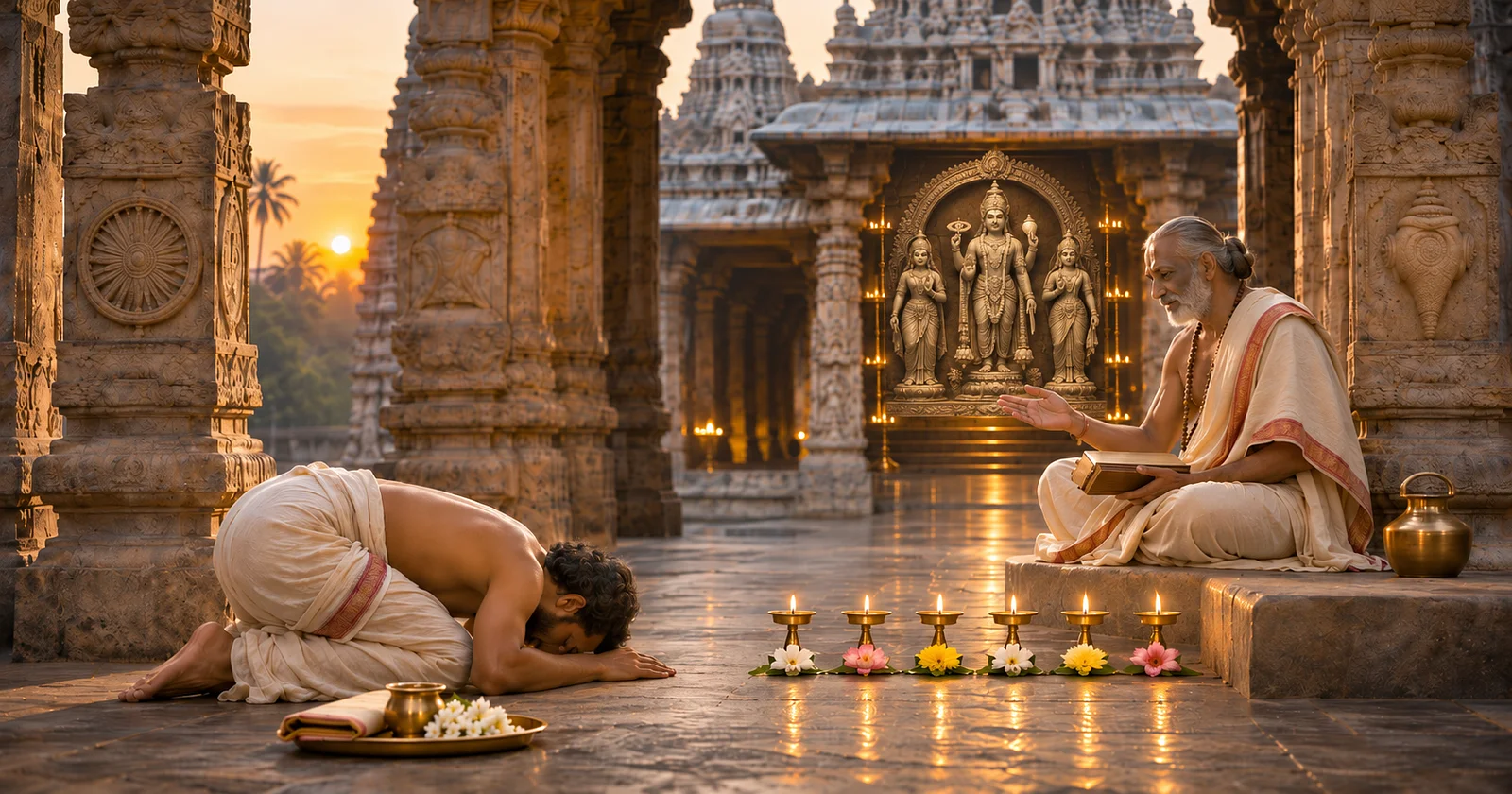
The ācārya teaches the soul’s dependence on Bhagavān, transmits the sacred teaching and guides the disciple’s observance. In Śrīvaiṣṇava practice, samāśrayaṇa, initiation through the five saṃskāras, and the teaching or performance of prapatti both take place within this relationship. Each has its own function, and the authority to instruct and initiate belongs to the received discipline of the lineage.
Deśika recognises three modes of prapatti:
-
Sva-niṣṭhā: the aspirant performs the surrender himself, with understanding.
-
Ukti-niṣṭhā: the disciple performs it in the words the ācārya teaches him.
-
Ācārya-niṣṭhā: the ācārya performs the surrender on the disciple’s behalf and undertakes his protection.
Each mode is complete. The one who surrenders through the ācārya’s words, or through the ācārya himself, is a prapanna in the full sense. Sva-niṣṭhā concerns how the surrender is performed; the understanding that makes it possible was itself received from a teacher, so it confers no exemption from the teacher-disciple relationship.
What of the seeker who stands far from any ācārya, as the anāśramī often does? Deśika answers on three levels. First, reaching an ācārya is itself the Lord’s work. In chapter 1 he names six causes that bring a person to an ācārya: the Lord’s love, good deeds done unknowingly (yādṛcchika-sukṛta), the Lord’s gracious glance, freedom from hostility, willingness to learn, and the company of good people. The seeker’s distance does not limit the Lord’s reach. Second, the burden falls on the teacher as well. In chapter 30 Deśika requires compassionate instruction free from the pursuit of gain, and he allows the year-long examination of a disciple to be shortened when a fit seeker has come from afar. Third, ācārya-niṣṭhā asks nothing of the disciple’s learning: the ācārya surrenders on his behalf. The seeker’s part is to want the ācārya and to go towards him by whatever road is open.
Dharma After Surrender
Completed surrender is not yet completed liberation. In the Śatadūṣaṇī, vāda 31, Deśika rejects the claim that final mokṣa is already accomplished while karma-conditioned embodiment continues. He allows that an embodied person may be called liberated in a loose sense, and that meditation gives a real experience of Brahman. The full, unbroken attainment comes only after the body falls. Nyāsadaśaka 4 voices the prapanna’s request:
śrīmann abhīṣṭavarada tvām asmi śaraṇaṃ gataḥ |
etaddehāvasāne māṃ tvatpādaṃ prāpaya svayam ||
“O Lord with Śrī, giver of the boons one desires, I have come to You for refuge. At the end of this body, bring me Yourself to Your feet.” The request is addressed, as the Dvaya is, to the Lord with Śrī. Since liberation is not yet complete, embodied life and its duties continue.
The soul acts through an agency that depends upon Bhagavān. In the Tattvamuktākalāpa, Jīvasara 8, the self is boddhā kartā ca bhoktā, “a knower, an agent and an experiencer,” whose agency depends on Bhagavān. Verse 9 rejects the claim that effort is pointless because events will occur as destined: some results come through effort as their appointed cause. Prapatti is such an effort. The prapanna entrusts the burden of his protection to the Lord and remains capable of intention, responsibility and service.
Prapatti changes the seeker’s relation to the means of liberation. It does not change his nature. Śeṣatva, the soul’s enduring dependence on Bhagavān and existence for His purposes, belongs to the soul by nature. In surrender the aspirant performs the enjoined act that places his protection in the Lord’s hands. The śeṣatva he already had now governs his life consciously.
Kaiṅkarya, service to Bhagavān, is śeṣatva in act, and it is also the content of the goal. The liberated soul’s enjoyment of Bhagavān overflows as service, and the prapanna’s remaining embodied life is directed towards the same end. Śāstra teaches which service is commanded and which is permitted. The prapanna performs both as service, not as payment towards mokṣa.
Deśika defines liberation in the Tattvamuktākalāpa, Jīvasara 64: āvirbhūtasvarūpā niravadhikasukhabrahmabhuktis tu muktiḥ, “liberation is the enjoyment of Brahman, bliss without limit, with the self’s nature made manifest.” Must such service carry the pain that goes with service? He answers that the pain belongs to the conditions of bondage. With those removed, service accords with the self’s nature and is pure joy. In the Śatadūṣaṇī, vāda 51, he shows that liberated cognition has an object: Brahman with His qualities and glory. The liberated self knows, enjoys and serves Bhagavān.
For the prapanna, ājñā-kaiṅkarya is service the Lord commands: the nitya and naimittika duties that apply to him. Omitting it violates His command and is an offence. Anujñā-kaiṅkarya is service He permits and welcomes, such as temple service, tending flowers for worship or serving devotees. Doing it pleases Him; omitting it is no fault. Permitted service never overrides commanded service, and service that breaks a command is itself an offence.
Deśika gives the force of the command in the Rahasyatrayasāra, chapter 17, quoting the Lord:
śrutismṛtī mamaivājñā yas tām ullaṅghya vartate |
ājñācchedī mama drohī madbhakto ’pi na vaiṣṇavaḥ ||
“Śruti and smṛti are My command. One who lives in violation of it breaks My command and is My enemy; though he call himself My devotee, he is no Vaiṣṇava.” Devotion that sets aside the Lord’s command is not devotion to Him.
In the Śatadūṣaṇī, vāda 63, Deśika states the general rule:
varṇāśramadharmā hi sarvāsu niṣṭhāsu itikartavyatātvenāvatiṣṭhante.
“For the duties of varṇa and āśrama remain in every discipline as its required procedure.” He adds: na ca karmayogābhyutthitasyāpi jñānayoginaḥ svavarṇāśramakarmanivṛttiṃ brūmaḥ, “nor do we say that the jñāna-yogī, even when he has risen beyond karma-yoga, ceases from the works of his own varṇa and āśrama.” Sva, “his own,” ties the duty to the person: a renunciant does not take on a householder’s rites. The Rahasyatrayasāra applies the same principle to the prapanna.
For the anāśramī, finding which commands apply is the first task. Common duties remain. Duties arising from an existing initiation, a relationship or a particular occasion are each examined on their own ground. A rite that requires a wife, consecrated fires or another qualification binds only where that qualification exists, unless śāstra authorises a substitute. The lack of a qualification for one rite does not settle every other duty.
An initiated widower illustrates this. His twilight worship rests on his initiation, not on his marriage, and continues (Manu 2.101–102). A rite that requires a wife does not. An uninitiated dvija is first bound to the expiation and upanayana that restore his eligibility; one outside the twice-born varṇas keeps the dharma common to all and the duties of his own varṇa. Neither the promise of prapatti nor the label anāśramī yields one ritual schedule for everyone. The ācārya identifies the governing injunction, the person’s established status, the occasion, his capacity and any permitted alternative.
The Lord remains the sole refuge. Where prescribed nitya and naimittika rites address other deities, Deśika explains them as worship of Nārāyaṇa present within those deities as their inner ruler; the deities are His body. Outside these rites the prapanna does not worship other deities, take refuge in them or seek favours from them. Doing so contradicts ākiñcanya and ananyagatitva.
The prapanna remains answerable for wrongdoing. Slight offences committed unknowingly after surrender disappear without leaving a stain; the Lord pardons them. For a deliberate offence he must perform expiation. One form of it is punaḥ prapadana: a separate act of surrender made as expiation for that offence alone. It is not a second prapatti for liberation, which was completed once. If he fails to expiate, his prapatti is not undone. He does not go to the world of Yama; the Lord protects him after a light punishment in this very life. At most his complete release is delayed, and his prapatti still yields mokṣa. Among offences, those against Bhagavān’s devotees, bhāgavatāpacāra, stand in the front rank. Deśika quotes the Lord: whoever hates them hates Me also. Confidence in the Lord’s protection is the ground for faithful service and for correction when one errs.
What a Seeker Can Do Today
What can the anāśramī do now, before and after he reaches an ācārya?
Keep the dharma common to everyone. Yājñavalkya Smṛti 1.122 names non-injury, truthfulness, abstention from theft, purity, control of the senses, generosity, self-restraint, compassion and patience; Manu 10.63 gives the first five. Honest livelihood, care for dependants and restraint in speech give these duties their daily form.
Keep the duties of one’s varṇa. One who has been initiated continues his sandhyā and the other daily duties his initiation brings.
Establish regular remembrance and worship. Recite Bhagavān’s names and learn suitable stotras. Once initiated through samāśrayaṇa, wear the ūrdhvapuṇḍra received in it and perform daily tiruvārādhana, the home worship of the Lord, as the ācārya teaches it. The Lord accepts a leaf, a flower, a fruit or water offered with devotion (Gītā 9.26). Continual glorification and japa sustain a disciplined devotional life (9.14; 10.25).
Undertake austerity according to capacity and instruction. Fasting belongs among the practices Rāmānuja names at Brahma Sūtras 3.4.36. Ekādaśī is kept according to its own rules as received in the tradition.
Hear the tradition and serve within one’s means. These are the directions Rāmānuja left his disciples, which Deśika records in chapter 17 of the Rahasyatrayasāra. Study or hear the Gītā, Rāmāyaṇa, Mahābhārata and Viṣṇu Purāṇa under reliable guidance. The Nālāyira Divyaprabandham stands at the centre of Śrīvaiṣṇava instruction. Learn the meaning of the three rahasyas, the Tirumantra, the Dvaya and the carama śloka, from the ācārya. Serve Bhagavān’s devotees; this service ranks with service to Him. Feeding people and serving in the temple are forms of dāna and kaiṅkarya, undertaken in proportion to one’s resources and responsibilities.
Seek the ācārya. Have him establish which injunctions apply and which omissions need correction, and receive samāśrayaṇa and prapatti from him. Where a teacher is hard to reach, a recognised maṭha, the published teaching of the lineage or a trusted member of the tradition can lead to one; meanwhile, keep the dharma and the devotion already open.
After surrender, continue in service. Fulfill the duties that apply, correct wrongdoing, honour Bhagavān and His devotees, worship no other deity, and rest in the knowledge that one’s protection has been entrusted to Him. Surrender is complete as the means to liberation; service continues for the rest of life.
Conclusion
The adhikārī for bhakti-yoga is the twice-born seeker, and the anāśramī among them remains eligible. The duties that support it are those of the āśrama, and where the āśrama fails, those of the varṇa, with japa, fasting, giving and worship. Where those duties become impossible, eligibility continues outside the āśrama, but remaining outside is justified only while the impediment lasts; entering an āśrama is the better course. Where bhakti-yoga is closed or too slow, prapatti, a vidyā in its own right, is open to all.
The seeker receives instruction, fulfils the dharma that applies to him and entrusts himself to Śrīman Nārāyaṇa.
Jai Dvārikādhīśa.
References:
1) Mahānārāyaṇa Upaniṣad (Taittirīya Āraṇyaka 10), the anuvāka beginning satyaṃ paraṃ paraṃ satyam. The ending am lengthens the stem vowel only where it counts as sarvanāmasthāna, that is, outside the neuter (Aṣṭādhyāyī 1.1.43, 6.4.8); in the neuter it is elided (7.1.23), giving brahma. Deśika, Nyāsaviṃśati, with his own commentary; Nikṣeparakṣā. Rahasyatrayasāra, ch. 9, Upāyavibhāgādhikāra, pp. 103–110.
2) Rahasyatrayasāra, ch. 8, Adhikārivibhāgādhikāra, pp. 94–102; ch. 9, p. 108; ch. 10, Prapattiyogyādhikāra, pp. 110–114: without distinction of caste or āśrama, pp. 110–111; from the brāhmaṇa to the caṇḍāla and the four grounds, p. 114. Nyāsaviṃśati 5.
3) Chāndogya Upaniṣad 6.14.2. Raṅgarāmānuja, Bhāvaprakāśikā on the Śrutaprakāśikā, Anārabdhakāryādhikaraṇa: vimokṣyate sampatsyata ity arthaḥ, puruṣavyatyayaś chāndasaḥ; Aṣṭādhyāyī 3.1.85, vyatyayo bahulam. Brahma Sūtra 4.1.19 with Śrībhāṣya and Śrutaprakāśikā.
4) Nyāsaviṃśati 20, with Deśika’s own commentary. Nyāsatilaka 10 and 15 (prārabdhabhaṅgāt phalam adhikam). Rahasyatrayasāra, ch. 18, pp. 183, 189; ch. 20, pp. 199–201.
5) Varāha Purāṇa, the Varāha carama śloka, as cited in Deśika’s commentary on Nyāsaviṃśati.
6) Rāmānuja, Śaraṇāgatigadya. Rahasyatrayasāra, ch. 28, Dvayādhikāra, p. 431, on Śrī as mediator.
7) Ahirbudhnya Saṃhitā 37.28–29. Lakṣmī Tantra 17.60–61, 17.74. Rahasyatrayasāra, ch. 11, Parikaravibhāgādhikāra, pp. 115–126; ch. 12, Sāṅgaprapadanādhikāra, pp. 127–136; mahāviśvāsa, pp. 117, 123; one act, performed once, pp. 126, 131; want of faith, ch. 13, p. 139. Deśika, Nyāsadaśaka 1–2.
8) Rahasyatrayasāra, guruparamparā introduction, p. 2; ch. 1, Upodghātādhikāra, p. 15; ch. 8; ch. 30, pp. 566–573, especially p. 571. Nyāsatilaka, the sections on sva-niṣṭhā and ācārya-niṣṭhā. On samāśrayaṇa in present practice: Parakāla Maṭha.
9) Śatadūṣaṇī, vāda 31, Jīvanmuktibhaṅgavāda. Nyāsadaśaka 4–10.
10) Tattvamuktākalāpa, Jīvasara 8–9, with Sarvārthasiddhi.
11) Rahasyatrayasāra, ch. 3, pp. 22–31, especially p. 30; ch. 13, Kṛtakṛtyādhikāra, pp. 136–140; ch. 15, Uttarakṛtyādhikāra, pp. 147–159; ch. 17, p. 169; ch. 22, pp. 215–227; ch. 25, Prabhāvavyavasthādhikāra, p. 314.
12) Tattvamuktākalāpa, Jīvasara 64, with Sarvārthasiddhi. Śatadūṣaṇī, vāda 51, Muktasaṃvinnirviṣayatvabhaṅgavāda.
13) Tattvamuktākalāpa, Jīvasara 39. Nyāsaviṃśati 20, with Deśika’s commentary. Rahasyatrayasāra, ch. 17, Śāstrīyaniyamanādhikāra, pp. 174–175.
14) Rahasyatrayasāra, ch. 17, p. 172. Compare Viṣṇudharma 74.30: śrutiḥ smṛtir mamaivājñā tām ullaṅghya yajec chubhe | sarvasvenāpi māṃ devi nāpnoty ājñāvighātakṛt ||
15) Śatadūṣaṇī, vāda 63, Adhikārivivekavāda. Rahasyatrayasāra, ch. 25, pp. 313–317.
16) Rahasyatrayasāra, ch. 13, p. 137; ch. 24, p. 279.
17) Rahasyatrayasāra, ch. 18, Aparādhaparihārādhikāra, pp. 176–189: unknowing offences, pp. 176, 189; offences against bhāgavatas, pp. 184–185, 188; further prapatti as the atonement for deliberate offences, pp. 177, 181–183; no going to the world of Yama and light punishment in this life, p. 178; prapatti not undone, release at most delayed, p. 179.
18) Yājñavalkya Smṛti 1.122, with Vijñāneśvara’s Mitākṣarā: Sanskrit. Manu 10.63.
19) Rahasyatrayasāra, ch. 17, pp. 168–169.