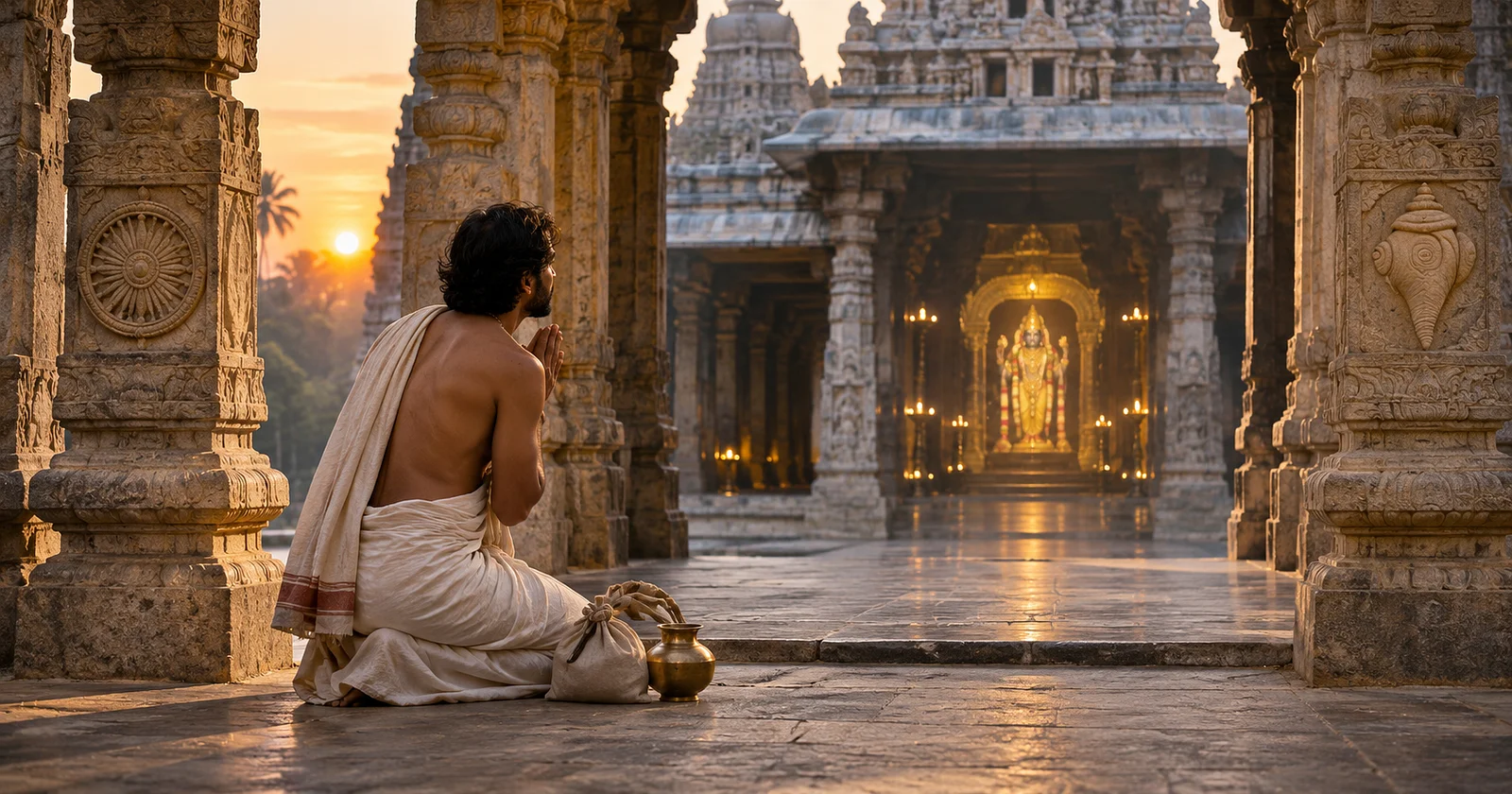
What becomes of the person who seeks Bhagavān while standing outside the recognised āśramas? A man may have finished his studentship and found no wife. Another may have lost his wife and lack the detachment for renunciation. Someone else may have grown up without the initiation his family once observed. The desire for mokṣa can arise in each of them, though their circumstances and qualifications differ.
Four questions follow: who may undertake a particular discipline, which duties support it, what follows when those duties become impossible, and how one who cannot undertake that discipline attains liberation.
Rāmānuja’s Śrībhāṣya and Svāmī Vedānta Deśika’s teaching on prapatti answer all four. Liberating Brahmavidyā takes the form of sustained upāsanā, the discipline called bhakti-yoga. The anāśramī remains eligible for it, aided by practices that do not depend on an āśrama. Where bhakti-yoga is closed to a person, or where he cannot bear its delay, another vidyā stands open: prapatti, surrender to Śrīman Nārāyaṇa. In every case, the seeker fulfills the dharma that applies to him.
Why Āśrama-Karma Matters
The āśramas organise a life of religious discipline. Their prescribed duties have a place in the pursuit of Brahmavidyā, the knowledge and sustained contemplation of Brahman.
The Bṛhadāraṇyaka Upaniṣad says:
tam etaṃ vedānuvacanena brāhmaṇā vividiṣanti yajñena dānena tapasānāśakena.
Brāhmaṇas seek to know this Self through Vedic recitation, sacrifice, giving and the austerity of fasting (4.4.22).
Brahma Sūtra 3.4.26 draws the conclusion:
sarvāpekṣā ca yajñādiśruter aśvavat.
And vidyā requires all works, because scripture names sacrifice and the rest, as a horse requires its equipment. Rāmānuja explains the simile: as the horse, though the means of a man’s travel, requires its harness and its grooming, so vidyā, though the means of release, requires the obligatory and occasional rites as its equipment. Against the Advaitin view that works serve only to produce the desire to know (vividiṣā), Deśika shows in the Śatadūṣaṇī, vāda 6, that they assist the knowledge itself. Sūtras 3.4.32–33 add a second ground: these duties bind a person by virtue of his āśrama, whether or not he has taken up the pursuit of liberation. A single rite therefore binds as āśrama-karma and also assists vidyā.
Vidyā here has a precise meaning. Knowledge develops through repeated contemplation of Brahman: āvṛttir asakṛd upadeśāt, repetition, because the teaching is given repeatedly (4.1.1). The remembrance becomes steady and acquires a vividness comparable to direct perception. The meditation is practised daily until death (4.1.12). For the knower the obligatory rites have knowledge as their effect, so the rites that support the meditation continue daily as well (4.1.16).
Deśika states the doctrine in the Tattvamuktākalāpa, Jīvasara 29: sā ca dhīḥ prītirūpā, “it is cognition taking the form of love.” Verse 30 names it dhruvānusmṛti, steady remembrance. Knowing and loving are one sustained contemplation.
How do outward rites assist an inward meditation? Through worship. The Viṣṇu Purāṇa says:
varṇāśramācāravatā puruṣeṇa paraḥ pumān |
viṣṇur ārādhyate panthā nānyat tattoṣakāraṇam ||
The Supreme Person, Viṣṇu, is worshipped by one who keeps the conduct of his varṇa and āśrama; that is the path, and there is no other cause of His pleasure (3.8.9). The Gītā teaches the same:
svakarmaṇā tam abhyarcya siddhiṃ vindati mānavaḥ.
A person attains perfection by worshipping Him through his own work (18.46). Sacrifice, giving and austerity are not to be abandoned; they purify the wise (18.5). Rāmānuja draws the conclusion at 3.4.26: the meditation arises through the daily rites paramapuruṣārādhanarūpaiḥ … paramapuruṣaprasādadvāreṇa, “which are the worship of the Supreme Person, by way of the Supreme Person’s grace.” Pleased by this worship, Bhagavān destroys the sin that blocks knowledge from arising. The mind is cleared, and the meditation can begin and grow steady.
Hence the difficulty: if āśrama duties support Brahmavidyā, what of the person whose circumstances prevent their performance?
Who is the Anāśramī ?
An anāśramī stands outside the recognised āśramas. The adhikaraṇa that treats him, Brahma Sūtras 3.4.36–39, is the Vidhurādhikaraṇa, named after the widower (vidhura). Rāmānuja names the cases at 3.4.39:
nivṛttabrahmacaryasya mṛtabhāryasya cāvairāgye sati dārālābha āpat.
“For one who has completed his studentship and for one whose wife has died, when detachment is lacking, failure to obtain a wife is a calamity.” The thirty-fourth Ahobila Yati, commenting on Deśika’s Adhikaraṇasārāvalī, names the usual cause: dhanādyabhāvāt, want of wealth and the like. The anāśramī’s state is therefore āpat, distress, and is governed as distress is governed.
The adhikaraṇa examines the absence of āśrama membership in a seeker who possesses every other qualification the vidyā requires.
Marital status alone does not settle the category. Lifelong brahmacarya is itself an āśrama, and sannyāsa has its own conditions and obligations. Before the term is applied to an unmarried person today, his actual religious standing must be known.
Circumstantial inability also differs from refusing an obligation one can fulfil. The next adhikaraṇa, beginning at 3.4.40, treats separately the fall from a vowed station: lifelong studentship, the forest life or renunciation. The rule for the widower does not extend to that case.
Nor does it extend to the one who claims exemption. In the Śatadūṣaṇī, vāda 65, Deśika refutes the alepaka doctrine: the claim that one has passed beyond the recognised stations and become untouched by religious obligation. He finds no fifth āśrama in any authority: śrutismṛtītihāsapurāṇādiṣu pañcamāśramavidhānādarśanāt, “because no injunction of a fifth āśrama is seen in śruti, smṛti, itihāsa, purāṇa or elsewhere.” That polemic is aimed at self-declared exemption. It does not touch the widower or anyone else whom circumstance has placed outside an āśrama.
Does the Absence of an Āśrama Exclude Brahmavidyā?
Bādarāyaṇa answers:
antarā cāpi tu taddṛṣṭeḥ.
Those standing between the āśramas are also eligible, because such cases are seen in the texts (3.4.36).
Rāmānuja names Raikva, Bhīṣma and Saṃvarta, all grounded in the knowledge of Brahman while belonging to no āśrama. Raikva, found beneath a cart in the narrative of the Saṃvarga-vidyā (Chāndogya Upaniṣad 4.1.8), taught that vidyā. Bhīṣma’s celibacy was a kṣatriya’s oath taken for his father’s sake, not the vowed āśrama of naiṣṭhika brahmacarya, so he stood between the stations. Saṃvarta wandered free of every station. Rāmānuja draws the conclusion: practices that assist knowledge are wider than the duties peculiar to any āśrama.
Japopavāsadānadevatārādhanādi, japa, fasting, giving, the worship of the deity and the like, remain available where particular fire-rites cannot be performed.
The following sūtras complete the answer:
api ca smaryate.
Smṛti also records this (3.4.37).
viśeṣānugrahaś ca.
Special practices also assist knowledge (3.4.38).
At 3.4.37 Rāmānuja cites Manu:
japyenāpi ca saṃsidhyed brāhmaṇo nātra saṃśayaḥ.
A brāhmaṇa attains perfection through japa as well; of this there is no doubt (2.87). At 3.4.38 he invokes the Praśna Upaniṣad, which speaks of seeking the Self through austerity, brahmacarya, faith and knowledge (1.10). These are duties not bound to any particular station. Which mantra the seeker recites, and how, depends on his eligibility and is learned from a teacher.
Deśika gives the whole adhikaraṇa in a single verse of the Adhikaraṇasārāvalī:
dārālābhe virakter mradimani ca bhaved antareṇāśramān yaḥ
tasmin niśśeṣadharmatyaji bhavatu kathaṃ brahmavidyeti cen na |
sāmānyair varṇadharmair guṇaniyatiyutaiḥ sā hi tatrāpi sāṅgā
bhīṣmādau dṛṣṭam etad bhavati tu vṛṣale gatyabhāvād abhāvaḥ ||
“One who, failing to obtain a wife while his detachment is still weak, stands outside the āśramas: how can Brahmavidyā belong to him, who has given up every dharma? Not so. Through the general duties of his varṇa, joined with the discipline of renunciation, it is complete with its limbs even there; this is seen in Bhīṣma and others. In the śūdra, however, it is absent, for want of the means.”
The objection assumes that standing outside the āśramas means abandoning all dharma. Deśika denies it. His son Kumāra Varada explains guṇaniyati as phalasaṅgakartṛtvādiparityāga, the giving up of attachment to fruit and of the sense of independent agency. The thirty-fourth Ahobila Yati names the varṇa duties that remain to the widower: satyavacanajapopavāsadevatāpūjanādi, truthful speech, japa, fasting, the worship of the deity and the like. Performed with that renunciation, they keep the vidyā complete with its limbs. Sudarśana Sūri’s Śrutaprakāśikā on 3.4.36 states the rule:
āśramadharmānupapattau varṇadharmair anugraha upapadyate.
“Where the duties of an āśrama cannot be performed, assistance comes through the duties of varṇa.” The duties that survive the loss of an āśrama are varṇa duties, not merely the ethics common to all humanity. Deśika’s last line fixes the limit he reads in the adhikaraṇa: it widens eligibility across the āśramas, not across the varṇas.
Why Entering an Āśrama Remains Preferable
The adhikaraṇa concludes:
atas tv itaraj jyāyo liṅgāc ca.
But the other is better than this, and also because of indicatory marks (3.4.39). Standing within an āśrama is better than standing outside one. Rāmānuja gives the reason:
bhūyodharmakālpadharmakayor atulyakāryatvāt, a station with many duties and a station with few do not have equal effect.
To be without an āśrama is a state for times of distress; whoever is able must enter one. The indicatory mark is smṛti, and he quotes it:
anāśramī na tiṣṭhet tu dinam ekam api dvijaḥ |
āśrameṇa vinā tiṣṭhan prāyaścittīyate hi saḥ ||
A dvija must not remain without an āśrama for even a day; one who remains without one incurs expiation (Dakṣasmṛti, chapter 1).
The widower who can remarry, and the bachelor who comes into the means to keep a household, must therefore enter the āśrama. The justification for remaining outside an āśrama lasts only as long as the impediment does; eligibility for Brahmavidyā continues within the āśrama he enters.
Nor does the rule make the fourth station the only door to liberation. In the Tattvamuktākalāpa, Jīvasara 37, Deśika rejects the argument that calling the fourth station the “mokṣa-āśrama” excludes the others from liberating vidyā.
He answers from śruti: yāvajjīvaṃ dvitīyāśramavati punarāvṛttyabhāvo ’py adhītaḥ, “for one in the second āśrama all his life, non-return to birth is also taught.” The fourth station has only a greater fitness (carame yogyatādhikyamātram).
Three Situations Requiring Different Answers
First, a person who has the relevant qualifications but lacks an āśrama because of circumstances. Brahma Sūtras 3.4.36–39 address him. The practices available to him assist Brahmavidyā while he seeks to enter an āśrama.
Second, a person who was eligible for upanayana and never received it within the prescribed period. He is a vrātya, one who has missed the stipulated initiation (Manu 2.38–39). Yājñavalkya admits him again through the vrātyastoma (1.38), and the Mitākṣarā places upanayana after it. Until then, prapatti stands open to him as to everyone.
Third, a person outside the three twice-born varṇas. Rāmānuja holds in the Apaśūdrādhikaraṇa (1.3.33–39) that such a person has no adhikāra for the upāsanā taught in the Veda. Without upanayana there is no Vedic study, and smṛti forbids the śūdra even to hear the Veda. Deśika’s verse closes on the same point.
Rāmānuja nevertheless acknowledges Vidura and others who possessed knowledge of Brahman despite their present birth. His explanation:
vidurādayas tu bhavāntarādhigatajñānāpramoṣāt jñānavantaḥ prārabdhakarmavaśāc cedṛśajanmayoginaḥ.
“Vidura and the others possessed knowledge because what they had gained in another birth was not lost; prārabdha karma joined them to such a birth.” The Gītā affirms that yogic progress continues across births (6.43–45). Deśika states the distinction in the Rahasyatrayasāra, chapter 24: eligibility to commence the prescribed upāsanā is one thing; the completion in this life of a discipline begun in an earlier one is another. Both the restriction and the exceptional case stand.
The Scriptural Promise of Refuge
Is the person for whom bhakti-yoga is closed then shut out of mokṣa?
The term must first be fixed. Bhakti-yoga, in the technical sense, is the sustained liberating discipline of Brahma Sūtra 4.1, with its prerequisites of initiation and Vedic study. Devotion in the wider sense is open to all: loving Bhagavān, praising Him, hearing of His deeds and serving Him. The restrictions on the technical discipline do not attach to every use of the word bhakti.
Nor does Deśika soften those restrictions. In the Śatadūṣaṇī, vāda 62, he presses an opponent: if ordinary instruction can produce the cognition that removes bondage, how can that cognition be restricted to particular groups? The argument exposes an inconsistency in the opposing system. Stating his own position, he says:
naivam asmanmate prasaṅgaḥ … upāsanavidhīnāṃ ca upanayanādyaṅgakādhyayanavidhisiddhasvādhyāyasampannajñānatraivarṇikādhikārilābhena.
“No such consequence follows in our system … since the injunctions of upāsanā find their eligible persons in the three twice-born varṇas, possessed of knowledge from the Veda learned under the injunction of study, whose limb is upanayana.” The answer to the excluded seeker’s question lies elsewhere, in the scriptural teaching of refuge.
The Śvetāśvatara Upaniṣad declares:
mumukṣur vai śaraṇam ahaṃ prapadye.
“Desiring liberation, I take refuge in Him” (6.18). The one who surrenders is the seeker of liberation, and the Upaniṣad itself speaks the act of surrender.
In the Rāmāyaṇa, as the acceptance of Vibhīṣaṇa is debated, Rāma states His vow:
sakṛd eva prapannāya tavāsmīti ca yācate |
abhayaṃ sarvabhūtebhyo dadāmy etad vrataṃ mama ||
“To one who has sought refuge even once and asks, saying ‘I am Yours,’ I grant protection from all beings. This is My vow” (Yuddhakāṇḍa 18.33). Sakṛd eva, “even once”: the Lord binds Himself by vow to a single surrender.
The Gītā expressly includes women, vaiśyas, śūdras and those of adverse birth in its assurance of the highest goal:
māṃ hi pārtha vyapāśritya ye ’pi syuḥ pāpayonayaḥ |
striyo vaiśyās tathā śūdrās te ’pi yānti parāṃ gatim ||
“Those who take refuge in Me, Pārtha, even those of adverse birth, women, vaiśyas and śūdras, they too reach the highest goal” (9.32). Deśika cites this verse for the eligibility of women and of every birth for prapatti. Vyapāśritya, “taking refuge,” is śaraṇāgati; the verse grants universal access to surrender, not to the technical bhakti-yoga.
The Gītā’s final teaching is the command at the centre of the Śrīvaiṣṇava doctrine of surrender:
sarvadharmān parityajya mām ekaṃ śaraṇaṃ vraja |
ahaṃ tvā sarvapāpebhyo mokṣayiṣyāmi mā śucaḥ ||
“Having given up all dharmas, take refuge in Me alone. I shall release you from all sins. Do not grieve” (18.66). Deśika reads parityajya as the giving up of any attempt at the other means, which presupposes that the one addressed lacks the competence for them. It does not command him to abandon dharma: what one is capable of performing is not to be given up for the sake of prapatti. His duties continue, performed as service and not as a means.
(To be Continued in Part Two…)
References:
1) Rāmānuja, Śrībhāṣya on Brahma Sūtras 1.3.33–39, 3.4.26, 3.4.32–40, 4.1.1–19. Vedānta Deśika, Śrīmad Rahasyatrayasāra, tr. M. R. Rajagopala Ayyangar (Kumbakonam, 1946), sadagopan.org; page numbers below refer to this translation. Sanskrit texts of the Śrībhāṣya and of Deśika’s works: vishvAsa, rAmAnujIyam.
2) Bṛhadāraṇyaka Upaniṣad 4.4.22; Śrībhāṣya 3.4.26.
3) Śrībhāṣya 3.4.26: yathā puruṣagamanasādhanabhūto ’śvaḥ svaparikarabandhaparikarmāpekṣaḥ, evaṃ mokṣasādhanabhūtāpi vidyā nityanaimittikakarmaparikarāpekṣā. 3.4.32, 3.4.33. Śatadūṣaṇī, vāda 6, Vividiṣāsādhanatvabhaṅgavāda.
4) Śrībhāṣya 4.1.1, 4.1.12, 4.1.16.
5) Deśika, Tattvamuktākalāpa, Jīvasara 29–30, with Sarvārthasiddhi.
6) Viṣṇu Purāṇa 3.8.9. Bhagavadgītā 18.5, 18.46, both quoted by Rāmānuja at 3.4.26. Śrībhāṣya 1.1.1 and 3.4.26.
7) Śrībhāṣya 3.4.39. The thirty-fourth Ahobila Yati, Padayojanā on Adhikaraṇasārāvalī, adhikaraṇa 3.4.9, verse 20: pāṇigṛhītadārāṇāṃ maraṇe dhanādyabhāvād dārāntarālābhe; text at vishvAsa, adhikaraNa-sArAvalI.
8) Śrībhāṣya 3.4.40. Śatadūṣaṇī, vāda 65, Alepakamatabhaṅgavāda.
9) Śrībhāṣya 3.4.36. Chāndogya Upaniṣad 4.1–3. M. Rangacharya and M. B. Varadaraja Aiyangar, tr., Śrībhāṣya 3.4.36, n. 1210.
10) Śrībhāṣya 3.4.37, 3.4.38.
11) Deśika, Adhikaraṇasārāvalī, adhikaraṇa 3.4.9 (Vidhurādhikaraṇa), verse 20, with the commentaries of Kumāra Varada (guṇaniyatiyutaiḥ phalasaṅgakartṛtvādiparityāgātmakaguṇaniyatiyutaiḥ) and the thirty-fourth Ahobila Yati, Padayojanā (varṇadharmaiḥ satyavacanajapopavāsadevatāpūjanādibhir vidhurasyāpi sambhāvitaiḥ). Sudarśana Sūri, Śrutaprakāśikā on 3.4.36.
12) Śrībhāṣya 3.4.39, quoting the Dakṣasmṛti.
13) Tattvamuktākalāpa, Jīvasara 37, beginning turyo niṣkṛṣya mokṣāśrama iti.
14) Manu 2.38–39, with Medhātithi. Yājñavalkya Smṛti 1.37–38: sāvitrīpatitā vrātyā vrātyastomād ṛte kratoḥ; Vijñāneśvara’s Mitākṣarā on 1.37–38: kṛte tu tasminn upanayanādhikāriṇo bhavanti.
15) Śrībhāṣya, Apaśūdrādhikaraṇa, 1.3.33–39; Thibaut’s translation at wisdomlib and 1.3.38. Rahasyatrayasāra, ch. 24, Sādhyopāyaśodhanādhikāra, p. 262; Vidura, ch. 25, p. 302.
16) Śatadūṣaṇī, vāda 62, Apaśūdrādhikaraṇavirodhavāda.
17) Śvetāśvatara Upaniṣad 6.18.
18) Vālmīki Rāmāyaṇa, Yuddhakāṇḍa 18.33: Sanskrit; English.
19) Bhagavadgītā 9.32. Rahasyatrayasāra, ch. 24, p. 262.
20) Bhagavadgītā 18.66, with Rāmānuja’s Gītābhāṣya. Rahasyatrayasāra, ch. 29, Caramaślokādhikāra, pp. 469–472, 497–499.