Introduction Building upon the previous section (Part One: The Sacred Kṣetra of Gopāla), where we explored the scriptural references that sanctify Braj Bhūmi, this part turns to the meaning and archaeological context of the 84 kos Parikrama, the region’s most revered pilgrimage circuit. By examining its historical geography and the discoveries made along this ancient route, we gain a clearer understanding of the landscape in which recent findings by Dr. Vinay have emerged. This perspective not only highlights the continuity of Braj’s sacred tradition but also helps us appreciate the uniqueness and significance of the new archaeological evidence.
Braj 84 kos Parikrama
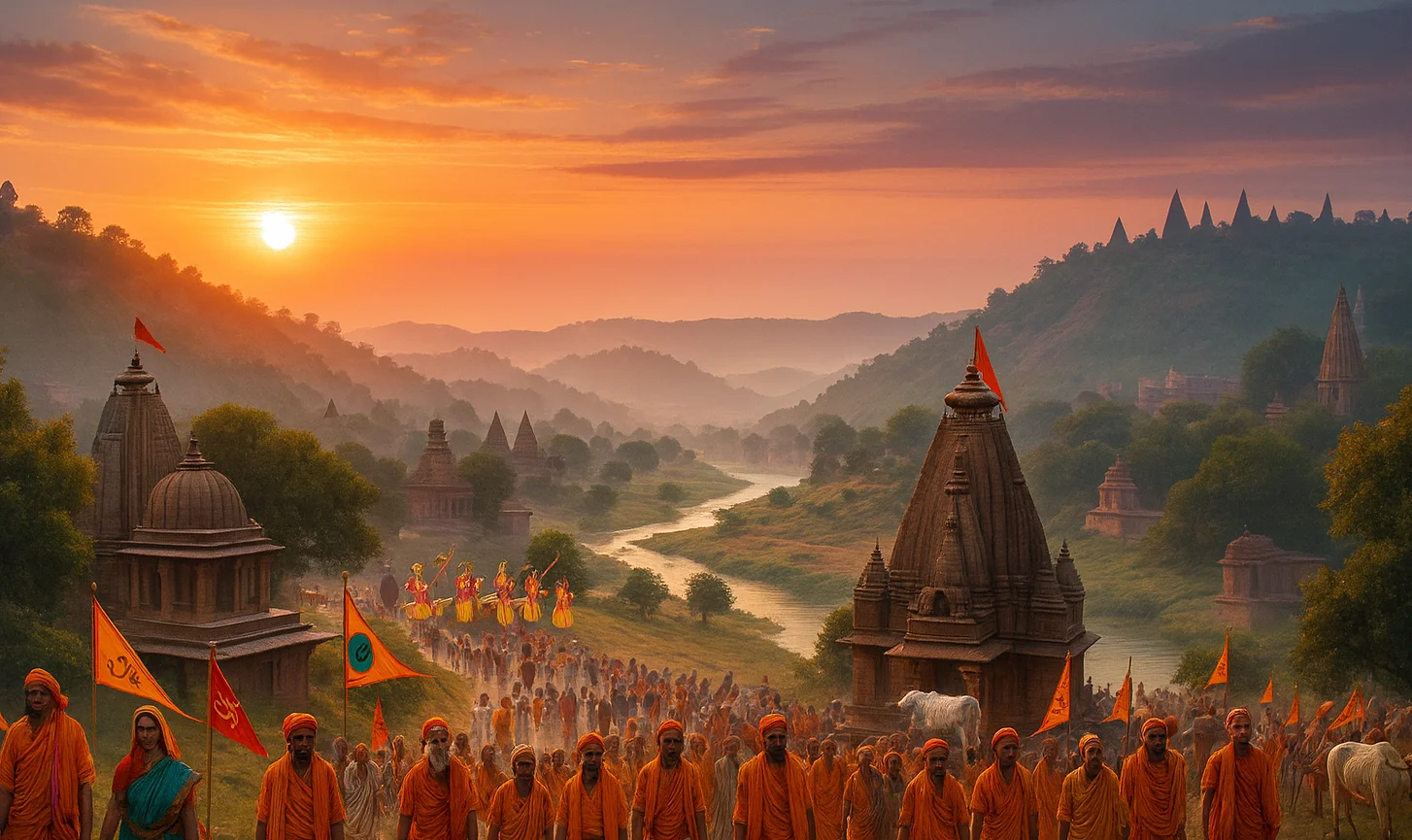
The concept of Braj Parikrama seems to be related to the pan-Indian concept of tīrthāṭana (religious tourism). The concept was developed to understand the pilgrimage centers holistically. The Braj Parikrama is related to nature’s worship, as all natural sources like groves, rivers, hills, lakes, ponds, and even the dust of Braj (Braj-raj) are revered. This concept of worshipping nature can be understood by the prevailing practice of the Vallabhīya Puṣṭimārgī sect, who still call Braj Parikrama as Vanayātrā.
Sarichchhailavanoddesān mukundapadabhūṣitān/Ākrīḍanīkṣamāṇānāṃ mano yāti tadātmatām// ~Śrīmadbhāgavata Purāṇa (10.46.22)
In antiquity, the first Vraja yātrā is credited to Uddhava, who was sent by Kṛṣṇa himself to Vraja to meet his parents and the gopīs and relieve them from the agony caused by separation. It is here that for the first time the importance of Vraja as the līlā-sthala of Śrī Kṛṣṇa is highlighted when the gopīs tell Uddhava that their mind gets absolved in him as they behold the streams, hills and woodlands as well as the playgrounds graced by the footprints of Śrī Kṛṣṇa:
Āsāmaho caraṇareṇujuṣāmahaṃ syāṃ vṛndāvane kimapi gulmalatauṣadhiṇām/Yādustyajaṃ svajanamāryapathaṃ ca hitvā bhejurmukundapadavīṃ śrutibhirvimṛgyām//~Śrīmadbhāgavata Purāṇa (10.47.54-55)
Again, it informs that Uddhava stayed for a few months there in Vraja in order to drive away the grief of the cowherd women. Celebrating in song the story of the pastimes of Kṛṣṇa, he brought delight to Gokula. Śrīmadbhāgavata Purāṇa again refers to Uddhava expressing his desire to be incarnated as any of the shrubs, creepers or herbs in the woodlands of Vṛndāvana, so as to catch the dust of the feet of gopīs, who trod the path of devotion leading to Kṛṣṇa.
Uddhava also says that he repeatedly salutes the dust of the feet of the blessed women of Nanda’s Vraja, whose loud singing of the stories of Kṛṣṇa purifies the three worlds:
Vande nandavrajastrīṇāṃ pādareṇumabhīkṣaṇaśaḥ/Yāsāṃ harikathodgītaṃ punāti bhuvanatrayam// (10.47.63)
Śrīmadbhāgavata Khaṇḍa of the Skanda Purāṇa mentions that Vajranābha, the great-grandson of Kṛṣṇa, had heard the story of the Śrīmadbhāgavata from Uddhava at Govardhana. It indicates a second Vraja-yātrā of Uddhava, though he is mentioned to be staying at Badrikāśrama. Nārada is also said to have visited Vraja. Pātāla Khaṇḍa of the Padma Purāṇa mentions that Nārada searched for Rādhā in Vraja and had a glimpse of Rāsa-līlā at Kusuma Sarovara. The Vṛhad Nāradīya Purāṇa (Uttara Khaṇḍa, 79th chapter, Mathurā Māhātmya) gives a detailed account of Nārada’s Vraja yātrā, mentioning the vanas and upavanas (Shesh 1959: 91-117).
Śrīmadbhāgavata Khaṇḍa of the Skanda Purāṇa gives a detailed account of the life of Kṛṣṇa and how his great-grandson Vajranābha was brought to Mathurā by Arjuna and made the king of Mathurā. When Parīkṣita, king of Hastināpura, visits Mathurā, he advises Vajranābha to re-establish the places related to the life activities of Kṛṣṇa. With the help of ṛṣi Śāṇḍilya, many places were re-established: a cantonment was established at Govardhana, Dīrghapura (Dig), Mathurā, Mahāvana, Nandigrāma (Nandgaon) and Vṛhatsānu (Barsana). But with the passage of time, these places were lost and were revived during the medieval period by Vallabhācārya and his pupils on the one hand and Caitanya and his disciples on the other hand.
Braj 84 kos Parikrama Route and Archaeology

Braj 84 kos Parikrama (approximately 3 kms) has three routes at present: one outer Parikrama and two inner Parikramas. Places visited in the shorter inner circumambulation cover a major part of Mathura District and Deeg and Kaman tehsils of the newly formed District Deeg. The outer Parikrama and second inner Parikrama cover a larger area and also include parts of District Palwal (Haryana) and Aligarh. The important sites on the outer Parikrama route are:
Mathura, Bad, Dhangaon, Tarsi, Nagari (Umri), Kumudvan, Sonkh, Bachhgaon, Konthra, Samai, Bahej, Kuchawati, Deeg, Didawali, Tankoli, Khoh (south-west), Adibadri, Alipur Brahman, Barolidhau, Khuntpuri, Kedarnath, Badali, Luhesar, Agarawali, Kalawata, Bhojanthali, Nandera, Unchera, Parehi, Pai, Jurahra, Wikati, Jakhokar, Nehrida, Suhira, Punahana (north-west), Maryaka, Andhop, Saundhad, Lohina, Banchari, Moroli, Palri, Khambi, Likhi, Hasanpur, Marav, Khajpur, Managarhi, Awakhera, Kaneka, Seupatti, Bajna (north-east), Lalpur, Shall, Jarailiya, Sikandarpur, Tehra, Bijau, Rajagarhi, Karahri, Dadisara, Tentigaon, Eroli, Harnaul, Nasiti, Jawra, Arua, Kasera, Kukrari, Raya, Saras, Itauli, Bandi, Baldev (south-east), Khirari, Jhandipur, Shahpur.
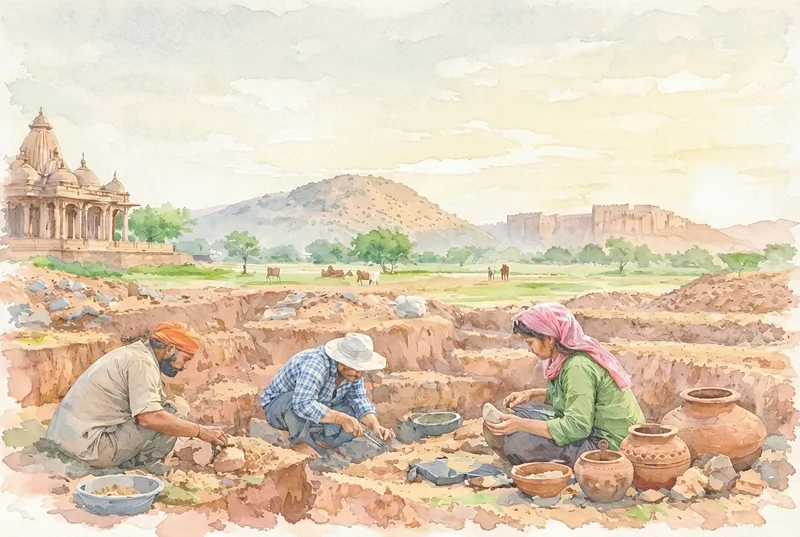
During archaeological investigations in the area, it was observed that a majority (50%) of the sites date back to the Painted Grey Ware (PGW)1 period in antiquity and then continued during the succeeding cultural periods. About 40% to the early centuries of the Common era and the remaining 8% to the medieval period; a few are just isolated religious sites like Adibadri, Kedarnath, Bhojanthali.
Archaeology of Inner 84 kos Parikrama
At present, the Inner 84 kos Parikrama of Gauḍīya and Vallabha paramparā (with slight variations) passes through the following places as shown in the map below:

Among all these, Mathura, Govardhan, Kaman, Barsana, Mahavan and Vrindavan are the places with the most detailed itinerary, and a pilgrim returns to these places more than once during the process of Parikrama. Among the above-mentioned places, the majority of settlements (in bold) date back to the PGW period, while a few belong to the Mauryan period. The rest of the settlements are datable to the early centuries of the Common era, except 5-6 settlements, which are early medieval in nature. Other spots in the above list are ponds and temples, which should be considered within the landscape of the ancient settlements. A few ponds are situated at some distance from the ancient settlements, but in all probability their antiquity should be considered in relation to the ancient settlements only.
Issues with the Archaeology of Braj or Mathura:
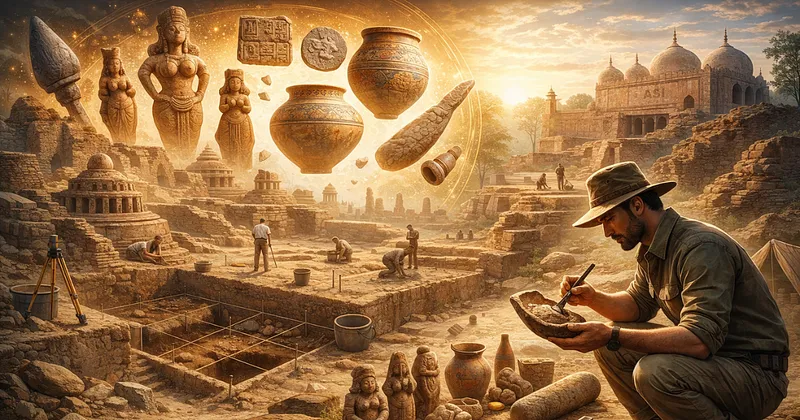
It is an established fact that Mathura is one of the most important archaeological as well as cultural centers of Bhārata, but the biggest drawback so far has been the limited archaeological information and the late dating of the earliest cultures of this region. In the pre-Independent Bhārata, Mathura was excavated on many occasions, but unscientifically, generally to obtain sculptures, relics, inscriptions, and similar astonishing antiquities. No emphasis was given to establish the earliest chronology of the town. Archaeologically, Mathura came to prominence as an important place for art and archaeological studies after Col. Stacy found some antiquarian remains, especially the ‘Silenus sculpture’ from here in the year 1836.
After this, Sir Alexander Cunningham paid several visits to Mathura between 1853 and 1882, of which several accounts are available in the Archaeological Survey Reports (A.S.R.) written by him and his associates. The A.S.R. nos. I (pp. 231-44), III (pp. 13-46), XVII (p. 111), XX (pp. 30-54) deal specifically with the city of Mathura and its nearby area. During his first visit to Mathura (A.S.R., I, pp. 231-244), his main aim was to identify the spots at Mathura that matched the description of the Chinese travelers’ (Xuanzang and Faxian’s) accounts. He had explored the area around Katra and found some Buddhist art relics there and in the vicinity. He also identified various sites near the River Yamuna as ancient mounds with a probable Buddhist connection. Some of these mounds were: Nāga, Dhruva, Nārada, Saptarṣi, Bali, Ānanda, Vināyaka Tīlās and Kans Qilā. Between the years 1861 and 1882, many new sites came to light because of the work of F.S. Growse, the then District Collector of Mathura (Growse 1883).
Some of the conclusions drawn by them were:
- The oldest city of the aboriginal King Madhu was at Madhupura, now Maholi.
- The ancient city of Mathurā, after the defeat of Madhu, was built on the site of present-day Katra, with the Bhuteshwar Temple as its center.
- The Jumna Fort was the last city.
- The Buddhist establishment came into existence at Mathura during the third century BCE.
- The possible site of Upagupta Monastery was either at Kankali (according to Growse) or the Jail mound.
- Buddhism was in decline in the region from the seventh century CE and had completely disappeared by the time of Mahmūd of Ghaznī’s invasion in 1017 CE.
Other significant contributions to the archaeology of the Mathura region came from A. Fuhrer in the years 1888-91, when he excavated the site of Kankali Tila (although a kind of destruction), which unearthed the earliest Jaina settlement in India at that site along with a large number of Jaina, Buddhist and Brahmanical art and architectural pieces (Smith 1904). Two very important sites were excavated at the beginning of the twentieth century by Pt. Radhakrishna, namely Tokri Tila at Mant and Mora shrines. Both these excavations were undertaken by Pandit in the years 1910-11 and 1911-12 (ASI-AR 1910-11 and 1911-12). The most striking find of the Tokri site was its identification as a Kushan devakula with a number of royal portraits, broken sculptures, and several important Kushan inscriptions. At the site of Mora, the first clearance work was undertaken by Vogel himself when he recovered a number of stone sculptures, one having a slightly legible inscription. After the excavations of Pandit at the site, some important bricks with inscriptions of the period of Brihsvatimitra and possibly some broken stone sculptural pieces were found. At the site of Ganeshra, Pt. Radhakrishna recovered a number of Buddhist sculptures and brickbats, some of them with inscriptions. At the site of Jaisinghpura (possibly Kankor Tila), Pt. Radhakrishna obtained some Buddhist sculptures and some broken inscriptions. Some new sculptures and architectural remains were also found by Pandit at the site of Katra, and most of these belonged to the Buddhist faith.
With this, we conclude the second part of this series. In the next part, we shall dive into the procedural details of the excavation that took place at Bahaj—one of the key places in the 84 kos Parikrama.
Footnotes:
- The term "PGW" refers to the Painted Grey Ware culture, an Iron Age culture in Northern India from approximately 1200 to 600 BCE. It is known for its distinctive, fine grey pottery with black painted geometric designs and is associated with the Later Vedic Period.
References (Primary Sources):
- Sri Vraja Mandala Poster credits - Indioddyssey
- 84 Kos Parikrama Route Map - The parikrama of barsana and nandgaon in braj mandal: need for holistic revival and rejuvenation by Rita Gulat; International Journal of Innovative Research and Growth; July 2023.
- Arthaśāstra of Kauṭilya. 1961 (tr.) Shamsastry, R. Mysore: Mysore Printing and Publishing House
- Aṣṭādhyāyī of Pāṇini’s (tr.). Pt. Isvarachandra. 2009. Delhi: Chaukhambha Sanskrit Pratishthana.
- Braja Vastu Varṇana by Jagatānanda.
- Garuḍa Purāṇa. Gorakhpur: Gita Press.
- Padma Purāṇa. Gorakhpur: Gita Press.
- Śrīmadbhāgavata Purāṇa. Gorakhpur: Gita Press.
- Śrīmadgarga Saṃhitā. Gorakhpur: Gita Press.
- Varāha Purāṇa. Varanasi: Kashiraj Trust.
- Viṣṇu Purāṇa. Gorakhpur: Gita Press.
- Vraja Bhakti Vilāsa by Nārāyaṇa Bhaṭṭa. Mathura (Kusumsarovar): Baba Krishnadas.