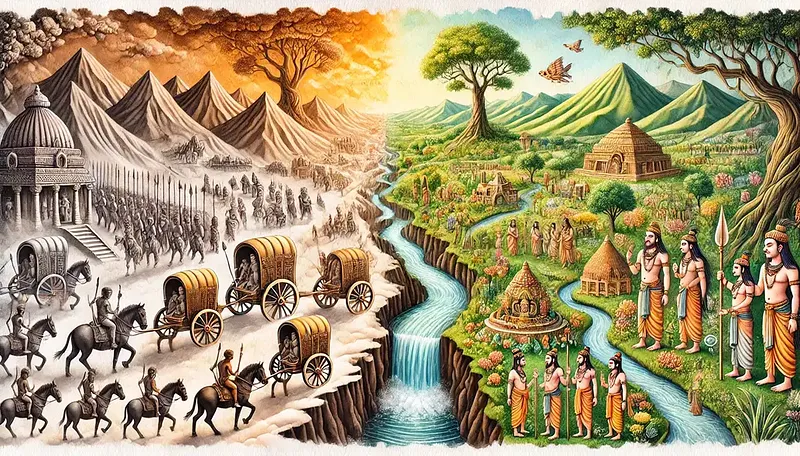
Agni was the originating god, and it is to Agni that the Rig Veda opens its invocation; Agni of the two heads, one harmful, one helpful; Agni of the three arms, the manifestation of fire in the heavens as the sun, in the sky as lightning, and on the earth as flame; Agni, the medium between the gods and humanity, the mediator between humans and the earth...1
Agni is the all-knower, who gazes out at the many dawns of creation over the unfolding days, and is sent forth as the rays of the sun spreading light across sky and earth. Stephen Pyne writes that perhaps nowhere other than India have the cultural and natural parameters of fire converged so closely and so clearly. In this ancient civilisation, fire was exalted, elevated to a divine status and incorporated into ritual, purification and sacrifice. The first hymn of the Ṛgveda is a hymn to Agni, who is second only to Indra in the number of hymns written to him.
Agni do I invoke—the one placed to the fore, god and priest of the sacrifice, the Hotar, most richly conferring treasure. Agni, to be invoked by ancient sages and by the present ones— he will carry the gods here to this place. By Agni one will obtain wealth and prosperity every day, glorious and richest in heroes.2 translation by Stephanie Jamison and Joel P. Brereton
Agni was eventually eclipsed by the numerous Gods that populated the Hindu pantheon after the Vedic era, however, the special status accorded to Agni was retained in ritual, where his appearance marks the beginning of every sacrifice. Fire remains as fundamental to Hinduism today as it was millennia ago. Its power of destruction is incorporated into myth and imprinted in religion, as in the Mahābhārata, wherein the God Agni consumes the Khāṇḍava forest and all the beings that dwell within. In the Bhāgavata Purāṇa, Kṛṣṇa consumes a forest fire that threatens to obliterate the cowherd boys and their herd of cattle that hid amidst the tall cane.
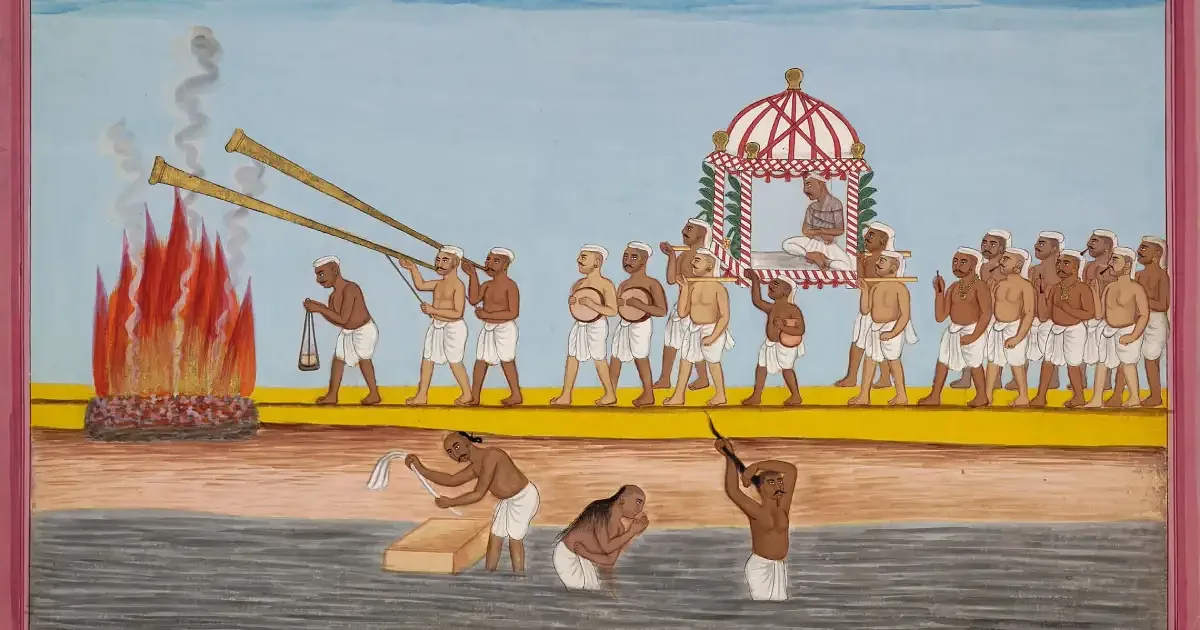
Fire accompanies birth, marriage, and every other milestone — in some cases, a flame from the same fire serving all through the liturgical life cycle. Life also ends in fire, the crematory flames engulfing the mortal body to ensure that the spirit ascends to paraloka. As Gaston Bachelard observed in his ‘The Psychoanalysis of Fire’ (1968), fire “links the small to the great, the hearth to the volcano, the life of a log to the life of the world.” The Śatapathabrāhmaṇa describes the spirit of the deceased journeying to the realm of ancestor-spirits as a metaphorical third birth. First, one is born from the mother and father. One whose dharma is to sacrifice is born a second time when he performs a sacrifice. He is born for a third and final time when placed upon the fire, and he arises again. Cremation exemplifies the transformative power of fire and its fundamental ability to affect our experience of the tangible materiality of the world. “Death in the flame is the least lonely of deaths. It is truly a cosmic death in which a whole universe is reduced to nothingness along with the thinker. The funeral pyre accompanies him in his passing.” (Gustave Bachelard, 1968).
Western Attitudes
In the 1851 novel ‘Moby-Dick’, the author Herman Melville describes the atrocious smell of boiling whale blubber on board the Pequod as having “an unspeakable, wild, Hindoo odor about it, such as may lurk in the vicinity of funeral pyres” (emphasis mine). During this period in time, associating an unbearable stench to human cremation and hence to Hindu India had already gained popularity around the world.
Moreover, many Western accounts claimed that cremation was a sign of the Hindu indifference towards — and even the mistreatment of—their deceased loved ones. Their hostile descriptions of cremation and its supposed immorality spurred debates among colonial writers and only served to reinforce the image that India was barely civilized by the standards of the Christian West. The British regarded their public display of emotion during funerals that was the norm among the bourgeois Victorian society as a mark of their superior civilization and nobler sensibilities. It is likely that they were unaware that much of the grieving takes place privately at home before the body was carried to the ghat for cremation. Europeans deplored the Hindus for their apparent lack of feelings for their dead. For instance, the sanitarian J. R. Martin in 1837, wrote that Bengalis showed “none of the tender feeling cherished in burying the dead among Christians.” In 1824, Bishop Reginald Heber of Calcutta claimed that Indians displayed no more emotion at a sati or cremation than “would have been called forth by a bonfire in England. I saw no weeping and heard no lamentations.”
The identification of Benares with its cremation ghats only increased, augmented by the first known photographs of Manikarnika being taken in the 1850s or 60s and through the burgeoning necro-tourism. Colonel Henry S. Olcott, the cofounder of the Theosophy Society, wrote of Manikarnika Ghat with the same stereotypical European repulsion: “a brutally realistic scene, with no poetry or refinement about it”. However, having witnessed a Buddhist cremation in Ceylon, Olcott later changed his mind about open-air cremation and the “all- purifying fire.” When he passed away, he was cremated on a sandalwood pyre.
In the late 1870s an unnamed Englishwoman, a long-time resident in India, visited Benares with her husband, with the preconceived notion that the city was the seat of “Brahminic superstition” which exhibited the lowest forms of sensuality, idolatry, and depravity. She found the views from the meandering Ganga beautiful. However, as her boat approached Manikarnika Ghat, she noted the sudden transformation from beauty and sunlight to deformity and gloom, calling it “Satan’s own metropolis”. She struggled to contain her horror and disgust as she looked upon the cremation pyres piled with “heaps and heaps of human bodies, brought thousands of miles, and from every quarter of the Eastern world, to be burned within the sacred precincts of the Ganges.” She wrote-
What a sight it was! and what a situation! Amid the crackling of human bones in the flames, the foetid odour that arose, and the countless piles of swathed corpses lying all around me, waiting their turn to be cremated, were seen the semi-nude bodies of living men, begrimed with human soot, and blackened with human charcoal, looking more horrible than even the piled-up heaps of the dead.. Through all the darkening sights and scenes which I have witnessed in my numerous journeyings and long residence in India, this fiery cemetery of the city of Benares looms ever before my memory, as if an enemy had been empowered to drag me through Tophet, and to transform for the moment the face of the fair and beautiful earth into a hideous place, at which the heart sickens and the mind turns away with loathing.3
Such descriptions by missionaries, travellers, and British residents alike, expressing their repugnance for Indian rituals and ceremonies were aplenty: Europeans in Bombay and other Indian cities relentlessly complained about cremation as public nuisance, an intolerable invasion of their urban space, a threat to their privacy and property, a religious affront, and health hazard. They argued that the practice must be banned or exiled to the outskirts of the cities. The frequent epidemics, such as bubonic plague in 1897, which caused bodies to pile up at cremation grounds, did little to curb the Western hostility to open-air cremation.
The loathing for Hindu cremation was made evident, with Christian representations painting a picture of barbarism, cruelty, and ungodliness. A London weekly declared in 189 that The Hindoos burn their dead in a very objectionable and primitive fashion, simply laying the body on a stack of wood . . . and setting fire to it.”
The story soon took an unexpected turn. Reviled by missionaries, opposed by the British, viewed as one of India’s more fascinating “spectacles” by Westerners, the traditional Hindu practice of cremation was strategically reconfigured in the late 19th and early 20th where emerging political, religious, and social movements intersected. Serving as a vehicle for assertive Hindu nationalism — distinguishing Hindu identity from burial-practicing Muslims and Christians — it also defined opposition to British colonialism. Paradoxically, while millions of Indians were dying of starvation and disease, their deaths, to the European observer, was nothing more than a spectacle and cremation was a curiosity of the morbid tourist gaze.
As nationalism and the independence movement in India gained traction, the bodies of the martyred dead were publicly commemorated, followed and mourned by vast crowds as the body was carried through the city to the burning-ground, and the cremated body often became a source of patriotism. The British reacted by prohibiting such fervent nationalist demonstrations while simultaneously conducting their own cremation ceremonies to honor Indians who had died in service of the British regime. This duality transformed the cremation ground into a contested space, representing both state rhetoric and anticolonial resistance.
Soon, akin to the cow-protection movements that emerged in late-nineteenth-century Northern India, cremation became an emblem of Hindu rights and identity, pitted against that of the colonizer and the Abrahamic “other”. Outside of India, wherever the British recruited vast numbers of Indians as indentured laborers, their right to cremation became a demand to respect their dead. For Indians that died abroad, the zeal to be cremated served as a vehicle for ethnic and religious self-assertion, advancing a renewed sense of Hindu religious identity.
The British also used fire as a tool of vengeance, to incinerate the dead and intimidate the living. Following the 1857–58 mutiny and rebellion, the British carried out many acts of retributive violence against the bodies of rebels. One was the brutal firing of captured sepoys from the muzzles of cannons. Another example was when the army of General James Neill in July 1857 entered the recaptured city of Cawnpore, and ordered that the corpses of Hindu rebels were to be buried in a deliberate reversal of the Hindu custom. The funerary fire that sanctifies the Hindus’ death was denied to them, to avenge the death of Europeans and prevent their memorialization as heroes and martyrs. Yet another striking instance was when, in the early 1920s, the Rampa Rebellion, a prolonged guerrilla uprising, erupted among the predominantly tribal communities in the northern regions of the Madras Presidency. When the rebel leader Alluri Sitarama Raju was finally captured and executed in 1924, his body was sent to a British officer and an Indian tahsildar for identification before being cremated without any rites or ceremony.
The Cremation Movement in the West
The once-abhorred practice gradually took on a more favourable character. Cremation fire was increasingly seen, not as a primitive violence or desecration of the body of the dead, but as a purifying, spiritual, ethereal ritual.
The process was slow. In 1864, Edmund A. Parkes, a former military doctor, published his Manual of Practical Hygiene, which contained a chapter on “the disposal of the dead” in which Parkes was highly critical, from a sanitary perspective, of earth-burial, preferring cremation. He remarked: “If the dead are buried so great at last is the accumulation of bodies that the whole country round a great city becomes gradually a vast cemetery.” He explained that decaying bodies release carbolic acid, ammonia, hydrogen, and other putrid gases. William Eassie, a British cremationist sided with Indian cremation, believing that when properly done, it was greatly superior to the endless Christian and Muslim burial grounds in Calcutta, which were “nurses for cholera, fever, and dysentery.”

For many in the West, cremation was inextricably viewed as a heathen practice. As a Times of India correspondent reflected in 1890, “There will be a reluctance to adopt a practice which is connected with religions which European missionaries are striving to obliterate.” Negative reports from India continued to surface in the British press as the cremation debate grew more heated. Critics questioned whether Britain truly intended to emulate India and adopt what they decried as an abhorrent, uncivilized, and un-Christian practice. Notwithstanding, the British reluctantly adopted “sanitary cremation” in brick crematoriums situated far from the cities.
For many in the West, open-air cremation in the Indian tradition was still deeply offensive. Beneath the opposition to what was a sanitary and practical practice lay entrenched prejudices: a disdainful perception of Indians, particularly low-caste and migrant laborers, as inherently inferior, and the persistent portrayal of India as primitive, regressive, and barbaric. For others, it entailed the pragmatic self-interest of the colonial regime and its reluctant acceptance of an immutable “other,” or a growing, genuine cultural interest in India, or perhaps simply an Orientalist curiosity for the exotic and unconventional. As David Arnold writes, “[e]ven in an age of strident imperialism and belligerent racism, India had its earnest enthusiasts and cultish devotees.”
Hindu cremation underwent a profound transformation, reclaiming its place with dignity and purpose. In defiance of crude Western stereotypes that dismissed Indian practices as backward and barbaric, and through a measured engagement with colonial concerns over sanitation and funerary customs, “traditional” cremation evolved into a modern rite and a public act of commemoration.
Historians have often noted how Hinduism was redefined from the late nineteenth century onward, shaped in opposition to colonial and internal others and consolidated across its once diverse socioreligious spectrum. Though cremation has received less attention in these discussions, it undoubtedly played a crucial role in constructing this modern, unified identity. By selectively adopting technological advancements from the West while maintaining its core tradition of open-air pyres, cremation became a symbolic marker of Hindu India's distinctiveness.
By the late 19th and early 20th centuries, cremation had gained social authority and political momentum among the Hindus, a force the British could neither control nor diminish. High-profile cremations of intellectuals, spiritual leaders, and nationalist figures elevated the practice’s public stature and solidified its status as an essential Hindu rite.
Contemporaneously, this modernized form of cremation harkens back to the Vedic conception of sacrifice, where the body of the illustrious dead becomes an offering to the Gods, seeking assurance for the well-being of the nation, its people, and the enduring strength of the Hindu faith. Cremation was as a bridge between the ancient and the modern, a timeless sacred ritual that affirmed an overt religious identity.
Note: Most of the information in this article is taken from Arnold, David. Burning the Dead: Hindu Nationhood and the Global Construction of Indian Tradition. Berkeley: University of California Press, 2021.
References
- Stephen J. Pyne, Nataraja: India's Cycle of Fire, Environmental History Review, Volume 18, Issue 3, Fall 1994, Pages 1–20.
- Joel P. Brereton, Stephanie W. Jamison, The Rigveda: The Earliest Religious Poetry of India. United Kingdom: Oxford University Press, 2014.
- “Cremation in India,” The Young Folk’s Budget, April 19, 1879, 253.