
Caturmukha liṅga in the sanctum of Chaumukha Mahadeo Temple, Nachna Madhya Pradesh. Archaeological Survey of India.
In the broad and complex landscape of Hindu religious symbolism, few icons evoke the depth of metaphysical meaning, ritual potency, and aesthetic significance as the liṅga of Śiva. Etymologically rooted in the Sanskrit word liṅga, meaning “sign,” the Śiva liṅga traverses a spectrum of interpretations—from the subtle metaphysical principle (liṅga śarīra) to the concrete phallic form, and ultimately to the cosmic principle itself, prakṛti or pradhāna. One of the most profound and visually arresting iterations of this icon is the mukhaliṅga—a liṅga adorned with the anthropomorphic face or faces of Śiva. The mukhaliṅga stands at the intersection of abstraction and embodiment, offering a composite vision that integrates the metaphysical with the manifest.
The Liṅga Purāṇa (LP) presents Śiva’s liṅga as encompassing three primary significations: as liṅga, as a phallus, and as a cosmic substance—prakṛti, the subtle matter constituting Śiva’s liṅga śarīra or subtle body (LP 1.20.70). The Śvetāśvatara Upaniṣad introduces this idea by stating that the supreme Lord has no liṅga, meaning he is beyond characteristics and transcends all signs (ŚU. 6.9). Yet paradoxically, Śiva is signified by the liṅga—the “sign” that points toward the imperceptible and yet is real.
The liṅga, then, becomes a symbolic bridge between the unmanifest and the manifest. As the potentiality latent within a thing (such as fire in kindling), it signifies the imperceptible essence—what exists before and beyond form. In the Sāṅkhya and Yoga darśanas, liṅga denotes the subtle body—liṅga śarīra—that precedes and sustains the sthūla śarīra, or gross body. Śiva, as the imperishable puruṣa, is both the animating principle of this subtle body and its substratum.
The Phallic Form
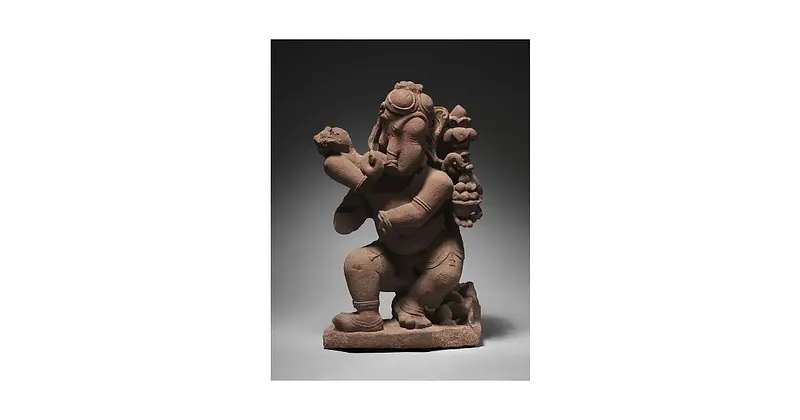
 Ekamukhaliṅga, Kashmir, 7th century. The Metropolitan Museum of Art
Ekamukhaliṅga, Kashmir, 7th century. The Metropolitan Museum of Art In the symbolic embodiment of the liṅga as a phallus, Śiva is present in the generative power of the phallus, containing the bīja or seed. Just as the seed is invisible within the phallus, Śiva remains unseen within the liṅga. The Mahābhārata (7.172.86–90) affirms that Śiva is recognized within the liṅga, not as the liṅga itself, but as the presence dwelling within and operating through this form. This phallic symbolism intersects with the cosmological—since the liṅga is also the cosmic pillar, the axis of creation, and the niṣkala stambha through which Śiva manifests.
In certain temples, such as Chidambaram, the liṅga is represented by ākāśa (space), the subtlest of the five elements. Here, Śiva is worshiped in the form of the ākāśa liṅga, a symbol that embodies not only spatial extension but also the ungraspable, all-penetrating presence of the divine. The absence of tangible shape accentuates the presence of the Absolute in its most transcendent form, being beyond rūpa (form), śabda (sound), and nāma (name).
Niṣkala and Sakala: The Iconic and Aniconic
Śaiva theology distinguishes between the niṣkala and sakala aspects of Śiva. The former means “without parts” and denotes the absolute, formless, undivided reality—the brahman (Śiva Purāṇa 1.5.10). The latter refers to Śiva with discernible features—sākāra, or form. The Śiva Purāṇa (ŚP) clarifies that while the niṣkala liṅga is reserved for the innermost sanctum, representing the transcendent Lord, the sakala images are varied and serve as outward, embodied expressions of the same reality (ŚP 1.5.11–13, 20–24).
The iconic (sakala) and aniconic (niṣkala) forms thus exist in a continuum. The pillar is not merely a symbol; it is the form through which Śiva reveals his svarūpa, his true nature. The dual modes of worship—through image and through sign—highlight the dialectic of Hindu theology: the Absolute is both with form and beyond form.
 From: The Presence of Śiva by Stella Kramrisch, 1988
From: The Presence of Śiva by Stella Kramrisch, 1988
The Emergence of the Mukhaliṅga
Among the most remarkable visual syntheses of Śaiva iconography is the mukhaliṅga—a liṅga combined with the face (mukha) or faces of Śiva. These heads project from the curved surface of the liṅga and are modeled from the ears forward, integrating seamlessly into the cylindrical shaft. The faces manifest the ontological reality of the liṅga, making explicit the hidden essence of Śiva.
 Caturmukha Liṅgā, copper alloy; dated 1045 (Thakuri period), Nepal (Kathmandu Valley). The Metropolitan Museum of Art
Caturmukha Liṅgā, copper alloy; dated 1045 (Thakuri period), Nepal (Kathmandu Valley). The Metropolitan Museum of Art The five faces of Śiva corresponds to the pañcabrahmans—Sadyojāta, Vāmadeva, Aghora, Tatpuruṣa, and Īśāna. Each is associated with a direction, a mantra, an element, a sense, and an organ of perception or action. The Taittirīya Āraṇyaka (TĀ 10.43–47) first articulates this fivefold system, which is echoed in later texts like the Liṅga Purāṇa (LP 2.14.1–31).
 From: The Presence of Śiva by Stella Kramrisch, 1988
From: The Presence of Śiva by Stella Kramrisch, 1988 Predominantly, mukhaliṅgas are four-faced, each aligned with one of the four cardinal directions. The fifth face, though not depicted, is understood to be present—transcendentallyy positioned at the top, beyond the reach of sensory perception. This fifth face represents Īśāna, the upward-pointing aspect of Śiva’s divinity, often described as colorless or crystalline in form.
The mukhaliṅga thus becomes a mantric object—its faces corresponding to thought-forms or mantras in which the deity is immanent. The five faces each correspond to the five syllables of the pañcākṣara mantra—namaḥ śivāya. In worship, the devotee encounters Śiva not only in image but also through vibration, devotion, and presence.
A purāṇic tale from Kanchipuram recounts that Śiva, after destroying creation in one night, manifested as a liṅga of light — liṅgodbhava. Within this fiery column, he recreated the world—planets, gods, humans, animals, and more. Brahmā, after worshiping this linga, was granted the power of creation. Here, the jyotirliṅga is both cosmic event and personal revelation—a meeting point of dissolution and genesis, emptiness and form.
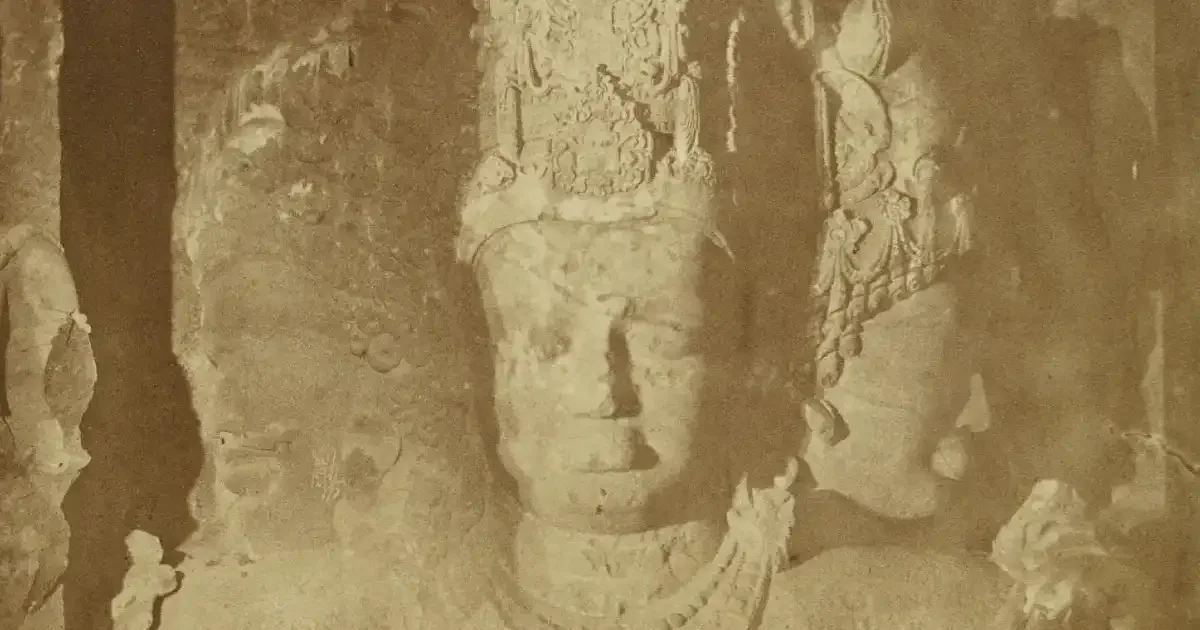
The temple to Śiva at Elephanta captures this metaphysical insight in art. Within its stone-carved sanctum, a pure cylindrical liṅga rises in stark contrast to the surrounding monumental sculpture of Sadaśiva, which itself integrates the vertical liṅga form. This aesthetic confluence of myth, ontology, and vision allows multiple modes of understanding to inhabit one sacred space.
 Trimurti sculpture at Elephanta, Bombay, dated 1862. William Simpson
Trimurti sculpture at Elephanta, Bombay, dated 1862. William Simpson Tāntrika Symbolism
Beyond theological symbolism, the mukhaliṅga also encodes a tantric map of spiritual ascent. The ūrdhvaliṅga—the upright, vertical liṅga—symbolizes the retention and upward movement of creative energy, retas, transformed into bodhicitta, the awakened mind. The head or heads upon the liṅga represent this sublimation: the conversion of procreative energy into mental and spiritual illumination.
This idea resonates with the tantric interpretation of the spine as a sacred conduit. The faces on the liṅga signify awakened centers of consciousness along this vertical axis. The mukhaliṅga thus becomes a symbolic composite of human physiology, cosmic reality, and metaphysical insight—a visual shorthand for liṅgopāsanā, or meditative worship of the liṅga.
Svāyambhuva Liṅgas and the Sanctity of Stone
Among liṅgas, the svāyambhuva or self-existent ones hold special reverence. As the Kāmikāgama states, these were not made by human hands but arose spontaneously—manifestations of divine will. These natural stone liṅgas are believed to have existed eternally, saturated with prakṛti’s timeless essence. Even man-made stone liṅgas partake of this aura, inheriting the sacred density and permanence of their material.
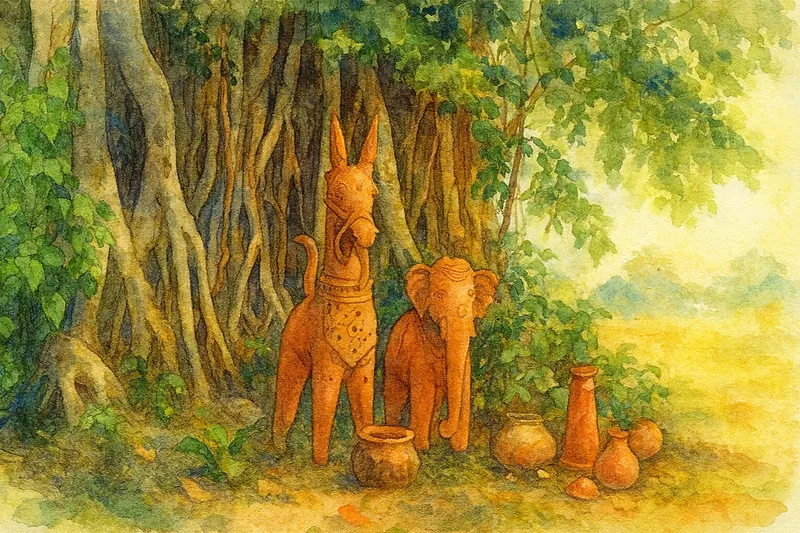
Many mukhaliṅgas, whether natural or sculpted, are found in vessels and urns bearing human features—traditions that coalesced into the concept of the mukhaliṅga. This form represents the crystallization of sacred sound, mantra, and form into a visible, touchable icon.
The mukhaliṅga, in its gradation of form, maps the spectrum from the unmanifest Paramaśiva to the fully manifest Maheśvara. At one end is the formless, undifferentiated liṅga; at the other, the anthropomorphic images of Śiva. Between these poles lies the pañcamukha liṅga—neither fully formless nor fully formed—a symbolic midpoint where abstraction begins to take shape, where the transcendental becomes immanent.
In the aṣṭamūrti concept, where Śiva manifests as the eight realities of the cosmos, the pañcabrahman structure of the mukhaliṅga reflects his totality. The human body, as microcosm, becomes the site of realization. The four visible faces of the linga look outward toward the world, but the fifth—crystalline and upward—points to the Absolute.
The mukhaliṅga stands as a powerful theological and iconographic synthesis within the Śaiva tradition, uniting the abstract metaphysical principles of the liṅga with the anthropomorphic presence of Śiva. Its form reflects a layered cosmology: at once a symbol of the unmanifest (niṣkala), a manifestation of divine agency in the world (sakala), and a visual embodiment of sacred sound and elemental structure through the pañcabrahman schema. By integrating symbolic verticality, tantric interiorization, and devotional accessibility, the mukhaliṅga affirms the Śaiva vision of a divine reality that transcends yet permeates all forms. As such, it is not merely an object of worship but a theological statement rendered in stone or metal—a point of convergence where ontology, ritual, and art intersect.
References: The Presence of Śiva by Stella Kramrisch, 1988