Ask about Dhurandhar today, and many people may first think of the recent film Dhurandhar. The word itself now circulates through cinema, publicity, and popular recall. But long before this contemporary echo, there was M. V. Dhurandhar: a true dhurandhar of the arts, a formidable master whose name once commanded respect across the worlds of painting, illustration, art education, princely patronage, and popular visual culture.
To return to Mahadev Vishwanath Dhurandhar today is to return to a question Indian art history has not always treated with sufficient patience. What do we do with the Indian academic painter? More precisely, what do we do with an artist who trained within the apparatus of colonial art education, mastered its realism, and accepted its demands of draughtsmanship and pictorial order, yet filled that canvas with Indian ceremony, gendered presence, devotional feeling, social detail, and the visual life of a society in transition?

Dhurandhar, born in 1867 and active until his death in 1944, stands at one of the most revealing junctions in modern Indian art. He was shaped by the Sir J. J. School of Art in Bombay, became one of its most distinguished teachers, and belonged to that broad formation we now identify as the Bombay School. But it was not the Bombay of later manifestos, bohemian rebellion, and post-independence modernism. It was an earlier Bombay: mercantile, colonial, reformist, multilingual, princely-connected, print-saturated, and visually hungry. It was a city in which art traveled between the academy, the court, the lithographic press, the illustrated book, the theater hoarding, the advertisement, the calendar, and the middle-class home.
Dhurandhar’s career cannot be understood apart from this world of circulation. He was not only a painter of canvases. He was an illustrator, designer, teacher, portraitist, chronicler of ritual life, maker of popular images, and interpreter of mythological and social subjects. His hands moved from princely commissions in Sangli and Aundh to illustrations and advertisements meant for a wider public. This range has often worked against him in art-historical memory. The modern museum prefers the singular artist before the autonomous work. Dhurandhar belonged instead to a more porous visual culture, where the distinction between fine art and applied art had not yet hardened into a moral hierarchy.
The phrase often used for him, “romantic realist,” is useful only if we handle it carefully. Dhurandhar was indeed a realist in the academic sense. He understood anatomy, proportion, perspective, modeling, costume, and the construction of narrative space. His figures stand securely within the pictorial field. His groups are carefully arranged. His surfaces reveal a disciplined eye trained by colonial pedagogy. But his realism is always social. He paints not simply what bodies look like but how bodies behave within ritual, gender, rank, affection, labor, and devotion.
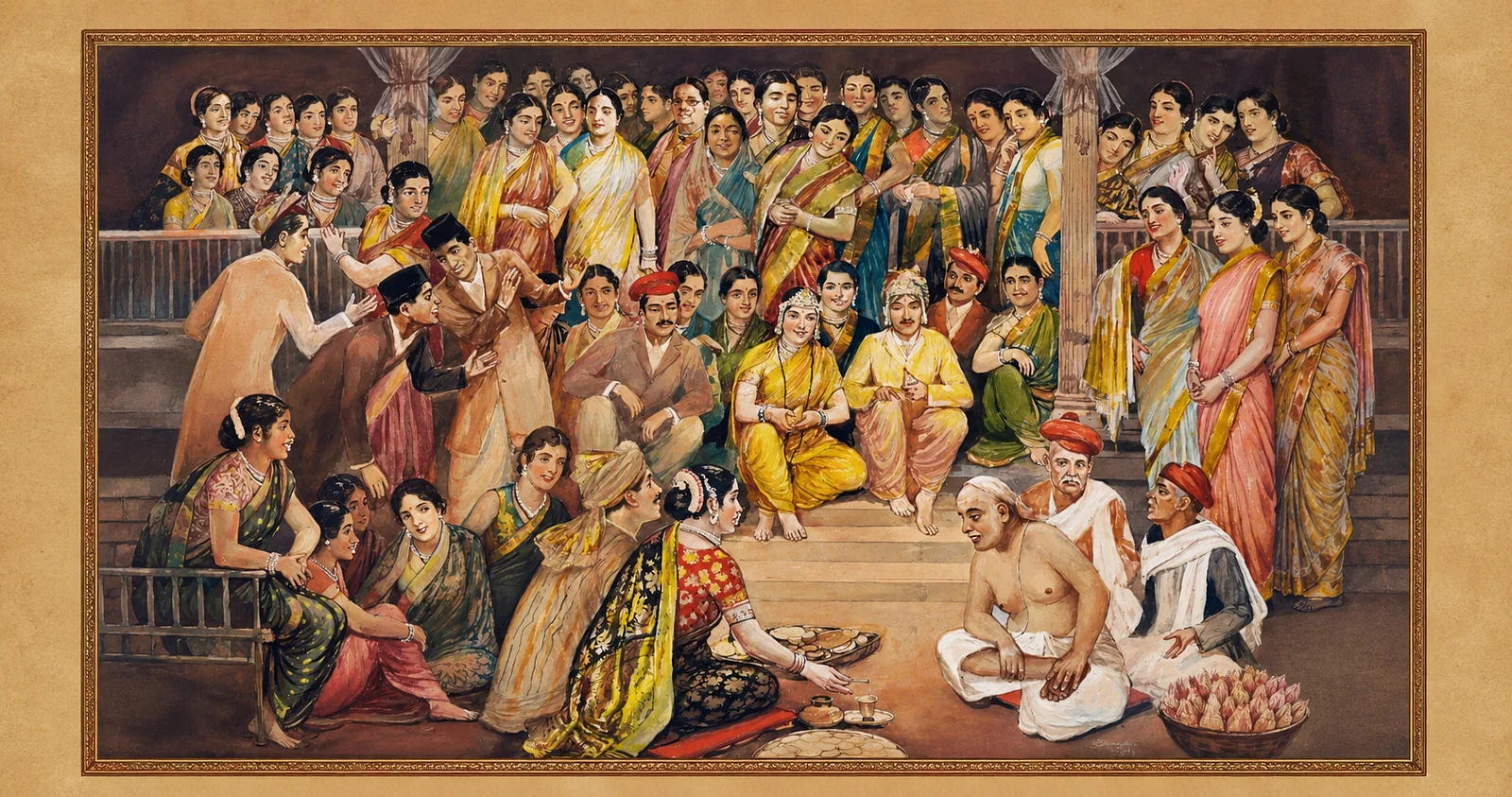
 In Scene of Hindu Marriage Ceremony and A Pathare Prabhu Wedding Ceremony, we find Dhurandhar at his most revealing. The wedding is not treated as a picturesque custom, nor as a decorative display of “native” life. It is rendered as social theater, but theater of a serious kind. The eye moves across garments, turbans, jewelry, ritual vessels, flowers, seated bodies, absorbed faces, and gestures of attention. The bride and groom may occupy the ceremonial center, but the painting is sustained by the human field surrounding it: elders, women, officiants, attendants, kin, and observers. Dhurandhar understands that ritual is not an event but an arrangement of relations. This is why his marriage scenes deserve to be read as social documents, but not in the narrow documentary sense. They do not simply record a ceremony but reveal the social life. A wedding, in Dhurandhar’s hands, becomes an occasion to paint community, gendered etiquette, domestic authority, sacred form, public display, and emotional containment. His realism is at once descriptive and interpretive. It tells us how people sit, look, wait, participate, and hold themselves before the sacred and the social gaze.
Dhurandhar’s art also opens an important question about the relation between colonial knowledge and Indian representation. The nineteenth-century colonial state and its allied institutions produced an immense visual archive of Indian communities, costumes, crafts, occupations, and rituals. Much of this archive was classificatory. It converted people into types. Dhurandhar worked in a period saturated by that habit of seeing. Yet his best works exceed the coldness of ethnographic classification. His figures are never only specimens of community. They have interiority, even when rendered within conventional settings.
This is particularly visible in his treatment of women. Dhurandhar’s women are among the most remarkable presences in late colonial Indian art. Whether as bride, devotee, goddess, water-carrier, worker, or domestic figure, they are painted with a rare combination of grace and self-possession. They do not merely serve as ornaments within the pictorial scheme. They occupy space. Their bodies carry awareness. Their gestures are restrained but not passive. The face may be lowered, but the figure is not diminished. The sari, jewelry, hair, and posture are rendered with care, yet the woman is never reduced to a costume.
This is where Dhurandhar differs from both colonial ethnographic illustration and much nationalist idealization. The ethnographic image often turns the woman into a bearer of type. The nationalist image often turns her into an allegory: Bhārat Mātā, Śakti, purity, sacrifice, and tradition. Dhurandhar’s women are closer to social beings. They inhabit a world of work, affection, adornment, ritual, and everyday dignity. His gaze is not free of the conventions of his time. No painter is. But it is attentive rather than possessive. He gives women pictorial weight.
The comparison with Raja Ravi Varma is inevitable, and rightly so. Both artists worked through European realism to render Indian mythological and social subjects. Both entered the world of reproducible images. Both helped create a popular visual vocabulary for modern India. Yet Dhurandhar’s contribution is distinct. Ravi Varma often monumentalized myth through the aura of oil painting, theater, and aristocratic portraiture. Dhurandhar worked with a more dispersed visual intelligence. He moved easily between the divine and the domestic, between the courtly and the civic, between the sacred episode and the social scene. His art is less about heroic singularity and more about inhabited worlds.
In this sense, Dhurandhar’s importance lies not only in his paintings but also in his understanding of image circulation. He knew that modern Indian seeing was being formed outside the elite gallery. Lithographs, calendars, advertisements, book illustrations, postcards, and posters were remaking the visual habits of a new public. Dhurandhar participated in this process with unusual skill. He did not see applied art as a lesser activity. He understood, perhaps more instinctively than many later critics, that public visual culture is where a society repeatedly encounters itself.
This is also why his exclusion from the central narrative of modern Indian art is revealing. After independence, Indian art history was shaped by powerful stories of rupture. The Bengal School was celebrated for rejecting colonial academic realism and recovering an “Indian” spiritual idiom through the wash technique, Mughal-Rajput references, and anti-materialist sensibility. Later, modernists claimed another freedom: abstraction, distortion, urban anxiety, cosmopolitan form, and a conscious break from both revivalism and colonial academicism. Between these two histories, the Bombay academic painter became difficult to place.
Dhurandhar suffered from this discomfort. To nationalist critics, he could appear too close to colonial pedagogy. To modernists, he could appear too readable. To curators, he could appear to be too many things: a painter, an illustrator, a designer, and a popular imagemaker. To a canon built around formal innovation, his commitment to recognizable beauty seemed unfashionable. Yet this judgment tells us more about the limits of the canon than about Dhurandhar.
Realism in colonial India was never a simple matter of imitation. It was a contested visual language. It could certainly be used to discipline Indian artists to European standards. But it could also be redirected toward Indian subjects, publics, and affective worlds. Dhurandhar’s paintings show this redirection precisely. The academic method remains visible, but its emotional and social charge is Indian. He uses colonial training to paint Hindu ceremonies, Maharashtrian women, devotional scenes, princely figures, urban communities, and the minute choreography of social life.
The question, then, is not whether Dhurandhar was derivative. The better question is, what did Indian artists make realism do? In Dhurandhar’s case, realism became a medium of recognition. It allowed viewers to see themselves, their rituals, their dress, their gods, their domestic arrangements, their ceremonies, and their social relations. It made beauty public without obscuring it. It offered intelligibility without surrendering craft. It gave dignity to the ordinary gesture.
This accessibility has often been mistaken for artistic simplicity. But accessibility is not the enemy of seriousness. Dhurandhar’s best works are serious because they understand the visible as a carrier of social meaning. A bride’s posture, a woman’s sideways glance, the arrangement of a wedding group, the texture of a sari, the bend of a worker’s body, and the meeting of Rādha and Kṛṣṇa—these are not merely pleasing images. They are acts of cultural translation. They bring together academic training, Indian subject matter, emergent publics, and the emotional codes of late colonial society.
To rediscover Dhurandhar today is therefore not an antiquarian exercise. It is a correction in the history of Indian seeing. It asks us to revisit the Bombay School, colonial art education, print culture, popular devotional imagery, the role of women in social representation, and the relationship between realism and public life. It also asks us to loosen the grip of a narrow modernist suspicion that too often treated recognizable form as an intellectual failure.
Dhurandhar’s art does not announce itself through rebellion. It gathers its force through attention. It notices the ceremony, the household, the body, the garment, the threshold, the god, the bride, the worker, the community. It does not seek to shatter tradition, nor does it freeze tradition into lifeless nostalgia. It paints a picture of social continuity amid change.
This is his quiet power. In Dhurandhar, colonial realism becomes something more layered than an imported style. It becomes a language through which Indian society, in the late nineteenth and early twentieth centuries, began to picture itself in public. His work stands between the court and the city, the sacred and the civic, the manuscript memory and the printed image, the academic classroom and the popular bazaar. He belongs to all these worlds, and for that very reason, he escaped the neat categories through which we later wrote art history.
M. V. Dhurandhar was not a minor academic painter awaiting polite recognition. He was one of the makers of modern Indian visual culture. To see him again is to recognize that the story of Indian art is not only the story of nationalist revival or modernist rupture. It is also the story of realism, reproduction, ceremony, gender, public taste, and the long life of images among ordinary viewers.
His forgottenness, then, is not accidental. It is a symptom. And his return allows us to ask what else Indian art history has misplaced in its desire for cleaner narratives.