Read Parts One, Two, Three here
In our last conversation beneath the banyan tree, we spoke about yātrā — how a journey need not always begin with a departure or end at a destination. We explored how even a familiar ritual, observed year after year, could become a journey of its own. I was thinking about that conversation recently. We spoke of the things we carry with us on these journeys, the people who walk alongside us and the experiences that leave their mark on us. But who helps us make sense of all that we encounter? Who teaches us to pause, to observe, to question and, sometimes, simply to listen?
That brought me back to a question we had touched upon earlier.
Gurus? Why plural?
The more I sat beneath the banyan thinking about it, the more I realised that we were certainly not the first to ask this question. Long before us, seekers had understood that wisdom does not always come from a single teacher, a single book or even a single tradition. They showed us another way of learning — to observe, to listen, to remain humble and to be open to whatever life places before us. A person may teach us through words, another through silence, and yet another through the way they live. Sometimes the lesson may come from something as ordinary as a tree, a river or a bird. The teacher need not even know that we are learning from them.
Think about how much we learn simply by watching those around us. As children, we rarely understood that our parents were teaching us. We watched how they spoke to others, how they dealt with difficult situations, how they welcomed guests and how they went about their daily routines. There were no formal lessons, no instructions written down for us to follow. Much of what we absorbed came from being around them. I often think of my mother in this context. There are things she taught me without ever sitting down to teach me. Some I understood only much later, when life placed me in situations where those lessons suddenly made sense.
And perhaps we too are teachers without realising it. Someone may be watching the way we live, listening to something we say, or simply observing how we respond to a difficult moment, and carrying away a lesson from us that we may never know we gave. It is an interesting thought, isn't it? We spend so much time looking for teachers, but we may ourselves be teaching someone through the simplest things we do.
Perhaps that is the beauty of remaining a seeker. We never really arrive at a point in life where we can say that we have learnt enough. Every experience has something to leave behind, if only we are attentive enough to notice it. We gather knowledge, reflect upon it and slowly, through living, begin to understand what that knowledge means to us. Sometimes the understanding comes immediately; sometimes it takes years. To learn with humility, while remembering that our own lives may be teaching someone else — that too is part of being a seeker.
This thought brought me back to the word yātrā. We had spoken of it as a journey, but perhaps every yātrā is also a journey of learning. We begin with a certain understanding of ourselves and of the world, and somewhere along the road, something changes. We encounter people, places and experiences that quietly alter the way we see. We may not recognise the change while it is happening; only when we look back do we realise that the person who began the journey is not quite the person who returned. Perhaps that is why the journey matters as much as the destination. The road itself becomes the teacher.
And this brought to mind a story of a king who once encountered a wandering ascetic and asked him a very simple question.
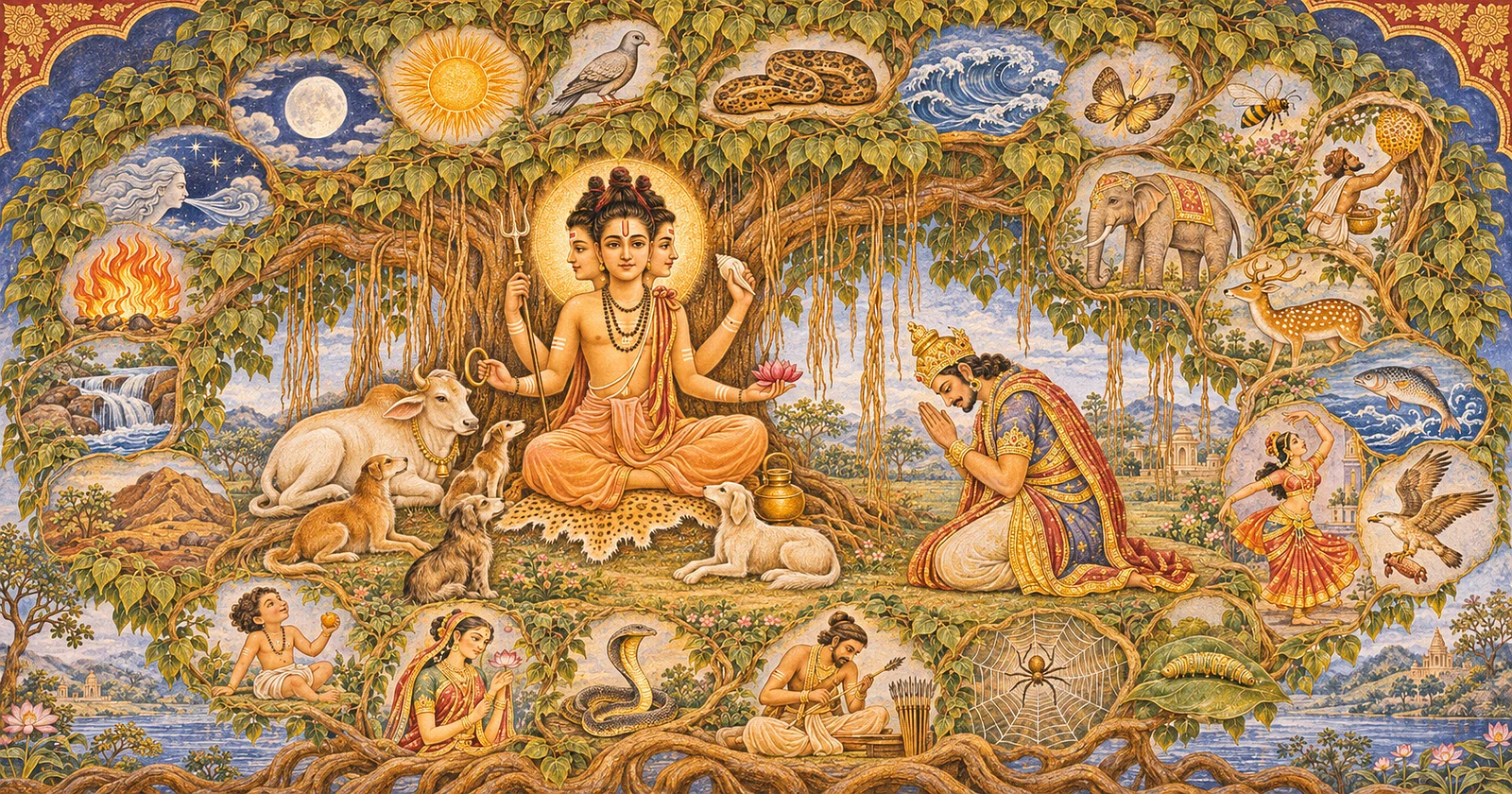
The king was Yadu, and the ascetic was Dattātreya.
Yadu had seen many holy men before, but there was something unusual about this one. He appeared to possess almost nothing, yet he seemed completely at ease. There was no visible sign of wealth, position or worldly success, and yet there was a quiet contentment about him that even a king might envy. What had this man discovered that allowed him to remain so peaceful when he had so little? Was it something he had learnt from a teacher? Had he spent years in the company of learned sages? Curious, Yadu approached him and asked where he had learnt such freedom.
Dattātreya did not name a teacher in the way Yadu might have expected. Instead, he told the king that he had twenty-four Gurus.
I can almost imagine Yadu's expression. A Guru is one thing; two or three might still be understandable. But twenty-four? And these were not twenty-four learned sages sitting in an āśrama waiting to instruct him. Dattātreya had learnt from the world itself — from the Earth, the wind, the sky, water and fire; from the Sun and Moon; from animals, birds and insects; from people he encountered and from the things he simply observed.
What an unusual way of looking at the world! Imagine finding a teacher in the Earth beneath your feet, in the wind that passes without holding on to anything, or in a bird going about its daily search for food. We usually look for wisdom in places where we expect to find it. Dattātreya seemed to have discovered that it could be found almost anywhere.
Suddenly, our own conversations beneath the banyan seemed to take on a different meaning. Had we not already been doing something similar? We had listened to the river. We had watched the rain. We had sat with the Earth. We had looked towards the Sun. Each had left us with a thought, a question, perhaps even a little change within ourselves. Maybe we had been speaking of Gurus without realising that we were already walking a path that Dattātreya had walked long before us.
I began to wonder whether there is a difference between merely seeing something and actually observing it. We pass trees every day, but how often do we stop to notice how they grow, how they bend with the wind, how they provide shelter to so many living beings? We hear the river flowing, but do we ever sit long enough to watch the way it moves around an obstacle? We see the Sun rise and set every day, and yet there is something new to notice each time. Perhaps the world has been offering us lessons all along, but we have been too occupied to pay attention.
And now I found myself becoming curious about the things Dattātreya had noticed. What had the Earth taught him? What had he seen in the Sun? What could the wind possibly teach a seeker? And what could an arrow-maker, a spider or a moth have to do with wisdom? The questions seemed almost amusing, and yet there was something wonderfully disarming about them. If Dattātreya could look at the ordinary world and discover teachers everywhere, perhaps the real lesson was not simply about the twenty-four Gurus at all. Perhaps it was about learning how to look.
Of course, this does not mean that we no longer need human teachers or that every observation can replace the guidance of a Guru. There is so much we learn through the wisdom and experience of those who have walked the path before us. A good teacher can help us see what we might otherwise overlook. But perhaps Dattātreya was showing us that learning need not be confined to the place where we go seeking it. Sometimes it comes from an unexpected encounter; sometimes from a moment of silence; and sometimes from something we have seen a hundred times but never really noticed.
Each person's yātrā is different. The people we meet, the experiences we gather and the lessons that stay with us are shaped by the lives we lead. What speaks deeply to one seeker may not speak in quite the same way to another. And that is perfectly alright. We do not all have to learn in the same way or arrive at the same understanding. What matters is that we remain open to learning, even when the teacher appears in an unexpected form.
The banyan above us rustled gently, its leaves catching the afternoon breeze. I looked up at its vast branches and wondered how many people had sat beneath trees like this before us, asking questions, listening and learning. We were certainly not the first seekers to sit beneath a tree and wonder about the mysteries of life. Perhaps we were simply the latest ones on an ancient path.
And so, beneath our banyan, we began to follow the footsteps of a seeker who had discovered twenty-four Gurus in the world around him. I found myself wondering what each of them had taught him, and whether we had been walking past our own Gurus without recognising them.
Perhaps it is time we stopped for a while and looked again.