.png)
Read Part One, Two, Three, Five, Six
Introduction
A Civilizational Invitation
A yātrā in Bhārata is an invitation.
To step into the layered stories of the world's oldest living civilization,
To immerse in wonder at the treasures that open up,
To allow one's consciousness to expand in communion with this ancient land.
A yātrā pushes our imagined boundaries. Civilizationally, it is designed to transform and elevate. When we come out on the other side, we are no longer the same.
In this series of evocative photo essays, join Shubham Pal on his journey across Bhārata—through its hallowed millennia-old history, monuments, kṣetras, art and craftsmanship, regional delicacies passed down through generations, and relish with joy his encounters with the large-heartedness of her people and culture.
Come, learn of Bhārata with a yātrī who has chosen to traverse the lesser-known paths.
Author's Introduction & Context Setting
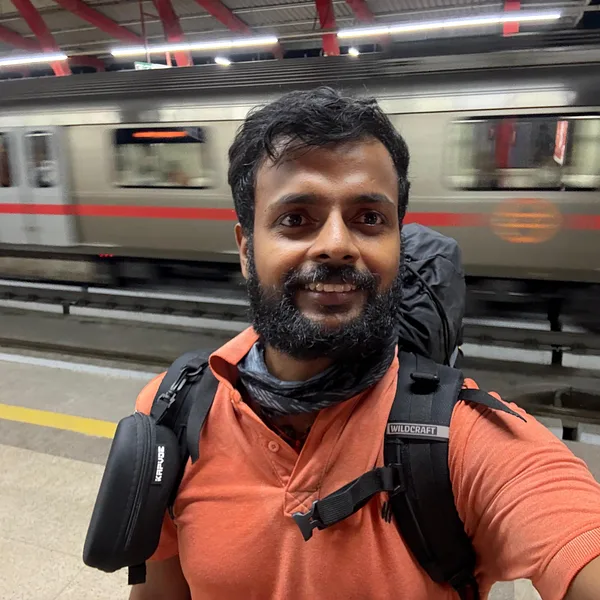
I am Shubham Pal, originally from Varanasi and currently living in Delhi, where I work as an Electrical Engineer. For months, one question stayed with me: How well do I really know Bharat? I had read about its history, traditions, and diversity, but I wanted to experience them firsthand rather than through books or social media. I wanted to meet people from different communities, learn about their crafts, taste local food, understand their way of life, and experience the land at the pace of a bicycle.
Like many young professionals, I had both professional and family responsibilities. Funding a months-long expedition meant that leaving my job was not an option. Fortunately, my job allowed me to work remotely, making it possible to pursue this dream without stepping away from my career or neglecting my responsibilities at home. Carrying my laptop throughout the journey, I balanced my office work with the expedition.
Maintaining both commitments was the most challenging part of the journey. Most days began early in the morning with long hours of cycling, often lasting until evening or sometimes until nights. After reaching my destination and finding a place to stay, I would open my laptop and complete my office work, frequently working late into the night. Most nights, I slept for only four to five hours before beginning the next day's ride. The journey tested not only my physical endurance but also my discipline, resilience, and ability to balance adventure with my professional and family responsibilities.
My interest in Indian Knowledge Systems (IKS) also shaped this journey. I have always been fascinated by the idea that knowledge is not confined to classrooms but is gained through observation, travel, dialogue, and lived experience. I wanted to understand Bharat by experiencing it directly—through its landscapes, its people, its traditions, and its living culture.
This photo essay series is a reflection of that journey. Beginning with Gujarat and continuing along India's coastline, these photo essays showcase the story of the places I visited, the people I met, and the lessons I learned. For me, this expedition was an attempt to understand Bharat not as a tourist, but as a learner. Every kilometre became a lesson, every conversation a classroom, and every village a chapter in understanding the country I call home.
Photo Essay Part Four
After a refreshing rest day in Mandvi, it was time to get back on the road. My destination for the day was Bhachau, and by the end of the ride, I had covered around 137 kilometers.
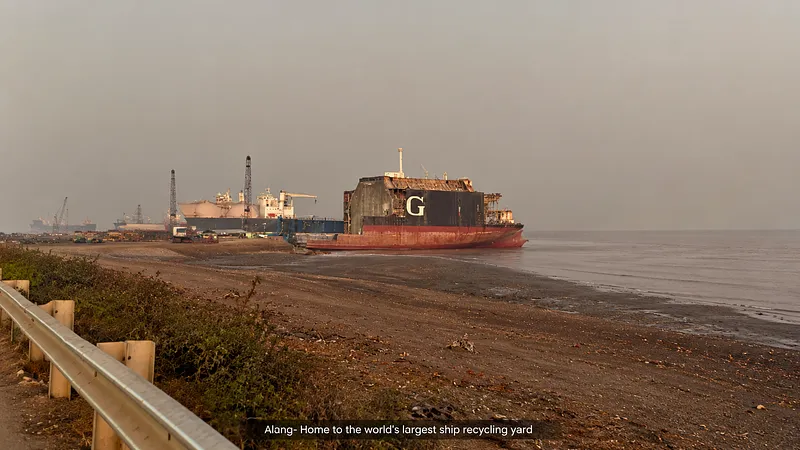
I chose to ride through the Mundra region. As I approached the area, the landscape changed dramatically. The peaceful roads of Kutch gave way to large industrial complexes, factories, and heavy truck traffic. It was fascinating to witness one of Gujarat's major industrial hubs in action.
At the same time, the journey made me reflect on the impact of rapid industrialization. While these industries provide employment and drive economic growth, they also leave a visible mark on the environment and influence the lives of the people living nearby. Cycling through the region gave me a chance to observe both sides of this development from close quarters.
As the day came to an end, I reached Bhachau, carrying with me not just the kilometers I had ridden, but also new thoughts and perspectives gained along the way.
24th December 2025
On 24th December, I left Bhachau and cycled towards Amran, covering around 102 kilometers. By evening, I reached the Meldi Maa Temple Ashram, where I decided to stay for the night.
Along the way, I passed through vast agricultural fields and, for the first time, witnessed the cultivation of kapas (cotton). Seeing the white cotton spread across the fields gave me a new appreciation for the hard work of the farmers and the importance of agriculture in this region.
The most memorable part of the day, however, was my stay at the ashram. A group of devotees was also staying there, preparing to walk all the way to Dwarka to participate in the flag ceremony at the top of the Dwarkadhish Temple. They spoke Kutchi, a language I couldn't understand, yet we never felt like strangers. Through smiles, gestures, and a few shared words, we managed to communicate and spent the evening together.
They warmly welcomed me and served me a simple homemade meal. The authentic desi khana was one of the tastiest meals I had eaten on the journey. It reminded me that kindness doesn't depend on language—it is understood by everyone.
As I went to sleep in the peaceful surroundings of the temple, I felt grateful for another day on the road, filled not just with kilometers, but with unforgettable human connections.


25th December 2025
On 25th December, I left the Meldi Maa Temple Ashram after taking the blessings of Meldi Maa. Before departing, I offered my respects to the elders and the group of devotees I had spent the previous evening with. Although we spoke different languages, they had treated me like family, and saying goodbye was not easy.
My destination for the day was Amran, around 95 kilometers away.
As I rode towards Jamnagar, the surroundings changed once again. The city was heavily industrialized, and I could clearly see its impact on the environment. At one point, I came across what looked like a black river or drainage canal. I wasn't sure exactly what it was, but its condition was disturbing and made me reflect on the environmental cost of rapid industrial development.
By evening, I reached a Hanuman Temple, where I was welcomed for the night. The people there prepared a simple yet delicious traditional meal of rotla, chaas, sabzi, and gur (jaggery). After a long day on the bicycle, that wholesome homemade food felt incredibly satisfying.
As I rested for the night, I realized that one of the greatest gifts of this journey was the kindness of strangers. Every temple, every village, and every shared meal became a reminder that India's warmth lies in its people as much as in its landscapes.


26th December 2025
On 26th December, I left the Hanuman Temple early in the morning and set off for Dwarka, covering around 116 kilometers.
This was a day I had been eagerly waiting for. Dwarka is one of the four sacred Char Dham pilgrimage sites, and I was excited to finally experience its spiritual atmosphere. As I entered the city, I found it bustling with pilgrims. Since it was the holiday season, the streets and temples were packed with devotees from all over the country.
After searching for accommodation, I was fortunate to find a place to stay at Mathura Bhavan. The day had been physically demanding, with the bright Gujarat sun beating down throughout the ride. Even after sunset, the city's lights and festive atmosphere seemed to keep the energy alive.
Despite the crowds and the long ride, I felt a deep sense of happiness. Reaching Dwarka was not just another stop on my coastal expedition—it was the fulfillment of a long-awaited spiritual milestone, marking another unforgettable chapter in my journey.


27th December 2025
I woke up early, excited to explore the sacred places around Dwarka. The day began with seeking the blessings of Lord Dwarkadhish at the famous Dwarkadhish Temple. After days of cycling, standing before the deity was a peaceful and emotional moment.
From there, I visited the Gomti Ghat, where the Gomti River meets the Arabian Sea. Watching the river merge with the sea was a beautiful sight and felt symbolic, as my journey was all about following India's coastline.
Next, I rode to the Nageshwar Jyotirlinga, one of the twelve sacred Jyotirlingas of Lord Shiva. After offering my prayers, I continued to Bet Dwarka(via Sudarshan Bridge), a place deeply connected with the life of Lord Krishna.
Before the day ended, I reached the Dandi Hanuman Temple. Although I had ridden only 46 kilometers, the day was filled with spiritual experiences rather than long hours on the road. I decided to stay at the temple for the night. The peaceful atmosphere, surrounded by fellow devotees, made it the perfect place to rest before continuing my coastal journey the next morning.


To be continued...
Read Part One, Two, Three, Five, Six
(All photographs attrtibuted to author)
%20(1).png)