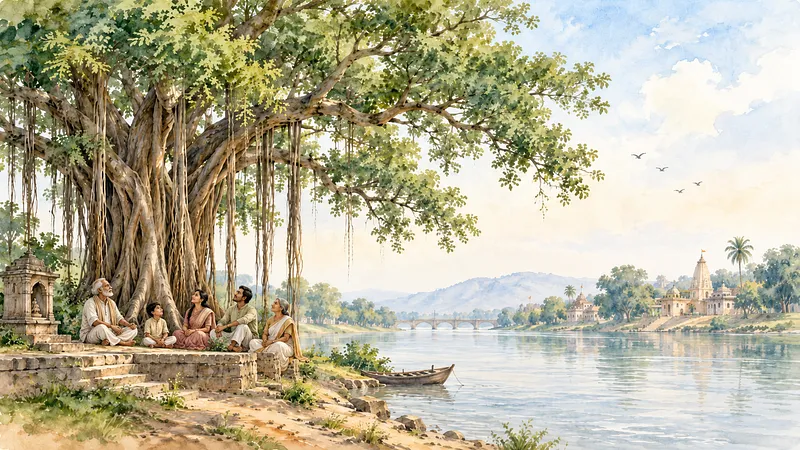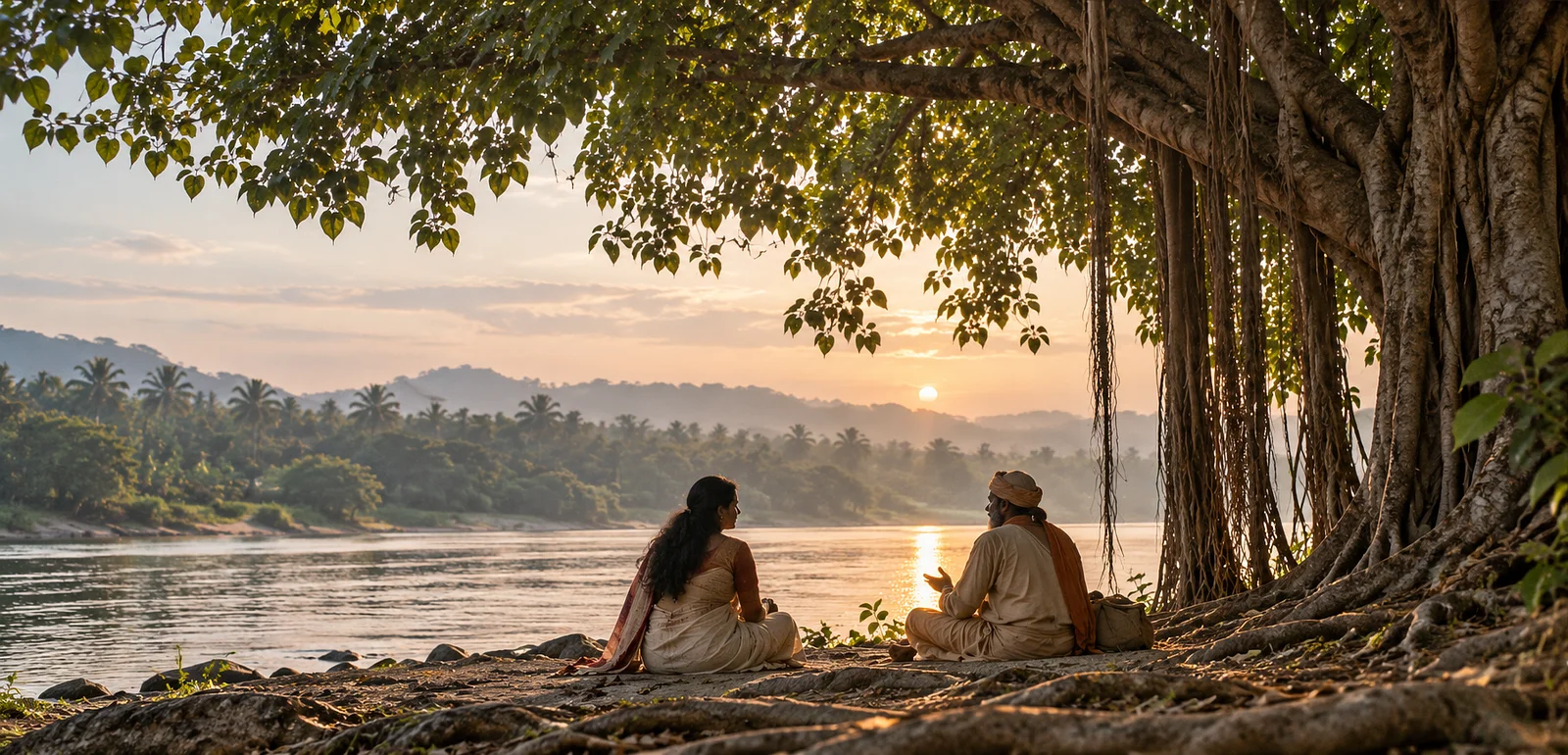
The banyan drew us once again one morning, inviting us beneath its familiar canopy as the Sun climbed gently into the sky to fill the grove with its gentle warmth. The lingering freshness left behind by the rain seemed to have surrendered itself to the light, and the world around us had awakened with renewed vigour.
From somewhere in the distance came the soft chant of “Śaṃ no Mitraḥ, Śaṃ Varuṇaḥ...”, carried gently by the morning breeze. A phrase I had heard countless times suddenly sought my attention—Pratyakṣa Brahma, the visible Brahman.
I smiled. Over the past few days, we had sat beneath this ancient banyan listening to the river, the rain, the earth and now the Sun. We had spoken of those manifestations of nature that could be seen, heard, touched and experienced. Those who came before us greeted them, lived in harmony with them and revered them. Yet I wondered if there was something more, a deeper layer of wisdom hidden beneath these visible forms. Was nature merely what our eyes perceived, or had our sages encoded profound truths within these seemingly simple symbols used to represent it?
That morning, my mind was searching. Why did the ṛṣis imagine Sūrya travelling across the heavens in a chariot drawn by seven horses? Why seven? Was it merely poetry, or was there a deeper symbolism waiting to be discovered? Why did the number seven appear so often in the way our tradition understood the world? And why did they call the Sun Pratyakṣa Brahma, the visible manifestation of the Absolute?
I realised that I had been looking at the Sun for years without really looking at him. I had watched the sunrise, felt his warmth, complained about the summer heat and waited for the first golden light of morning, yet how often had I paused to wonder about what I was actually seeing? The Sun had been so familiar that he had almost become invisible to me.
Perhaps familiarity does that to us. We see the same tree every day and stop noticing its changing leaves. We hear the same birds and no longer listen to their calls. We watch the sky move through dawn, noon and dusk, yet rarely pause to ask what these rhythms might reveal. The sages who came before us seem to have possessed a different kind of attention. They observed what was immediately before them, questioned what they saw and allowed these questions to lead them deeper.
The thought made me smile. Maybe the seven horses were not simply waiting for me to discover what they represented. Maybe they were inviting me to look at the Sun differently—to move from seeing to observing, from observing to questioning and from questioning to contemplating.
Our tradition says that a Guru appears when the disciple is ready. A Guru does not always appear draped in saffron robes or seated upon an exalted seat. Sometimes wisdom comes through a child whose innocence reveals a forgotten truth. Sometimes it arrives in the words of a wandering bhikṣu. Sometimes it appears through a stranger we may never meet again.
The form matters little. What matters is whether our minds are quiet enough to listen. Will a Guru appear and will I be able to recognise and understand the wisdom imparted?
The questions lingered in the silence. The river flowed on, the banyan stood unmoved, and the sunlight continued to dance upon its leaves. I closed my eyes for a moment, allowing the warmth of the Sun to settle upon my face. It was then that I heard footsteps.
A traveller was making his way along the riverbank, searching for a place to rest beneath the generous shade of the banyan. He carried little besides a small cloth bag slung across his shoulder and the dust of many roads upon his feet. There was nothing extraordinary about him, and yet something about his unhurried gait suggested that he had walked not merely across villages and mountains, but through stories, traditions and time itself.
He paused, folded his hands with a gentle smile and asked, “May I sit with you?”
We moved a little to make room beneath the banyan.
The traveler settled himself as though he had always known this place. He placed his little cloth bag beside him, cupped a handful of water from the river and, after offering it silently to the rising Sun, sat watching the light dance upon the rippling waters. There was no urgency about him. He seemed content to let the silence speak before words did.
Eventually, we shared with him the questions that had occupied our minds all morning. We spoke of the Sun, of Pratyakṣa Brahma, of the reverence our tradition had shown to the visible manifestations of nature, and finally, almost apologetically, I asked the question that had refused to leave me. Why had they imagined Sūrya travelling across the heavens in a chariot drawn by seven horses? Why seven? Was it merely poetic imagination, or had they hidden something deeper within that image?
The traveller looked at us with a gentle smile, but instead of answering, he turned his gaze once again towards the Sun. After a long silence he said, “It is curious, is it not, that almost everyone asks about the horses, yet very few stop to wonder why the Sun rides in a chariot at all?”
The question caught us by surprise. We had been so eager to understand the seven that we had overlooked the chariot itself.
“Our sages seldom chose their symbols carelessly,” he continued. “Before we ask why there are seven horses, perhaps we must first understand why there is movement.”
He pointed towards the river. It had not ceased flowing since we had arrived. The breeze still wandered through the branches above us. Birds crossed the morning sky, and the Sun, though it appeared still to our eyes, continued its timeless journey across the heavens.
“Nothing in creation stands apart from movement,” he said softly. “The river flows, the seasons change, the Earth turns, and life itself is a journey from one moment to the next. A chariot is not merely a vehicle. It is a reminder that existence itself is always in motion.”
His words settled gently within us. Then he asked, “When you look at the sunlight dancing upon the river, how many colours do you see?”
“One,” I replied instinctively.
He smiled. “And yet within that one light lies seven colours.”
He looked towards us again. “Tell me, how many notes give life to your music?”
“Seven.”
“And how many days complete your week?”
“Seven.”
He did not explain. He simply let the questions remain with us.
The river continued its song. The banyan stood unmoved. Somewhere beyond the trees, a temple bell rang once more, as though marking the passing of another thought. A curious excitement stirred within me. Until that moment, the number seven had seemed nothing more than repetition. Now it felt like an invitation.
“Our sages had a remarkable way of observing the world,” the traveller said quietly. “When the same pattern appeared again and again, they did not always dismiss it as coincidence. They paused. They contemplated. They asked what nature might be trying to teach them.”
He spoke of the seven horses of Sūrya’s chariot, of light revealing its many colours, of sound unfolding through the seven svaras, and of the mysterious recurrence of seven in our sacred imagination. He did not present these as answers to be memorised, but as threads waiting to be followed. The more we listened, the more it seemed that those ancient seers had looked at the visible world with a depth of attention we have perhaps forgotten. What we might see as separate—the light, the sound, the rhythm of time—could also be contemplated as different expressions of an underlying order.
The more I listened, the more I wondered whether the number itself was less important than the habit of noticing. Seven was appearing before us in colour, music and the rhythm of time, but the real lesson seemed to lie in the attention with which we had begun to see these connections. The sages had not merely collected numbers; they had observed patterns, contemplated them and allowed questions to remain alive.
I found myself thinking about sound. If the sages had listened so closely to the world around them, had they also listened for something beyond the sounds that the ear could hear? My mind went instinctively to Om, the sacred Praṇava, the primordial sound so deeply woven into our contemplative traditions.
“And what of Om?” I asked.
The traveller was silent for a moment.
“Some questions,” he said, “must first be heard before they can be answered.”
He closed his eyes, and for a few moments none of us spoke. The river flowed beside us. The leaves rustled overhead. Somewhere in the distance, the chant continued. The warmth of the Sun rested gently upon our faces.
Perhaps that was the traveller’s greatest teaching. He had not come to fill our minds with information. He had come to teach us how to look again. The Sun we had watched that morning was no longer merely a luminous disc rising in the eastern sky. He had become light, rhythm, time, energy and life; a visible presence through which generations had contemplated something far greater than themselves. What appeared simple on the surface seemed to hold layers of meaning, waiting patiently for the one who was willing to pause, observe and listen.
The traveller opened his eyes and looked once more towards the Sun.
“Do not hurry to find all the answers,” he said. “Some truths reveal themselves only when you are ready to see them.”
The breeze moved gently through the banyan leaves. The river carried the sunlight onward, and the traveller remained silent beside us. For the moment, there was nothing more to ask.
We simply sat there, beneath the ancient tree, warmed by the Sun and surrounded by the sounds of a world that had been speaking all along.
Perhaps that was enough for one morning. The questions could wait. The Sun would rise again tomorrow.